
What Is a Water Heater Anode Rod and How Does It Work?
The Sacrificial Guardian of Your Water Tank
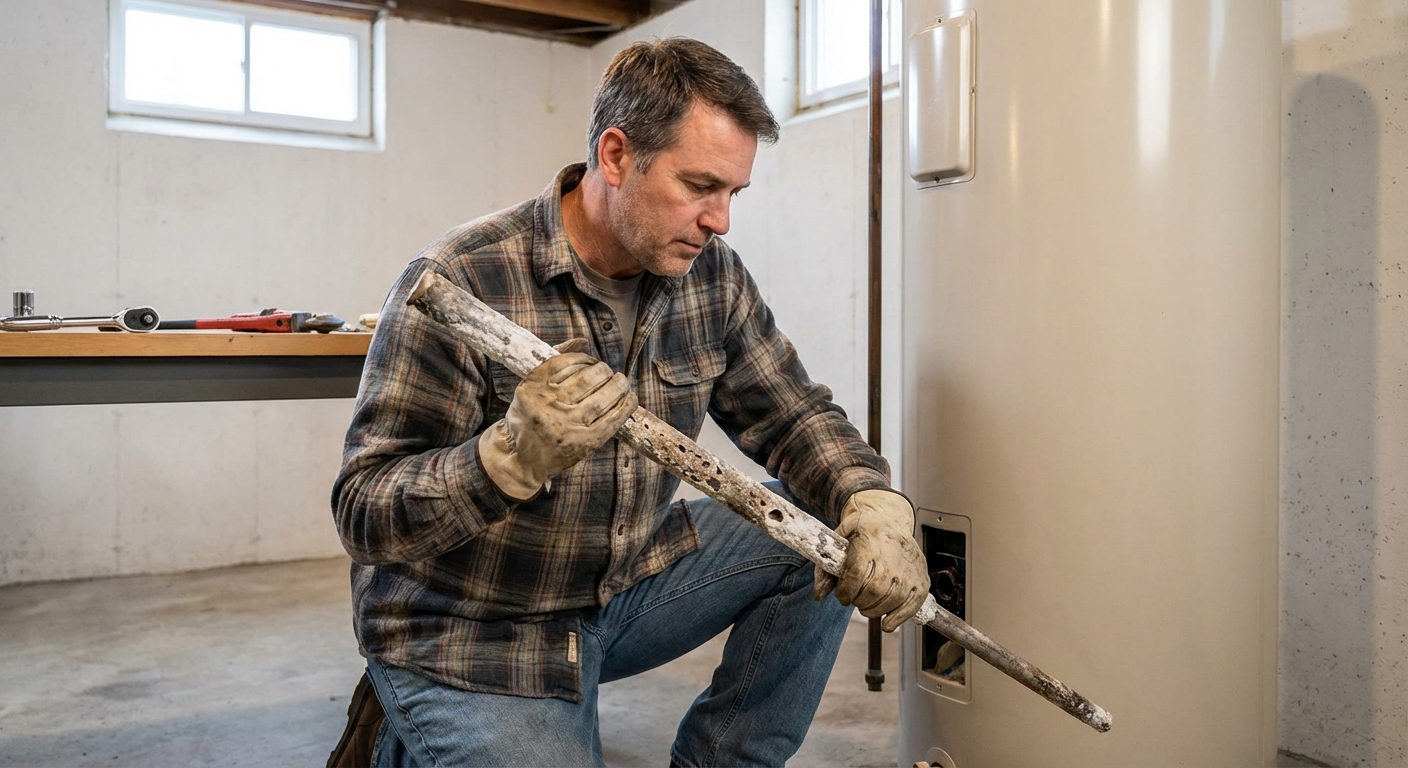
A water heater anode rod is a long metal rod installed inside your water heater tank that serves as a "sacrificial" component designed to corrode in place of the steel tank itself. This critical part is typically made from magnesium, aluminum, or a zinc-aluminum alloy wrapped around a steel core wire.
The anode rod prevents tank corrosion through an electrochemical process called galvanic action. Because the rod's metal is more reactive than the steel tank, it attracts corrosive elements in the water (including dissolved minerals, oxygen, and aggressive ions) and reacts with them first. As these elements attack the anode rod instead of your tank walls, the rod gradually deteriorates while your tank remains protected.
The Science Behind the Protection
The electrochemical principle is straightforward: when two different metals are submerged in an electrolyte (your water), the more reactive metal will corrode preferentially. Magnesium and aluminum have a higher electrochemical potential difference relative to iron and steel, making them ideal sacrificial materials.
This process happens continuously as long as the anode rod has material remaining. Once the rod corrodes down to its core wire or loses significant mass, it can no longer provide adequate protection, leaving your tank vulnerable to rust and eventual failure. Understanding how your water heater expansion tank works alongside the anode rod helps protect your entire system.

Find Trusted & Licensed Plumbers in Ohio
Get matched with companies for your specific needs
Warning Signs Your Anode Rod Needs Replacement
Sulfur Smell and Water Quality Issues
One of the most noticeable signs of anode rod failure is a distinctive rotten egg or sulfur smell coming from your hot water. This odor occurs when bacteria in the tank react with a depleted anode rod, producing hydrogen sulfide gas. The smell is particularly strong when you first turn on the hot water tap.
Rusty or discolored water is another clear indicator. When your hot water appears reddish-brown or has visible particles, it signals that the anode rod can no longer protect the tank and corrosion has begun attacking the steel walls. If you notice low water pressure along with these issues, you may have multiple plumbing concerns to address at once.
Performance and Structural Problems
Listen for unusual noises from your water heater. Popping, crackling, or banging sounds typically indicate sediment buildup in the tank, which often accompanies a deteriorating anode rod. This sediment layer insulates the heating element, reducing efficiency and forcing your heater to work harder.
Reduced heating efficiency or insufficient hot water can also point to anode rod issues. As sediment accumulates, it prevents proper heat transfer and reduces your tank's effective capacity. If your water heater pilot light won't stay lit, that could indicate separate but related maintenance needs.
The most serious warning sign is visible corrosion or active leaks on the tank exterior. Rust stains, moisture, or actual drips signal that internal corrosion has progressed significantly. At this stage, you may need complete water heater replacement rather than just anode rod service. Consider whether a tankless water heater installation might be more cost-effective at this point.
Inspection Reveals the Truth
Visual inspection provides definitive answers. During an anode rod check, replacement is necessary if:
- The core wire is exposed for more than 6 inches
- The rod's thickness has reduced to less than ½ inch
- Heavy corrosion or calcium buildup covers the rod
- Less than 50% of the original rod material remains
Inspection Schedule and Replacement Frequency
How Often Should You Check Your Anode Rod?
Current 2026 industry guidance recommends inspecting your anode rod every 2 to 3 years, with many plumbers including it in annual water heater tune-ups (especially in hard-water areas or large households). The standard replacement interval is every 3 to 5 years for typical residential tanks. Commercial or very heavily used heaters may need replacement every 1 to 2 years.
Factors That Affect Replacement Timing
Several conditions can accelerate anode rod deterioration and require more frequent replacement:
Water quality plays the biggest role. Hard water with high mineral content speeds up the corrosion process significantly. Homes with water softeners or acidic water (low pH) may also experience faster rod depletion. Consider installing a water filtration system to protect both your anode rod and the rest of your plumbing.
Water usage matters too. Large families who use more hot water put greater demand on the anode rod's protective capacity, often shortening its effective lifespan to 2 to 3 years.
Water chemistry including pH balance affects how aggressively the water attacks both the anode rod and tank. Imbalanced pH levels accelerate the entire corrosion process.
The anode rod material itself makes a difference. Magnesium rods tend to corrode faster than aluminum rods, especially in soft water conditions.
The Longevity Payoff
Current 2026 data shows that a typical tank-style water heater lasts about 8 to 12 years with proper maintenance, but often only 6 to 8 years when anode rod service and flushing are neglected. With consistent anode replacement on a 3 to 5 year schedule (plus annual flushing), many units now routinely reach the 12 to 15+ year range, and well-maintained heaters can run even longer.
Without proper anode rod maintenance, the steel tank begins rusting as soon as the rod fully corrodes. Once rust perforates the tank wall, leaks develop and complete water heater replacement becomes necessary, a much more expensive proposition than simple rod replacement. Understanding water heater thermal expansion helps you maintain the entire system properly.
Types of Anode Rods: Which One Is Right for You?
Magnesium Anode Rods
Magnesium anode rods are the most common type installed in new water heaters. They provide excellent corrosion protection due to magnesium's high reactivity and superior electrochemical potential difference compared to steel.
Magnesium rods work best in soft water environments where their reactivity provides optimal protection. However, they can contribute to rotten egg smells when sulfate-reducing bacteria are present in the water supply.
Aluminum and Zinc-Aluminum Anode Rods
Aluminum (and aluminum-zinc) anode rods offer a longer-lasting alternative with a slower corrosion rate. They perform particularly well in hard water conditions, and zinc-aluminum versions are specifically designed to reduce sulfur odors in well water.
While aluminum rods last longer between replacements, they provide somewhat less aggressive protection than magnesium. Some homeowners report water quality issues including cloudiness or a metallic taste with aluminum rods.
Powered (Titanium) Anode Rods
Powered anode rods represent a different approach entirely. These permanent, non-sacrificial rods use a titanium electrode and a small low-voltage controller to provide continuous protection through impressed current, so the rod itself does not corrode away.
Popular 2026 models like Corro-Protec offer 20-year warranties, work in any water type, and use only about $2 to $3 of electricity per year. The main drawbacks are the higher upfront cost and the requirement for an outlet near your water heater.
Choosing the Right Type
For most households, magnesium rods work well and are the most economical choice for standard water conditions. Switch to aluminum or zinc-aluminum if you have hard water or experience sulfur smell issues. Consider powered rods if you want a permanent, maintenance-free solution and don't mind the higher initial investment.
Replacement Process and 2026 Cost Breakdown
DIY vs. Professional Installation
Replacing a water heater anode rod is a straightforward DIY project for homeowners with basic mechanical skills. The process typically takes 1 to 2 hours and requires minimal tools. However, some situations warrant professional help, particularly if you're uncomfortable working with plumbing or your heater is in a difficult location.
2026 Cost Breakdown
DIY replacement runs about $20 to $50 for a standard magnesium or aluminum anode rod, or $30 to $90 total once you add Teflon tape, a garden hose, and (if needed) a 1 1/16-inch deep socket wrench at $15 to $30.
Professional installation typically costs $110 to $300, with most homeowners paying around $200 to $300 including parts and labor. This option makes sense if the old rod is severely corroded or your heater is in a tight space. Compare this to professional drain cleaning service costs to see how it stacks up against other plumbing maintenance.
Powered anode rod systems cost $150 to $300 for the part and roughly $300 to $450 installed, with commercial units running over $500 per anode.
For context, a full water heater replacement in 2026 averages $1,500 to $2,200 for standard tank units and $1,400 to $3,900 (or up to $5,000+) for tankless systems, so anode rod maintenance is one of the cheapest ways to delay that major expense.
Step-by-Step Replacement Process
Preparation Phase:
- Turn off the power supply (circuit breaker for electric heaters, gas valve for gas models)
- Shut off the cold water inlet valve
- Attach a garden hose to the drain valve and drain approximately 6 inches of water from the tank
- Locate the anode rod access port on top of the water heater
Removal Process:
- Use a 1 1/16-inch socket wrench with a ratchet to loosen the anode rod hex head
- If the rod is stuck, place a steel pipe over the wrench handle for additional leverage
- Carefully remove the old rod (it may be heavy)
- Inspect the removed rod to understand its condition
Installation Process:
- Clean the threads on the new anode rod
- Wrap Teflon tape clockwise around the threads (3 to 4 wraps)
- Insert the new rod and hand-tighten as much as possible
- Use the socket wrench to tighten securely (don't overtighten)
- Remove the drain hose and close the drain valve
- Open the cold water inlet valve to refill the tank
- Open a hot water faucet to release air from the system
- Check for leaks around the anode rod port
- Restore power once the tank is full
Common Installation Challenges
Stuck or seized rods are the most common problem, especially in older heaters. The rod can become tightly bonded through years of corrosion. An impact wrench or extra leverage from a breaker bar usually solves this. Apply penetrating oil and wait 15 minutes before attempting removal if the rod won't budge.
Limited space above the heater prevents removal of standard rods. Flexible anode rods solve this problem by bending or coming in segments that thread together. This is similar to working in tight spaces during shower cartridge replacement or toilet flange repair.
Stripped hex heads occur when using the wrong socket size or excessive force. Prevention is key: use the correct socket and avoid over-torquing.
How Anode Rod Replacement Extends Water Heater Life
The Economics of Prevention
A new water heater installation in 2026 averages $1,500 to $2,200 for a standard tank and $3,000 to $5,000+ for tankless or high-efficiency units. In contrast, replacing an anode rod every 3 to 5 years costs just $20 to $50 DIY or $200 to $300 professional. Over a 20-year period, you'll spend $100 to $400 on DIY anode rod maintenance versus thousands on premature tank replacement.
The math is compelling: regular anode rod maintenance can push your water heater from the neglected 6 to 8 year range up to 12 to 15+ years. This translates to avoiding at least one full heater replacement, easily saving $1,500 to $3,000 over the life of your home.
Additional Benefits Beyond Longevity
Regular anode rod maintenance provides benefits beyond just preventing tank failure:
Improved efficiency: A protected tank maintains better heat transfer without rust buildup, keeping energy costs lower. This is especially important when considering hot water recirculating pumps for your system.
Better water quality: Fresh anode rods prevent rusty water, sediment, and sulfur smells that affect your home's water quality.
Maintained warranty coverage: Many manufacturers require documented anode rod maintenance to honor extended warranty terms.
Fewer emergency repairs: Proactive maintenance prevents sudden failures that require expensive emergency plumber visits and helps avoid hidden water damage throughout your system.
Frequently Asked Questions
How do I know if my water heater has an anode rod?
Nearly all traditional tank-style water heaters (gas, electric, and heat pump models with glass-lined steel tanks) come equipped with at least one anode rod installed during manufacturing. To locate yours, look at the top of the water heater for a hex-head bolt, often near the center or marked in your owner's manual. Some models have the anode rod built into the hot water outlet, while others use a dedicated port under a plastic cap. Tankless water heaters and a few stainless-steel tank models don't have anode rods.
Do tankless and heat pump water heaters need anode rod replacement?
Tankless water heaters do not have anode rods because they don't store water in a corrosive steel tank, so no anode replacement is needed. Most heat pump water heaters, however, are essentially storage tanks with a heat pump on top and use the same glass-lined steel construction, so they do have anode rods that need inspection every 1 to 3 years and replacement every 3 to 5 years. Check your model's manual to confirm whether your heat pump unit uses a stainless-steel tank that skips the anode entirely.
What happens if I never replace my anode rod?
If you never replace your anode rod, it will eventually corrode completely, leaving your tank's steel walls exposed to corrosive water. Rust will form inside the tank, creating sediment, discolored water, and ultimately leaks as corrosion perforates the tank wall. Once a tank starts leaking, replacement is the only option. Most neglected water heaters fail within 6 to 8 years instead of reaching their potential 12+ year lifespan.
Is it worth replacing the anode rod in an old water heater?
If your water heater is 8 to 10 years old or older and has never had anode rod maintenance, the tank may already have significant internal corrosion. In this case, you might consider replacing the entire unit rather than just the rod. However, if the heater still functions well with no signs of leaking or severe rust, replacing the anode rod can add several years of life for relatively little cost. Consider upgrading to a tankless system if replacement is imminent.
Can I install a longer-lasting anode rod than what came with my heater?
Yes, you can upgrade to different anode rod types regardless of what originally came with your water heater. Many homeowners switch from magnesium to aluminum or zinc-aluminum for hard water and sulfur issues, or invest in powered titanium rods for permanent protection. Just ensure you purchase a rod with the correct thread size (typically ¾ inch NPT) and appropriate length for your tank size. Flexible or segmented rods work in any heater where space is limited.