
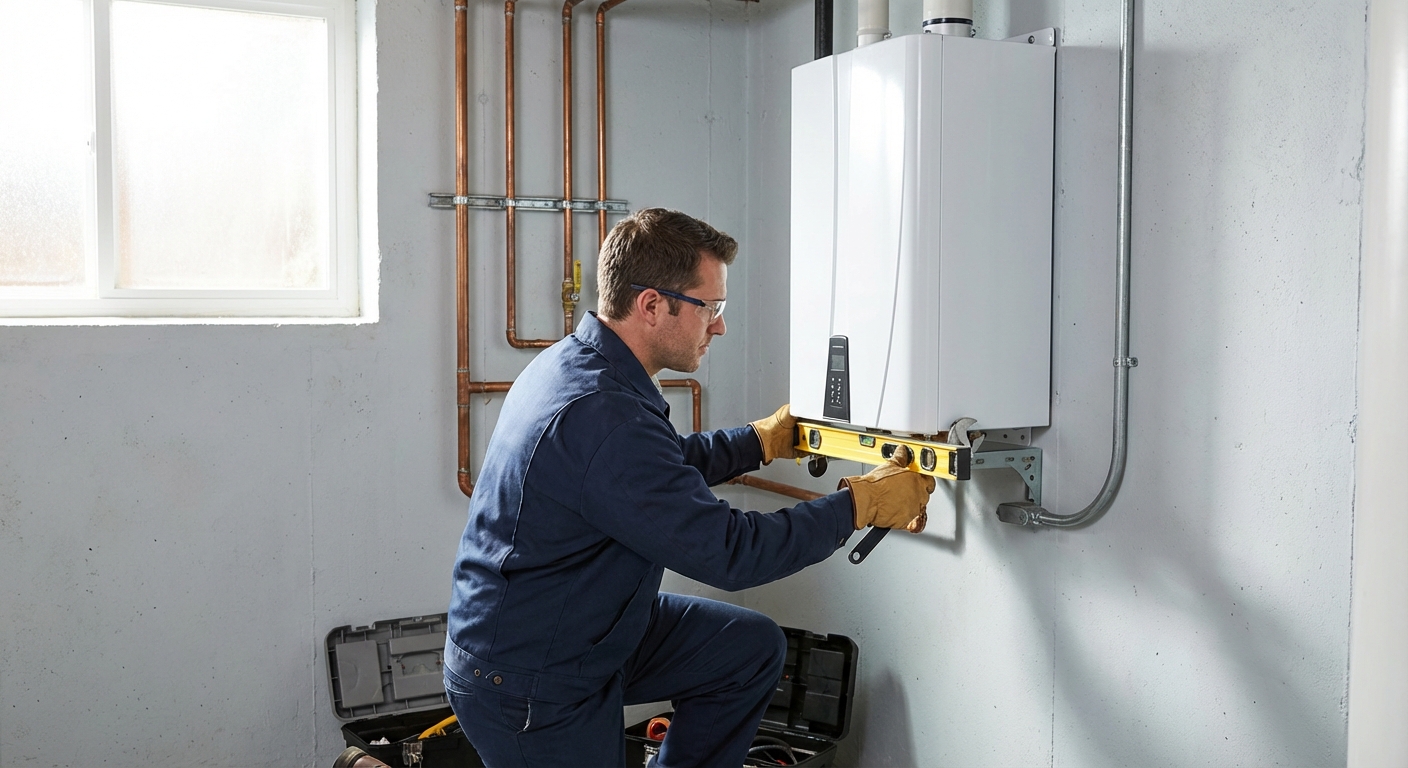
Understanding Tankless Water Heater Installation Costs in 2026
Installing a tankless water heater in 2026 typically costs between $1,400 and $5,600, including equipment and labor. According to current industry data, most homeowners fall in the $2,400 to $4,300 range depending on fuel type and installation complexity, with Home Depot listing an average total cost for tankless water heater installation of about $4,300. Electric models tend to land on the lower end, while gas models run higher due to additional venting and gas line requirements.
The unit itself accounts for 40-45% of total costs, ranging from $600 to $2,600 depending on fuel type and capacity. Installation labor adds $600 to $2,500, with supplies like pipes, fittings, and valves contributing $150 to $300. Permits typically cost $50 to $200.
Cost Breakdown by Fuel Type
| Fuel Type | Unit Cost | Total Installed Cost |
|---|---|---|
| Electric | $600-$1,000 | $1,400-$3,000 |
| Propane | $1,000-$2,000 | $1,600-$4,500 |
| Natural Gas | $1,500-$2,600 | $2,100-$5,600 |
Several factors significantly impact installation costs. Gas line upgrades can add $300 to $900, while electrical panel upgrades for electric units may cost $250 to $900. New venting installation for gas models adds $200 to $600, and removing an old tank water heater costs $100 to $300. If you're experiencing issues with your existing system, you may also need emergency plumber services before installation.
Factors That Affect Installation Costs
Converting from a traditional tank to tankless presents several cost variables. Older homes may need significant gas line or electrical upgrades to meet increased power demands. Venting modifications require new ducting and proper termination points that comply with local codes.
Plumbing adjustments often involve cleaning or replacing old pipes, resizing lines for proper flow, and adding insulation. Relocation needs arise because tankless units mount differently than tanks, potentially requiring wall reinforcement or moving the unit to a better location.
These retrofit challenges can increase costs by 50% or more compared to direct replacement scenarios. While the federal Energy Efficient Home Improvement Credit no longer applies to 2026 installations, state and utility rebates may still offset costs by $300 to $600. Common issues like low water pressure should be addressed before installation to ensure optimal performance.

Find Trusted & Licensed Plumbers in Ohio
Get matched with companies for your specific needs
Installation Requirements and Technical Specifications
Understanding installation requirements helps you prepare for the conversion and avoid unexpected costs. Tankless water heaters have specific needs that differ significantly from traditional tank models.
Electrical Requirements
Gas tankless models require 120V access for control boards and digital displays, typically needing a dedicated receptacle within three feet. Outdoor units require weatherproof outlets with protective covers.
Electric models demand more substantial electrical infrastructure:
- Dedicated breakers with proper amperage
- Wire gauge matching unit specifications
- Appropriate voltage based on rating plate requirements
- Proper grounding per local electrical codes
- GFCI protection where required by code
- Verification that your breaker panel has adequate capacity
Attic or basement installations need switched lighting nearby and bonding electrodes connecting hot, cold, and gas pipes.
Gas Line Specifications
Most tankless water heaters need a minimum ¾-inch gas line, though ½-inch may work for short runs with adequate pressure and certain lower-demand units. The increased gas demand of tankless systems often requires upgrading from existing ½-inch lines serving traditional tank heaters.
Installation must include a shutoff valve for safety, a union for easy disconnection, a sediment trap to protect the unit, approved joint compound rated for gas, verification that gas type and pressure match the rating plate, and leak testing with soap solution.
Professional verification ensures your existing gas supply can handle the increased demand when running at full capacity. This is crucial because tankless units draw more gas per minute than tank models, even though they operate for shorter periods.
Venting Requirements for Gas Models
Gas tankless water heaters require direct-vent installation, piping exhaust directly outside rather than through chimneys. This represents a significant change from tank water heaters that may use existing flue systems.
Non-condensing models use stainless steel venting due to high exhaust temperatures, while condensing units can use PVC or polypropylene because their lower exhaust temperatures (below 140°F) allow plastic materials. Proper clearances from windows, doors, overhangs, and air intakes must be maintained according to manufacturer specifications.
Electric vs Gas Tankless Water Heaters
Choosing between electric and gas tankless water heaters involves evaluating performance, costs, and your home's infrastructure. Each type offers distinct advantages depending on your situation.
Performance Comparison
Gas models deliver superior flow rates of 5-10+ gallons per minute, making them ideal for larger households with multiple simultaneous hot water demands. They can handle two showers running while the dishwasher operates without temperature drops.
Electric units typically provide 2-5 GPM in cold climates (up to 8 GPM in warm regions), suitable for smaller homes or point-of-use applications. Their performance decreases more significantly in colder climates where incoming groundwater temperatures are lower.
Operating Cost Differences
Operating costs in 2026 generally favor gas in most regions, though the gap is often smaller than people assume. At present, a natural gas tankless water heater is about 10-15% cheaper to operate than an electric tankless heater in many markets. However, this varies significantly based on local utility rates and usage patterns.
Electric units boast very high efficiency, often 99%+ in some models, while gas models achieve 80-96% efficiency depending on whether they are condensing units. Despite lower efficiency ratings, cheaper natural gas prices often result in lower total operating costs in regions with abundant gas supply.
Over 15 years, gas systems can save thousands of dollars in operating costs compared to electric models, though this advantage diminishes in areas with expensive natural gas or inexpensive electricity. The payback period ranges from 12-20 years for electric models and 22-27 years for gas when compared to traditional tanks.
Installation Complexity
Electric models have lower upfront costs and simpler installation requirements but may require electrical panel upgrades costing $850 to $1,700. They don't need venting systems, making them easier to place anywhere in your home.
Gas models need venting systems and potentially gas line extensions but often provide better performance for high-demand households. The additional complexity increases installation costs but delivers superior flow rates that justify the investment for larger families.
2026 DOE Efficiency Standards Update
The Department of Energy finalized new efficiency standards that affect commercial water heaters starting October 6, 2026. Residential water heater standards under this same rule do not take effect until May 6, 2029, so most homeowners installing a standard residential tankless unit in 2026 are unaffected.
However, if you live in a large home that uses a "light-duty commercial" or "residential-duty commercial" gas water heater (typically input >75,000 Btu/h), the new standards may impact your replacement options. Beginning October 6, 2026, commercial gas storage water heaters must meet 95% thermal efficiency, and commercial gas-fired instantaneous (tankless) units must meet 96% thermal efficiency, which effectively requires condensing technology.
For typical single-family homes, this means standard residential tankless models remain widely available with current efficiency ratings. A consumer gas tankless rule proposed in 2024 was nullified by Congress and withdrawn in 2025, so no new federal efficiency mandate currently applies to residential gas tankless heaters.
Sizing Your Tankless Water Heater
Proper sizing ensures your tankless system delivers adequate hot water during peak demand periods without oversizing and wasting money on unnecessary capacity.
Calculate Temperature Rise Requirements
Temperature rise equals your desired output temperature (typically 120°F) minus incoming groundwater temperature. Groundwater varies by region from 40°F in northern climates to 65°F in southern areas.
For example, if your groundwater temperature is 55°F and you want 120°F output, you need a unit capable of a 65°F temperature rise at your required flow rate. Higher temperature rises reduce a unit's effective GPM capacity, making this calculation crucial for cold climates.
Determine Peak Flow Rate
Calculate peak flow by adding fixture demands used simultaneously during your household's busiest times. Standard fixture flow rates include:
| Fixture | Flow Rate (GPM) |
|---|---|
| Shower | 1.8-2.5 |
| Kitchen Sink | 1.0-1.5 |
| Bathroom Sink | 0.75-1.0 |
| Dishwasher | 1.0-1.5 |
| Washing Machine | 1.5-2.0 |
Consider your realistic peak scenario. For example, if two showers (2.5 GPM each) run while the dishwasher operates (1.5 GPM), you need 6.5 GPM at your required temperature rise. This realistic assessment prevents both undersizing (which causes temperature drops) and oversizing (which wastes money).
Household Size Guidelines
Use these as starting estimates, then refine with actual fixture calculations:
- 1-2 people (1 bathroom, 1-2 fixtures): 3.5-6 GPM capacity
- 3-4 people (2 bathrooms, 2-3 fixtures): 5-8 GPM capacity
- 5+ people (3+ bathrooms, 3-4 fixtures): 7-10+ GPM, or consider multiple units
Benefits of Tankless vs Traditional Tank Heaters
Understanding the advantages and disadvantages of each system helps you make an informed investment decision based on your priorities and circumstances.
Tankless Water Heater Advantages
Tankless water heaters provide endless hot water supply, eliminating the wait for tank recovery after showers or laundry. According to the U.S. Department of Energy, tankless water heaters are 24-34% more energy-efficient than conventional tank heaters for homes that use 41 gallons or less of hot water per day, and about 8-14% more efficient for homes that use a lot of hot water, around 86 gallons per day.
Space savings prove substantial. Tankless units mount on walls and measure approximately 20x28 inches, freeing valuable floor space for storage or other uses. They also last 20+ years compared to 10-15 years for tank models, reducing long-term replacement costs and inconvenience.
Traditional Tank Advantages
Traditional tanks cost less upfront, typically $800 to $2,400 installed, making them attractive for budget-conscious homeowners or those planning to move within a few years. They work with existing infrastructure without extensive modifications, avoiding expensive gas line or electrical upgrades.
Tanks provide consistent performance regardless of simultaneous demand up to capacity limits. Simpler technology means lower repair costs and easier DIY troubleshooting. Parts availability and technician familiarity make tank repairs generally less expensive than tankless service calls.
When Tankless Makes Sense
Determining whether tankless fits your situation requires honest assessment of your household needs, budget, and long-term plans.
Ideal Scenarios for Tankless
Tankless water heaters prove ideal for households with high hot water demand, particularly during peak morning or evening hours when multiple family members need showers simultaneously. Growing families benefit from the unlimited supply that prevents morning scheduling conflicts.
They excel in homes where space is limited or when renovating basements, laundry rooms, or utility closets. The compact wall-mount design allows creative placement options that optimize floor plans.
Energy-conscious homeowners seeking reduced utility bills benefit from tankless efficiency, especially in regions with expensive energy costs. Long-term homeowners can recoup higher installation costs through energy savings over the 20+ year lifespan.
When Traditional Tanks Make More Sense
Tankless may not suit homes with very hard water without proper water softener installation, as mineral buildup reduces efficiency and requires frequent descaling. Budget-constrained situations where upfront costs outweigh long-term savings may favor traditional tanks, particularly for homeowners planning to move within 5-10 years.
Homes requiring extensive electrical or gas system upgrades should carefully evaluate retrofit costs. When upgrades exceed $2,000-$3,000, the total investment may not justify the benefits for smaller households with modest hot water needs.
Top Tankless Brands and Professional Installation in 2026
Plumbing brand rankings consistently list Rheem, Navien, and Rinnai among the top tankless water heater brands for 2026. Rheem offers strong all-around reliability with smart features like the IKONIC series, Navien leads in premium condensing and combi units, and Rinnai is known for durable high-flow models like the Sensei series.
Step-by-Step Installation Overview
Professional installation typically takes 3-8 hours depending on complexity. The process begins with removing the existing water heater if present, then mounting the tankless unit on the wall using proper backing with adequate clearance for service access.
Gas line extensions or electrical upgrades are completed as needed, following local codes and manufacturer specifications. New venting systems are installed for gas models, following manufacturer specifications for termination locations and clearances.
Plumbing connections include installing isolation valves for maintenance convenience, connecting hot and cold water lines with proper unions, adding pressure relief valves rated for 150 PSI, and installing thermostatic mixing valves to prevent scalding. The system is then purged, tested for gas leaks or electrical safety issues, and calibrated to manufacturer specifications.
DIY vs Professional Installation
DIY installation is strongly discouraged due to complex gas line work, electrical requirements, and venting specifications that require professional expertise and proper permitting. Improper installation creates serious safety hazards including gas leaks, carbon monoxide poisoning, electrical hazards, and code violations that void warranties.
Licensed plumbers carry insurance, provide warranties on installation workmanship, understand local codes, and have specialized tools for proper testing. For homeowners interested in reducing costs, obtaining multiple quotes and scheduling installation during off-peak seasons (late spring or early fall) often yields better pricing. Similar to drain cleaning services, professional plumbing work provides peace of mind and long-term reliability.
Maintenance Requirements and Long-Term Costs
Proper maintenance extends tankless water heater lifespan and preserves efficiency, protecting your investment and maximizing energy savings. Learn more about tankless water heater maintenance and recommended service intervals.
Annual Maintenance Tasks
Descaling removes mineral buildup that reduces efficiency and flow rates, costing $100 to $300 when performed professionally. Hard water areas require more frequent descaling, potentially every 6-12 months, while softer water areas may only need annual service. Addressing water heater sediment buildup early prevents costly damage.
Filter cleaning every six months maintains efficiency and prevents debris from damaging internal components. Most homeowners can perform this simple task themselves by shutting off water supply, removing the inlet filter screen, rinsing thoroughly, and reinstalling.
Annual inspections verify proper combustion for gas models, check venting systems for blockages, test safety controls and sensors, verify proper water flow and temperature, and inspect for leaks or corrosion.
Preventive Maintenance Strategies
Water softener installation in hard water areas dramatically reduces descaling frequency and extends unit lifespan. The $1,200-$3,800 investment in a whole-house water softener pays dividends through reduced maintenance costs and improved efficiency. Pairing your tankless unit with a hot water recirculating pump can also improve comfort and reduce water waste.
Flushing the system with vinegar annually provides a DIY descaling option that costs under $10. The process involves connecting a pump and bucket with vinegar solution to the service valves and circulating for 45-60 minutes to dissolve mineral deposits.
Most manufacturers recommend professional service annually to maintain warranty coverage, though homeowners can perform basic filter cleaning between professional visits.
Frequently Asked Questions
How much does it cost to install a tankless water heater in 2026?
Installation costs in 2026 range from $1,400 to $5,600 total, with most homeowners paying $2,400 to $4,300 depending on fuel type and home modifications. Electric models cost less at $1,400 to $3,000, while gas models run $2,100 to $5,600 due to venting and gas line requirements. Labor accounts for $600 to $2,500, with the remainder covering equipment, materials, and permits.
Is there still a federal tax credit for tankless water heaters in 2026?
No. Federal tax credits for heat pump and gas tankless water heaters ended on December 31, 2025. If you installed a qualifying unit in 2025, you can still claim it on your 2026 tax return using Form 5695 with the appropriate manufacturer code. Some state and utility rebates remain available, so check local programs before purchasing.
Are tankless water heaters worth the investment?
Tankless water heaters prove worthwhile for long-term homeowners with high hot water demand who value energy efficiency and space savings. They save 24-34% on energy costs and last 20+ years compared to 10-15 years for tanks. However, higher upfront costs and the expiration of the federal tax credit mean payback periods of 12-27 years depending on usage and fuel type.
Can I install a tankless water heater myself?
DIY installation is strongly discouraged due to complex gas line work, electrical requirements, and venting specifications that require professional expertise and permitting. Improper installation creates safety hazards including gas leaks, carbon monoxide risks, and code violations that may void warranties. Licensed plumbers have the training, tools, and insurance necessary to complete installations safely.
What size tankless water heater do I need for my home?
Size depends on peak flow rate demand and required temperature rise for your climate. Calculate by adding simultaneous fixture demands in GPM and determining the temperature difference between groundwater and desired output temperature. Most households need 3.5-6 GPM for 1-2 people, 5-8 GPM for 3-4 people, and 7-10+ GPM for larger families. Cold climates require higher-capacity units due to greater temperature rise requirements.