
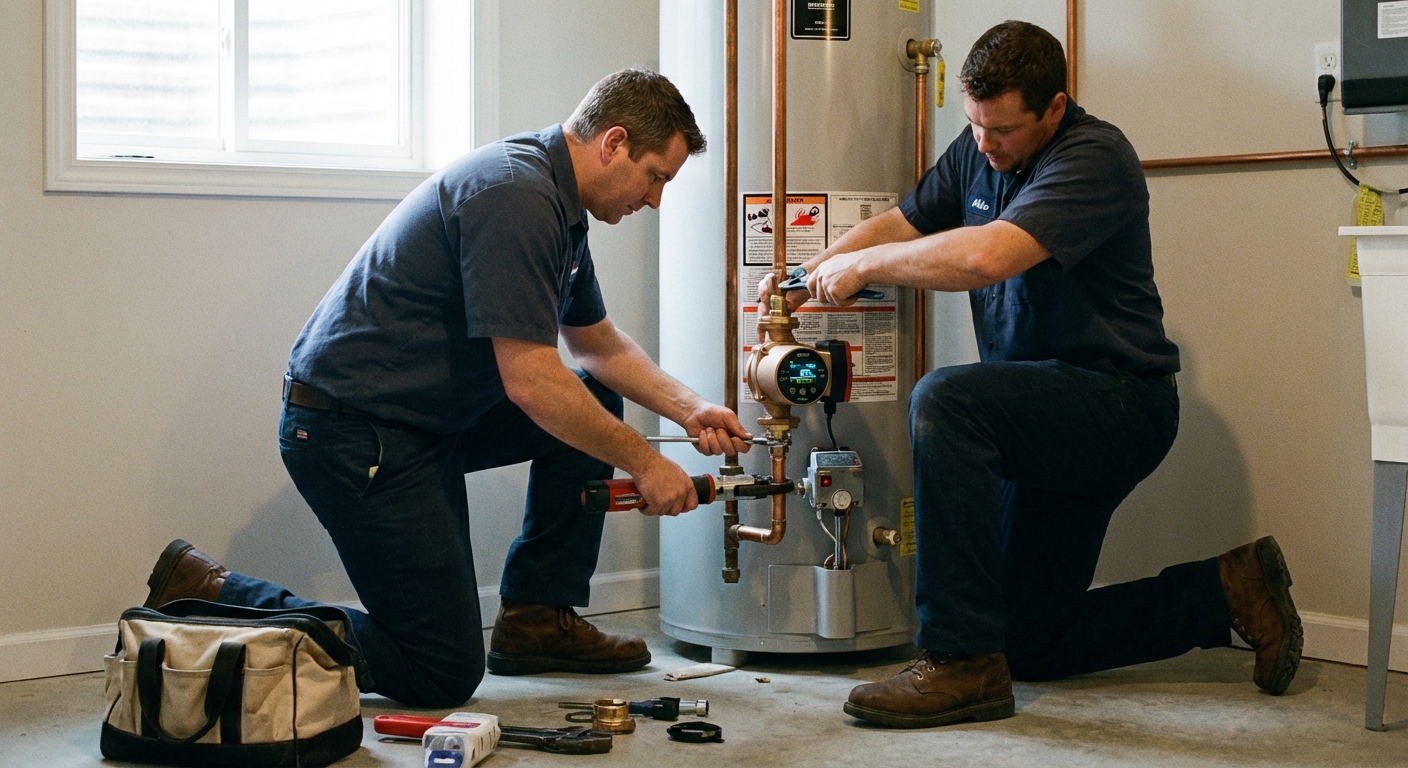
How Hot Water Recirculating Pumps Work
Hot water recirculating pumps eliminate the wait for hot water by continuously or periodically circulating heated water through your plumbing system. These systems ensure instant hot water delivery at any faucet or fixture while significantly reducing water waste.
The pump installs at your water heater and works with either a dedicated return line or a crossover valve system. In dedicated loop configurations, hot water travels through supply pipes to fixtures, then returns via a separate pipe to the heater. Retrofit systems use the existing cold water line as the return path, making installation simpler and more affordable for existing homes.
When you turn on a hot water tap, the recirculating pump has already pre-warmed the pipes, delivering hot water almost instantly instead of letting gallons run down the drain while waiting. The system monitors water temperature and activates based on programmed schedules, demand triggers, or temperature thresholds.
Modern recirculating pumps draw only 25-40 watts during operation and include smart features like temperature sensors and programmable timers. They integrate seamlessly with both traditional tank water heaters and tankless water heaters, though tankless systems require careful flow rate matching (typically 0.5-0.6 gallons per minute) to ensure proper activation.

Find Trusted & Licensed Plumbers in Ohio
Get matched with companies for your specific needs
Types of Hot Water Recirculating Systems
Timer-Based Systems
Timer-based recirculating pumps operate on programmable schedules aligned with your household's typical hot water usage patterns. You set specific times when the pump activates, usually morning and evening hours when demand peaks.
These systems prevent constant operation while maintaining convenience during high-use periods. Most timer-based models include 24-hour programming with multiple on-off cycles, allowing you to customize operation around your family's routine. However, they may waste energy if your schedule changes or you are away from home, since the pump runs regardless of actual demand.
Demand-Based Systems
Demand-based pumps activate only when you need hot water, offering maximum energy efficiency. These systems use push-button controls, motion sensors, or smartphone apps to trigger circulation.
When activated, the pump runs for 30-90 seconds until hot water reaches the fixture, then automatically shuts off. This approach minimizes heat loss and energy consumption while providing instant hot water on demand. Many homeowners find demand systems ideal for balancing convenience with operating costs, especially when paired with low water pressure solutions.
Installation involves mounting activation buttons near fixtures or integrating motion sensors under sinks. Some advanced 2026 models connect to smart home systems, allowing voice control or smartphone activation before reaching the bathroom or kitchen.
Temperature-Controlled Systems
Temperature-controlled pumps use sensors to monitor water temperature in the pipes. When the water cools below a preset threshold (typically around 85°F), the sensor triggers the pump to recirculate until reaching the desired temperature.
These systems automatically maintain warm water in pipes without manual intervention, making them convenient for households with unpredictable usage patterns. The automatic temperature monitoring prevents over-cycling while ensuring hot water availability whenever needed. Advanced models learn usage patterns over time, optimizing operation schedules based on actual demand.
Temperature-controlled systems work particularly well in homes where water heater thermal expansion requires careful pressure management, as they cycle less frequently than timer-based alternatives.
Top Recirculating Pump Brands in 2026
Choosing the right brand makes a significant difference in performance, noise level, and longevity. Several manufacturers dominate the 2026 market:
- Taco: A plumber favorite with the popular Taco 0015 series featuring 3-speed motors and internal flow checks. Best for dedicated return line systems.
- Bell & Gossett: The Ecocirc Potable series uses electronically commutated motors (ECM) for ultra-quiet operation and minimal energy use.
- Watts Premier: The most popular complete retrofit kit, including pump, timer, and under-sink crossover valve. Ideal for DIY installation without a return line.
- Laing/Goulds AutoCirc: Compact under-sink pumps known for quiet operation, great for retrofits where space is tight.
- Everbilt: A budget-friendly big-box option with solid user ratings for standard residential duty.
Benefits of Hot Water Recirculating Pumps
Significant Water Conservation
A typical family of four wastes up to 12,000 gallons of water per year just waiting for hot water to reach fixtures, which is roughly 25-35 gallons per day per household. Recirculating pumps reduce this waste by 80-90%, saving approximately 10,000 gallons per year.
According to the Natural Resources Defense Council, more than 10% of all hot water drawn for showering in a typical single-family home is wasted while waiting for hot water to arrive. Nationally, that adds up to roughly 280 million gallons of heated water wasted every single day just from showers. For families concerned about environmental impact and water conservation, recirculation pumps represent substantial savings.
Immediate Convenience
Nobody enjoys waiting for hot water, especially during busy mornings or when washing hands frequently. Recirculating pumps deliver hot water within seconds, eliminating the frustration of running taps while waiting.
This convenience proves particularly valuable in large homes with long pipe runs, where hot water might otherwise take 60-90 seconds to arrive. Multi-story homes benefit most dramatically, especially when the water heater sits in the basement and primary bathrooms occupy upper floors.
Lower Water Bills
In 2026, U.S. water commodity charges commonly range from $4 to $9 per 1,000 gallons, and combined water plus sewer rates can reach $17 or more per 1,000 gallons in major systems like Washington DC and New York City. Saving 10,000 gallons annually translates to roughly $60 to $170 in reduced utility costs nationally, with the average American family of four now paying about $78 per month for water alone.
These monetary savings help offset the system's initial investment and operating costs. Homeowners in areas with expensive water and sewer service see faster payback periods on their pump investment.
Reduced Energy Waste
Beyond water savings, recirculating pumps can reduce energy waste from running water unnecessarily. When properly configured with timers or demand controls, modern systems minimize the energy required to maintain warm pipes while maximizing efficiency.
However, continuous operation systems may increase overall energy consumption through pipe heat loss. The key is selecting demand-based or well-programmed timer systems that circulate water only when needed, preventing the energy penalty associated with constantly maintaining warm pipes.
Installation Requirements and Process
System Components
Hot water recirculating pump installations require several key components. The pump unit attaches to the water heater's hot water outlet using 3/4-inch fittings with appropriate gaskets. A temperature-sensitive crossover valve or check valve installs at the farthest fixture from the heater.
Most DIY-friendly kits include the pump, sensor valve, flexible hoses, adapters, and mounting hardware. You will also need access to a standard 120V grounded electrical outlet near the water heater (avoiding exhaust vents on gas units). Professional installations may also verify expansion tank requirements during the process.
The crossover valve serves as the key component in retrofit systems, connecting hot and cold supply lines under the farthest sink. This valve contains a thermostatic element that allows cooled water to flow into the cold line when the pump operates, then closes once hot water arrives.
Installation Steps
For typical demand-based systems, installation takes 1-2 hours for DIY homeowners with basic plumbing skills. First, shut off power and water to the heater. Disconnect the hot water outlet pipe and install the pump, ensuring it pumps away from the heater. Reconnect the hot water line using pipe dope or Teflon tape on threads, then plug in the pump.
At the farthest fixture (usually a sink), close the hot and cold shutoff valves. Attach adapters to the sensor valve's outlet ports, then reroute the existing supply lines through the crossover valve. Secure all connections finger-tight plus a quarter turn, ensuring gaskets and rubber washers seal properly.
Ideal Candidates for Installation
Large homes with long pipe runs between the water heater and fixtures benefit most from recirculating pumps. If you wait more than 30 seconds for hot water, or if your water heater sits far from frequently-used fixtures, you are an excellent candidate.
Households with PEX plumbing systems often find retrofit recirculation pump installation easier since flexible PEX lines simplify connection modifications. Older homes with rigid copper plumbing may require more extensive work, particularly for dedicated loop installations.
Families with high hot water usage, multiple bathrooms, frequent handwashing, or large households see the greatest water and cost savings. Pairing recirculation with other water conservation upgrades compounds savings dramatically.
Costs and Energy Consumption
Equipment and Installation Costs in 2026
Hot water recirculating pump systems range from $500 to $7,000 total depending on type and installation complexity. According to 2026 cost guides, the typical installed cost for a residential pump now lands around $650 to $1,700, with many straightforward jobs falling in the $600 to $1,200 range.
The pump unit itself costs $200 to $600 based on materials and features. Basic stainless or bronze units run $200 to $400, while smart pumps with timers, thermostats, or variable-speed features cost $400 to $600. Professional labor adds $300 to $900 for standard jobs, with higher costs when a dedicated return line must be added behind walls or under floors. Permits and small materials typically add another $100 to $200.
| System Type | Equipment Cost | Installation Cost | Total Cost Range |
|---|---|---|---|
| Comfort/Retrofit (DIY) | $200-400 | $0 | $200-400 |
| Comfort/Retrofit (Professional) | $200-400 | $300-900 | $650-1,700 |
| Dedicated Loop System | $400-600 | $1,500-6,500 | $2,000-7,000 |
| Timer-Based System | $250-500 | $300-800 | $550-1,300 |
| Demand-Based System | $300-600 | $300-1,000 | $600-1,600 |
Operating Costs
Energy consumption varies dramatically by system type. On-demand pumps consume minimal electricity, just $1 to $5 annually since they run only 30-90 seconds per activation.
Timer-based systems cost $40 to $100 yearly depending on programmed run times and local electricity rates. Continuous recirculation systems are most expensive, potentially adding $100 to $300 annually to water heating costs due to heat loss from constantly warm pipes.
At average 2026 U.S. residential electricity rates of 16 to 19 cents per kilowatt-hour (with substantial state variation from under 12¢ in the South to over 30¢ in Hawaii and parts of New England), modern energy-efficient pumps drawing 25-40 watts cost just $5 to $35 annually when properly controlled.
Homes with well-insulated hot water pipes minimize heat loss, reducing the energy penalty of recirculation. Wrapping pipes with foam insulation costs $1 to $3 per linear foot but significantly reduces operating expenses for any recirculation system type.
Payback Period Through Water Savings
Most homeowners recoup their investment within 5 to 10 years through water savings alone, with high-cost-water regions seeing payback in as little as 3 to 5 years. With typical installed costs of $650 to $1,700 and annual water savings of $60 to $170, the financial case becomes compelling for homes with long pipe runs.
Demand-based systems with minimal energy consumption offer the best financial performance since operating costs stay low while water savings remain high. Factor in the convenience value and reduced environmental impact, and recirculating pumps provide solid value for qualifying homes.
FAQ
How long do hot water recirculating pumps last?
Quality hot water recirculating pumps typically last 10 to 15 years with proper maintenance. Premium models from established manufacturers like Taco, Bell & Gossett, and Watts often exceed this lifespan, while budget models may require replacement sooner. Regular inspection of connections and occasional descaling in hard water areas extends pump longevity, especially in homes without a water softener.
Do recirculating pumps work with tankless water heaters?
Yes, recirculating pumps work with both tank and tankless water heaters, though tankless systems require careful consideration. The pump must maintain flow rates of 0.5 to 0.6 gallons per minute to meet the tankless heater's minimum activation threshold. Some tankless manufacturers offer integrated recirculation systems specifically designed for compatibility. Learn more about tankless water heater installation requirements to ensure proper system matching.
Will a recirculating pump increase my water heater's workload?
Recirculating pumps do increase water heater operation since they require reheating water that cools in the pipes. The additional workload depends on system type, with demand systems adding minimal heating cycles while continuous systems significantly increase energy consumption. Proper insulation on hot water pipes reduces heat loss and lessens the burden on your water heater. Understanding water heater thermal expansion helps ensure your system handles the additional cycling safely.
Can I install a hot water recirculating pump myself?
Many homeowners successfully install basic recirculating pump systems as DIY projects. Comfort systems designed for retrofits (like the Watts Premier kit) require only basic tools and 1 to 2 hours for installation. You will need to connect the pump at the water heater and install a crossover valve at the farthest fixture. However, dedicated loop systems requiring new piping should be professionally installed, and you should always follow local plumbing codes.
Are recirculating pumps worth it for small homes?
For small homes with short pipe runs, recirculating pumps provide less financial benefit than in larger homes. If hot water arrives within 10 to 15 seconds without a pump, the water savings may not justify the equipment cost. However, even small homes might benefit if the water heater sits far from fixtures or if water conservation is a priority. Consider whether other water conservation plumbing upgrades might provide better value for compact floor plans.