
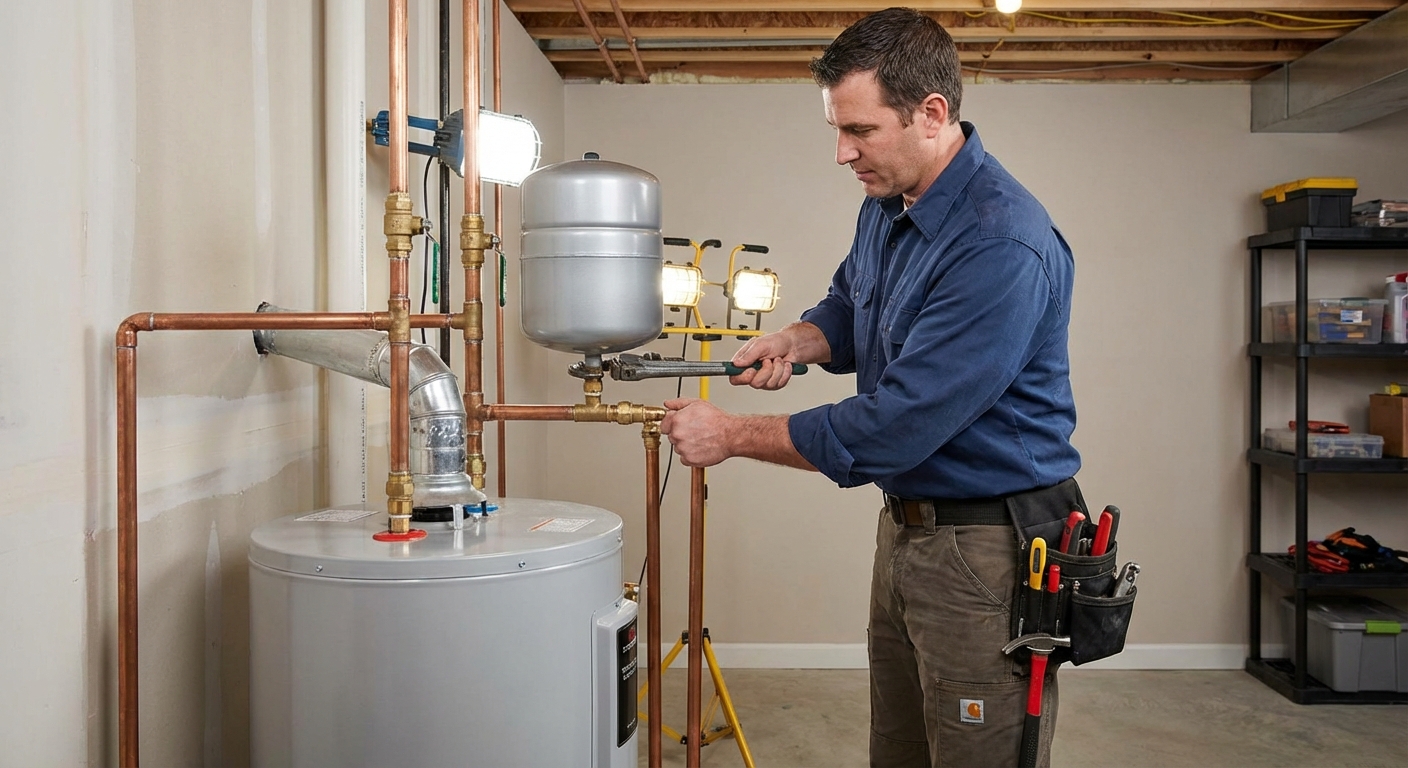
Understanding Thermal Expansion in Water Heating Systems
Thermal expansion is the physical process where water increases in volume when heated. As water temperature rises, water molecules gain kinetic energy and move farther apart, decreasing density and increasing volume. Water expands approximately 2-4% when heated from typical incoming temperatures of 50°F to standard water heater settings of 120-140°F. For a 40-gallon water heater, this means about 0.5 gallons of additional water volume is created during each heating cycle.
Since water is nearly incompressible, this expanded volume must go somewhere. In older open plumbing systems, the excess water would simply flow backward through the pipes into the municipal water supply, relieving pressure naturally. However, modern plumbing systems are designed differently, creating what's known as a closed system that prevents this natural pressure relief.
The difference between open and closed systems is critical. In an open system, thermal expansion poses no problem because the expanded water has an escape route. But when that pathway is blocked, pressure builds rapidly with each heating cycle, creating stress throughout your entire plumbing system.

Find Trusted & Licensed Plumbers in Ohio
Get matched with companies for your specific needs
Why Modern Closed Systems Create Pressure Problems
Today's plumbing systems commonly include backflow prevention devices, check valves, and pressure-reducing valves installed between your home and the municipal water supply. These safety devices are one-way valves designed to prevent contaminated water from flowing backward into the public water system, an important public health protection mandated by most municipalities.
However, these devices create an unintended consequence: they trap expanding water inside your home's plumbing system. When your water heater cycles on and heats the water, the expanded volume cannot escape back to the municipal supply. The result is dramatic pressure buildup that occurs two to three times daily during each heating cycle.
How Pressure Builds in Closed Systems
Without an outlet for this expansion, system pressure can spike from normal levels of 50-60 psi to dangerous levels exceeding 150 psi. This repeated stress affects every component in your plumbing system, from the water heater itself to pipes, fittings, and fixtures throughout your home.
Each time your water heater fires up, the cycle repeats: water heats, expands, pressure spikes, and components throughout your system absorb the stress. Over weeks and months, this constant pressure cycling takes its toll on seals, valves, connections, and appliance components. What starts as a minor inconvenience can quickly escalate to major plumbing failures, sometimes even causing a water heater leak that requires emergency service.
Common Sources Creating Closed Systems
Several devices commonly installed in modern homes create closed plumbing systems:
- Backflow preventers: Standalone devices or integrated into pressure-reducing valves
- Check valves: One-way valves that prevent reverse flow
- Pressure-reducing valves with integral check valves: Regulate incoming pressure while blocking backflow
- Water meters with built-in check valves: Many newer meters include backflow prevention
If your home was built or underwent plumbing work in recent decades, there's a strong likelihood that one or more of these devices is present, making an expansion tank essential.
Symptoms of Thermal Expansion Problems
Several warning signs indicate that thermal expansion is causing problems in your plumbing system. Recognizing these symptoms early can prevent serious damage and costly repairs. The most visible signs typically appear at the water heater itself, but effects can be noticed throughout your entire plumbing system.
Dripping Temperature and Pressure Relief Valve
The most common symptom is a dripping or frequently discharging temperature and pressure (T&P) relief valve on your water heater. This valve is designed as an emergency safety device to prevent catastrophic failure, not to handle regular pressure relief from thermal expansion. When you see water pooling around the discharge pipe or notice the valve releasing water regularly, it's responding to excessive pressure in the system.
Constant dripping is particularly problematic because mineral-laden water can cause buildup that eventually blocks the valve. A blocked T&P valve creates a serious safety hazard, since it's your last line of defense against dangerous pressure buildup. Mineral sediment buildup inside the tank can compound these pressure issues even further.
High and Fluctuating Water Pressure
Other symptoms include high or fluctuating water pressure, even if you have a pressure-reducing valve installed. You may notice sudden bursts of hot water when opening faucets, or pressure that seems inconsistent throughout the day. This erratic behavior indicates that pressure spikes from thermal expansion are overwhelming your system's normal pressure regulation.
Leaking Fixtures and Strange Noises
Leaking fixtures are another telltale sign. Dripping faucets and running toilet fill valves that occur without obvious cause often result from repeated pressure surges damaging seals and components. These may seem like minor annoyances, but they're symptoms of a larger problem affecting your entire plumbing system.
Strange noises in your plumbing system also indicate pressure problems. Creaking pipes during water heater recovery, banging, knocking, or water hammer sounds all signal excessive pressure. You might also discover water pooling around the base of your water heater, leaks from pipe joints and fittings, or mineral deposits forming around fixtures, all consequences of thermal expansion pressure.
Code Requirements for Expansion Tanks (2024-2026)
Major plumbing codes across the United States now mandate thermal expansion tanks in closed plumbing systems. Understanding these requirements is essential for homeowners, as non-compliance can affect permits, warranties, and liability in case of damage.
National Plumbing Code Standards
The 2024 International Plumbing Code (IPC) Section 607.3 requires that a thermal expansion control device be connected to the water heater cold water supply pipe at a point downstream of all check valves, pressure-reducing valves, and backflow preventers. The 2024 Uniform Plumbing Code (UPC) Section 608.3 contains parallel language, requiring an approved, listed, adequately sized expansion tank, or equivalent device, on the building side of any normally closed device. These model codes serve as the foundation for most local plumbing regulations across the country.
Both codes specify that the device must be approved, listed for potable water use, and sized per manufacturer instructions. Sizing depends on water heater capacity, supply pressure, temperature rise, and acceptance volume. Typical residential systems operate at 40-60 psi and require tanks matched to the water heater capacity. The rule is straightforward: if you have a closed system, an expansion tank (or other approved control device) is mandatory, not optional.
Local Code Adoption and 2026 Amendments
Many municipalities have adopted these model codes, making expansion tanks a requirement for permit approval on new installations and water heater replacements. However, local codes may include additional requirements or specific installation guidelines. For example, Georgia's 2026 IPC amendment packet tightens Section 607.3, specifying that the device must sit downstream of all check valves, PRVs, backflow preventers, and shutoff valves, while adding tank location and sizing criteria. Ohio's 2024 plumbing code update also expanded allowable pressure-control methods beyond expansion tanks alone.
Some jurisdictions require permits for expansion tank installation, while others allow homeowners to install them without inspection. A licensed plumber familiar with your local amendments is the safest path to compliance.
Manufacturer Warranty Requirements
Beyond code requirements, water heater manufacturers typically require expansion tanks in closed systems to maintain warranty coverage. Most major manufacturers explicitly state in their installation manuals that failure to install a required expansion tank voids the warranty. This means that even if you could avoid code requirements, you'd risk losing warranty protection on a major appliance.
| Code/Standard | Latest Edition | Requirement |
|---|---|---|
| International Plumbing Code (IPC) | 2024 (Sec. 607.3) | Required downstream of all check valves, PRVs, backflow preventers |
| Uniform Plumbing Code (UPC) | 2024 (Sec. 608.3) | Required on building side of any normally closed device |
| State Amendments | 2025-2026 (e.g., GA, OH) | Often add location, sizing, and pressure-control alternatives |
| Manufacturer Warranties | Current | Typically required for coverage |
A preventive plumbing inspection is a smart way to verify code compliance if you're unsure about your system's configuration.
How Expansion Tanks Solve the Problem
An expansion tank is a steel chamber with an internal rubber diaphragm or bladder that separates water from a pre-pressurized air cushion. This simple but ingenious design provides a safe space for expanded water to go, eliminating the pressure buildup that damages plumbing systems.
The Mechanics of Pressure Absorption
When water in your heater expands, the excess volume flows into the expansion tank through the connection on the cold water line. As water enters the tank, it pushes against the flexible diaphragm, compressing the air cushion on the other side. This compression absorbs the expanded water volume without allowing system pressure to rise dangerously.
The beauty of this system is its automatic operation. No valves, electronics, or manual intervention are required. As water heats and expands, it naturally seeks the path of least resistance, which is the expansion tank's flexible diaphragm. As the water cools and contracts, the compressed air gently pushes the water back into the system, maintaining consistent pressure throughout the heating and cooling cycles.
Proper Sizing and Installation
Proper sizing is critical for expansion tank effectiveness. The tank must accommodate the expansion volume of your specific water heater while maintaining safe operating pressures. Professional plumbers calculate the correct size based on water heater capacity, system operating pressure, incoming water temperature, water heater temperature setting, and total system volume.
A typical 40-50 gallon residential water heater usually requires a 2-gallon expansion tank, while larger 80-gallon heaters may need 4.5-gallon tanks. Undersized tanks won't adequately control pressure, while oversized tanks waste money without providing additional protection.
Per 2024 IPC Section 607.3, installation location matters: the tank must sit on the cold water inlet line downstream of all check valves and backflow devices. It should be mounted vertically or horizontally according to manufacturer specifications, with independent support so its weight doesn't stress pipe connections.
Maintenance and Longevity
Expansion tanks typically last 5-10 years, with utility company guides citing an average lifespan of about 6 years depending on water quality and pressure conditions. The primary maintenance task is checking the air pressure in the tank annually using a tire pressure gauge at the valve on the tank. The air pressure should match your system's water pressure (usually 50-60 psi for the air side when the water side is empty).
Over time, the diaphragm or bladder can fail, causing the tank to become waterlogged. When this happens, the tank loses its ability to absorb expansion and must be replaced. Signs of failure include the tank feeling heavy with water, no hollow sound when the upper portion is tapped, visible rust or leaks at fittings, return of pressure problems, or water coming out of the air valve when tested.
Consequences of Not Addressing Thermal Expansion
Ignoring thermal expansion problems can lead to serious and costly consequences that extend far beyond simple inconvenience. The repeated pressure spikes stress every component in your plumbing system, causing cumulative damage that worsens over time.
Damage to Plumbing Components
The constant pressure cycling affects seals, valves, and connections throughout your home. Seals deteriorate faster than normal, solenoid valves in dishwashers and washing machines fail prematurely, and pipes and fittings develop leaks from the repeated stress. What might seem like isolated fixture problems are actually symptoms of system-wide pressure abuse.
Leaking fixtures, running toilets, and dripping faucets all require repair or replacement. Each component failure costs money and causes water waste. More seriously, hidden leaks behind walls or under floors can go undetected, causing extensive water damage, mold growth, and structural issues. A seasonal plumbing review can help catch this damage before it spreads.
Accelerated Water Heater Failure
Your water heater itself suffers the most damage from uncontrolled thermal expansion. Internal pressures stress tank welds and fitting connections, accelerating corrosion and tank failure. The temperature and pressure relief valve, designed only for emergency use, wears out from constant activation and may fail when actually needed.
Manufacturers have warned that water heaters in closed systems without proper thermal expansion control may last only 6 to 13 months, compared to typical lifespans of 8-12 years for tank units and 15-20+ years for tankless systems. According to 2026 Angi data, replacing a standard tank water heater now costs an average of around $1,334, with most homeowners paying between $882 and $1,811 (and high-efficiency or tankless systems running $2,000-$4,500 or more). That turns a 10+ year appliance into a disposable item.
Warranties are also automatically voided without expansion tanks in closed systems. The roughly $325 average cost of a professionally installed expansion tank is trivial compared to replacing a water heater years ahead of schedule.
Safety Hazards and Emergency Situations
The most dangerous consequences involve safety hazards that can threaten your family and home. In gas-fired water heaters, prolonged pressure buildup can collapse the center flue, which is the chimney inside the tank that vents combustion gases. When the flue collapses, deadly carbon monoxide cannot escape and may leak into your home instead.
In extreme cases, if a thermostat fails and water temperature rises above 212°F, the water becomes superheated. When a faucet opens, this superheated water can instantly flash to steam, causing violent reactions or even tank explosions. While rare, these catastrophic failures cause severe property damage and pose serious injury risks.
Financial Impact Comparison (2026 Costs)
The financial argument for addressing thermal expansion is overwhelming:
| Cost Category | With Expansion Tank | Without Expansion Tank |
|---|---|---|
| Expansion tank installation (2026) | $150-$450 (avg. $325) | $0 |
| Water heater lifespan | 8-15 years | 6-13 months |
| Premature tank replacement (2026) | $0 | $1,200-$2,500+ |
| Tankless replacement (2026) | $0 | $2,000-$4,500 |
| Fixture/appliance repairs | Minimal | $500-$2,000+ |
| Potential water damage | Minimal risk | $5,000-$50,000+ |
| Total 10-Year Cost | $150-$450 | $10,000-$60,000+ |
The numbers speak for themselves. Investing a few hundred dollars in proper thermal expansion control saves thousands in repairs and potentially tens of thousands in damage prevention.
FAQ
What is thermal expansion in a water heater?
Thermal expansion is the natural increase in water volume that occurs when water is heated. As water temperature rises, water molecules spread apart, causing volume to expand by approximately 2-4%. In a typical 40-gallon water heater, this creates about half a gallon of additional water volume that must be accommodated within your plumbing system. This is a basic principle of physics that occurs every time your water heater fires up.
Why does my water heater's pressure relief valve keep dripping?
A dripping pressure relief valve typically indicates excessive pressure in your water heater caused by thermal expansion in a closed plumbing system. The valve is opening to release dangerous pressure buildup because expanded water has nowhere to go when backflow preventers block the return path to the municipal supply. This is a warning sign that you need an expansion tank installed, as the relief valve is not designed for continuous pressure management and may fail or become blocked with mineral deposits over time.
Do all water heaters need expansion tanks?
Not all water heaters require expansion tanks, but most modern homes do because of closed plumbing systems. Under the 2024 IPC and UPC, an expansion tank (or equivalent device) is required whenever a check valve, pressure-reducing valve, or backflow preventer creates a closed system. Older homes with truly open systems do not need expansion tanks, and tankless water heaters often skip them due to minimal stored volume, though many jurisdictions still require expansion control when the cold supply has any backflow device.
How much does it cost to install a water heater expansion tank in 2026?
According to 2026 Angi data, a professionally installed water heater expansion tank averages about $325, with most homeowners paying between $150 and $450 total. The tank itself usually costs $40-$200 depending on size, and plumber labor typically adds $50-$150. Costs vary by region, water heater size, and whether other code-related upgrades (like a new PRV or T&P valve) are needed at the same time.
How do I know if I have a closed plumbing system?
You have a closed system if your home has a pressure-reducing valve, backflow preventer, or check valve installed on the main water line entering your home. These devices may be located near the water meter, main shutoff valve, or where the water line enters the house, often in the basement, crawl space, or utility room. If you're unsure, a licensed plumber can inspect your system and determine if it's closed, which would require an expansion tank under current codes. Most homes built or renovated in the past 20-30 years have closed systems.
What happens if I don't install an expansion tank when needed?
Without an expansion tank in a closed system, repeated pressure spikes will damage your plumbing components, appliances, and water heater, potentially shortening your water heater's life from 8-15 years to just 6-13 months. You'll experience leaking fixtures, premature failures, and voided warranties, with 2026 replacement costs averaging around $1,334 for a standard tank and up to $4,500 for tankless systems. Most seriously, excessive pressure in gas water heaters can collapse the internal flue, creating carbon monoxide hazards, or in extreme cases cause tank ruptures or steam explosions from superheated water. The roughly $325 expansion tank investment prevents tens of thousands in potential damage and protects your family's safety.