
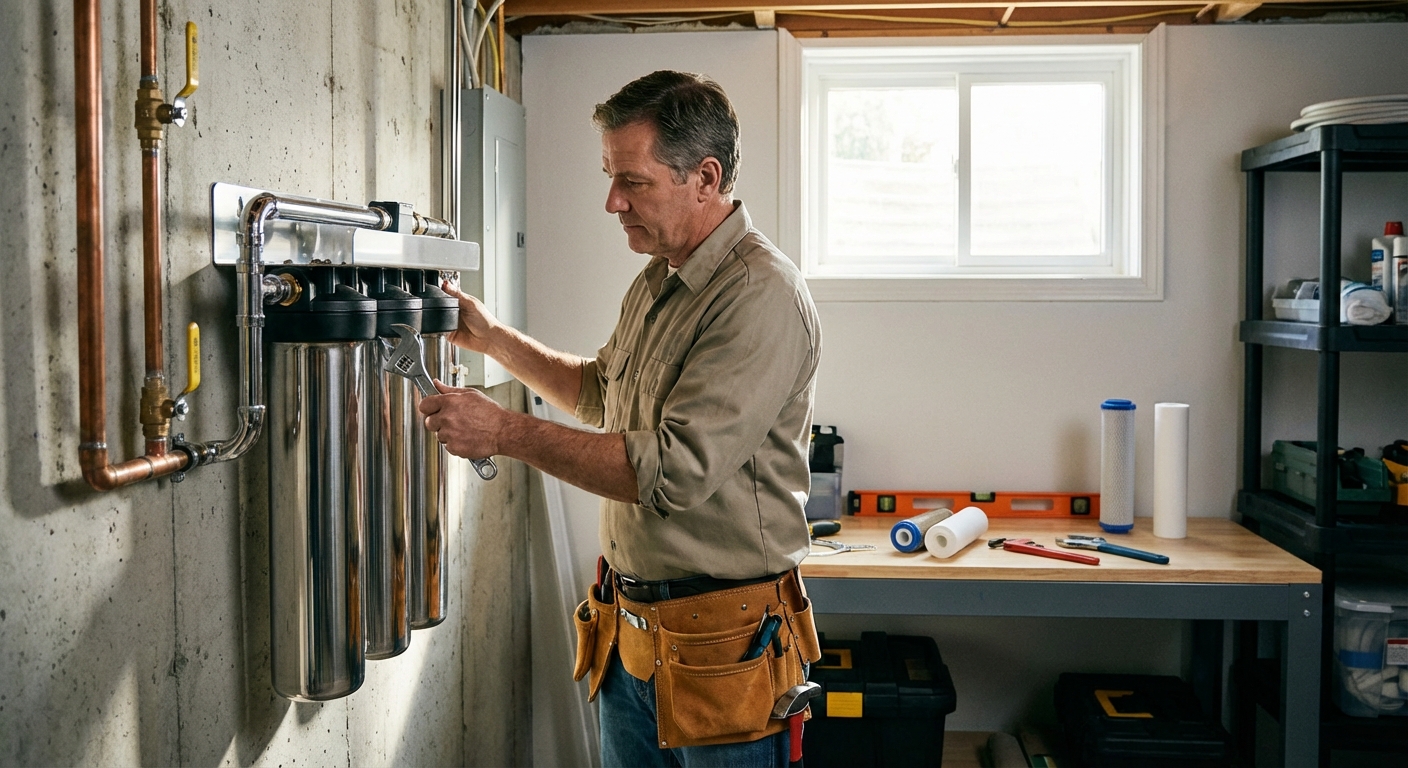
Understanding Water Filtration System Types
Choosing the right water filtration system for your home requires understanding the different types available, their installation requirements, costs, and what contaminants they remove. Each system serves a specific purpose, from basic sediment removal to comprehensive purification that eliminates bacteria and dissolved solids. According to 2026 industry data, the average U.S. homeowner spends about $2,273 on a water treatment system, with most projects landing between $1,130 and $3,537.
Whole House Water Filtration Systems
Whole house filtration systems install at your main water line, treating all water entering your home. These comprehensive systems remove sediment, chlorine, chloramines, heavy metals (lead, iron, manganese), PFAS/PFOA/PFOS, pesticides, herbicides, VOCs, industrial solvents, rust, and taste or odor compounds. Multi-stage systems often combine sediment pre-filters, activated carbon blocks, and KDF media to achieve up to 99.6% removal of chlorine and 95% reduction of various chemicals.
Installation Requirements:
- Professional installation required due to main line connection
- May require plumbing modifications costing $200 to $800
- Needs adequate drainage system
- Access to main water line (limited access increases costs 10-20%)
- Installation complexity: High
2026 Costs:
- Equipment: $1,000 to $4,000
- Installation labor: $200 to $600
- Total installed cost: $850 to $10,000 (varies by home size and complexity)
- Basic city water systems: $850 to $1,500 installed
- Multi-stage carbon/softener systems: $2,000 to $4,000
- Large or specialty systems: $4,000 to $10,000
Maintenance:
- Sediment filters: Replace every 6-12 months ($50 to $150 annually)
- Carbon filters: Replace every 6-12 months ($100 to $300 annually)
- Total annual maintenance: $150 to $500
Similar to how tankless water heater installation requires main line work, whole house filtration systems demand professional expertise for proper integration with your home's plumbing.
Under Sink Water Filters
Under sink systems provide point-of-use filtration specifically for drinking and cooking water at your kitchen faucet. Carbon-based filters excel at removing chlorine (up to 99%), VOCs, pesticides, herbicides, lead, and compounds causing unpleasant taste or odor. These systems don't address dissolved minerals or microbes as effectively as reverse osmosis, but they're excellent for improving water quality for consumption.
Installation Requirements:
- Moderate DIY feasibility for handy homeowners
- Basic plumbing connections under sink
- No major modifications typically needed
- Requires space in cabinet beneath sink
- Installation complexity: Low to Medium
2026 Costs:
- Equipment: $150 to $600
- Professional installation: $100 to $500 (if hired)
- Total cost: $150 to $1,100
Maintenance:
- Filter cartridges: Replace every 6-12 months
- Replacement cost: $20 to $100 per change
- Annual maintenance: $30 to $200
If you're comfortable with basic plumbing tasks similar to dishwasher plumbing connections, under sink filter installation should be manageable.
Reverse Osmosis Systems
Reverse osmosis (RO) systems provide the most thorough water purification available for home use, removing up to 99% of dissolved solids, heavy metals, salts, nitrates, fluoride, bacteria, viruses, and cysts through semi-permeable membranes. The multi-stage process typically includes sediment pre-filtration, carbon filtration, the RO membrane, and post-filtration polishing. These systems are available as point-of-use units (typically under sink) or whole-house installations.
Installation Requirements:
- Professional installation strongly recommended
- Multi-stage filtration setup with specific sequence
- Wastewater drain line required (modern systems waste 1 to 3 gallons per gallon filtered)
- Under sink or whole house mounting options
- May require dedicated faucet installation
- Installation complexity: Medium to High
2026 Costs:
- Countertop RO: $200 to $850 installed
- Under-sink RO: $450 to $1,600 installed
- Under-sink RO with extra plumbing: $650 to $2,000
- Whole house RO: $6,000 to $20,000+ installed
- Installation labor only: $200 to $500 for straightforward jobs
Maintenance:
- Pre/post filters: Replace every 6-12 months ($30 to $100)
- RO membrane: Replace every 2-3 years ($75 to $300)
- Annual maintenance cost: $100 to $200
UV Water Purification Systems
UV systems use ultraviolet light at specific wavelengths to inactivate 99.99% of viruses, bacteria, and 99% of chlorine-resistant cysts like Cryptosporidium and Giardia, all without adding chemicals to your water. However, UV systems don't remove chemicals, sediments, heavy metals, or particulates, making them most effective as a final treatment stage after mechanical and carbon filtration. They're particularly valuable for well water or areas with bacterial contamination concerns.
Installation Requirements:
- Professional installation required
- Electrical hookup needed (typically 110V)
- Main water line integration
- Often paired with sediment pre-filter
- Must protect UV bulb from sediment
- Installation complexity: High
2026 Costs:
- Point-of-use UV: $150 to $500
- Standard whole-house UV: $500 to $1,500
- High-capacity whole-house UV: $1,500 to $2,500
- Total installed: typically $700 to $2,000
Maintenance:
- UV bulb replacement: Annually required ($50 to $150)
- Electricity: $20 to $50 per year
- Quartz sleeve cleaning: Every 6-12 months
- Annual total: $70 to $200

Find Trusted & Licensed Plumbers in Ohio
Get matched with companies for your specific needs
Choosing Between Whole House vs Point of Use
The decision between whole house and point of use filtration significantly impacts your costs, maintenance, and water quality throughout your home. Understanding when each approach makes sense helps you maximize your investment and achieve your water quality goals.
When to Choose Whole House Systems
Whole house filtration treats every drop of water entering your home before it reaches any fixture or appliance. Choose this comprehensive approach when:
- Your home uses well water requiring treatment
- You have hard water or widespread contamination issues
- You want to protect plumbing and appliances from scale and corrosion
- Large families with high daily water usage
- Health concerns, especially with infants, elderly, or immune-compromised family members
- You're a long-term homeowner planning to stay 5+ years
- You experience skin or respiratory irritation from chlorine in shower water
Key Benefits:
- Treats all water for bathing, laundry, and drinking simultaneously
- Protects pipes, water heaters, and appliances from mineral buildup
- Reduces chlorine vapors inhaled during hot showers
- Better long-term value despite higher upfront costs
- Less frequent maintenance than multiple point-of-use units
- May increase home value
Similar to how water heater expansion tanks protect your plumbing system, whole house filters provide system-wide protection. If you have hard water concerns specifically, check out our guide on hard water treatment options.
When to Choose Point of Use Systems
Point of use filtration targets specific outlets, typically your kitchen faucet for drinking and cooking water. This focused approach makes sense when:
- You're renting or living in an apartment
- Working with a limited budget under $1,000
- Primarily concerned about drinking and cooking water quality
- Your municipal water is generally good but has taste or odor issues
- You want to target specific contaminants at one location
- You need a temporary or portable solution
Key Benefits:
- Significantly lower upfront investment
- DIY installation often possible (saving $100 to $500)
- Focused treatment where water quality matters most
- Can be removed and relocated if you move
- More efficient for treating only potable water uses
| Factor | Whole House | Point of Use |
|---|---|---|
| Upfront Cost (2026) | $850 to $10,000 | $150 to $1,100 |
| Installation | Professional required | Often DIY-friendly |
| Coverage | All fixtures and appliances | Single faucet or area |
| Maintenance Frequency | Every 6-12 months | Every 6-12 months per unit |
| Long-term Value | Excellent (10+ years) | Good (5-7 years) |
| Best For | Homeowners, families | Renters, budget-conscious |
Many homeowners implement a hybrid approach, installing a basic whole house sediment and carbon filter for general protection, then adding a reverse osmosis system under the kitchen sink for superior drinking water quality. This combination provides comprehensive treatment while managing costs effectively. If you're experiencing low water pressure issues, consider system capacity carefully because some whole house filters can reduce flow rates if undersized.
Water Testing: The Critical First Step
Before investing in any water filtration system, testing your water is essential to identify specific contaminants and choose the appropriate treatment technology. Water quality varies dramatically based on source (municipal vs. well), geographic location, infrastructure age, and seasonal factors. Recent national analysis found PFAS in water serving at least 143 million Americans, and a separate study of nearly 5,000 public systems identified unregulated contaminants affecting 97 million residents. Without testing, you might purchase a system that doesn't address your actual water quality issues. Our complete home water quality testing guide walks through the entire process.
Testing Options and Costs
Home Test Kits:
- Cost: $20 to $100
- Results: Basic indicators within 24 hours
- Best for: Initial screening of common issues
- Limitations: Less accurate than lab testing
Professional Lab Testing:
- Cost: $100 to $300 (comprehensive panels)
- Results: Detailed analysis in 5-10 days
- Best for: Comprehensive contaminant identification
- Accuracy: Laboratory-grade precision
Municipal Water Reports:
- Cost: Free from your water utility
- Results: Available online or by request
- Best for: Understanding source water quality
- Limitations: Doesn't reflect in-home contamination
Critical Contaminants to Test For
Essential Tests (All Homes):
- Chlorine and chloramines
- Disinfection byproducts (TTHMs, HAA5)
- pH levels (6.5 to 8.5 ideal range)
- Total dissolved solids (TDS)
- Hardness minerals (calcium, magnesium)
- Lead (especially important under the 2024 Lead and Copper Rule Improvements, which lower the action level to 10 ppb)
Well Water Additional Tests:
- Bacteria and coliform (E. coli)
- Nitrates and nitrites
- Iron and manganese
- Sulfur compounds (rotten egg odor)
- Arsenic
Homes with Specific Concerns:
- PFAS/PFOA/PFOS (near industrial areas or military bases). See our dedicated PFAS water testing guide for more.
- VOCs and pesticides (agricultural areas)
- 1,4-dioxane (in areas near industrial activity)
- Copper (homes with copper plumbing)
- Hexavalent chromium and other heavy metals
- Radon in water
Similar to how you'd investigate water line leaks to protect your home, water testing identifies invisible threats to your health.
Choosing Based on Specific Contaminants
Different filtration technologies excel at removing specific contaminants. Matching your water test results to the appropriate system ensures effective treatment and avoids wasting money on inadequate solutions.
Contaminant Removal Comparison
| Contaminant Type | Best System | Effectiveness | Alternative Options |
|---|---|---|---|
| Sediment/Rust/Sand | Whole house sediment filter | 99%+ | Point-of-use sediment filter |
| Chlorine/Chloramines | Carbon filter (any type) | 99%+ removal | KDF media in whole house |
| Heavy Metals (Lead, Mercury) | RO or carbon with KDF | 95-99% removal | NSF 53 certified cartridges |
| Bacteria/Viruses | UV or RO | 99.99% inactivation | Combination recommended |
| PFAS/PFOA/PFOS | NSF 53 carbon or NSF 58 RO | Reduces below 20 ppt | Specialized carbon blocks |
| Dissolved Solids/TDS | Reverse osmosis only | 99%+ removal | No effective alternative |
| Pesticides/VOCs | Carbon filters | Excellent | Multiple stage carbon |
| Fluoride | Reverse osmosis | 95%+ removal | Activated alumina (less effective) |
| Nitrates | Reverse osmosis | 95%+ removal | Ion exchange (less common) |
| Iron/Manganese | Oxidation + filtration | Excellent | Water softener + sediment filter |
System Selection for Common Scenarios
Scenario 1: Municipal Water with Chlorine and Lead Concerns
- Primary system: Under sink carbon filter (NSF/ANSI 53 certified) or basic whole house carbon
- Upgrade option: Add reverse osmosis under sink for drinking water
- Expected cost: $150 to $1,500
Scenario 2: Well Water with Bacteria and Sediment
- Primary system: Whole house sediment pre-filter plus UV purification
- Essential addition: Pressure tank protection
- Expected cost: $1,500 to $3,500
Scenario 3: Hard Water with Multiple Contaminants
- Primary system: Whole house multi-stage (sediment + carbon + KDF)
- Optional addition: Water softener plus kitchen RO
- Expected cost: $2,500 to $8,000
Scenario 4: PFAS Contamination (Forever Chemicals)
- Primary system: NSF/ANSI 58 reverse osmosis with PFAS-certified carbon stages
- Whole house option: NSF/ANSI 53 multi-stage carbon with verified PFAS reduction
- Expected cost: $500 to $6,000
Combining Systems for Comprehensive Treatment
For homes with multiple water quality issues, layered filtration provides the most effective solution:
- Basic Protection Layer: Whole house sediment filter (5 micron). Cost: $300 to $800 installed
- Chemical Removal Layer: Whole house carbon filter for chlorine, VOCs, and PFAS. Cost: $800 to $2,000 installed
- Microbial Protection Layer: UV purification system. Cost: $700 to $2,000 installed
- Drinking Water Polish: Under sink reverse osmosis. Cost: $450 to $1,600 installed
This comprehensive approach addresses different contaminants at optimal points in your plumbing system, similar to how multiple strategies address drain cleaning throughout your home. A complete multi-layer system typically ranges from $3,000 to $8,000, but provides protection equivalent to premium bottled water at every tap.
Installation Complexity and Ongoing Costs
Understanding installation requirements and long-term expenses helps you budget accurately and avoid surprises. Total cost of ownership includes initial purchase, installation, and years of maintenance, not just the sticker price. Homewyse's May 2026 estimate puts the basic cost to install a water filter system at $990 to $1,245 per unit, before any complex modifications.
DIY vs Professional Installation
DIY-Friendly Systems:
- Under sink carbon filters (2 to 4 hours, basic tools)
- Countertop filters (15 minutes, no tools)
- Faucet-mounted filters (30 minutes, basic tools)
- Success rate: 80 to 90% for homeowners with basic skills
Professional Installation Strongly Recommended:
- Whole house systems (4 to 8 hours, specialized tools and expertise)
- Reverse osmosis systems (2 to 4 hours, proper sequencing critical)
- UV systems (3 to 6 hours, electrical and plumbing integration)
- Success rate: 95%+ with licensed professionals
Similar to emergency plumber services, professional installation costs more but prevents expensive mistakes.
Factors Increasing Installation Costs
Several variables can significantly impact your installation expenses:
Location and Access Challenges:
- Limited main line access: 10-20% cost increase
- Crawlspace installations: $100 to $300 additional
- Tight spaces requiring extra labor: $150 to $400
- Distance from main line: $50 to $200 per 10 feet
Plumbing Modifications:
- Drainage line installation: $200 to $800
- Dedicated circuit for UV: $150 to $500
- Water pressure adjustment: $100 to $300
- Backflow prevention: $200 to $500
Property Type Factors:
- Well water systems often require additional components
- Multi-story homes have complex routing that increases labor
- Old plumbing may need upgrades before installation
- Code compliance, permits, and inspections add $100 to $500
Long-Term Maintenance and Replacement Costs
Ongoing maintenance represents a significant portion of total ownership over a system's 10 to 15 year lifespan. Budget for these recurring expenses based on 2026 pricing:
| System Type | Annual Maintenance Cost |
|---|---|
| Point of Use Carbon Filters | $40 to $200 |
| Whole House Systems | $150 to $500 |
| Reverse Osmosis Systems | $100 to $200 |
| UV Purification | $70 to $200 |
Consequences of Neglected Maintenance
Failing to replace filters on schedule creates multiple problems:
- Reduced effectiveness: Contaminants break through saturated filters
- Increased energy costs: Clogged filters increase energy consumption 20 to 30%
- System damage: Sediment can damage downstream components
- Health risks: Bacterial growth in old filters
- Voided warranties: Most manufacturers require proof of maintenance
Regular maintenance, similar to sump pump maintenance, prevents expensive failures and protects your investment.
10-Year Total Cost of Ownership
Comparing total costs over a decade reveals the true investment:
| System Type | Initial Cost | 10-Year Maintenance | Total 10-Year Cost |
|---|---|---|---|
| Under Sink Carbon | $300 | $400 to $2,000 | $700 to $2,300 |
| Whole House Basic | $2,000 | $1,500 to $5,000 | $3,500 to $7,000 |
| Kitchen RO System | $600 | $1,000 to $2,000 | $1,600 to $2,600 |
| Whole House + RO | $3,500 | $2,500 to $7,000 | $6,000 to $10,500 |
While whole house systems cost more initially, they protect plumbing and appliances worth thousands, potentially offsetting their higher price through extended equipment lifespan and reduced repair costs.
Frequently Asked Questions
What is the average cost to install a whole house water filtration system in 2026?
Whole house water filtration systems typically cost between $850 and $10,000 installed in 2026, with the average homeowner spending around $2,273 according to Angi. Basic city water systems run $850 to $1,500 installed, multi-stage carbon and softener combinations range from $2,000 to $4,000, and large or specialty systems can reach $4,000 to $10,000. Additional factors like crawlspace access, drainage modifications, or well water requirements can add $200 to $1,000 to the base cost.
How often do water filtration system filters need to be replaced?
Filter replacement frequency depends on the system type, water usage, and contamination levels in your water supply. Sediment pre-filters typically need replacement every 3-6 months, activated carbon filters every 6-12 months, and reverse osmosis membranes every 2-3 years. UV bulbs require annual replacement regardless of usage. Monitor water flow rate and taste changes as indicators that filters need changing even before the recommended schedule.
Can I install an under sink water filter myself or do I need a plumber?
Under sink water filters are generally DIY-friendly if you're comfortable with basic plumbing tasks like connecting supply lines and shutoff valves. Most installations take 1 to 2 hours using common tools like adjustable wrenches, a drill, and a screwdriver. However, hiring a plumber costs $100 to $500 and ensures proper installation, maintains manufacturer warranties, and prevents potential leaks. Similar to bathroom sink drain repair, basic skills make DIY feasible but professionals guarantee results.
Should I choose a whole house system or just filter my drinking water?
Choose a whole house system if you have widespread water quality issues affecting showers, laundry, and appliances, or if you want comprehensive protection for your entire plumbing system and family health. Whole house filtration makes sense for well water, hard water problems, or when chlorine causes skin irritation during bathing. Opt for point-of-use filtration if you're primarily concerned with drinking and cooking water quality, have budget constraints under $1,000, or rent your home. Many homeowners use a hybrid approach with both for the best of both worlds.
How do I know which water filtration system removes the contaminants in my water?
Start with comprehensive water testing to identify specific contaminants in your supply, either through professional lab analysis ($100 to $300) or home test kits ($20 to $100). Match test results to system capabilities: carbon filters effectively remove chlorine, VOCs, and pesticides; reverse osmosis eliminates dissolved solids, heavy metals, and fluoride; UV systems inactivate bacteria and viruses. Look for NSF/ANSI 53 certification for health-related contaminants like lead and PFAS, or NSF/ANSI 58 for reverse osmosis PFAS reduction below 20 parts per trillion.