
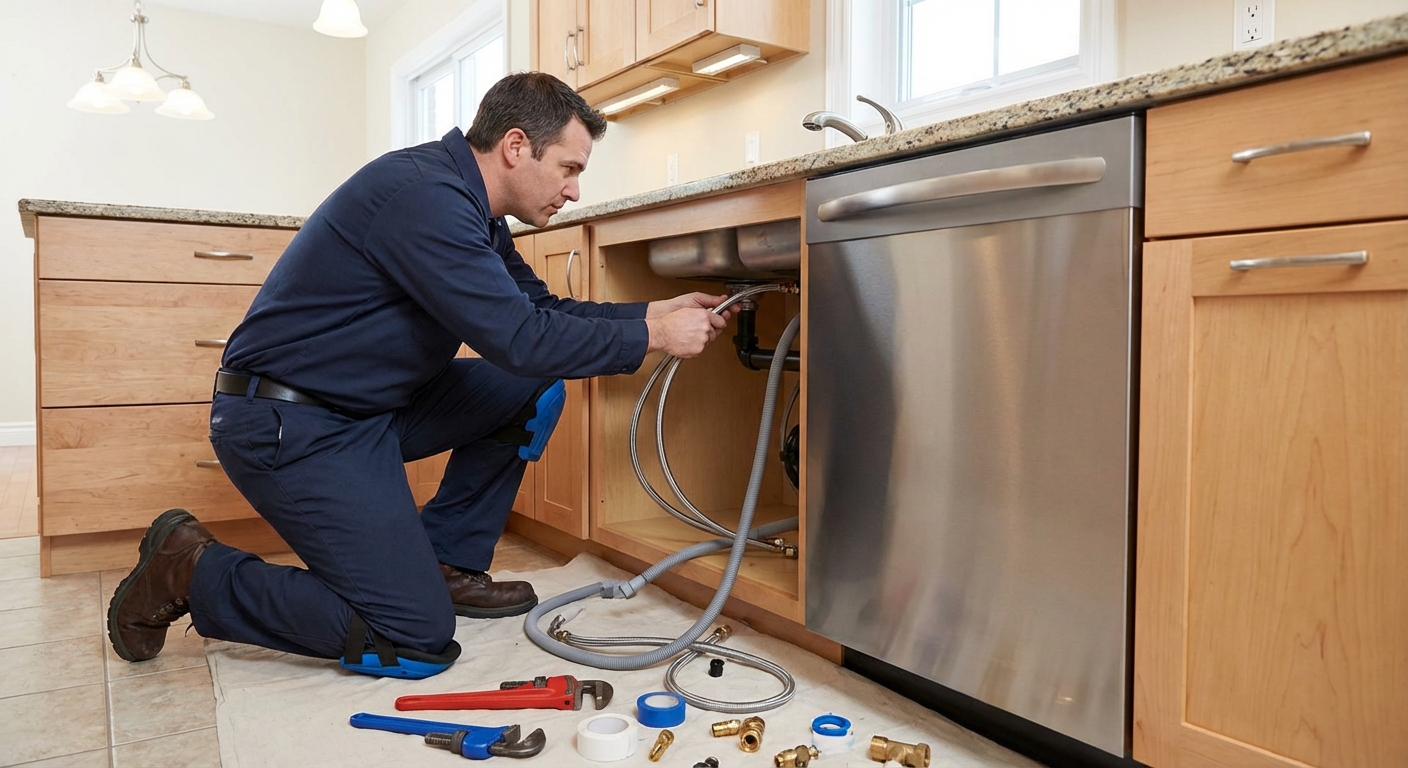
Understanding Dishwasher Plumbing Requirements
Installing a dishwasher requires three essential plumbing components working together: a hot water supply connection, a properly configured drain line, and backflow prevention through either an air gap or high loop. Each component must meet specific code requirements to ensure your dishwasher operates safely and efficiently.
The water supply connection taps into your home's hot water line, typically located under the kitchen sink. Most 2026 installations use a 3/8-inch braided stainless steel supply line rated for at least 120 psi, connected to a dual-outlet shut-off valve that allows independent control of water to both your dishwasher and sink faucet. This valve should be easily accessible for maintenance and emergency shutoffs.
The drain line connects your dishwasher to either the sink drain or garbage disposal. This connection must include proper venting and be secured with clamps to prevent leaks. The drain hose must maintain the correct positioning, with manufacturers commonly specifying a maximum run length of 10 feet to ensure wastewater flows out efficiently.
Backflow prevention is critical for protecting your dishwasher from contaminated water. Under the International Plumbing Code, dishwashers must discharge indirectly through an air gap or air break, while the Uniform Plumbing Code generally requires a dedicated air gap device. Most jurisdictions accept either a deck-mounted air gap or a high loop where the drain hose rises to the underside of the countertop and is secured in place (typically at least 32 inches above the floor per manufacturer instructions).
Water Supply and Drain Line Installation
Installing the water supply line properly ensures consistent water flow and prevents leaks that could cause expensive water damage. Start by locating your hot water supply under the sink and installing a dual-outlet shut-off valve if one isn't already present. Avoid using rubber or vinyl supply lines, which can degrade and burst. Braided stainless steel is the current 2026 standard.
Connect the supply line to the valve on the bottom of the unit. Tighten brass fittings by hand first, then add no more than a quarter turn with pliers. Brass is soft, and over-tightening is one of the most common causes of cracked fittings and slow hidden leaks. Always verify that a rubber washer is present inside the water hose fitting before tightening, and use PTFE (Teflon) tape on threaded male fittings to prevent slow drips.
For the drain line, route the drain hose to create a high loop fastened as high as possible to the underside of the countertop if you're not using an air gap. Secure the hose with clamps at all connection points, whether you're connecting to a sink drain or garbage disposal. If connecting to a disposal, remember to remove the knockout plug first. Leaving it in place is one of the most common installation mistakes that causes drainage failure.
Your hot water supply should maintain a temperature of at least 120°F for optimal cleaning performance. Address any plumbing problems like inadequate flow before installing your dishwasher to ensure proper operation.

Find Trusted & Licensed Plumbers in Ohio
Get matched with companies for your specific needs
Electrical and Plumbing Code Compliance
Understanding code requirements is essential for safe, legal dishwasher installation. Both electrical and plumbing codes exist to protect your home and family, and violations can lead to failed inspections, fines, or even denied insurance claims if problems occur.
The National Electrical Code (NEC) now mandates Class A GFCI protection for dwelling-unit dishwashers under section 422.5(A)(7), regardless of whether the appliance is hard-wired or cord-and-plug connected. Most standard dishwashers draw 12 to 15 amps and require a dedicated 120-volt circuit. While some installations can use a 15-amp circuit with 14 AWG wire, the current recommended standard for 2026 installations is a dedicated 20-amp circuit with 12 AWG wiring to handle higher-load models.
The receptacle location is specifically regulated: for built-in dishwashers, the outlet must be positioned in an adjacent cabinet or wall space within reach of the dishwasher's power cord. The receptacle cannot be located directly behind the dishwasher where it would be inaccessible without removing the appliance.
Plumbing codes follow either the International Plumbing Code (IPC) adopted by most Eastern and Midwestern states or the Uniform Plumbing Code (UPC) used primarily in Western states. Both require minimum 3/8-inch water supply lines and proper backflow prevention. The drain connection must always be above the P-trap, never on the sewer side of it.
Air gap requirements by state in 2026: California, Washington, Hawaii, and Minnesota explicitly mandate a physical dishwasher air gap, and a high loop alone does not meet code in these states. Most other states allow either an air gap or a properly installed high loop, but local jurisdictions can impose stricter requirements. Many cities require permits for new dishwasher installations or relocations, typically costing $25 to $100.
Common code violations to avoid include sharing circuits with kitchen lighting or small appliances, missing GFCI protection, improperly placed receptacles, absent air gaps or high loops, connecting the drain below the P-trap, and missing shut-off valves. Working with licensed plumbers helps ensure compliance and protects you from these costly mistakes.
Installation Costs and What to Expect in 2026
Understanding the full cost breakdown helps you budget appropriately and decide between DIY and professional installation. Dishwasher plumbing costs have risen modestly in 2026 compared to prior years due to labor and materials inflation.
Typical professional installation with existing hookups now averages $1,000 to $1,500 nationally in 2026, with most homeowners paying around $1,200 for a standard job. Homewyse data shows a range of $904 to $1,678 per dishwasher, while plumbing companies report labor-only pricing of $850 to $1,100 depending on whether the old unit needs to be removed.
New installation with no existing hookups (creating water supply lines and drain connections from scratch) runs $1,200 to $2,500, with plumbing modifications alone potentially reaching $1,270 to $3,200 in complex jobs. Plumbers and electricians commonly charge $75 to $150 per hour for this work in 2026, with most residential rates clustering around $90 to $120 per hour.
| Service Type | 2026 Cost Range | What's Included |
|---|---|---|
| Basic hookup (existing lines) | $350-$800 | Connect to existing plumbing |
| Standard professional install | $1,000-$1,500 | Full hookup with existing infrastructure |
| New rough-in plumbing | $1,200-$2,500 | New supply and drain lines |
| Complex installation | $3,500+ | Custom cabinetry, electrical upgrades |
| Permits | $25-$100 | Required for most new installs |
Additional costs may include upgrading your electrical panel if you don't have a dedicated circuit available ($150 to $900), installing an air gap if required by code ($50 to $150), or modifying cabinetry to accommodate different dishwasher dimensions ($100 to $500).
Materials costs are relatively modest for DIY installations. A basic installation kit including a braided stainless supply line, drain hose, fittings, and clamps costs $30 to $80. Higher-quality premium fittings may add another $30 to $50.
Improper installation can lead to leaks, water damage, and expensive repairs that far exceed professional installation costs. A failed DIY installation might cost $500 to $2,000 or more to repair water damage to cabinets, flooring, or drywall. If you're planning major kitchen work, plumbing financing options can help spread costs over time.
DIY Installation vs Hiring a Professional
Deciding whether to tackle dishwasher plumbing yourself or hire a professional depends on your skill level, existing infrastructure, and local code requirements. Understanding when each approach makes sense helps you save money while avoiding the most common plumbing mistakes.
DIY installation works well when you're replacing an existing dishwasher with existing water supply and drain connections already in place. If you're comfortable with basic home repairs and have the necessary tools (adjustable wrenches, screwdrivers, drill, level, and PTFE tape), you can handle straightforward hookups. Modern dishwashers are designed for easier installation, with many requiring only a power cord plug-in rather than hardwiring.
The main DIY tasks include connecting the water supply line, routing and securing the drain hose to create a proper high loop, connecting the power source, and leveling the unit. Leveling is critical: an uneven dishwasher can cause water to pool in one corner and leave standing water after cycles.
Professional installation becomes essential when you need to create new plumbing connections in a location that's never had a dishwasher. Professional plumbers understand local codes and have experience identifying potential problems before they occur.
Hire a professional if your installation requires any of these situations:
- Electrical modifications: Adding a new dedicated circuit, upgrading your electrical panel, or hardwiring the dishwasher
- Plumbing modifications: Extending water supply lines, creating new drain connections, or modifying existing plumbing
- Code compliance concerns: Ensuring your installation meets local electrical and plumbing codes, especially in air-gap-mandatory states
- Complex configurations: Installing in tight spaces, dealing with unusual cabinet dimensions, or working around existing obstacles
The most common DIY mistakes include forgetting to remove the knockout plug from garbage disposals, creating drain loops that are too low to prevent backflow, over-tightening brass fittings until they crack, using the wrong supply line material, and failing to test for leaks before pushing the dishwasher into place.
Consider your time value when making this decision. A professional can complete installation in 2 to 4 hours, while DIYers often spend 6 to 8 hours or more, especially on their first installation.
Insurance considerations matter too. Professional installations typically include warranties on workmanship, and licensed plumbers carry insurance that protects you if something goes wrong. DIY installations that cause water damage may not be covered by homeowner's insurance if the damage resulted from improper work.
Common Connection Problems and Drainage Issues
Understanding common dishwasher plumbing problems helps you prevent issues before they occur and diagnose them quickly when they do. Most drainage problems stem from improper initial installation rather than appliance failure.
Improper drain hose positioning is the most frequent culprit behind drainage issues. When the drain hose connects too low or lacks a high loop, gravity and water pressure from the sink allow dirty water to siphon back into your dishwasher. This creates standing water, foul odors, and contamination of supposedly clean dishes.
The solution is creating a proper high loop where the drain hose rises and fastens to the underside of your countertop. Secure this loop with mounting brackets or zip ties to prevent it from sagging over time. If your jurisdiction requires an air gap, install it properly on your countertop or sink and keep it clean of debris.
Connecting the drain below the P-trap is a serious code violation that allows sewer gases and contaminated water to reach the dishwasher. Always use the disposal's dishwasher inlet or a wye fitting on the sink tailpiece above the trap.
Garbage disposal connection mistakes account for many installation failures. Every garbage disposal has a knockout plug that seals the dishwasher drain inlet until you're ready to connect a dishwasher. Forgetting to remove this plug blocks drainage completely, causing water to back up into your dishwasher.
Shared drain line clogs affect your dishwasher when the common P-trap or sink drain line develops buildup. When your sink drains slowly all the time, the P-trap likely needs professional drain cleaning. Food debris, grease, and soap scum accumulate over time, restricting flow for both your sink and dishwasher.
Prevent these issues by running your garbage disposal for several seconds before starting the dishwasher. Never pour grease down your sink drain. Monthly, clean your dishwasher's filter and wipe down the interior to remove food particles before they enter the drain system.
Clogged air gaps signal their presence by overflowing water onto your countertop when the dishwasher drains. The air gap has a small cap you can remove to access the interior. Clean out any food debris or buildup that's blocking the air flow.
Leaking connections waste water and can cause significant damage to cabinets and flooring. Most leaks occur at connection points: where the supply line attaches to the shut-off valve or dishwasher inlet, or where the drain hose connects. Check all connections annually and tighten any that show signs of moisture. When DIY troubleshooting doesn't resolve the issue, professional leak detection services can identify hidden problems before they cause major damage.
Frequently Asked Questions
What size water supply line does a dishwasher need?
Dishwashers in 2026 typically require a 3/8-inch braided stainless steel supply line connecting to your home's hot water system. This size provides adequate flow rate for the appliance to fill properly during wash cycles. The supply line should include a shut-off valve located under the sink for easy access. Avoid rubber or vinyl lines, which are prone to degradation and bursting.
Do I legally need an air gap for my dishwasher installation?
Air gap requirements vary by state and local codes. As of 2026, California, Washington, Minnesota, and Hawaii require a physical air gap by state plumbing code, while most other states accept a properly installed high loop. Check with your local building department before installation, since installing without a required air gap can fail inspection and may void appliance warranties.
How much does it cost to install a dishwasher with plumbing in 2026?
Standard professional installation with existing hookups averages $1,000 to $1,500 in 2026, with most homeowners paying around $1,200. New installations requiring fresh plumbing and electrical infrastructure typically run $1,200 to $2,500, while complex jobs with custom cabinetry or electrical upgrades can exceed $3,500. Plumbers and electricians commonly charge $75 to $150 per hour.
Why is water backing up into my dishwasher from the sink?
Water backing up indicates a backflow prevention failure, usually caused by an improperly installed drain hose without a high loop or functioning air gap. The drain hose may be connected too low or below the P-trap, allowing sink water to flow back into the dishwasher. Check that your drain hose rises and fastens to the underside of the countertop, or install an air gap if required by code.
Does my dishwasher need GFCI protection under the 2026 NEC?
Yes. Under NEC section 422.5(A)(7), dwelling-unit dishwashers require Class A GFCI protection regardless of whether they are hard-wired or cord-and-plug connected. This rule has expanded in recent code cycles to cover all dishwasher connection methods. If your current installation lacks GFCI protection, upgrading is recommended for safety and is required for any new or replacement installation.