
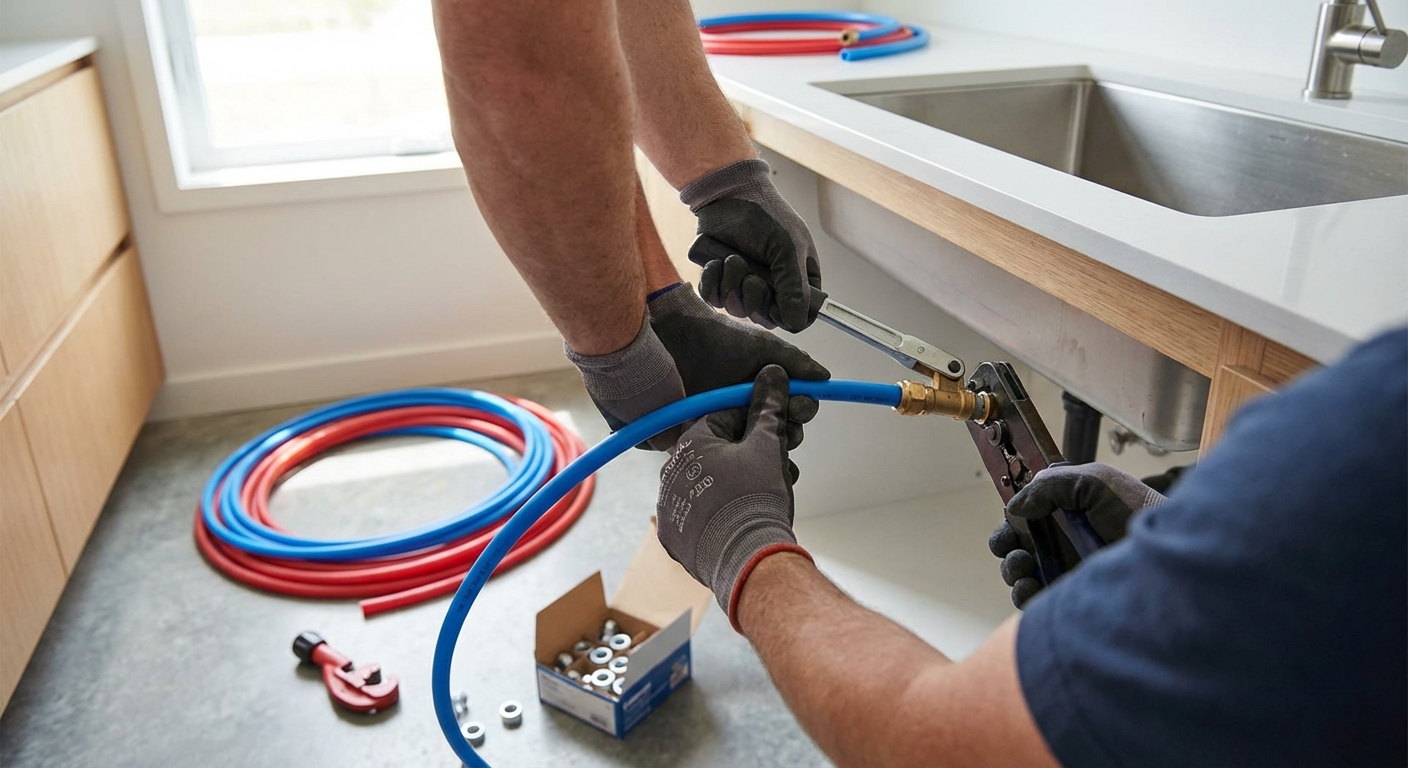
What Is PEX Plumbing and How Does It Work?
PEX (cross-linked polyethylene) is a flexible plastic tubing material that has become the dominant choice for residential water supply systems in 2026. The cross-linking process modifies the molecular structure of standard polyethylene, creating stronger bonds that enhance the material's temperature resistance, chemical stability, and overall durability.
Unlike traditional rigid piping, PEX bends easily around corners and through tight spaces, allowing plumbers to run continuous lines with fewer connections. This fundamental flexibility distinguishes PEX from both copper and CPVC alternatives, reducing potential leak points and streamlining installation.
PEX comes in three main types (PEX-A, PEX-B, and PEX-C), each manufactured using different cross-linking methods. PEX-A is produced using the peroxide method during extrusion, resulting in roughly 85% crosslinking and the highest flexibility with thermal memory that allows it to return to its original shape after kinking. PEX-B uses a silane moisture-cure process, achieves about 65 to 70% crosslinking, offers the best chlorine and oxidative resistance, and remains the most commonly used type in North American homes. PEX-C uses electron-beam irradiation and is typically reserved for short runs or specialty uses.
Key Differences: PEX vs. Copper vs. CPVC
Understanding how PEX compares to traditional plumbing materials helps homeowners make informed decisions about their water supply systems.
Cost Comparison: In 2026, PEX materials cost between $0.50 and $2 per linear foot, while copper runs $2 to $8 per linear foot (with Type L copper averaging 2 to 3 times the price of PEX). CPVC falls in the middle at approximately $0.50 to $1 per linear foot, but requires more labor-intensive installation than PEX.
Durability Factors: Copper offers excellent rodent resistance and handles outdoor exposure well, lasting 50 to 70+ years. CPVC resists corrosion and can last up to 100 years in ideal conditions. PEX typically lasts 40 to 60+ years when properly installed indoors, with PEX-A often quoted at 60+ years and PEX-B at 50+ years. Some manufacturers project lifespans approaching 100 years under ideal conditions, though century-scale field data does not yet exist.
Installation Complexity: PEX's flexibility allows for snaking through walls and around obstacles with minimal cutting and patching. Copper requires soldering skills and more precise measurements, while CPVC needs primer and cement for joints. This makes PEX the fastest and most DIY-friendly option. Learn more about how the two materials stack up in our copper vs PEX plumbing comparison.

Find Trusted & Licensed Plumbers in Ohio
Get matched with companies for your specific needs
Advantages and Disadvantages of PEX Plumbing
Understanding both the benefits and limitations of PEX helps you determine if it's the right choice for your home.
Major Advantages of PEX
Exceptional Flexibility: The ability to bend PEX around corners and obstacles reduces the number of fittings needed, which means fewer potential leak points. Plumbers can often run continuous lines from the manifold to individual fixtures, creating cleaner installations with improved reliability.
Superior Freeze Resistance: PEX expands when water freezes inside, then contracts back to normal once thawed. PEX-A in particular has been shown to withstand pressures up to 500 PSI in extreme cold. This expansion property prevents the catastrophic bursting that commonly occurs with rigid copper or CPVC pipes in freezing conditions, potentially saving thousands in water damage repairs.
Cost Savings: Beyond the lower material costs, PEX installation requires significantly less labor time than copper. The reduced need for wall cutting, faster connection methods, and elimination of soldering all contribute to lower total project costs. Homeowners typically save between $4,000 and $8,000 on whole-house repiping compared to copper in 2026.
Corrosion and Scale Resistance: Unlike copper, which can develop pinhole leaks in acidic water or scale buildup in hard water, PEX is immune to corrosion, mineral build-up, and electrolysis. This resistance extends the system's lifespan and maintains consistent water flow rates over decades. Read our guide on corrosion-resistant plumbing pipes to see how PEX compares to other corrosion-resistant materials.
Quiet Operation: PEX naturally dampens water flow noise and eliminates the loud banging of water hammer that metal pipes transmit throughout a home. The flexible material absorbs vibrations and pressure fluctuations that rigid pipes amplify.
Energy Efficiency: PEX provides better insulation than metal pipes, reducing heat loss as hot water travels from your water heater to fixtures. This translates to faster hot water delivery and lower energy bills over time.
Notable Disadvantages of PEX
UV Sensitivity: Direct sunlight rapidly degrades PEX, causing brittleness and potential failure. Any exposed PEX must be protected from UV light, making it unsuitable for outdoor applications without proper shielding. For exterior projects, see our outdoor plumbing installation guide for material recommendations.
Rodent Damage Potential: Mice, rats, and squirrels can chew through PEX piping, creating leaks that may go unnoticed until significant damage occurs. Areas with known rodent problems require additional protective measures or alternative piping materials in vulnerable locations.
Chemical Concerns: While certified PEX meets safety standards, 2024 to 2025 research has drawn renewed attention to trace amounts of volatile organic compounds (VOCs) like MTBE, tert-butyl alcohol (TBA), and toluene leaching from new installations, particularly in highly chlorinated or low-mineral water. Studies show VOC release is highest in the first 5 years and remains below EPA safety thresholds, but emerging research on microplastics is pushing regulators to require more thorough flushing protocols.
Temperature Limitations: Although PEX handles hot water well (rated to roughly 200°F or 93°C), it shouldn't be used directly near boiler connections or in recirculation loops without proper temperature mitigation. High temperatures can reduce the material's expected lifespan.
Professional Installation Recommended: While PEX appears DIY-friendly, improper installation (particularly with crimp or expansion fittings) can lead to leaks and premature failure. Code compliance also requires specific certifications and practices that DIY installers may overlook.
Installation Methods, Safety, and Cost Analysis
Choosing the right installation method and understanding safety certifications ensures your PEX plumbing system performs reliably for decades.
PEX Installation Methods Explained
Crimp Connections: The most widely used residential method employs copper or stainless steel rings compressed around the pipe and fitting using a crimping tool. This proven technique offers reliability at reasonable tool costs ($50 to $150 for quality crimpers). Crimp connections work with all PEX types but perform best with PEX-B.
Clamp Connections: Similar to crimp systems, clamp methods use stainless steel bands secured with a specialized clamping tool. These connections provide reliable performance at slightly lower tool costs and work well with PEX-B and PEX-C. The wider band distributes pressure more evenly.
Expansion Connections: This premium method temporarily stretches PEX-A pipe using an expansion tool before inserting the fitting. As the pipe contracts to its original size, it creates a powerful 360-degree seal that strengthens over time. Expansion fittings also provide full-bore flow with no internal diameter reduction at joints, unlike insert-style crimp fittings. Tools cost $200 to $500.
Push-Fit Connections: These tool-free fittings simply push onto the pipe end, making them ideal for repairs and small retrofits. However, push-fit fittings cost 5 to 10 times more than crimp alternatives ($8 to $15 each versus $1 to $2).
Safety Concerns and Required Certifications
Modern PEX plumbing is safe for drinking water when it carries proper certifications. Look for these essential standards:
NSF/ANSI/CAN 61 (NSF-pw): The primary certification verifying that PEX doesn't leach harmful contaminants into potable water above established health limits. This standard requires rigorous extraction testing for heavy metals, VOCs, and other substances under various temperature conditions.
NSF/ANSI 14: Covers plastic piping system components, including dezincification-resistant brass fittings that resist stress-crack corrosion.
ASTM F2023 and NSF P171: Chlorine resistance protocols. ASTM F2023 supports a 25-year adjusted lifetime, while NSF P171 is more stringent and supports approximately 40 years. Look for NSF P171-tested PEX if you have highly chlorinated municipal water.
A 2024 government-backed study found that VOC release from PEX is highest in the first 5 years (especially with aggressive water) but remains below regulatory safety limits. NSF has explicitly stated that phthalates are not released from PEX and that certified products are safe for drinking water.
If you're considering upgrading your hot water system alongside PEX installation, learn about tankless water heater installation to maximize energy efficiency and savings.
Flushing Protocol: California code now requires new PEX installations to be flushed twice over at least one week (an initial 10-minute flush, a one-week soak, then full branch flushing). This protocol is becoming a best practice nationwide to minimize early VOC and odor issues.
Detailed Cost Comparison and ROI
Understanding the complete cost picture helps homeowners budget appropriately and maximize savings.
| Project Type | PEX Cost Range (2026) | Copper Cost Range (2026) | Potential Savings |
|---|---|---|---|
| 1,500 sq ft home repipe | $4,500 to $8,500 | $8,000 to $13,000 | $3,500 to $4,500 |
| 2,000 sq ft home repipe | $4,500 to $10,000 | $9,000 to $18,000 | $4,500 to $8,000 |
| National average (PEX) | ~$7,500 | ~$11,500 | ~$4,000 |
| Per linear foot (material) | $0.50 to $2.00 | $2.00 to $8.00 | $1.50 to $6.00 |
For a deeper breakdown of total project costs by home size and complexity, see our whole house repiping cost guide.
Cost Factors Beyond Materials: Labor accounts for about 70% of a typical repipe bill. Total project cost depends on home size, number of fixtures (adding $250 to $800 each), accessibility of existing plumbing, local labor rates, and permit fees. Two-story homes typically cost 20 to 30% more than single-story installations.
Financing Options: If a major repipe stretches your budget, explore plumbing financing options to spread the cost over manageable monthly payments.
Lifespan, Maintenance, and Ideal Applications
Maximizing your PEX plumbing investment requires understanding realistic lifespan expectations and optimal use cases.
Expected Lifespan and Longevity Factors
PEX plumbing typically lasts 40 to 60+ years when properly installed and maintained. Modern PEX fittings have demonstrated reliable performance even after 30 to 40 years of field service.
Water Quality Impact: Hard water can cause buildup at fittings, while highly chlorinated or "aggressive" water (very low mineral or RO-treated) may accelerate oxidative degradation. PEX-B's superior chlorine resistance makes it the better choice in heavily chlorinated municipal systems.
Temperature Considerations: While PEX handles freezing conditions excellently, continuous operation near the 200°F maximum can shorten lifespan. Most residential applications operate well within safe temperature ranges.
Installation Quality: Professional installation with proper support spacing (32 inches for horizontal runs, 72 inches for vertical) and correct fitting techniques maximizes lifespan. Poor installation can result in premature failures within 10 to 15 years.
Environmental Protection: Indoor PEX protected from UV light and rodent access will reach or exceed manufacturer estimates. Exposed or improperly protected installations may fail within just a few years.
Maintenance Requirements and Common Issues
PEX requires minimal maintenance compared to copper or CPVC systems. No preventive measures are needed for corrosion, and the material doesn't develop scale buildup. Build PEX inspections into your routine preventive plumbing maintenance checklist to catch issues early.
Rodent Prevention: In areas with known rodent activity, inspect accessible PEX annually for chew marks. Consider adding physical barriers like metal plates or conduit in vulnerable areas such as crawl spaces or attics.
UV Protection Verification: During roof or exterior work, ensure any exposed PEX remains covered or wrapped. Even short-term UV exposure during renovations can compromise pipe integrity.
Winterization: For vacation homes or unheated spaces, PEX's flexibility provides excellent freeze protection. However, draining the system before extended freezing periods eliminates any risk and prevents potential expansion fitting failures.
Ideal Applications for PEX Plumbing
PEX excels in specific scenarios where its unique properties provide maximum value:
Whole-House Repiping: Renovation projects benefit enormously from PEX's flexibility. This makes PEX especially valuable for old house plumbing problems where aging galvanized or polybutylene pipes need full replacement.
New Construction: Builders favor PEX for its speed of installation and material cost advantages. Manifold distribution systems with dedicated lines to each fixture simplify troubleshooting and allow shutoff of individual fixtures without affecting the entire house.
Radiant Floor Heating: PEX's flexibility and temperature tolerance make it perfect for in-floor heating applications. The material withstands repeated heating cycles and distributes warmth evenly throughout heated spaces.
Freeze-Prone Areas: Homes in cold climates benefit significantly from PEX's expansion properties. PEX-A specifically can handle pressures up to 500 PSI when frozen, making it the safest choice for garages, crawl spaces, and other areas subject to occasional freezing.
House Flips and Resale Projects: PEX's speed and cost advantages make it ideal for investors. See our guide to plumbing for house flipping for ROI-focused upgrade strategies.
Areas to Avoid: Outdoor applications, direct sun exposure, and areas with heavy rodent activity are poor choices for PEX. These locations benefit from copper or properly protected CPVC instead.
Frequently Asked Questions About PEX Plumbing
How long does PEX plumbing last compared to copper pipes?
PEX plumbing typically lasts 40 to 60+ years when properly installed indoors, while copper pipes can last 50 to 70 years or more. PEX-A often achieves 60+ years and PEX-B 50+ years, with both offering superior freeze resistance and immunity to the corrosion-related pinhole leaks that affect copper. The slightly shorter lifespan is offset by significantly lower installation costs and reduced risk of freeze damage. Quality and installation practices affect both materials' longevity more than the materials themselves.
Is PEX plumbing safe for drinking water in my home?
Yes, PEX plumbing is safe for drinking water when it carries NSF/ANSI/CAN 61 (NSF-pw) certification, which verifies the material doesn't leach contaminants above established health limits. A 2024 government-backed study confirmed that while newly installed PEX releases trace VOCs during the first 5 years (highest with aggressive or highly chlorinated water), levels remain below EPA safety thresholds. NSF has also confirmed that phthalates are not released from PEX. Always purchase certified PEX, flush new systems thoroughly, and avoid long stagnant branches to minimize chemical exposure.
Can I install PEX plumbing myself to save money?
DIY PEX installation is possible for homeowners with basic plumbing knowledge and the right tools, potentially saving 30 to 50% on labor costs. However, local building codes (which now follow 2024 to 2025 IPC/UPC editions in many states) typically require permits and inspections regardless of who performs the work. Push-fit connections offer the easiest entry point for simple repairs, while crimp or clamp methods require modest tool investment for larger projects. For whole-house repiping, professional installation ensures code compliance, proper support spacing, and warranty protection.
What causes PEX pipes to fail and how can I prevent problems?
The most common causes of PEX failure include UV exposure (causing brittleness and cracking), rodent damage, improper installation (kinked pipes, incorrect fittings, inadequate support), and prolonged exposure to high chlorine concentrations. Brass fitting failures from dezincification are also a common issue, which is why modern codes require NSF 14-certified fittings. Prevent problems by protecting all PEX from direct sunlight, installing physical barriers in rodent-prone areas, choosing PEX-B for high-chlorine water, and hiring certified installers or following manufacturer guidelines precisely.
How much does it cost to repipe a house with PEX in 2026?
In 2026, repiping a typical single-family home with PEX costs $4,000 to $10,000, with a national average around $7,500. A 1,500 square foot home generally ranges from $4,500 to $8,500, while a 2,000 square foot home runs $4,500 to $10,000 depending on complexity. These costs include materials ($0.50 to $2 per linear foot), labor ($75 to $125 per hour), permits, and minor drywall repair. Copper repiping costs $8,000 to $18,000 for the same projects, making PEX 25 to 50% less expensive overall.