
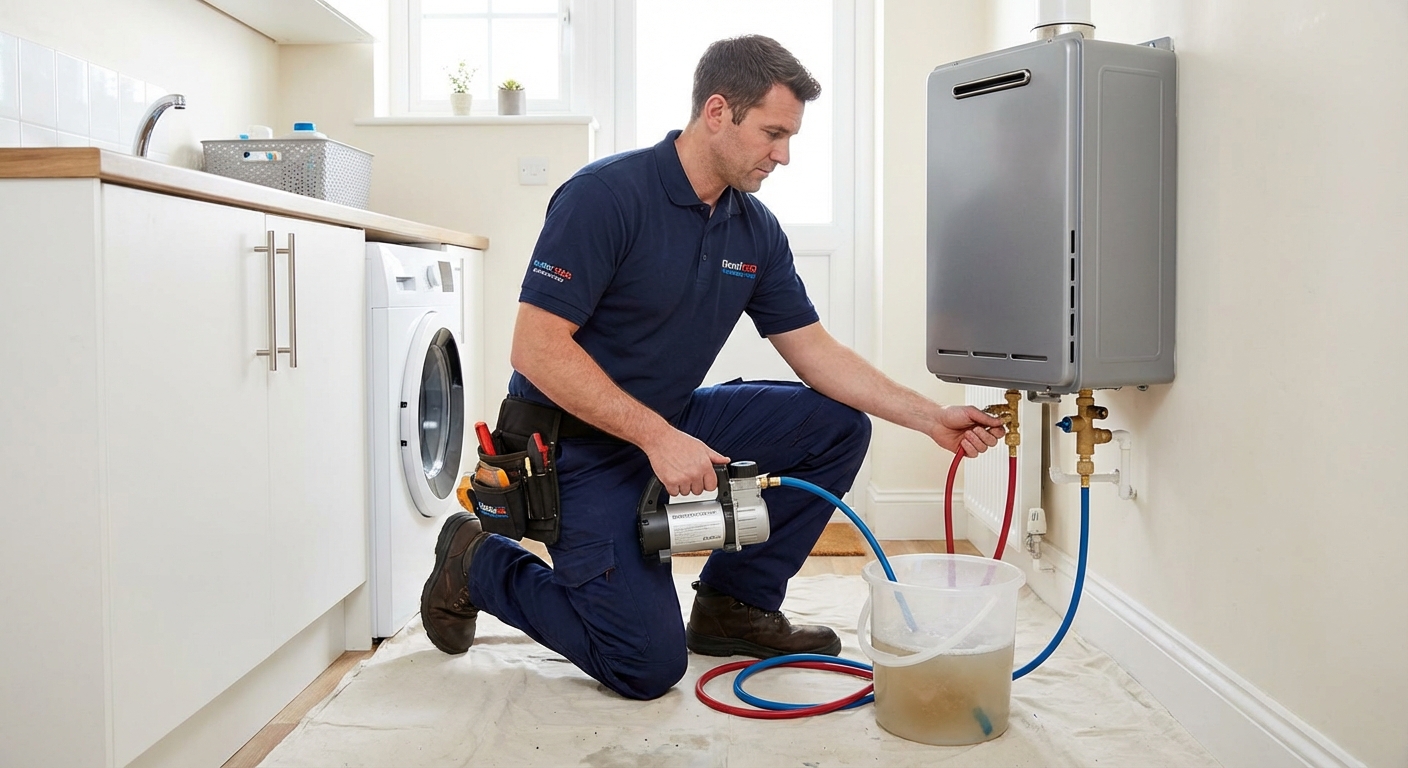
Why Tankless Water Heaters Need Annual Maintenance
Tankless water heaters provide endless hot water and energy efficiency, but they require regular maintenance to perform at their best. Unlike traditional water heater systems, tankless units are particularly sensitive to mineral buildup due to their compact design and high-heat operation.
Mineral Buildup and Scale Formation
Water contains dissolved minerals like calcium and magnesium that vary based on your geographic location. When heated in a tankless system, these minerals precipitate and accumulate inside the heat exchanger and pipes, forming hard scale deposits. This buildup acts as an insulating barrier between the heating element and water, forcing your unit to work significantly harder to achieve the same temperature.
The heat exchanger is the core component of your tankless system and features narrow passages designed for efficient heat transfer. When scale forms on these surfaces, it creates a thermal barrier that dramatically reduces the unit's effectiveness. In hard water areas, this buildup can become substantial within just months of operation. Learn more about hard water treatment options to prevent rapid scale formation.
Impact on Efficiency and Performance
As scale accumulates, your tankless water heater's efficiency can drop from its rated 90%+ performance to as low as 60-70%. The consequences include:
Mineral deposits prevent proper heat transfer, causing higher energy consumption, increased utility bills that can exceed $200 annually, inconsistent water temperatures, longer wait times for hot water, and unusual noises like popping or rattling. Regular maintenance prevents these issues and protects your investment. For broader prevention strategies, see our preventive plumbing maintenance guide.

Find Trusted & Licensed Plumbers in Ohio
Get matched with companies for your specific needs
How to Flush and Descale Your Tankless Water Heater
Regular flushing removes mineral buildup and restores your unit's performance. You can choose between DIY maintenance or professional service depending on your comfort level and warranty requirements. The process is similar in concept to flushing a traditional tank to remove water heater sediment buildup.
DIY Flushing Process
Completing a thorough flush takes 1-2 hours. Follow these step-by-step instructions:
Safety and Preparation (15 minutes):
- Turn off power to the unit by flipping the circuit breaker or unplugging
- Shut off gas supply valve if gas-powered
- Close cold water supply valve and hot water service valve
- Allow unit to cool for 30 minutes minimum
- Wear protective gloves and safety goggles
- Gather all necessary tools and materials
Flushing Steps (60-90 minutes):
- Locate isolation valves (cold and hot) and service valves on your unit
- Remove protective service valve caps using an adjustable wrench
- Connect hose from cold service valve to submersible pump inlet
- Connect hose from hot service valve to bucket outlet for recirculation
- Pour 4-5 gallons of descaling solution or white vinegar into bucket
- Open both service valves by turning them parallel to pipes
- Plug in pump and run for 45-60 minutes continuously
- Monitor solution level, ensuring at least 5 pints remain
- Turn off pump and close cold service valve
- Disconnect cold hose and flush with clean water for 5-10 minutes
- Remove and rinse the inline filter screen
- Close service valves and reinstall protective caps
- Slowly open isolation valves to refill the system
- Run hot water taps to purge air from lines
- Restore power and gas, then check for error codes or leaks
Professional vs DIY Service Comparison
Understanding the trade-offs helps you make the right choice for your situation:
| Factor | DIY Approach | Professional Service |
|---|---|---|
| Cost | $100-300 for a complete kit; $25-70 annually after kit purchase | $150-350 per visit in 2026 (avg $200-250) |
| Time Required | 1-2 hours plus learning curve | 45-90 minutes total |
| Skill Level | Basic plumbing knowledge needed | Expert handling guaranteed |
| Warranty Status | May void if improperly performed | Maintains manufacturer compliance |
| Equipment | Consumer-grade maintenance kit | Commercial descaling solutions |
| Problem Detection | Limited to visible issues | Comprehensive inspection included |
| Best For | Accessible units, handy homeowners | Warranty protection, complex installations |
DIY maintenance works well for straightforward tankless installations, but professional service provides peace of mind and protects your warranty investment.
Tankless Water Heater Maintenance Kit Components
A complete maintenance kit makes DIY flushing straightforward and provides everything needed for effective descaling. Quality equipment ensures successful maintenance and a reusable setup that pays for itself quickly.
Essential Kit Components
Submersible Pump:
- Rated 1/6 to 1/3 horsepower (or 500-1,100 GPH) for adequate circulation
- Designed specifically for acidic descaling solutions
- Durable construction for repeated annual use
- Thermal overload protection
- Standard 3-prong grounded plug for safety
Bucket with Platform:
- 3-5 gallon capacity to hold sufficient solution
- Elevated or raised pump platform prevents sediment intake
- Lid included to minimize splashing during operation
- Chemical-resistant plastic construction
- Graduated volume markings for easy measurement
Connection Hoses:
- 5-6 feet long to reach most installations
- 3/4-inch NPT diameter for optimal flow rate
- Color-coded (blue for cold, red for hot) to prevent confusion
- Stainless steel or heavy-duty rubber construction
- Brass or chrome-plated fittings that resist corrosion
Descaling Solution Options:
- Citric acid-based commercial descalers (faster acting, appliance-safe)
- Food-grade white vinegar (economical and effective)
- pH-neutral formulas safe for copper and stainless steel heat exchangers
- Biodegradable and environmentally friendly
Kit Costs and Popular Brands in 2026
Complete DIY flush kits in 2026 typically range from $100 to $300, with most homeowner-grade options landing between $120 and $180. Professional flushing service runs $150 to $350 per visit, so a quality reusable kit pays for itself after a single use.
Popular brands and 2026 price points include:
- Chromex Tools: Full descaler kit with 128 oz solution runs around $150-160; powder-descaler version around $128
- Rheem RTG20124: Brand-matched flush kit available at major home centers in the mid-$100s
- Mizudo / Water Comfort Depot: Compact kits with 1/6 HP pump and foldable bucket
- My PlumbingStuff: Budget-friendly option with durable components ($100-130)
- Generic pump + vinegar setup: $50-80 if you assemble your own kit
Most kits work universally with all major tankless brands including Navien, Rinnai, Rheem, Noritz, and Bosch. You'll also need approximately 4 gallons of white vinegar per flush ($10-20) or replacement commercial descaling solution ($26-54 per bottle).
Maintenance Frequency Based on Water Hardness
How often you flush your tankless water heater directly depends on your local water quality. Just as water filtration systems address different contamination levels, maintenance frequency varies with mineral content.
Understanding Water Hardness Levels
Water hardness measures dissolved calcium and magnesium in milligrams per liter (mg/L) or grains per gallon (gpg). Most 2026 manufacturer guidance recommends flushing every 6 to 12 months, with the exact interval based on hardness and usage:
| Hardness Level | mg/L Range | gpg Range | Flush Frequency |
|---|---|---|---|
| Soft | 0-60 | 0-3.5 | Every 12-24 months |
| Moderate | 61-120 | 3.6-7.0 | Every 12 months |
| Hard | 121-180 | 7.1-10.5 | Every 9-12 months |
| Very Hard | 180+ | 10.6+ | Every 6 months |
To determine your water hardness, check your municipal water quality report, purchase an inexpensive test kit ($10-25), or contact your local water utility. Many utilities provide this information free upon request. Note that many manufacturer warranties require a softener or regular professional acid flushing when hardness exceeds roughly 11 gpg (about 200 ppm).
Recommended Maintenance Schedule
Soft Water (0-60 mg/L):
- Complete flush every 12-24 months
- Filter cleaning every 6 months
- Visual inspection quarterly
- Some 2026 manufacturers (with built-in scale detection) allow intervals up to 4-5 years in very soft water
Moderate Hardness (61-120 mg/L):
- Complete flush every 12 months (annual is standard)
- Filter cleaning every 4-6 months
- Professional inspection annually
- Represents most U.S. residential water supplies
Hard Water (121-180 mg/L):
- Complete flush every 9-12 months
- Filter cleaning every 3 months
- Professional inspection annually
- Consider water softener installation
Very Hard Water (180+ mg/L):
- Complete flush every 6 months
- Filter cleaning monthly
- Professional inspection semi-annually
- Water softener strongly recommended
Warning Signs Requiring Immediate Attention
Don't wait for scheduled maintenance if you notice:
Additional warning signs include visible mineral deposits on exterior components, sulfur or metallic smell in hot water, or the unit cycling on and off repeatedly. If you spot any moisture under the unit, review our guide on water heater leaking causes immediately.
Additional Monthly and Quarterly Tasks
Monthly Checks (5 minutes):
- Visual inspection for leaks around connections
- Check display panel for error codes
- Verify consistent hot water temperature
- Listen for unusual operational sounds
Quarterly Maintenance (15 minutes):
- Clean air intake filter on units with intake screens
- Inspect venting system for blockages or damage
- Test pressure relief valve operation
- Check condensate drain lines (condensing models)
Semi-Annual Service (30 minutes):
- Clean inlet filter screen thoroughly
- Test and clean flame sensor (gas models)
- Inspect for corrosion on exterior components
- Verify proper gas pressure or electrical connections
This schedule complements a broader annual plumbing maintenance routine and prevents problems before they become expensive repairs.
Maintenance Costs in 2026
Understanding current costs helps you budget effectively and choose between DIY and professional service options. Tankless maintenance represents preventative spending that saves substantially compared to repairs.
DIY Maintenance Investment
Initial Setup Costs:
- Maintenance kit (pump, hoses, bucket): $100-300
- White vinegar for first flush: $10-20
- Safety equipment (gloves, goggles): $10-15
- Optional pH test strips: $8-12
- Total first year: $128-347
Ongoing Annual Costs:
- White vinegar or descaling solution: $10-54 per flush
- Replacement inlet filter: $15-40 (every 2-3 years)
- Miscellaneous supplies: $5-10
- Total annual: $25-90
Over a 20-year lifespan, DIY maintenance costs roughly $628-2,000 total compared to $3,000-7,000 for professional service.
Professional Service Pricing
Based on 2026 industry pricing guides, expect the following:
- Annual flush and inspection: $150-350 (national average around $200-250)
- Semi-annual maintenance visit: $100-250 per visit
- Emergency descaling service: $250-500
- Filter replacement: $25-75 (parts and labor)
- Diagnostic fee: $75-150 (often waived with service)
Regional Cost Variations:
- Major metropolitan areas: $200-500 per visit
- Suburban markets: $150-350 per visit
- Rural areas: $125-300 per visit
- West Coast and Northeast: 20-30% above national average
- Midwest and South: 10-20% below national average
Service Plan Options:
- Annual maintenance contract: $200-400 (includes one complete service)
- Bi-annual plan: $350-600 (two visits)
- Priority service membership: $300-500 plus discounted rates
Cost of Neglecting Maintenance
Skipping maintenance leads to expensive consequences in 2026:
Repair Costs:
- Heat exchanger scaling damage: $500-1,300
- Flow sensor replacement: $150-400
- Valve replacement: $200-500
- Circuit board failure: $300-800
- Complete unit replacement: $3,000-5,500
Additional Expenses:
- Increased energy bills: $150-400 annually
- Water damage from leaks: $1,000-10,000+
- Emergency service calls: $200-500 per visit
- Voided warranty claims: full replacement cost
The average homeowner who neglects maintenance spends $2,500-4,000 more over the unit's shortened lifespan compared to those who maintain properly.
Consequences of Neglecting Maintenance
Skipping regular maintenance leads to progressive problems that compound over time, similar to ignoring other plumbing fixture lifespan factors.
Efficiency and Performance Degradation
Without regular flushing, mineral buildup acts as thermal insulation on the heat exchanger. Your tankless unit's efficiency drops dramatically over time:
Year 1 (No Maintenance):
- Efficiency: 85-90% (slight decline)
- Additional energy cost: $50-100 annually
- Minor performance issues begin
Year 2-3 (Continued Neglect):
- Efficiency: 70-80%
- Additional energy cost: $150-250 annually
- Noticeable temperature fluctuations
- Longer wait times for hot water
Year 4+ (Severe Neglect):
- Efficiency: 60-70% or lower
- Additional energy cost: $200-400 annually
- Frequent shutdowns and error codes
- Risk of complete failure
Shortened Equipment Lifespan
Properly maintained tankless water heaters typically last 15-20+ years, with Noritz, Navien, and Rinnai units often reaching 20-25 years with proper care. Neglected units commonly fail after:
- 8-10 years: Hard water areas without any maintenance
- 10-12 years: Moderate water with sporadic maintenance
- 12-15 years: Soft water with minimal maintenance
Replacing a unit 10 years early costs $3,000-5,500, far exceeding the $500-1,000 invested in proper maintenance over that period.
Warranty Violations and Denied Claims
Most 2026 tankless water heater manufacturers require professional installation and documented annual maintenance for warranty validity. Typical residential warranty coverage in 2026 includes:
| Brand | Heat Exchanger | Parts | Labor |
|---|---|---|---|
| Navien | 15 years | 5 years | 2-5 years |
| Rinnai | 12-15 years | 5 years | 1-5 years |
| Rheem | 10-12 years (model dependent) | 1-5 years | 1-5 years |
| Noritz | Up to 25 years | 5 years | 1 year |
| Bosch | 15 years | 3-5 years | 1 year |
Common Warranty Exclusions:
- Failure to perform manufacturer-recommended maintenance
- Scale damage from mineral buildup
- Use of non-approved descaling solutions
- DIY repairs that damage components
- Installation not meeting code requirements
- Retail-channel Rheem units often have shorter warranty terms than pro/dealer lines
Additional Problems from Neglect
Beyond efficiency loss, neglect creates safety and resale issues:
- Water damage risks from pressure-related leaks, potentially thousands in property damage
- Safety concerns including combustion problems and carbon monoxide risk on gas models
- Reduced home value when poorly maintained systems flag home inspections
- Emergency replacement at the worst possible time, often costing 20-50% more
Regular maintenance through simple descaling prevents all these costly consequences while ensuring reliable hot water delivery for decades.
Brand-Specific Maintenance Procedures
While the basic process is similar across brands, major manufacturers have specific requirements that affect warranty compliance.
Navien
Navien units feature dual stainless steel heat exchangers and built-in recirculation on many models, requiring careful attention:
- Use Navien-approved descaling solution or food-grade vinegar
- Flush both heat exchangers (process takes 90 minutes)
- Inspect and clean condensate neutralizer kit annually
- Clean air intake filter quarterly
- 15-year heat exchanger warranty with documented annual maintenance
- Watch for codes 012 (flame failure), 016 (flow sensor), and 331 (heat exchanger sensor)
Rinnai
Rinnai uses color-coded isolation valves (blue cold, red hot) and a flame rod that benefits from gentle cleaning:
- Annual flush in soft to moderate water, semi-annual in hard water
- Clean flame rod annually with fine-grit sandpaper
- Inspect combustion chamber and air intake screen
- 12-15 year heat exchanger warranty depending on model
- Common error codes: 11 (no ignition), 12 (flame failure), 34 (heat exchanger overheat)
Rheem and Ruud
- Annual descaling mandatory for warranty
- Clean inlet screen every 6 months
- Use Rheem-approved descaling solution (RTG20124 kit available)
- 10-12 year heat exchanger warranty on most models
- Retail-channel units often carry shorter warranty than contractor/dealer lines
- Advanced diagnostics available through the EcoNet app
Noritz, Bosch, and Takagi
- Noritz: Extended maintenance intervals in soft water (up to 2 years); some 2026 models carry up to a 25-year warranty
- Bosch: European design requiring Bosch-approved descaling products; 15-year heat exchanger coverage
- Takagi: Simple, DIY-friendly design with annual flushing and 10-year heat exchanger warranty
Using authorized service providers typically costs 10-20% more than independent plumbers but ensures warranty protection and brand-specific expertise.
Frequently Asked Questions
How much does it cost to maintain a tankless water heater annually in 2026?
DIY maintenance costs $25-90 per year after purchasing an initial kit ($100-300), primarily for descaling solution and supplies. Professional service in 2026 ranges from $150-350 annually with most homeowners paying $200-250 per visit. Hard water areas requiring semi-annual flushing will see higher costs. Over the unit's 15-20+ year lifespan, proper maintenance saves thousands compared to premature replacement.
Can I use regular vinegar to flush my tankless water heater?
Yes, food-grade white vinegar is an effective and affordable descaling solution recommended by many manufacturers including Noritz. Use approximately 4 gallons of undiluted white vinegar per flush, circulated for 45-60 minutes. While commercial citric acid descalers work faster on heavy mineral buildup, vinegar is safe, non-toxic, biodegradable, and costs only $10-20 per flush. Avoid apple cider, balsamic, or other specialty vinegars with additives that may damage components.
How do I know if my tankless water heater needs descaling?
Watch for reduced water flow or pressure, inconsistent water temperatures, unusual popping or whining noises during operation, frequent error codes on the display panel, or longer wait times for hot water. Your unit's digital display may show specific maintenance codes. Even without obvious symptoms, follow your scheduled maintenance based on water hardness (annual for soft to moderate water, every 6-9 months for hard water, and every 6 months for very hard water).
Will neglecting maintenance void my tankless water heater warranty?
Yes, most 2026 manufacturers require documented annual maintenance and professional installation to maintain warranty coverage. Navien offers 15 years on the heat exchanger, Rinnai 12-15 years, and Rheem 10-12 years, but only with proof of regular descaling. Keep detailed records including service dates, solutions used, and all receipts. Warranty exclusions specifically mention scale damage, so denied claims can leave you paying thousands in repairs.
Is professional maintenance necessary or can I always do it myself?
DIY maintenance works well for accessible units, homeowners with basic plumbing skills, and straightforward installations. Professional service is recommended for warranty compliance, homes with hard or very hard water, complex installations, and unresolved error codes. Professionals use commercial-grade equipment, detect hidden problems during inspections, and provide documentation for warranty purposes. Many homeowners alternate between DIY flushes and a professional inspection every 2-3 years.