
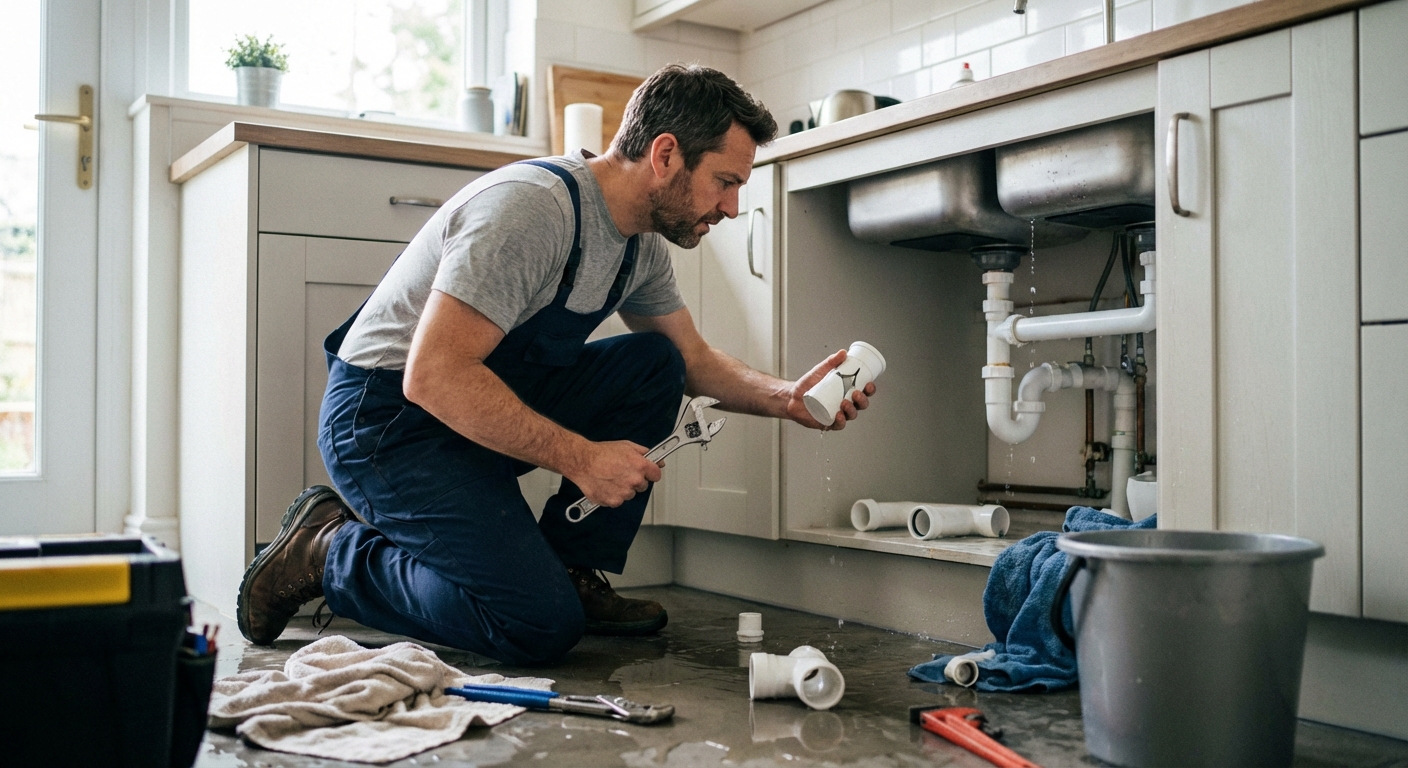
The Costliest DIY Plumbing Mistakes (And Their Consequences)
1. Using Chemical Drain Cleaners Too Often
Reaching for a bottle of liquid drain cleaner feels like an easy fix, but repeated use is one of the most damaging common plumbing mistakes homeowners make. These products contain caustic agents like lye, sulfuric acid, and hydrochloric acid that generate intense heat inside your pipes. Over time, that heat warps plastic pipes and corrodes metal ones, weakening the lining and making them far more prone to leaks and breaks.
Even a single use can degrade older pipes, and the damage compounds with every application. Beyond the pipes themselves, chemical cleaners can crack toilet bowls, eat away at sink enamel, and release toxic fumes into your home.
2. Overtightening Connections
"Tighter is better" is a dangerous myth in plumbing. Overtightening pipe fittings, supply lines, or toilet bolts is one of the most frequent DIY plumbing mistakes to avoid, and it rarely shows up right away. The cracked fitting or stripped thread may hold for days or weeks before failing suddenly, often causing a flood under your sink or around your toilet.
What gets damaged:
- Plastic fittings crack under excess pressure
- Metal threads strip and lose their seal
- Rubber gaskets warp and compress unevenly, causing leaks
The correct technique is "hand tight plus a quarter turn" for most connections. Having the right plumbing tools makes a real difference here. A quality torque wrench or basin wrench helps you apply controlled, consistent pressure without overdoing it.
3. Ignoring Small Leaks
A slow drip under the sink or around a faucet base feels easy to put off, but this is one of the most costly plumbing mistakes you can make. According to the EPA's WaterSense program, a faucet leaking at just one drip per second wastes more than 3,000 gallons per year (enough for 180 showers), while a leaky toilet flapper can silently waste thousands of gallons annually. The average U.S. household wastes roughly 9,400 gallons a year to leaks, and household leaks nationwide account for close to 900 billion gallons of wasted water each year, equal to the annual water use of nearly 11 million homes.
The real risk, though, is structural. Persistent moisture seeps into floors, walls, and ceilings, warping wooden beams, crumbling drywall, undermining foundations, and creating the perfect conditions for mold growth. What starts as a minor mitigation job can escalate into a $10,000 to $30,000 reconstruction project if it's ignored long enough. Water damage restoration alone averages $3,867 nationally in 2026, with most homeowners paying between $1,384 and $6,384 before insurance.
4. Flushing Items That Don't Belong
Despite being labeled "flushable," many wipes, paper towels, and hygiene products do not break down like toilet paper. This is one of the most common homeowner plumbing errors that leads to serious (and expensive) blockages.
| Item to Never Flush | Why It's Dangerous |
|---|---|
| "Flushable" wipes | Don't disintegrate; absorb debris and cause stubborn clogs |
| Feminine hygiene products | Swell in pipes and block flow |
| Dental floss | Acts like a net, trapping other debris |
| Cotton balls / Q-tips | Absorb water without dissolving |
| Paper towels | Far too thick to break down in pipes |
| Grease / food scraps | Solidifies when cooled, clogging pipes |
| Medications / chemicals | Damages septic systems and pollutes water |
The rule is simple: only toilet paper goes in the toilet. Everything else belongs in the trash.

Find Trusted & Licensed Plumbers in Ohio
Get matched with companies for your specific needs
When DIY Goes Wrong: Mistakes That Need a Pro
5. Attempting Repairs Beyond Your Skill Level
Confidence is good. Overconfidence in plumbing is expensive. One of the biggest plumbing repair mistakes homeowners make is tackling jobs that require licensed expertise. What starts as replacing a shutoff valve can quickly spiral into a flooded basement if something goes wrong, and in 2026 the average residential water damage claim payout falls between $12,500 and $15,400, according to Insurance Information Institute data and industry-wide 2026 statistics, with severe multi-room events regularly exceeding $20,000 to $30,000.
Reading our emergency plumber decision guide before an emergency strikes gives you a trusted contact ready to go when you need one fast.
6. Not Knowing Where Your Main Water Shutoff Is
This isn't just a mistake, it's a ticking time bomb. In a plumbing emergency like a burst pipe, every second without water shutoff means hundreds more gallons of damage. Yet many homeowners have no idea where their main water shutoff valve is located.
Make sure every adult in your household knows its location. Also test the valve annually. A shutoff valve that hasn't been turned in years may be stuck or corroded when you need it most.
7. Using the Wrong Tools
Using adjustable pliers when you need a basin wrench, or the wrong type of thread tape on a gas line, are classic plumbing mistakes that cause damage. Wrong tools lead to stripped fittings, cracked connections, and failed seals, often creating a bigger problem than the one you were trying to fix.
Building a basic emergency plumbing kit with the essentials ensures you're always working with the right equipment. A proper starter kit (plunger, pipe wrench, drain snake, basin wrench, and plumber's tape) typically costs between $150 and $250. That's often less than a single 2026 plumber service call, where the trip fee alone runs $75 to $200 at most companies before any repair labor, and standard hourly rates now average $90 to $110 nationwide.
Maintenance Mistakes That Add Up Over Time
8. Neglecting Regular Maintenance
Plumbing systems don't announce problems, they quietly deteriorate until something fails spectacularly. Skipping routine maintenance is one of the most overlooked plumbing mistakes renters and homeowners alike make. Annual maintenance tasks that take just a few hours can prevent thousands in emergency repair costs.
Key maintenance tasks by frequency:
| Frequency | Task |
|---|---|
| Monthly | Check under sinks for moisture or drips |
| Monthly | Run water in unused drains to refill traps |
| Quarterly | Test sump pump operation |
| Annually | Flush and inspect water heater |
| Annually | Test all shutoff valves |
| Annually | Schedule a professional inspection |
Our preventive plumbing maintenance guide and annual plumbing maintenance checklist are great resources to help you stay on top of every task.
9. Ignoring Water Pressure Issues
High water pressure feels great in the shower, but it's quietly destroying your plumbing. Most plumbing experts and municipal water suppliers recommend household pressure between 40 and 60 PSI, with around 50 PSI as the sweet spot. Under the International Plumbing Code and International Residential Code, once static pressure exceeds 80 PSI, an ASSE 1003-compliant pressure reducing valve (PRV) must be installed to bring pressure back down to 80 PSI or lower. Above that threshold, constant stress on pipes, joints, faucet valves, and water-using appliances dramatically shortens their lifespan and can cause burst pipes, water hammer, and premature appliance failure.
Low water pressure, on the other hand, can signal a leak somewhere in your system or a blockage that's getting worse. Either extreme warrants attention. A simple pressure gauge (under $15 at any hardware store) can be attached to an outdoor faucet to take a reading in minutes. If you see readings consistently above 75 PSI, it's time to check or install a PRV. A plumbing red flag inspection can also catch pressure problems before you buy a home.
10. Skipping Winterization
Frozen pipes are one of the most expensive plumbing disasters a homeowner can face. When water freezes inside a pipe, it expands with enough force to burst even copper and PVC. State Farm's most recent claims data (2024 through mid-2025) shows more than 20,000 freeze-related water damage claims totaling over $628 million, with the average claim payment exceeding $30,000. Broader industry averages for typical residential frozen pipe claims still cluster in the $10,000 to $15,000 range, and AAA has reported the average frozen pipe claim costs more than $11,000. Damage often compounds for hours before anyone even notices water is flowing.
Learn more about how to prevent frozen pipes before winter hits.
Frequently Asked Questions
Is it okay to use chemical drain cleaner occasionally?
Occasional use in a plastic or newer metal pipe may cause minimal harm, but it's still not recommended by most plumbers. Safer alternatives like a plunger, drain snake, or baking soda and vinegar solution are nearly as effective without the risk of pipe damage. If a clog keeps recurring, it's a sign of a deeper blockage that a professional should assess. Repeated chemical use will only mask the underlying problem while slowly degrading your pipes.
How do I know if a plumbing repair is beyond my DIY skill level?
A good rule of thumb: if the repair involves shutting off the main water supply, cutting into walls, working near a water heater, or dealing with a sewer line, call a professional. Jobs that require permits, like rerouting pipes or adding new fixtures, legally require a licensed plumber in most states. DIY is fine for small fixes like replacing a toilet flapper, a showerhead, or a faucet aerator. When in doubt, our emergency plumber guide can help you decide whether the situation warrants professional help.
What are the signs of a hidden plumbing leak?
Common signs include unexplained increases in your water bill, damp or discolored spots on walls or ceilings, musty odors, warped flooring, and the sound of running water when nothing is in use. Mold appearing in unexpected areas is another strong indicator of a hidden moisture source. Don't ignore these signals, since the longer a hidden leak runs, the more structural damage it causes. A professional can use pressure testing or thermal imaging to locate leaks without tearing into walls unnecessarily.
How often should I have my plumbing professionally inspected?
Most plumbing experts recommend a professional inspection every 1 to 2 years for homes under 20 years old, and annually for older homes. If your house has older galvanized or cast-iron pipes, yearly inspections are especially important since these materials are more susceptible to corrosion and buildup. In 2026, a standard plumbing inspection averages around $300 nationally, with typical costs ranging from $100 to $500 (higher when camera or sewer-scope work is added, which can push totals to $1,375 or more). Refer to our annual plumbing maintenance guide for a full checklist.
Are plumbing mistakes covered by homeowners insurance?
It depends on the cause. Sudden and accidental damage, like a pipe that unexpectedly bursts, is typically covered by standard homeowners insurance policies in 2026. However, damage caused by neglect, gradual leaks you ignored, or improper DIY repairs is usually excluded, and most policies won't pay to repair the pipe itself, only the resulting water damage. This makes preventive maintenance and prompt leak repair not just a cost-saving habit, but also a way to protect your insurance coverage. Always document repairs and maintenance work in case you ever need to file a claim.