
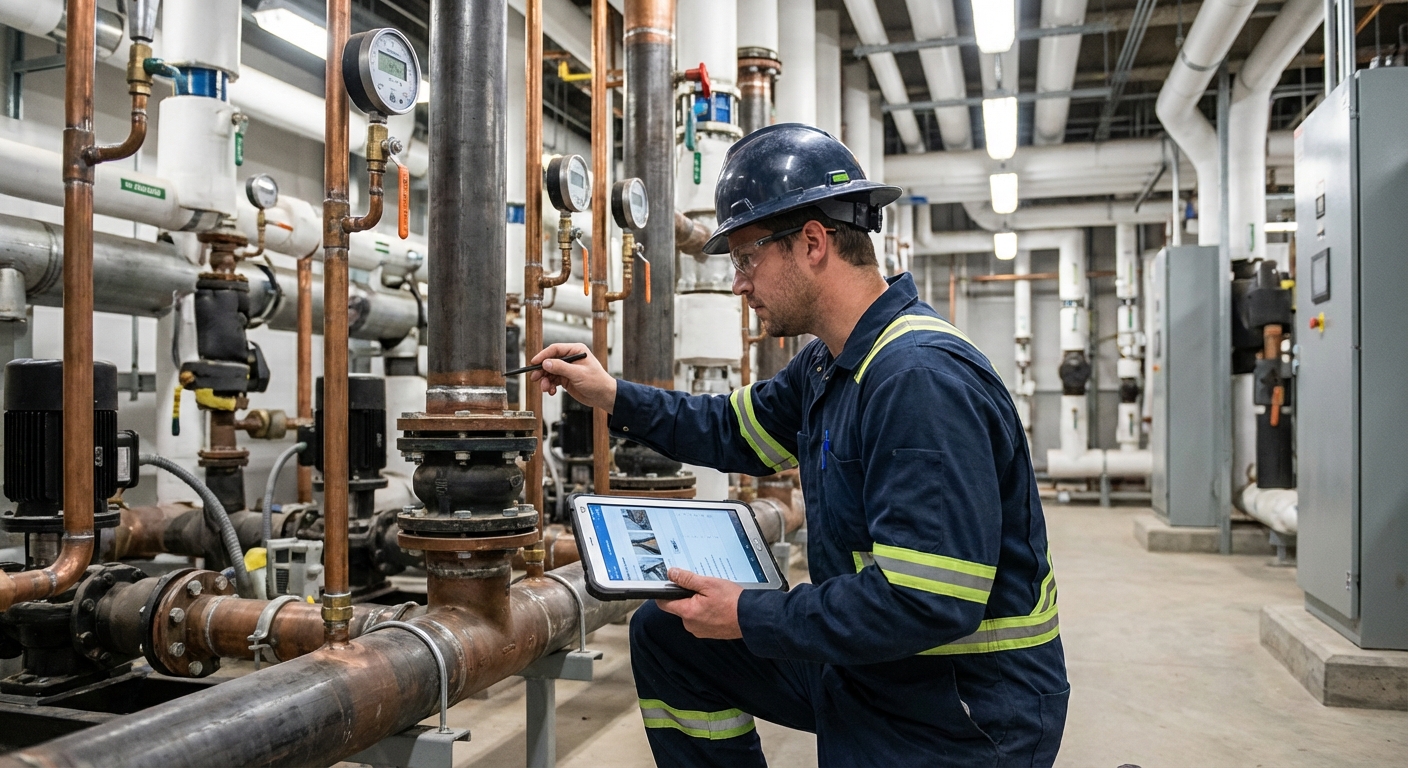
Understanding Commercial vs. Residential Plumbing Systems
Commercial plumbing systems operate on an entirely different scale than residential setups. While your home might have 10-15 fixtures, a commercial building can have hundreds of fixtures serving thousands of people daily. This dramatic difference in volume creates unique challenges that require specialized expertise.
Commercial systems use industrial-grade materials like copper, stainless steel, and cast iron pipes designed to withstand constant heavy use. These buildings feature complex networks spanning multiple floors with extensive valve systems, pressure boosters, and redundant safety features to prevent total system failures. When you compare this to residential plumbing's straightforward layouts, the complexity becomes evident.
The water pressure demands differ significantly too. Commercial buildings need powerful systems to deliver adequate water to upper floors while managing waste removal from hundreds of daily users. This requires high-capacity water heaters, advanced filtration systems, and sophisticated pressure management equipment far beyond what's needed for homes.
Understanding these differences explains why commercial properties need specialized plumbing contractors rather than general residential plumbers. The stakes are higher, since a plumbing failure in an office building or restaurant can halt business operations and create substantial financial losses. For a deeper breakdown, read our guide on residential vs commercial plumbing differences and learn what plumbing inspections cover for commercial properties.

Find Trusted & Licensed Plumbers in Ohio
Get matched with companies for your specific needs
Essential Commercial Plumbing Services Your Business Needs
Commercial properties require a comprehensive range of specialized services to maintain operations and ensure regulatory compliance. These services go well beyond basic repairs to include proactive maintenance and specialized testing.
Maintenance Contracts and Preventive Programs
Annual maintenance contracts have become standard for commercial properties in 2026. Pricing varies widely by building size and scope: small commercial spaces typically pay $1,000 to $3,000 per year, mid-size buildings often run $2,500 to $7,500, and large or high-demand facilities like hospitals, hotels, and industrial sites can exceed $7,500 to $20,000+ annually. These contracts typically include biannual or quarterly preventive visits to catch potential issues before they become costly emergencies.
What's included in these programs? Comprehensive inspections cover all fixtures, pipes, drains, water pressure systems, and emergency shutoff valves. Water heaters receive thorough servicing including relief valve checks, burner inspections, carbon monoxide testing, and temperature calibration. Drain and sewer line maintenance prevents the clogs and backups that can shut down business operations.
Most contracts offer valuable perks including 10-15% discounts on additional services, waived dispatch fees, priority scheduling, and extended warranties on completed work. These programs reduce unexpected downtime while extending equipment lifespan, which is crucial for businesses operating on tight margins. Compare this to standard plumbing service plans designed for homeowners to see how commercial agreements differ in scope.
Emergency Repair Services
Emergency plumbing services represent the most critical component of commercial plumbing support. Unlike residential properties where delayed repairs might cause inconvenience, commercial emergencies directly impact revenue. Every hour of downtime in a restaurant or office building translates to immediate financial losses.
Professional commercial plumbers provide 24/7 emergency response, understanding that burst pipes, sewer backups, or water heater failures can't wait until business hours. In 2026, commercial emergency labor typically runs $200 to $400 per hour with trip fees of $100 to $300, and rates climb higher in major metros. Knowing when to call an emergency plumber is critical for facility managers controlling costs.
Common commercial emergencies include:
- Burst pipes causing flooding and water damage
- Sewer line backups creating health hazards
- Water heater failures in multi-tenant buildings
- Main line breaks affecting entire facilities
- Fixture failures in high-traffic areas
Having a pre-established relationship with a commercial plumbing contractor ensures faster response times during emergencies. Many businesses maintain priority service agreements specifically for this reason. Reviewing emergency plumber cost trends helps you budget realistically.
Code Compliance and Inspections
Commercial plumbing must adhere to strict building codes and health regulations that vary by jurisdiction. Regular compliance inspections ensure your property meets current standards while avoiding costly violations that can result in fines or temporary closures.
Professional contractors stay current with evolving regulations including the International Plumbing Code (IPC) and local amendments. They coordinate with building inspectors during renovations and handle all permitting requirements. This expertise becomes invaluable when expanding facilities or updating aging systems, and understanding when plumbing permits are required is essential for any commercial renovation.
Backflow Prevention Testing
Backflow prevention protects public water supplies from contamination, a critical safety measure for all commercial properties. Most jurisdictions require annual testing of backflow prevention devices by a certified tester, with high-risk facilities like restaurants and hospitals often needing more frequent testing.
Several significant 2025-2026 regulatory changes are worth noting. In California, the State Water Resources Control Board replaced Title 17 with the Cross-Connection Control Policy Handbook (CCCPH). As of July 1, 2025, all backflow testers must hold certification from an SWRCB-recognized program, and by July 1, 2027, those programs must achieve ANSI accreditation. New and replacement commercial backflow devices in California must now be installed above ground following changes in ownership, use, or major modifications. Other utilities, including Colorado's ACWWA, have shifted entirely to owner-arranged testing as of 2026, with penalty fees and possible water service termination for non-compliance.
| Testing Frequency | Property Type | Device Type |
|---|---|---|
| Annual | Office buildings, retail | Double check valve |
| Semi-annual | Restaurants, hospitals | RPZ valve |
| Quarterly | Medical facilities, labs | Pressure vacuum breaker |
Failure to maintain current testing can result in water service disconnection, substantial fines, and legal liability if contamination occurs. Learn more about backflow prevention devices and certified testing requirements before your next inspection cycle.
Grease Trap Installation and Maintenance
Restaurants and food service establishments must install grease traps to capture fats, oils, and grease (FOG) before they enter sewer systems. These specialized devices prevent clogs while ensuring compliance with local health department regulations.
Many jurisdictions in 2026 use the "25% rule," requiring grease traps to be cleaned when FOG and food solids reach 25% of capacity, or at least every 90 days, whichever comes first. Installation requires professional commercial plumbers familiar with local requirements, and all service records must be retained for 3-5 years.
Most jurisdictions enforce strict FOG discharge limits, typically requiring levels below 100 mg/L. Annual inspections by health departments verify compliance. Working with experienced contractors ensures proper installation, maintenance scheduling, and regulatory documentation. For more detail, read our guide on grease trap cleaning requirements and 2026 cost benchmarks.
Licensing, Insurance, and Contractor Qualifications
Selecting properly qualified commercial plumbing contractors protects your business from liability while ensuring quality workmanship. Understanding credential requirements helps you make informed hiring decisions.
State and Local Licensing Requirements
Commercial plumbing licensing varies significantly by state, with no uniform national standard. Most states require master plumber or commercial contractor licenses for larger projects, involving rigorous testing on plumbing codes, safety regulations, and system design.
California requires a C-36 Plumbing Contractor license from the Contractors State License Board, which covers commercial and industrial work. Applicants need four years of journey-level experience, must pass CSLB exams, and must post a $25,000 contractor bond plus carry workers' compensation if they have employees. As of January 1, 2025, the license threshold also rose from $500 to $1,000, a rule that remains in effect for 2026.
Florida regulates plumbing through both local registration systems and a state-certified plumbing contractor path requiring plumbing and business exams, four years of experience including one year as a supervisor, a background check, and proof of financial stability. New York handles licensing largely at the city or county level rather than statewide, so commercial requirements depend entirely on the municipality where work is performed.
Insurance and Bonding Requirements
Adequate insurance coverage protects your business from financial risk during plumbing projects. Commercial plumbers should carry general liability insurance, workers' compensation coverage, and surety bonds as required by state law.
General liability insurance typically provides $1-2 million in coverage for property damage and injuries occurring during work. Workers' compensation protects you from liability if contractors injure themselves on your property. Surety bonds, ranging from $10,000 to $25,000 depending on state requirements, provide financial recourse if contractors fail to complete work.
Always request current certificates of insurance before work begins. Verify coverage amounts meet your property's needs, since larger projects may require higher limits. Some businesses add contractors as additional insured on policies during major projects for extra protection. Learn more about how to choose a qualified plumber and what credentials to verify.
Creating Effective Preventive Maintenance Programs
Proactive maintenance programs represent the most effective strategy for controlling commercial plumbing costs while preventing disruptive emergencies. Well-designed programs extend equipment lifespan and improve operational efficiency, as detailed in our preventive plumbing maintenance guide.
Water Heater and Equipment Maintenance
Water heaters represent significant investments requiring regular maintenance to achieve expected 10-15 year lifespans. Commercial units work harder than residential heaters, serving hundreds of users daily and demanding more frequent attention.
A major regulatory change is reshaping commercial water heater decisions in 2026. Effective October 6, 2026, new DOE minimum efficiency standards take effect, requiring gas-fired storage water heaters to meet 95% thermal efficiency and gas-fired tankless units to hit 96%. Only high-efficiency condensing models can be manufactured or imported after that date. While condensing units cost more upfront and require new venting, condensate drainage, and sometimes electrical upgrades, DOE estimates commercial operating cost savings of roughly $140 million per year industry-wide.
Semi-annual water heater maintenance should include:
- Flushing tanks to remove sediment buildup
- Testing temperature and pressure relief valves
- Inspecting and cleaning burners or heating elements
- Checking gas connections or electrical components
- Verifying proper temperature settings (120°F for most applications)
- Testing carbon monoxide levels for gas units
Modular tankless systems are increasingly popular in commercial settings, with restaurants and hotels installing multiple condensing tankless units in parallel for redundancy and load matching. These systems require different maintenance including descaling, filter cleaning, and combustion checks. Watch for early signs of trouble, since a leaking water heater in a multi-tenant building can mean immediate downtime.
Drain, Sewer Line Care, and Documentation
Commercial drain systems handle substantial waste volumes requiring proactive maintenance. Restaurants especially need regular drain cleaning to manage grease accumulation, food particles, and high water usage. Schedule professional drain cleaning annually for most commercial properties, increasing frequency to semi-annual or quarterly for high-volume facilities. Hydro jetting provides the most thorough cleaning for commercial applications.
Video camera inspections should accompany drain cleaning, allowing contractors to assess pipe condition and identify developing problems. Comprehensive maintenance records also provide valuable insights into system performance while demonstrating regulatory compliance. Many commercial plumbing contractors now offer digital record-keeping through online portals where you can access service history, inspection reports, and upcoming maintenance schedules.
Choosing the Right Commercial Plumbing Contractor
Selecting a qualified commercial plumbing contractor ranks among the most important decisions for protecting your business investment. The right contractor becomes a long-term partner supporting your operations.
Essential Qualifications and References
Start by verifying all necessary licenses and credentials. Request copies of licenses and confirm validity through state licensing boards. Check insurance certificates to ensure adequate coverage limits and current effective dates. Don't accept verbal assurances, and always insist on documentation.
Experience in commercial work matters more than years in business. A contractor with 20 years of residential experience may lack the specialized knowledge commercial properties require. Request references from at least three current commercial clients, preferably properties similar to yours in size and usage patterns. Ask specific questions about response times, quality, schedule adherence, communication, and whether they would hire the contractor again.
Understanding Pricing and Contracts
Commercial plumbing pricing structures vary by service type. Standard commercial labor in 2026 typically runs $100 to $250 per hour, with $150 to $400 per hour common in higher-cost metros. Emergency repairs add a 1.5x to 2x multiplier on top of standard rates, plus trip fees of $100 to $300. Scheduled maintenance often uses flat-rate pricing based on property size and system complexity.
Request detailed written estimates for any substantial work. Compare estimates from multiple contractors, but don't automatically choose the lowest bid since unusually low quotes may indicate inexperience, shortcuts, or plans to increase costs through change orders. For broader context, see our plumbing service cost guide.
Technology and Modern Solutions
Modern commercial plumbing increasingly incorporates technology that improves efficiency and prevents problems. The smart water tools market is projected to reach $50 billion globally, and contractors embracing innovation often provide better value through preventive approaches rather than reactive repairs.
Look for contractors offering IoT leak detection networks, in-line flow monitoring with automatic shutoff valves, smart submetering, and cloud-based dashboards that integrate with building management systems. These systems flag abnormal usage (such as continuous flow at 3 a.m.) and can shut off water automatically before major damage occurs. Insurance carriers are increasingly incentivizing or requiring automated leak detection for certain occupancies. Learn more about modern water line leak detection methods used in commercial buildings.
Frequently Asked Questions About Commercial Plumbing Services
What's the main difference between commercial and residential plumbing?
Commercial plumbing handles significantly higher water volume with more fixtures serving many people daily, requiring industrial-grade materials and complex multi-floor systems with redundant safety features. Residential plumbing uses simpler layouts with standard materials serving individual households with fewer fixtures and lower water demands. Commercial systems also face stricter code requirements including mandatory backflow prevention testing and specialized installations like grease traps that residential properties don't need.
How much do commercial plumbing maintenance contracts typically cost in 2026?
Commercial plumbing maintenance contracts in 2026 typically cost $1,000 to $3,000 annually for small spaces, $2,500 to $7,500 for mid-size buildings, and $7,500 to $20,000+ for large hospitals, hotels, and industrial sites. Pricing depends on building size, number of fixtures, visit frequency, and whether services like jetting, backflow testing, and documentation are included. These contracts usually offer 10-15% discounts on additional services, waived dispatch fees, and priority response, which more than offset the higher upfront cost compared to emergency-only billing.
How often does backflow testing need to be performed?
Most commercial properties require annual backflow prevention device testing, though high-risk facilities like restaurants, hospitals, and laboratories may need testing every six months or quarterly depending on local regulations. Testing must be performed by a certified tester, and in California, that means SWRCB-recognized certification today and ANSI-accredited certification by July 1, 2027. Failure to maintain current testing can result in water service disconnection, substantial fines, and legal liability.
What should I look for when hiring a commercial plumber?
When hiring a commercial plumber, verify they hold appropriate state and local licenses, carry adequate liability insurance and workers' compensation coverage, and maintain surety bonds as required. Request references from similar commercial properties and check their emergency response time guarantees, ideally 1-2 hours for critical situations. Ensure they offer comprehensive services including maintenance contracts, code compliance work, and specialized testing like backflow prevention rather than just basic repairs.
How are the new 2026 DOE water heater rules affecting commercial properties?
Effective October 6, 2026, new DOE standards require all newly manufactured commercial gas water heaters to meet high-efficiency condensing thresholds (95% for storage units, 96% for tankless). Non-condensing units will no longer be produced, which raises equipment and installation costs but reduces operating expenses significantly over the equipment's life. Businesses planning replacements should budget for new venting, condensate drainage, and possibly electrical upgrades, while modeling total cost of ownership against expected gas savings.