
Compare Home Insurance Plans in Ohio
Find your best options in less than 2 minutes



What Ice Dams Are and How They Damage Your Home
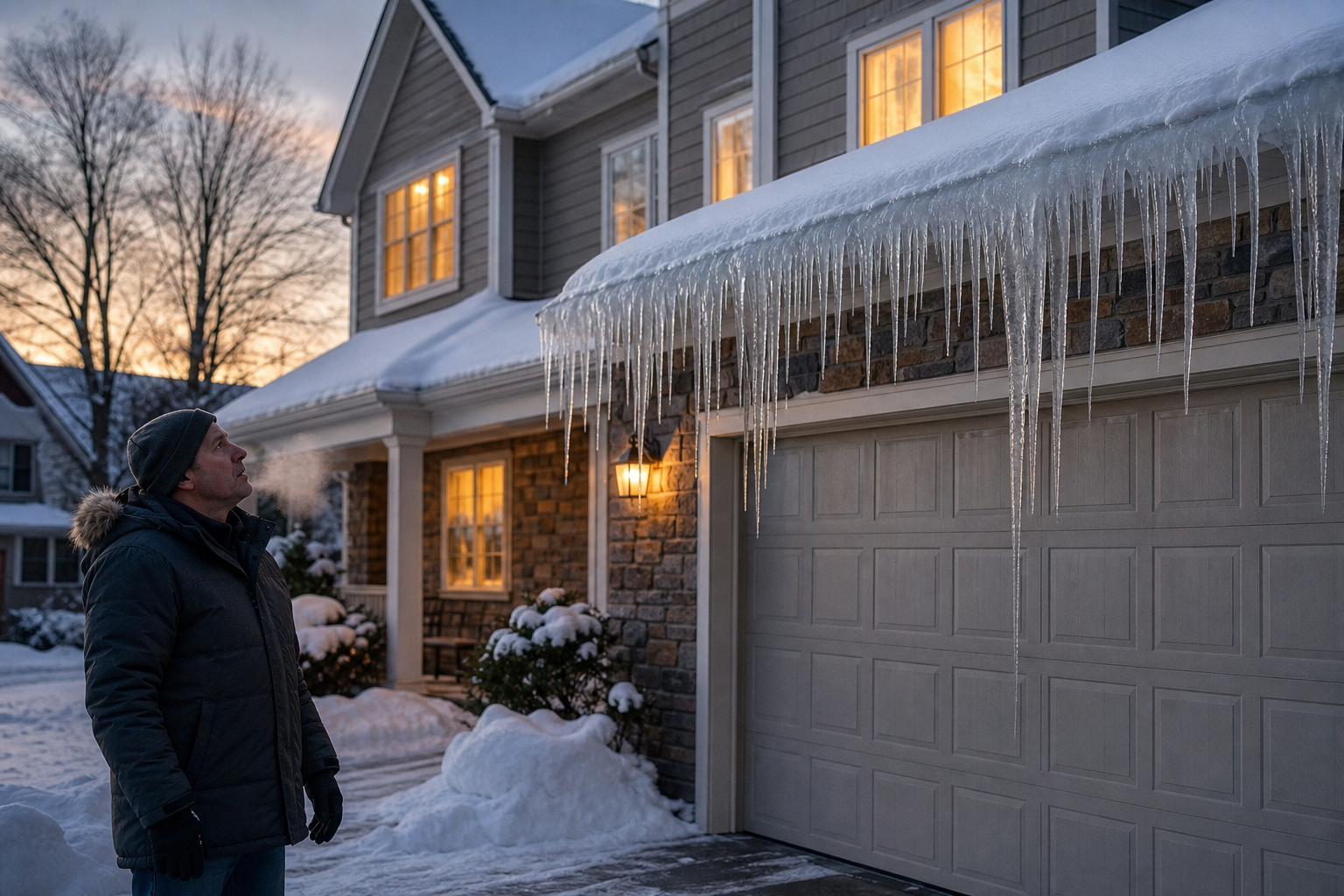
An ice dam is a ridge of ice that forms at the edge of a roof, usually along the eaves, when heat escaping into the attic melts snow on the upper roof. The meltwater runs down to the colder eave, refreezes, and gradually builds a wall of ice. Water continues to pool behind that wall and, with nowhere to drain, backs up under the shingles and finds its way into the home.
Once water breaches the roof deck, it can cause a chain of expensive damage:
- Roof damage. Lifted or torn shingles, damaged underlayment, and rotted decking. The sheer weight of ice can also rip off gutters and downspouts.
- Ceiling damage. Brown stains, bubbling paint, sagging drywall, and full collapse in severe cases.
- Wall damage. Water tracks down inside wall cavities, damaging drywall, paint, trim, and electrical wiring.
- Insulation damage. Wet attic and wall insulation loses its R-value and often has to be removed and replaced.
- Mold and secondary damage. Once moisture sits in walls or insulation, mold can develop in as little as 24 to 48 hours.

Compare Home Insurance Plans in Ohio
Find your best options in less than 2 minutes
Does Homeowners Insurance Cover Ice Dam Damage in 2026?
In most cases, yes. A standard HO-3 policy does not usually mention ice dams by name, but insurers typically treat the resulting damage as "weight of ice and snow" or sudden and accidental water damage, both of which are covered perils. State insurance departments and major carriers generally agree that interior and exterior damage caused by an ice dam is covered, subject to your deductible and exclusions. Basic HO-1 policies, however, do not cover snow or ice weight, so it is worth checking your policy form.
Here is how coverage usually breaks down under a typical HO-3 policy:
| Coverage Part | What It Pays For | Typical Ice Dam Application |
|---|---|---|
| Dwelling (Coverage A) | Structure, roof, walls, built-ins | Roof repair, drywall, ceilings, flooring, insulation |
| Personal Property (Coverage C) | Belongings | Furniture, electronics, clothing (varies by insurer, often excluded by Lemonade and Allstate for ice dams) |
| Loss of Use (Coverage D) | Extra living expenses | Hotel and meals if home is uninhabitable during repairs |
| Other Structures (Coverage B) | Detached garages, sheds | Sometimes limited or excluded for ice/snow damage |
Coverage for personal belongings varies more than dwelling coverage. Allstate specifically notes that personal property coverage typically does not protect belongings damaged by ice dams, while other carriers will pay for water-damaged furniture and electronics under the same sudden-and-accidental logic that governs dwelling losses. It helps to understand the broader rules for water damage and home insurance since ice dam losses are adjusted under those same policy provisions.
For a deeper look at how insurers separate covered water events from excluded ones, our guide on water damage coverage rules explains the sudden-versus-gradual test in detail.

Protect your home with State Farm
Average Rate:
Homeowners who bundle and save with State Farm save an average of $1,000 per year!

You're in Good Hands® with Allstate
Average Rate:
Get comprehensive home coverage with flexible policy options.

Customize your home coverage
Average Rate:
Only pay for the coverage you need with personalized home insurance.

Smart coverage for your home
Average Rate:
Protect what matters most with award-winning home insurance.
Common Exclusions and Why Ice Dam Claims Get Denied
Ice dam claims are notorious for denials and lowball offers. Insurers rarely reject them outright by saying "ice dams are not covered." Instead, they lean on specific exclusions to argue the loss is not really from a covered peril. Industry data shows insurers deny about 9% to 10% of water damage claims by arguing gradual seepage rather than sudden damage, and ice dam disputes drive a disproportionate share of those denials.
The top reasons claims get denied in 2026:
1. Maintenance neglect
This is the number one denial reason. Insurers argue the ice dam formed because of inadequate attic insulation, poor ventilation, clogged gutters, or a failure to clear snow. Maintenance neglect alone accounts for roughly 9% to 10% of all claim denials nationally, and public adjusters report that carriers like State Farm and Allstate lean on "poor maintenance" language to reduce or reject ice dam payouts. Our home insurance maintenance guide explains how to document upkeep so this argument does not stick.
2. Gradual seepage
Most policies cover "sudden and accidental" water damage but exclude "continuous or repeated leakage." Adjusters may claim the water was seeping into walls for days or weeks, not from a single event. Many carriers now enforce a 14-day seepage exclusion, and water damage claims have among the highest denial rates for exactly this reason. Filing within a 30-day window is often the strongest defense against a time-based denial.
3. No storm-created opening
Some newer policies only pay for interior water damage if a covered peril first created a sudden opening in the roof, such as a tree limb puncture or wind-torn shingles. If the ice dam simply pushed water under intact shingles, the insurer may argue there was no qualifying opening.
4. Pre-existing conditions and actual cash value on older roofs
Older roofs are a favorite target in 2026. The FHFA's March 18, 2026 Lender Letter LL-2026-03 now allows Fannie Mae and Freddie Mac to accept ACV-only roof coverage on single-family homes and condos, reversing a 2024 policy that required replacement cost value. That change has accelerated a broader carrier shift toward actual cash value settlements on roofs over 15 to 20 years old. Depreciation on an aging roof can cut your check by 40% or more. See our roof replacement coverage guide for how age affects payouts.
5. Mold sublimits
Even when the water damage is covered, mold remediation is often capped at $1,000 to $10,000 or excluded entirely, and construction-defect or wear-and-tear exclusions can knock out mold claims altogether.
How to Document Damage and File a Successful Ice Dam Claim
Documentation is the single biggest factor in whether your claim gets paid in full. Insurers are trained to look for reasons to reduce a settlement, so your job is to leave no room for interpretation.
Step 1: Photograph everything, immediately. Use your phone with timestamps enabled. Capture wide shots and close-ups of the ice at the eaves, icicles, roof edges, ceilings, walls, floors, insulation, and any damaged belongings. If ice falls, photograph its size and thickness before it melts.
Step 2: Build a written timeline. Note when the storm hit, when you first saw ice buildup, when leaks appeared, and when you called your insurer. This directly counters a "gradual seepage" argument.
Step 3: Mitigate further damage. Buckets, tarps, plastic sheeting, and emergency roof tarping are your responsibility. Save every receipt. Do not make permanent repairs before the adjuster inspects.
Step 4: Report the loss promptly. Call your insurer's claims line right away, ideally within 30 days. Get a claim number, the representative's name, and confirmation in writing.
Step 5: Get independent contractor estimates. Do not rely only on the insurer's preferred vendor. A separate roofer and water restoration estimate gives you leverage if the initial offer is low. Our full walk-through of the home insurance claims process covers what to expect at each stage, including the current J.D. Power average of about 29.6 days to repair and 40.7 days to final payment.
Step 6: Preserve the evidence. Do not throw out wet drywall or insulation until after the inspection unless there is a health or safety issue.
Typical Payouts, Deductibles, and Repair Costs in 2026
Most homeowners policies apply a standard all-other-perils (AOP) deductible (often $1,000 to $2,500) to ice dam claims. This is different from wind or hail losses, which increasingly carry percentage deductibles of 1% to 5% of dwelling value in Midwest and Texas markets. Unless your policy specifically defines ice dams under a wind/hail deductible, expect your regular AOP deductible to apply.
Typical 2026 repair costs:
| Damage Type | Typical Cost Range | Average |
|---|---|---|
| Ice dam removal (not covered) | $650 to $2,400 | $1,200 |
| Minor damage (ceiling stains, small drywall) | $500 to $2,000 | $1,100 |
| Moderate damage (wet insulation, drywall, sheathing) | $2,000 to $8,000 | $4,500 |
| Interior water restoration (walls + ceiling) | $1,300 to $6,200 | $3,500 |
| Severe damage (structural, mold, framing) | $8,000 to $15,000+ | Varies widely |
For a moderate, localized incident where water backed up under shingles and stained a ceiling or two, most homeowners see total repair costs in the $2,000 to $5,000 range before the deductible. More extensive claims involving multiple rooms, wet insulation, and mold can exceed $15,000. If structural framing is affected, our guide on structural damage coverage explains what to expect on larger losses.
Insurers may also depreciate the payout if you have actual cash value (ACV) coverage instead of replacement cost. On a 15-year-old roof, ACV depreciation can cut your check by 40% or more, and average roof replacement costs now run about $17,631 per Verisk data. This matters even more after the March 2026 FHFA rule change, which lets lenders accept ACV-only roof coverage on federally backed mortgages.
Prevention: What Works and Whether It Earns a Discount
Preventing ice dams is far cheaper than repairing them. Insurers rarely offer a specific "ice dam discount," but many carriers reward broader storm-hardening and energy-efficiency upgrades that also reduce ice dam risk.
The most effective prevention priorities:
- Air seal the attic. Close gaps around recessed lights, plumbing stacks, chimneys, and attic hatches. Cost: $300 to $1,500.
- Upgrade insulation to R-49 to R-60. This is the single strongest defense against ice dams. Cost: $1,000 to $4,500 for a typical home.
- Balance attic ventilation. Soffit intake plus ridge exhaust keeps the roof deck cold. Cost: $500 to $2,000.
- Install heat cables at problem eaves. Self-regulating cables cost $12 to $25 per linear foot installed, with typical systems running $800 to $2,000.
- Add ice and water shield at your next re-roof. Cost: $200 to $800 in added materials.
While a direct "ice dam prevention discount" is rare, upgrades that improve overall home resilience often reduce premiums 5% to 15%, similar to how mitigation credits work for wind damage coverage and hail damage prevention. Insurance.com's 2026 data shows an average 11% discount for a standard roof upgrade, up to 20% to 35% for Class 4 impact-resistant shingles, and 13% for upgrading major systems like electrical, heating, and plumbing. Smart water leak sensors and shutoff devices can also earn 5% to 15% credits from carriers like Nationwide, USAA, and Mercury. See our full home insurance discounts guide for a complete list.
The federal Inflation Reduction Act tax credit still covers 30% of insulation and air sealing costs up to $1,200 per year, and some utilities offer 75% to 100% rebates on eligible upgrades. Because frozen pipes often accompany ice dam events during hard freezes, it is worth reviewing your burst pipe and frozen pipe coverage at the same time. If you are still weighing whether to file at all after a smaller loss, our guide on when to file a claim breaks down the deductible math.
Frequently Asked Questions
Is ice dam damage always covered by homeowners insurance? Not always, but most standard HO-3 policies cover the resulting damage as either weight of ice and snow or sudden accidental water damage. Coverage depends on your specific policy wording, endorsements, and whether the insurer classifies the loss as sudden rather than gradual. Some newer policies now include specific ice dam exclusions or sublimits, so review your declarations page before winter.
Will my insurance pay to remove the ice dam itself? In almost all cases, no. Ice dam removal, which averages about $1,200 and can range from $650 to $2,400, is treated as routine maintenance and is your responsibility. A rare exception is limited emergency removal that directly prevents further covered damage after a loss has already occurred, but you should not assume this is covered.
What deductible applies to an ice dam claim? Your standard all-other-perils deductible typically applies, usually $1,000 to $2,500 in 2026. Ice dam damage is generally not classified as wind or hail damage, so percentage-based wind/hail deductibles usually do not apply unless your policy specifically states otherwise. In Midwest states with separate storm deductibles, always check the declarations page.
How do I keep my ice dam claim from being denied? Document the loss as sudden with timestamped photos, report it within 30 days, save all mitigation receipts, and show evidence of routine maintenance like recent gutter cleaning and attic inspections. Keep utility bills to prove the home was heated and occupied. If the insurer offers a low settlement or denies the claim, get independent contractor estimates and consider a public adjuster.
Do heat cables or insulation upgrades qualify for insurance discounts? There is rarely a specific ice dam prevention discount, but broader mitigation and energy-efficiency upgrades often reduce premiums 5% to 15%, and Class 4 impact-resistant roofs can save 20% to 35%. The bigger financial win is avoiding a claim entirely. A single water damage claim can raise your premium roughly 19% to 25% on average per Insure.com and The Zebra 2026 data, stays on your CLUE report for up to 7 years, and typically affects pricing for 3 to 5 years.