
Compare Home Insurance Plans in Ohio
Find your best options in less than 2 minutes



What Does Home Insurance Cover for Wind Damage?
Standard homeowners insurance (HO-3 policy) covers wind damage caused by a broad range of events, from a sudden straight-line wind gust that tears shingles off your roof to a tornado that levels your fence. Understanding exactly what qualifies, and what the limits are, is the first step to making sure you're not left holding the bill after a storm.
Types of Wind Events Covered
Most standard policies treat the following as covered perils under their windstorm provision:
| Wind Event | Coverage Status | Notes |
|---|---|---|
| Straight-line winds | ✅ Covered | Common in thunderstorms and derechos |
| Downbursts / Microbursts | ✅ Covered | Treated the same as straight-line winds |
| Tornadoes | ✅ Covered | No separate tornado insurance needed |
| Derechos / Nor'easters | ✅ Covered | Classified as windstorm damage |
| Hurricanes (inland) | ✅ Covered | May trigger a named-storm deductible |
| Hurricanes (coastal states) | ⚠️ Often Excluded | Separate windstorm policy may be required |
Wind vs. Tornado Damage: Tornadoes are simply an extreme form of windstorm. From an insurance standpoint, they are treated the same as any other wind event, so your standard policy covers both. The distinction only matters in coastal states where named storm deductibles are triggered by hurricane classifications, not tornadoes. Learn more in our guide to severe convective storm coverage, a peril category that has officially surpassed hurricanes as the costliest insured peril of the 21st century.
What Specific Structures Are Covered?
Here's how wind damage coverage breaks down across the most common areas of your home:
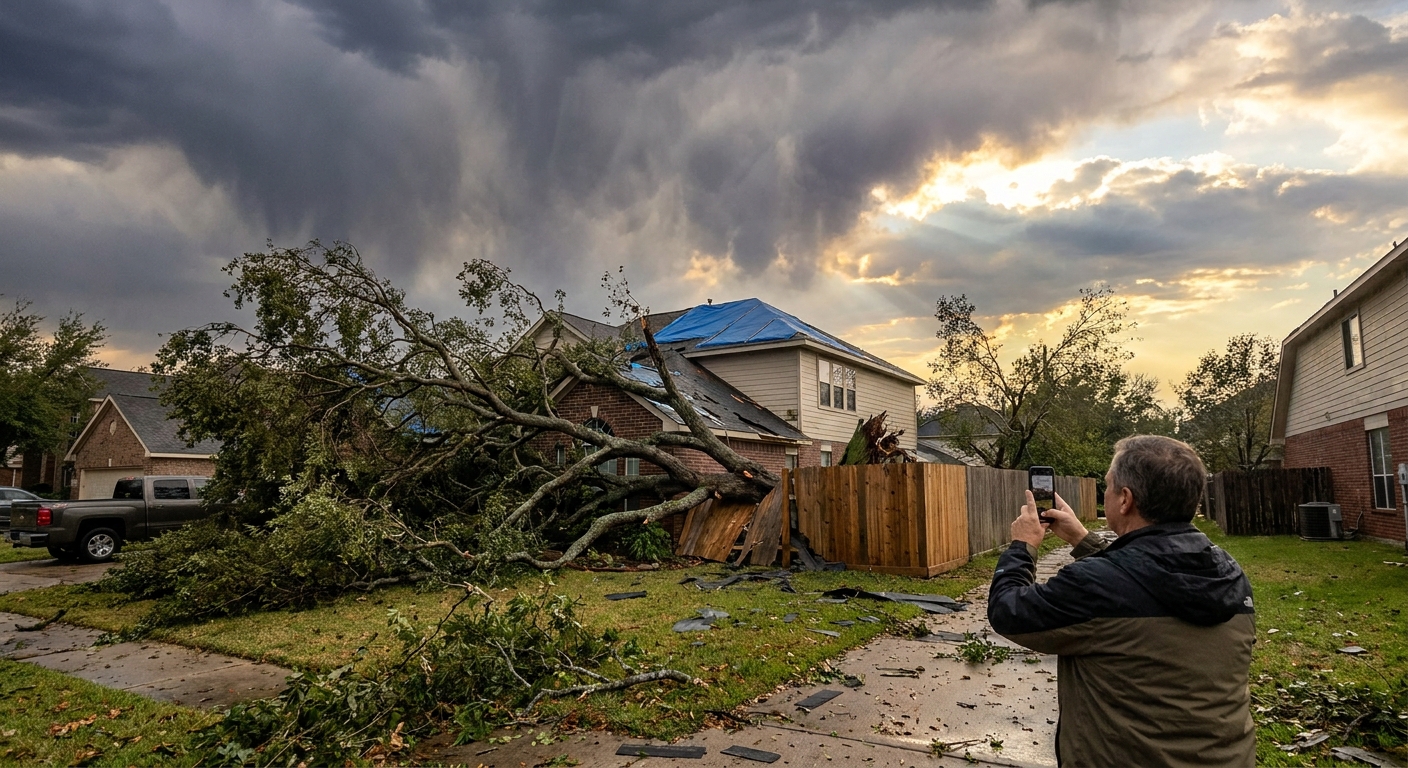
Roof: Wind damage to your roof, including torn-off shingles, punctures from wind-driven debris, or structural damage, is covered. Coverage may depend on your roof's age and upkeep. In 2026, most major carriers now enforce a strict roof age threshold, and a March 2026 FHFA rule permits Fannie Mae and Freddie Mac to accept ACV-only roof coverage on single-family homes and condos. Understanding the difference between actual cash value and replacement cost can significantly change your payout, since average roof replacement costs per Verisk have hit $17,631 in 2026. Also review roof age requirements if your roof is over 15 years old.
Siding: Wind can rip vinyl, metal, or composite siding panels off your home. Your dwelling coverage pays for repairs or replacement, including matching undamaged sections.
Windows: Broken windows from wind-driven debris or falling branches are covered. Learn more about when broken windows are covered under your policy, since the average window replacement now runs around $1,047 in 2026.
Detached Structures: Your garage, shed, or carport is covered under Other Structures coverage, typically 10% of your dwelling limit. For example, if your home is insured for $300,000, you'd have $30,000 in other structures coverage.
Fences: Wind-damaged fences fall under Other Structures coverage, sharing that 10% limit with all your detached structures combined. See our full breakdown of fence damage coverage for details on how depreciation affects your payout.
Trees: If a wind-toppled tree damages a covered structure (your home, garage, or fence), your policy covers the repairs and typically contributes to debris removal. However, if the tree falls in your yard without hitting anything, removal usually isn't covered. See our full breakdown of tree damage and home insurance.

Compare Home Insurance Plans in Ohio
Find your best options in less than 2 minutes
Wind/Hail Deductibles vs. Standard Deductibles
One of the most important, and most misunderstood, aspects of wind damage home insurance is how your deductible works. Many homeowners are surprised to find that a separate, higher deductible kicks in specifically for wind and hail claims. As of 2026, the average U.S. home insurance deductible has climbed 22% in the past year, and 2% is now the default wind/hail percentage in most storm-prone states.
How Standard Deductibles Work
A standard deductible is a flat dollar amount, typically $500 to $2,500, that you pay out of pocket before your insurer covers the rest of a claim. This applies to most covered perils: fire, theft, water damage, and similar events.
How Wind/Hail Deductibles Work
A wind/hail deductible is a separate deductible that applies exclusively to storm damage from wind, hail, or tornadoes. Unlike the flat-dollar standard deductible, wind/hail deductibles are almost always expressed as a percentage of your dwelling coverage, typically ranging from 1% to 5%, and up to 10-15% in high-risk coastal hurricane zones.
Real-Dollar Example:
If your home is insured for $400,000 and you have a 2% wind/hail deductible, you'll pay $8,000 out of pocket before your insurer covers a penny of wind damage. In Texas, the average wind/hail deductible now sits at roughly $7,761 (about 2.24% of the average dwelling coverage amount). Effective July 1, 2026, the Texas FAIR Plan Association eliminated its 1% wind/hail option entirely, replacing it with 2%, 3%, 4%, and 5% options, and existing 1% policies auto-renew to 2%. Many DFW-area carriers now default to 2%, with some West Texas policies now requiring 3%.
Understanding how percentage deductibles work is critical before you file any storm-related claim.
Which States Require Wind/Hail Deductibles?
Wind/hail deductibles are now standard in many storm-prone states. Coastal states more commonly use hurricane or named storm deductibles, while tornado-prone inland states use wind/hail deductibles. In 2026, most major Texas carriers default to 2%, and 3% is now common in West Texas and high-frequency hail corridors. Learn more in our detailed wind and hail deductible guide.
| Region | Deductible Type | Common States |
|---|---|---|
| Gulf Coast / East Coast | Hurricane / Named Storm | FL, TX, LA, NC, SC, GA |
| Midwest / Plains | Wind / Hail | TX, OK, KS, MO, NE, CO |
| Mid-Atlantic / Northeast | Wind / Hail or Standard | NY, NJ, MD, VA |

Protect your home with State Farm
Average Rate:
Homeowners who bundle and save with State Farm save an average of $1,000 per year!

You're in Good Hands® with Allstate
Average Rate:
Get comprehensive home coverage with flexible policy options.

Customize your home coverage
Average Rate:
Only pay for the coverage you need with personalized home insurance.

Smart coverage for your home
Average Rate:
Protect what matters most with award-winning home insurance.
How to File a Wind Damage Claim
Filing a wind damage claim correctly, and quickly, can mean the difference between a smooth payout and a lengthy dispute. This matters now more than ever: a Wall Street Journal analysis of NAIC data found the five largest U.S. home insurers (State Farm, Allstate, Liberty Mutual, USAA, and Farmers) failed to pay out on more than 44% of settled homeowner claims in 2025, up from 36% a decade earlier. An April 2026 Weiss Ratings analysis identified 15 large insurers that closed at least 50% of homeowner claims with no payment. Here's the process most insurers follow.
Step-by-Step Claims Process
Step 1: Secure Your Property First Make temporary repairs to prevent further damage (tarping a damaged roof, boarding broken windows). Save all receipts, since your insurer typically reimburses reasonable emergency repairs.
Step 2: Document Everything Before any permanent repairs, thoroughly photograph and video every damaged area: the roof, siding, windows, fences, detached structures, and any fallen trees. Capture wide shots and close-ups. Also note the date and approximate time of the storm.
Step 3: Contact Your Insurer Promptly File your claim as soon as possible via your insurer's phone line, app, or online portal. Provide your policy number, the storm date, and your initial documentation. Late filings can jeopardize coverage, and some states like Florida now enforce a strict 1-year filing deadline plus an 18-month supplemental deadline under § 627.70132.
Step 4: Meet the Adjuster Your insurer will schedule a property inspection, typically within a few days. Be present, walk the adjuster through all damage areas, and share all contractor estimates and photos you've gathered.
Step 5: Review the Settlement Offer Once the adjuster files their report, you'll receive a settlement offer minus your wind/hail deductible. J.D. Power's 2026 data pegs the average timeline at 29.6 days to repair and 40.7 days to final payment. See our full guide on the home insurance claims process for a timeline of what to expect.
When Insurers Dispute Wind Damage
Insurers may dispute your claim by arguing the damage was caused by:
- Pre-existing wear and tear or neglect, not wind
- Poor installation or maintenance of roofing materials
- Events not covered under your policy's wind provision
Documentation Checklist
| Document | Why It Matters |
|---|---|
| Photos & videos (before repairs) | Primary evidence of damage |
| Contractor repair estimates | Validates scope and cost of damage |
| National Weather Service records | Confirms wind speed and storm event |
| Receipts for emergency repairs | Supports reimbursement for temp fixes |
| Written insurer communications | Creates a dispute record if needed |
| Policy declarations page | Confirms your coverage and deductible |
If your claim is denied, you have the right to appeal. Hiring a licensed public adjuster or an attorney who specializes in insurance claims can significantly improve your outcome. The process is similar across all storm types, including hail damage claims and tornado damage claims.
Windstorm Mitigation Credits & How to Save on Premiums
One of the most underutilized ways to save money on wind damage home insurance is through windstorm mitigation credits. These are premium discounts your insurer applies when your home has features that reduce the risk of wind damage. With average U.S. homeowners premiums projected to reach roughly $3,057 by the end of 2026 (up 4% from $2,948 in 2025 per Insurify), and Florida commonly running well above $7,000 statewide, these credits matter more than ever.
How Mitigation Credits Work
You'll need to schedule a wind mitigation inspection performed by a licensed inspector (separate from a standard home inspection). The inspector evaluates your home's:
- Roof shape (hip roofs perform better than gable roofs in wind)
- Roof-to-wall connections (hurricane straps, clips, or engineered retrofits)
- Roof covering material and installation quality
- Opening protection (impact-resistant windows, storm shutters, garage door bracing)
- Secondary water resistance (self-adhering underlayment)
The inspector submits a standardized report to your insurer, who then calculates applicable credits. The credits typically apply within 4 to 6 weeks and can result in refunds if you've already paid your premium.
Potential Savings by State
| State | Estimated Discount on Wind Premium | Additional Incentives |
|---|---|---|
| Florida | Up to 88-90% off wind portion; typical savings $300 to $600/year | My Safe Florida Home $2-for-$1 match up to $10,000 |
| Alabama | 20% to 55% off wind portion | FORTIFIED grants up to $10,000 |
| Mississippi | 12% to 55% off wind portion | Free roof upgrade programs |
| South Carolina | 10% to 35% off wind portion | Tax credits up to $1,500 |
| North Carolina | 6% to 19% off wind portion | Roof grants up to $5,000 |
| Louisiana | Varies by carrier | Compliance-based incentives |
Homes in coastal markets should also review our guide on coastal home insurance costs and wind deductibles for a deeper look at how location affects both your premiums and your mitigation options. Florida homeowners specifically can dig deeper with our Florida home insurance guide, and Alabama homeowners can review the Alabama home insurance guide for coastal wind and FORTIFIED details.
Frequently Asked Questions
Does home insurance cover wind damage from straight-line winds and microbursts?
Yes. Standard homeowners insurance covers wind damage from straight-line winds, downbursts, and microbursts under the policy's windstorm provision. These events are treated identically to tornado damage from an insurance standpoint. The key consideration is whether your policy carries a standard deductible or a separate wind/hail deductible, which in 2026 is often 2% of dwelling coverage in storm-prone states.
What is a wind/hail deductible and how is it different from my regular deductible?
A wind/hail deductible is a separate, percentage-based deductible that applies specifically to damage caused by wind, hail, or tornadoes. Unlike your flat-dollar standard deductible (e.g., $1,000), a wind/hail deductible is calculated as 1% to 5% of your dwelling coverage. On a $400,000 home, a 2% wind/hail deductible means $8,000 out of pocket before your insurer contributes a dollar. Review your home insurance deductible options to understand what you're committed to.
Does insurance cover wind damage to a fence?
Yes, wind-damaged fences are covered under your policy's Other Structures coverage, which typically equals 10% of your dwelling coverage limit. However, this limit is shared across all detached structures, including garages, sheds, and carports, so large or complex properties may be underinsured without a limit increase. Most insurers also pay fence claims on an actual cash value basis, which can shrink payouts significantly for older fences.
What proof is needed if my insurer disputes my wind damage claim?
If an insurer disputes your claim, your strongest evidence includes dated photographs taken immediately after the storm, a National Weather Service or NOAA weather report confirming wind speeds at your location, independent contractor estimates detailing wind-specific damage patterns (such as uplift or directional debris impact), and any written communications with your insurer. Given that the five largest U.S. insurers failed to pay over 44% of settled 2025 claims (up from 36% a decade earlier), thorough documentation is more important than ever. A public adjuster or insurance attorney can help you build and present this case effectively.
How do windstorm mitigation credits save money on home insurance?
Windstorm mitigation credits are premium discounts applied when your home has features that reduce wind damage risk, such as a hip roof, hurricane straps, impact-resistant windows, or reinforced garage doors. After a licensed inspection confirms these features, your insurer applies credits that can reduce the wind portion of your premium significantly, with Florida law allowing credits up to 88-90% of the windstorm portion for homes with comprehensive protection. In Alabama, FORTIFIED-certified homes can qualify for grants up to $10,000, and Florida's My Safe Florida Home program provides free inspections plus $2-for-$1 matching grants up to $10,000 for eligible homeowners.