
Compare Home Insurance Plans in Ohio
Find your best options in less than 2 minutes



When Home Insurance Covers Your Roof and When It Doesn't
Home insurance does cover roof damage, but only under the right circumstances. Coverage hinges on two critical factors: what caused the damage and how old your roof is. Policies typically pay out when a sudden, unexpected event like a hailstorm or a falling tree destroys your shingles. They generally won't pay when your roof gradually deteriorates from years of wear, lack of maintenance, or simply old age.
In 2026, Verisk's U.S. Roof Report pegs the average residential roof replacement at $17,631, roughly 33% higher than the 2021-2024 baseline. National project guides put the typical homeowner range around $9,000 to $18,000 for a standard asphalt shingle roof, with premium materials pushing costs above $30,000. With prices climbing fast and claim denial rates at record highs, understanding your coverage before you file is more important than ever.

Compare Home Insurance Plans in Ohio
Find your best options in less than 2 minutes
Covered Perils vs. Excluded Causes of Roof Damage
Standard homeowners policies (HO-3 and HO-5) protect your roof under dwelling coverage (Coverage A). Coverage kicks in when damage results from a named or open peril listed in your policy.
What's Typically Covered
| Peril | Coverage Notes |
|---|---|
| Wind & Hailstorms | Most common roof claim; may carry a separate wind/hail deductible in high-risk states |
| Fire or Lightning | Covered under nearly all standard policies |
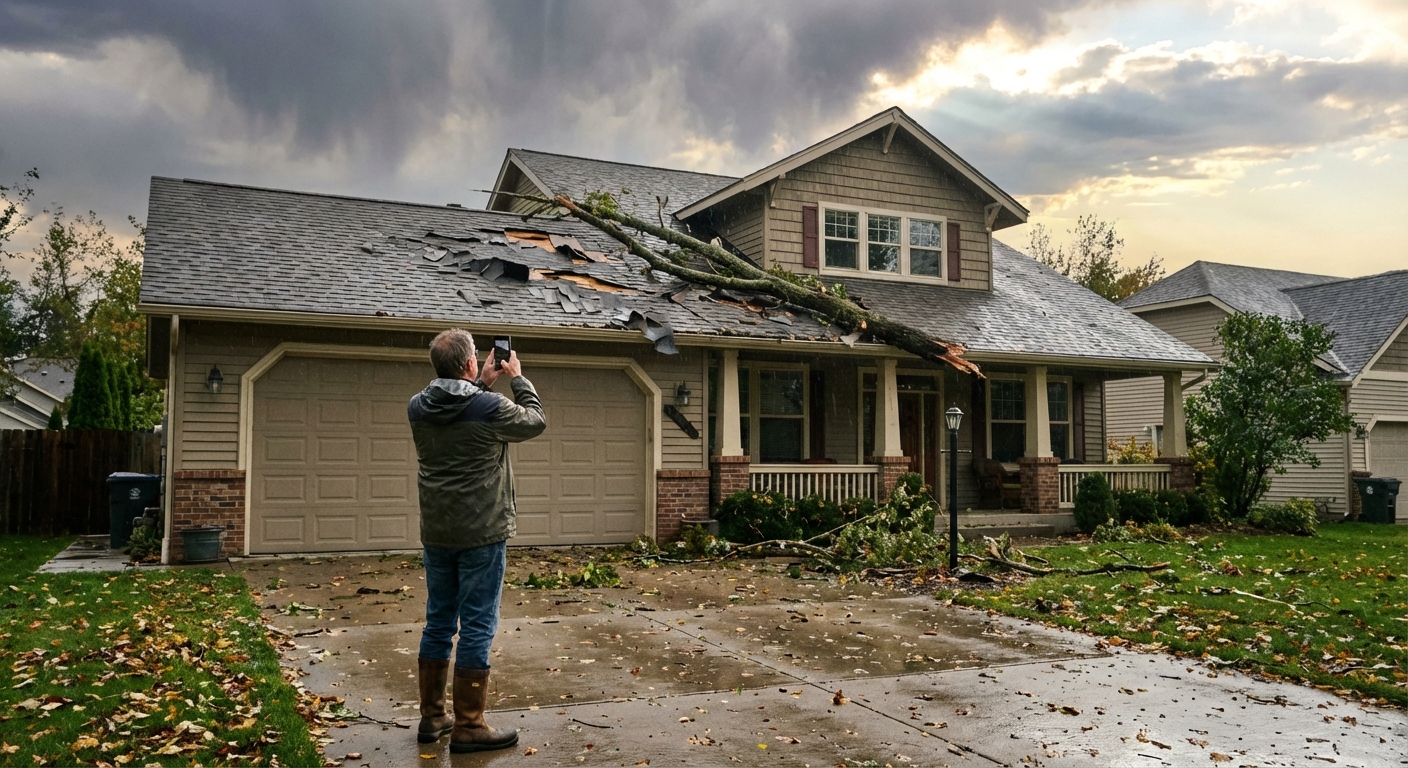
| Falling Objects | Includes trees, branches, and debris. Learn more about tree damage coverage |
| Weight of Ice, Snow, or Sleet | Covered when sudden collapse or damage occurs |
| Vandalism | Covered under most HO-3 and HO-5 policies |
What's NOT Covered
A standard homeowners policy typically excludes wear and tear from naturally aging materials, lack of maintenance such as replacing missing shingles or clearing debris, mold and rot from long-term moisture issues, flooding and earthquakes (which require separate policies), and pest or animal damage from rodents, birds, or insects. Insurers also exclude manufacturer defects, treating faulty materials as a product issue rather than an insurance event.

Protect your home with State Farm
Average Rate:
Homeowners who bundle and save with State Farm save an average of $1,000 per year!

You're in Good Hands® with Allstate
Average Rate:
Get comprehensive home coverage with flexible policy options.

Customize your home coverage
Average Rate:
Only pay for the coverage you need with personalized home insurance.

Smart coverage for your home
Average Rate:
Protect what matters most with award-winning home insurance.
Replacement Cost Value vs. Actual Cash Value: What You'll Actually Get Paid
The type of coverage on your policy determines how much money you'll receive, and the difference can be enormous. For a deep dive into the differences, see our guide on ACV vs RCV home insurance.
Replacement Cost Value (RCV)
RCV pays the full cost to replace your roof with a new equivalent at today's prices, minus your deductible. Under an RCV policy, the insurer typically issues an initial payment based on actual cash value, then sends a second check (called recoverable depreciation) once repair work is completed and documented.
Actual Cash Value (ACV)
ACV pays only the depreciated value of the existing roof, often far less than replacement cost. Insurers calculate depreciation using the roof's replacement cost, expected useful life, and current age. To understand the math behind it, our guide on actual cash value home insurance walks through real examples.
Depreciation formula example:
$17,000 replacement cost ÷ 20-year lifespan = $850/year depreciation 10-year-old roof: $17,000 − $8,500 = $8,500 ACV payout (before deductible)
The 2026 Fannie/Freddie ACV Rule Change
On March 18, 2026, the Federal Housing Finance Agency announced that Fannie Mae and Freddie Mac will accept Actual Cash Value (ACV) roof coverage instead of requiring full replacement-cost roof coverage for eligible single-family homes and condos. The rest of the dwelling still generally must be insured on a replacement-cost basis. Previously, most lenders insisted on RCV roof coverage as a condition of the mortgage. The downside for consumers: more homeowners are now being pushed into ACV without realizing the financial gap until they file a claim. Compare payout scenarios in our replacement cost vs actual cash value breakdown.
How Roof Age Affects Your Coverage in 2026
Roof age has become the single most important underwriting factor for home insurance. Most homeowners insurance carriers now use roof age as a rating factor when determining premiums, and industry underwriting guidelines show scrutiny commonly begins at 15 years, with coverage restrictions or non-renewals common past 20 years for asphalt shingle roofs.
Industry Age Thresholds (2026)
| Roof Age | Typical Insurer Response |
|---|---|
| Under 10 years | Full RCV coverage usually available |
| 10-15 years | Some carriers switch to ACV; higher premiums likely |
| 15-20 years | Many insurers require inspection; ACV or limited endorsements standard |
| 20+ years | Non-renewal common; ACV-only or roof replacement required |
For a deeper dive into how age impacts your insurability, see our guide on home insurance and old roof age requirements or our state-by-state breakdown of roof age home insurance rules.
How Depreciation Hits Older Roof Claims Hard
Consider this scenario: your 18-year-old asphalt roof (25-year lifespan) is destroyed in a windstorm. Replacement cost is $20,000.
- Annual depreciation: $20,000 ÷ 25 years = $800/year
- Total depreciation at 18 years: $800 × 18 = $14,400
- ACV payout: $20,000 − $14,400 = $5,600 (before deductible)
That's a $14,400 gap you'd need to cover out of pocket under an ACV policy. Verisk's 2026 U.S. Roof Report found that non-recoverable depreciation now represents nearly 20% of roof claims as carriers push older roofs to ACV-only settlements.
Wind and Hail Deductibles: The Hidden Cost of a Roof Claim
In 2026, most policies in storm-prone states carry a separate wind and hail deductible, expressed as a percentage of your home's insured value rather than a flat dollar amount. A wind/hail deductible typically runs 1% to 5% of your dwelling coverage (Coverage A). On a home insured for $300,000, a 2% wind/hail deductible means $6,000 out of pocket before insurance pays a cent.
Percentage-based wind/hail deductibles are now the default across Texas (where 2% has become the dominant standard, with 3% common in higher-risk areas like DFW), Illinois, Missouri, Oklahoma, and much of the Gulf Coast. The Texas FAIR Plan eliminated its 1% option effective July 1, 2026, automatically rolling 1% policies to 2% at renewal. Florida uses percentage-based hurricane deductibles set by insurer and coastal proximity. Our wind and hail deductible guide covers state-by-state requirements in detail, and our hurricane insurance guide breaks down separate hurricane deductibles.
Partial vs. Full Roof Replacement: How Insurers Decide
Not every roof claim results in a full replacement. Insurers send an adjuster to assess damage and determine whether repair or full replacement is warranted.
Factors That Lead to Full Replacement
- Damage is widespread across most or all roof sections
- Repair costs approach or exceed the cost of full replacement
- Matching shingles are no longer available, making patch repairs structurally or aesthetically inadequate
- The roof is structurally compromised beyond patchwork repair
Factors That Lead to Repair Only
- Damage is localized (e.g., a few missing shingles in one area)
- The roof is relatively new and structurally sound overall
- Matching materials are readily available
No universal damage percentage triggers automatic full replacement. The decision is based on the scope of damage, the roof's age and condition, material availability, and your specific policy language. However, when repairs cost more than 50% of replacement, most insurers will lean toward full replacement.
How to File a Roof Damage Insurance Claim
Filing a roof claim correctly and promptly is critical. Most policies require reporting within 30 to 60 days of discovering damage, and filing within 48 hours of a storm event is best practice. If hail caused the damage, our hail damage claims guide has specific advice on documenting evidence.
Step-by-Step Claim Process
Step 1: Document Everything Immediately Safely photograph damage from the ground using date-stamped photos. Capture missing shingles, debris, interior water stains, and any fallen objects. Save weather reports from the date of the event.
Step 2: Review Your Policy Check your deductibles (including any separate wind/hail or hurricane deductibles), coverage type (RCV vs. ACV), and filing deadlines before calling your insurer.
Step 3: Contact Your Insurer Report the damage through the claims hotline or online portal. Get a claim number and written confirmation of next steps.
Step 4: Get a Professional Roofing Estimate Hire a licensed contractor to inspect the roof and provide a detailed written estimate. Request that they be present during the adjuster's visit.
Step 5: Meet With the Insurance Adjuster Walk the adjuster through all documented damage. Your contractor's presence ensures nothing is overlooked.
Step 6: Review the Settlement Offer If the offer seems low, compare it to your contractor's estimate. You have the right to negotiate or request a re-inspection. Avoiding maintenance-related claim denials starts long before a storm hits.
Step 7: Complete Repairs and Close the Claim Submit final invoices and photos. Under RCV policies, this triggers your second recoverable depreciation payment.
Frequently Asked Questions
Will home insurance pay for a new roof due to age alone?
No. Home insurance is designed to cover sudden and accidental damage, not gradual deterioration. If your roof simply wears out over time, that's considered a maintenance issue and is excluded from coverage. In fact, insurers may require you to replace an aging roof just to keep your policy active in 2026.
Does home insurance cover a full roof replacement after hail damage?
It depends on the extent of damage and your policy type. If hail has caused widespread damage across the entire roof, insurers will typically approve full replacement. If damage is localized, expect a repair-only settlement. An RCV policy will pay the full replacement cost (minus your deductible), while an ACV policy will subtract depreciation based on your roof's age.
How much will insurance actually pay for a roof replacement in 2026?
Under an RCV policy, your insurer pays the full cost to replace the roof with like-kind materials, minus your deductible, often in two installments. With average roof replacement costs at roughly $17,631 per Verisk's 2026 U.S. Roof Report, an ACV policy on a 15-year-old roof could pay as little as $4,000 to $7,000 before deductibles. Switching from RCV to ACV can reduce payouts by 40% to 60% on older roofs.
Can my insurance company deny a roof claim because my roof is too old?
Yes. Many insurers now restrict or deny claims on roofs over 15 to 20 years old, switching them to ACV coverage or declining to renew the policy. In some cases, carriers require a professional inspection and may mandate roof replacement before continuing coverage. Florida Statute 627.7011 still prohibits non-renewal based solely on roof age for roofs under 15 years old, but the widely reported HB 815 update did not pass and did not take effect in July 2026.
What's the difference between a wind/hail deductible and a standard deductible?
Many policies in storm-prone states carry a separate wind and hail deductible, typically expressed as a percentage of your home's insured value (1% to 5%) rather than a flat dollar amount. On a $300,000 home, a 2% wind deductible means $6,000 out of pocket before insurance pays a cent on roof damage from wind or hail. That's significantly more than a standard $1,000 to $2,500 all-perils deductible.