
Compare Home Insurance Plans in Ohio
Find your best options in less than 2 minutes



When Does Home Insurance Cover a Fallen Tree?
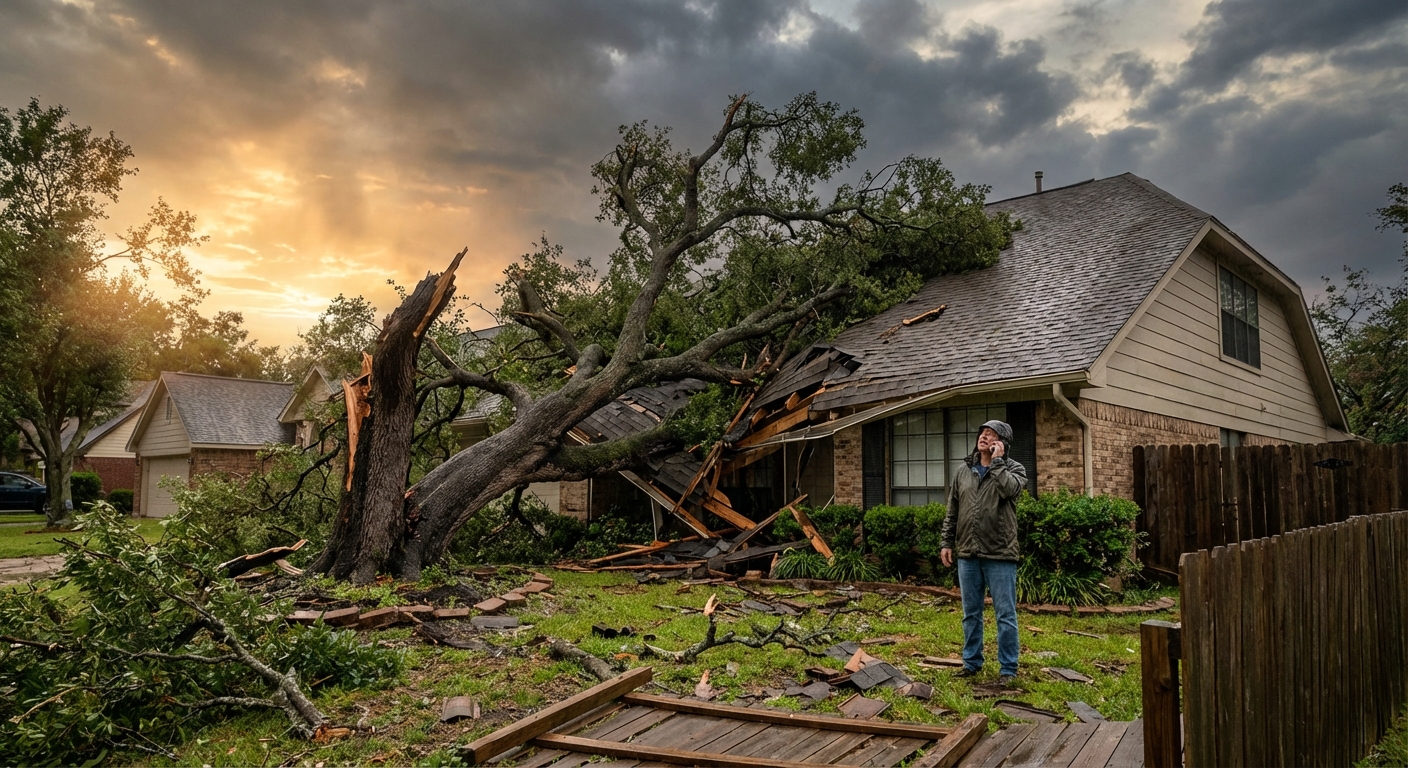
The short answer: your homeowners insurance covers tree damage when a tree falls due to a covered peril and strikes a covered structure. Standard HO-3 policies list covered perils that commonly cause tree falls, including windstorms, hail, lightning, fire, and the weight of ice or snow. If a tree topples for any of these reasons and damages your home, garage, fence, or shed, your dwelling or other structures coverage kicks in to pay for repairs, minus your deductible.
However, not every falling tree means an automatic payout. The damage must meet two conditions: the cause of the fall must be a covered peril, and the tree must have actually hit a covered structure (or in some cases, blocked a driveway or handicap-accessible ramp). A tree that simply falls into your yard without hitting anything is generally not covered for removal costs.
Covered vs. Not Covered: A Quick Breakdown

Compare Home Insurance Plans in Ohio
Find your best options in less than 2 minutes
Hurricane & Wind Deductibles: The 2026 Reality
If you live in a coastal or storm-prone state that uses separate hurricane or named-storm deductibles, your out-of-pocket cost for a tree-related claim can be dramatically higher than your standard deductible. These deductibles are almost always percentage-based, ranging from 1% to 10% of your dwelling coverage (and industry-wide as high as 15% in the highest-risk coastal zones). On a $400,000 home with a 5% wind deductible, that's $20,000 out of pocket before your insurer pays a cent.
Florida law is the most tightly regulated example. Under Florida Statute §627.701, insurers must offer hurricane deductible options of $500, 2%, 5%, or 10% of your Coverage A dwelling limit, with the deductible capped at 10% by statute. The hurricane deductible triggers only when the National Hurricane Center issues a hurricane watch or warning for any part of Florida, and applies through 72 hours after the last warning is terminated. Uniquely, Florida applies hurricane deductibles on an annual (calendar-year) basis rather than per storm, so if multiple hurricanes strike in the same year, you effectively pay the hurricane deductible only once. Note that the $500 option is often unavailable on homes valued over $1 million, which typically see 3%, 5%, or 10% options only.
Texas policies commonly carry a separate 2% wind and hail deductible in most of the state, rising to 3% to 5% or higher along the Gulf coast. Learn more about how percentage deductibles apply to storm-related claims in our wind damage coverage guide and our tornado damage breakdown.
| State Example | Typical 2026 Hurricane/Wind Deductible |
|---|---|
| Florida | $500, 2%, 5%, or 10% of dwelling (10% statutory cap) |
| Texas | 2% wind/hail standard; 3% to 5%+ on the coast |
| Louisiana | 2% to 5%+ in coastal parishes |
| North/South Carolina | 1% to 5% named-storm deductible |
| New Jersey, NY | 1% to 5% hurricane deductible |
| Tornado Alley states | 1% to 2% wind/hail deductible |

Protect your home with State Farm
Average Rate:
Homeowners who bundle and save with State Farm save an average of $1,000 per year!

You're in Good Hands® with Allstate
Average Rate:
Get comprehensive home coverage with flexible policy options.

Customize your home coverage
Average Rate:
Only pay for the coverage you need with personalized home insurance.

Smart coverage for your home
Average Rate:
Protect what matters most with award-winning home insurance.
Neighbor's Tree, Dead Trees & Liability Explained
What If Your Neighbor's Tree Falls on Your House?
This is one of the most misunderstood scenarios in home insurance. If your neighbor's tree falls on your property due to a storm or other act of nature, your own homeowners insurance is typically responsible for covering your repairs, not your neighbor's. This is confirmed by the Insurance Information Institute: home insurance follows the damaged property, not the origin of the tree.
The exception is negligence. If your neighbor knew their tree was dead, rotting, or diseased and failed to act, their liability coverage may come into play. In practice, your insurer will pay your claim first, then pursue reimbursement from your neighbor's insurance company through a process called subrogation. If subrogation succeeds, your deductible is often the first amount returned to you (subject to state law and policy terms). You typically won't need to sue your neighbor yourself; your insurer handles it. If subrogation fails (usually because the tree was healthy and the fall qualifies as an "act of God"), you keep your claim payment but generally do not get your deductible back.
Pro tip: If you notice a dead or leaning tree on your neighbor's property that poses a threat to your home, send them a written notice (certified mail is best). This creates a paper trail proving they were aware of the hazard, which can be critical if their tree later damages your property.
Dead & Diseased Trees: The Negligence Trap
One of the most common reasons tree damage claims get denied in 2026 is pre-existing knowledge of a hazardous condition. If an insurer can show that a tree was visibly dead, decayed, or diseased before it fell, and that you knew or reasonably should have known, your claim can be denied on grounds of negligence.
This applies to both your tree and a neighbor's. The insurer's position is straightforward: damage from a deteriorating tree is foreseeable and preventable, which takes it out of the "sudden and accidental" category that insurance is designed to cover. Adjusters actively look for evidence of decay, including fungal growth, hollow trunks, long-standing lean, and unpruned branches contacting the roof. With the five largest carriers now failing to pay more than 44% of homeowner claims (up from around 36% a decade ago per WSJ analysis of NAIC data) and the Weiss Ratings April 2026 study finding that 15 large U.S. insurers closed at least 50% of homeowner claims in 2025 with no payment, documenting tree condition is more important than ever. Wear-and-tear characterizations drive roughly a third of formal denials. Our guide on home maintenance requirements covers this shift in detail.
Debris Removal Limits & What They Mean for Your Wallet
How Much Will Insurance Pay for Tree Removal?
Most standard homeowners policies impose a sublimit specifically for tree debris removal, separate from your main dwelling coverage. This is one of the most important numbers to know, because actual tree removal costs in 2026 routinely exceed what your policy reimburses.
| Scenario | Typical 2026 Coverage |
|---|---|
| Tree removal after hitting a covered structure | $500 per tree, up to $1,000 per loss |
| Multiple trees removed from one event | Often capped at $1,000 total |
| Tree debris removal with no structural damage | Generally not covered |
| Tree blocking a driveway or handicap ramp | Covered up to sublimit |
| Trees/shrubs landscaping coverage | Up to 5% of dwelling limit ($500 to $750 per plant) |
| Structural repair costs (roof, walls, garage) | Covered up to dwelling limit |
Under the standard ISO HO-3 form, the tree removal sublimit caps out at $1,000 total per loss event, with no more than $500 for any one tree, regardless of how many trees fell. The good news: if a tree is physically resting on your roof and must be removed to make repairs, that removal cost is usually treated as part of the structural repair, not the sublimit. Some carriers offer optional endorsements to raise the debris removal limit, which is worth exploring if you have mature trees near the home.
Also be aware that policies typically cover only the debris needed to complete repairs. Full trunk removal, stump grinding, and root system removal are often excluded unless they physically impede structural work. Homeowners often pay thousands out of pocket for the final cleanup once repairs are done.
Real-world 2026 tree removal costs: Professional tree removal now averages about $850 to $906 nationally, with most non-emergency jobs falling between $820 and $992 per This Old House 2026 data. Small trees (under 30 feet) run $150 to $500, medium trees (30 to 60 feet) between $450 and $1,200, and large trees over 60 feet often cost $900 to $2,500. Emergency removals after a storm (a tree on a roof or power line) can reach $3,000 to $5,000, and very large trees over 80 feet can climb to $1,500 to $4,500 even for scheduled work.
Does Insurance Cover Preventive Tree Removal?
No, and this surprises many homeowners. Homeowners insurance does not cover the cost of removing a tree that is still standing, even if it's dead, leaning dangerously, or poses a clear risk to your home. Preventive removal is considered routine home maintenance, which is always the homeowner's responsibility. If you hire an arborist to remove a hazardous tree before it falls, you're paying out of pocket. The modest cost of removal now could save you from a denied claim or major structural damage later.
How to File a Tree Damage Claim & Protect Yourself
Step-by-Step: Filing a Tree Damage Claim
When a tree damages your home, acting quickly and methodically makes a significant difference in your claim outcome. Follow these steps:
- Ensure safety first. Do not enter a structurally compromised area. If there are downed power lines, call your utility company immediately.
- Document everything. Photograph the fallen tree, all damage, and the point of impact from multiple angles before any cleanup begins.
- Prevent further damage. Place tarps over exposed roof areas if it's safe to do so. Your policy's "duty to mitigate" clause requires you to prevent additional damage where possible, and failure to do so is a common denial reason.
- Contact your insurer. File your claim as soon as possible. Provide photos, a description of the event, and the approximate date and time of the storm. Late reporting drives roughly 15% of formal denials.
- Get repair estimates. Obtain at least two or three contractor quotes. Your insurer will send an adjuster, but having your own estimates is valuable.
- Keep all receipts. Track every expense related to the damage, including temporary lodging if the home is uninhabitable.
If a tree damages your roof, our guide on roof replacement coverage explains how RCV versus ACV settlements affect your payout, along with the 2026 FHFA rule that now lets Fannie Mae and Freddie Mac accept ACV-only roof coverage.
Documenting Hazardous Trees to Protect Your Coverage
One of the smartest things a homeowner can do is proactively document the condition of trees on and around their property. This serves two purposes: it helps you identify risks before they become emergencies, and it creates evidence that you acted responsibly, which matters enormously if a liability dispute arises.
When inspecting trees, look for structural defects like cracks, splits, or cavities, as well as decay indicators such as mushrooms or fungal growth on the trunk. Root issues (including heaving soil, exposed roots, or construction damage nearby) are also red flags. If you spot problems, have a certified arborist assess and document the tree in writing. This record proves you were aware of the hazard and took reasonable steps, which directly protects you from liability if the tree later damages a neighbor's property.
Insurance companies evaluate liability disputes based on three key questions: Did you know about the hazardous condition? Did you take reasonable steps to address it? Was the harm foreseeable? Strong documentation answers all three in your favor.
Just like structural damage claims and fence damage claims, tree damage claims hinge on whether the loss was "sudden and accidental." Proper maintenance records can make or break your case. For related storm scenarios, our guides on ice dam damage, hail damage claims, and lightning damage coverage explain how weather-related losses are handled. If a fallen tree also damages a detached shed or garage, review how other structures coverage works.
Frequently Asked Questions
Will homeowners insurance cover a tree that fell on my car?
No, your homeowners insurance does not cover vehicle damage. If a tree falls on your car, the claim goes through your auto insurance, specifically your comprehensive coverage (not collision). Comprehensive is designed for non-collision events like falling trees, hail, and natural disasters. If you only carry liability auto insurance, you would have no coverage for a tree falling on your vehicle.
What if a tree falls in my yard but doesn't hit anything?
If a tree falls into your yard without striking a covered structure or blocking a driveway or handicap-accessible ramp, removal is typically not covered by your homeowners policy. The cost of clearing it is your responsibility. The main trigger for coverage is damage to a covered structure, and without that, most policies treat it as a landscaping cleanup issue.
Can I be held liable if my tree falls on my neighbor's property?
It depends on the circumstances. If the tree was healthy and fell due to a storm or act of nature, you are generally not held liable, and your neighbor would file a claim with their own insurer. However, if you knew the tree was dead, diseased, or hazardous and failed to act, you could be found negligent. Your homeowners liability coverage would typically defend you in that situation, but the best protection is removing hazardous trees proactively.
Does home insurance cover a tree that fell due to rot or disease?
No. If a tree was already dead, rotting, or visibly diseased before it fell, most insurers will deny the claim based on neglect or lack of maintenance. This applies whether the tree damages your own home or a neighbor's property. Insurance is intended to cover sudden and accidental damage, not damage that results from a foreseeable and preventable condition.
How do I know if my policy has good tree damage coverage?
Review your policy's declarations page and look for the debris removal sublimit (often listed as a dollar figure per tree or per occurrence, commonly $500 per tree and $1,000 per loss under standard HO-3 forms). Also check whether your policy uses open-peril or named-peril coverage for your dwelling, since open-peril (HO-3) is broader and more protective. If you have large trees near your home, ask your agent about increasing your debris removal limit and confirm that wind and storm damage are not excluded or subject to a higher percentage deductible in your area.