
Compare Home Insurance Plans in Ohio
Find your best options in less than 2 minutes



What Does Hurricane Insurance Actually Cover?
Most homeowners are surprised to learn that there is no single standalone "hurricane insurance" policy. Instead, hurricane protection is built into (or layered on top of) your standard homeowners insurance policy. Understanding exactly what is and isn't covered could mean the difference between a full recovery and tens of thousands of dollars out of pocket.
Wind and Structural Damage: The Core of Hurricane Coverage
Standard homeowners insurance typically covers damage caused directly by hurricane-force winds. This includes:
- Roof damage from wind uplift, torn shingles, or debris impact
- Structural damage to walls, windows, and exterior siding
- Detached structures like garages, fences, and sheds (usually up to 10% of dwelling coverage)
- Rain intrusion, but only when wind first creates an opening (e.g., a blown-out window or torn roof allows rain to enter)
- Personal property damaged by wind or wind-driven rain inside the home
- Additional living expenses (ALE) if your home is uninhabitable during repairs
For a full breakdown of the six standard coverage types on your policy, review our hazard insurance guide or see what home insurance doesn't cover.
What Hurricane Insurance Does NOT Cover
This is where many homeowners get caught off guard. Several common types of hurricane damage are explicitly excluded from standard homeowners policies:
| Damage Type | Covered by Standard Homeowners? | What You Need Instead |
|---|---|---|
| Wind damage (roof, walls) | ✅ Yes | Included or windstorm endorsement |
| Rain through wind opening | ✅ Yes | Included |
| Rain flooding (no wind entry) | ❌ No | Flood insurance |
| Storm surge / coastal flooding | ❌ No | NFIP flood insurance |
| Overflowing rivers or creeks | ❌ No | Flood insurance |
| Sewer backup | ❌ No | Water backup endorsement |
Storm surge, the ocean water pushed inland by a hurricane, is one of the most destructive forces in a major storm, and it is not covered by your homeowners policy. It requires a separate flood insurance policy, typically through the National Flood Insurance Program (NFIP).

Compare Home Insurance Plans in Ohio
Find your best options in less than 2 minutes
Hurricane Deductibles: How They Work and What You'll Pay in 2026
Hurricane deductibles are one of the most misunderstood aspects of homeowners insurance. Unlike your standard deductible (typically a fixed dollar amount like $1,000), hurricane deductibles are calculated as a percentage of your dwelling coverage limit (Coverage A).
Percentage-Based vs. Flat-Dollar Deductibles
| Feature | Standard Deductible | Hurricane Deductible |
|---|---|---|
| Amount type | Fixed dollar (e.g., $1,000) | Percentage of dwelling (e.g., 2 to 5%) |
| Applies to | All other covered perils | Hurricane/named storm damage only |
| Example on $400K home | $1,000 out of pocket | $8,000 to $20,000 out of pocket |
| Typical range | $500 to $2,500 | 1% to 10% (up to 15% in some coastal states) |
For a home insured at $400,000, a 5% hurricane deductible means you pay $20,000 before your insurer covers a single dollar of hurricane damage. Learn more about how percentage deductibles work before selecting your coverage level.
When Does a Hurricane Deductible Trigger?
Hurricane deductibles don't apply to every windstorm. They activate only when a specific condition is met:
- The National Hurricane Center (NHC) issues an official hurricane watch or warning
- Damage occurs during the defined storm window (in Florida, from the moment a watch or warning is issued until 72 hours after it is lifted anywhere in the state)
- Some policies use "named storm deductibles" that trigger at lower wind thresholds (≥39 mph for tropical storms)
Florida's Hurricane Deductible Rules (2026 Update)
Florida still requires all insurers to offer hurricane deductible options of $500, 2%, 5%, or 10% of the policy's dwelling coverage limits under Statute 627.701. The 2% option remains the most common on a typical Florida policy. Following state approval, Citizens Property Insurance rolled out an average 8.8% multiperil rate cut (with wind-only policies dropping 5.5% on average) that took effect June 1, 2026 for renewals. That is the first personal-lines rate reduction from Citizens since 2015.
There are a few tier-based exceptions worth knowing:
- Homes insured for $250,000 or more: insurers do not need to offer the $500 option, but must offer 2%, 5%, or 10%
- Homes insured between $1M and $3M: insurers may offer 3%, 5%, and 10% in place of 2%, 5%, and 10%
- Homes insured above $3M: only 5% and 10% options are required
Florida also applies the hurricane deductible on a calendar-year basis, meaning it typically applies only once per year regardless of how many hurricanes hit. If the deductible is met on the first storm (with the same insurer or insurer group), subsequent hurricane claims that year fall under your all-other-perils (AOP) deductible instead. Understanding wind and hail deductibles is equally important, as those apply in non-hurricane wind events, and the rising trend in home insurance deductibles has pushed more of the risk onto homeowners.

Protect your home with State Farm
Average Rate:
Homeowners who bundle and save with State Farm save an average of $1,000 per year!

You're in Good Hands® with Allstate
Average Rate:
Get comprehensive home coverage with flexible policy options.

Customize your home coverage
Average Rate:
Only pay for the coverage you need with personalized home insurance.

Smart coverage for your home
Average Rate:
Protect what matters most with award-winning home insurance.
Hurricane Insurance vs. Flood Insurance: Know the Difference
Perhaps the single biggest coverage gap homeowners face after a hurricane is the wind vs. water divide. Your homeowners policy handles wind. Flood insurance handles rising water. These are two completely separate policies with separate premiums, deductibles, and claim processes.
What Each Policy Covers
The NFIP in 2026: Reauthorization Watch
The National Flood Insurance Program (NFIP), managed by FEMA, is still the primary source of flood insurance for most homeowners. Key 2026 facts:
- Building coverage limit: up to $250,000 for the structure
- Contents coverage limit: up to $100,000 (purchased separately)
- Average NFIP premium: roughly $976 per year nationwide, or about $1,114 in high-risk A or V zones
- Waiting period: typically 30 days before coverage takes effect
- NFIP authority currently expires September 30, 2026 and requires Congressional reauthorization. Since 2017, Congress has passed more than 35 short-term extensions rather than a long-term fix, and the NFIP Extension Act of 2026 (H.R. 5577) is currently on the House Union Calendar
- Risk Rating 2.0 now prices each property individually, with most premium increases capped at 18% per year until each policy reaches its full risk-based rate
Because the $250,000 building cap often leaves higher-value homes underinsured, private and excess flood insurance policies have grown rapidly. For a deeper look at your options, see our flood insurance guide.
Coastal Coverage Challenges, State Programs & Saving on Premiums
Homeowners in coastal areas face unique obstacles when shopping for hurricane coverage. The outlook in 2026 is mixed: Florida and Texas are showing early signs of recovery, while Louisiana coastal parishes remain strained. See the full comparison in our cheapest and most expensive states guide.
2026 Market Conditions by State
- Florida: After legislative reforms, private capacity has expanded, and Citizens Property Insurance approved an average 8.8% multiperil rate cut for 2026 (5.5% for wind-only), effective at renewal beginning June 1. More than 330,000 policyholders across all 67 counties will see decreases, with the largest cuts in South Florida: Broward (14.1%), Miami-Dade (14.0%), Palm Beach (11.9%), and Monroe (11.3%). Florida still leads the nation in cost, with Insurify projecting a $8,458 statewide average for 2026 on a $300,000 dwelling, and coastal Gulf and Atlantic counties routinely running $5,500 to $10,000+ (with Monroe/Keys often $9,000 to $18,000+). Read our full Florida home insurance guide for county-by-county detail.
- Louisiana: Coastal parishes still face fragile capacity and heavy reliance on Louisiana Citizens. For 2026, the Louisiana Department of Insurance approved a +3.4% FAIR Plan and -2.5% Coastal Plan change at Louisiana Citizens (about +3.1% statewide blended), effective January 1, 2026. The 2026 statewide average is running near $5,986 on a typical dwelling, with average premiums in coastal parishes still up 40% to 150% since 2020. Learn more in our Louisiana home insurance breakdown.
- Texas: High-risk coastal counties continue to rely on TWIA, which filed a 0% rate change for 2026 after its rate adequacy analysis found rates already adequate by 9% for residential and 4% for commercial coverage. Texas remains among the most expensive states nationwide, and after the Texas FAIR Plan eliminated its 1% wind/hail option on July 1, 2026, a 2% deductible is now the de facto standard. See our detailed Texas home insurance guide for regional detail.
- North Carolina: The NC Beach Plan remains the coastal wind option, and a cumulative 15% statewide rate hike is now fully in effect as of June 2026. See our North Carolina coastal vs inland guide.
Insurers in high-risk coastal zones typically require higher hurricane deductibles, may exclude wind coverage entirely, and charge two to three times more than inland areas. Our coastal home insurance guide walks through what to expect.
State-Backed Programs: Insurers of Last Resort
| State | Program | Purpose |
|---|---|---|
| Florida | Citizens Property Insurance Corporation | Last-resort homeowners & windstorm coverage |
| Texas | Texas Windstorm Insurance Association (TWIA) | Wind & hail coverage for coastal counties |
| Louisiana | Louisiana Citizens Property Insurance | Wind and homeowners coverage for high-risk areas |
| North Carolina | NC Insurance Underwriting Association (Beach Plan) | Beach and coastal wind coverage |
| Mississippi | MS Windstorm Underwriting Association | Coastal wind coverage |
Florida Citizens was created by the Legislature in 2002 as a not-for-profit government entity for residents who cannot find coverage in the private market. As of mid-2026, Citizens' policy count has fallen to about 336,000, a 76% drop from its October 2023 peak of roughly 1.41 million policies, showing that risk is meaningfully shifting back to the private market.
Wind Mitigation Discounts and Florida's 2026 Form
One of the best ways to lower your hurricane insurance costs is to invest in wind mitigation. In coastal Florida, the wind portion typically makes up 30% to 70% of your total premium, and when every mitigation category is maximized, the combined discount on the wind portion can reach 80% to 88%.
As of April 1, 2026, Florida requires all new wind mitigation inspections to use the updated OIR-B1-1802 (Rev. 04/26) form, adopted by the Florida Cabinet in September 2025 after the ARA Residential Wind-Loss Mitigation Study. Key changes:
- Stricter documentation with required photos, permits, and product approvals for every item marked
- Two new required items: Region (design wind speed based on ASCE 7-22) and Roof Slope
- Updated opening protection rules that disqualify credits if any window, door, sliding glass door, skylight, or garage door is damaged or in poor condition
- New performance-based options for roof-to-wall attachments, letting engineered connectors qualify as Clips, Single Wraps, or Double Wraps based on tested uplift capacity (e.g., ≥535 lb for Single Wraps, ≥891 lb for Double Wraps)
- Explicit recognition of IBHS FORTIFIED Home Roof, Silver, and Gold certificates as acceptable documentation for specific mitigation features
- The updated form is valid for up to 5 years from the inspection date
Key features that earn credits:
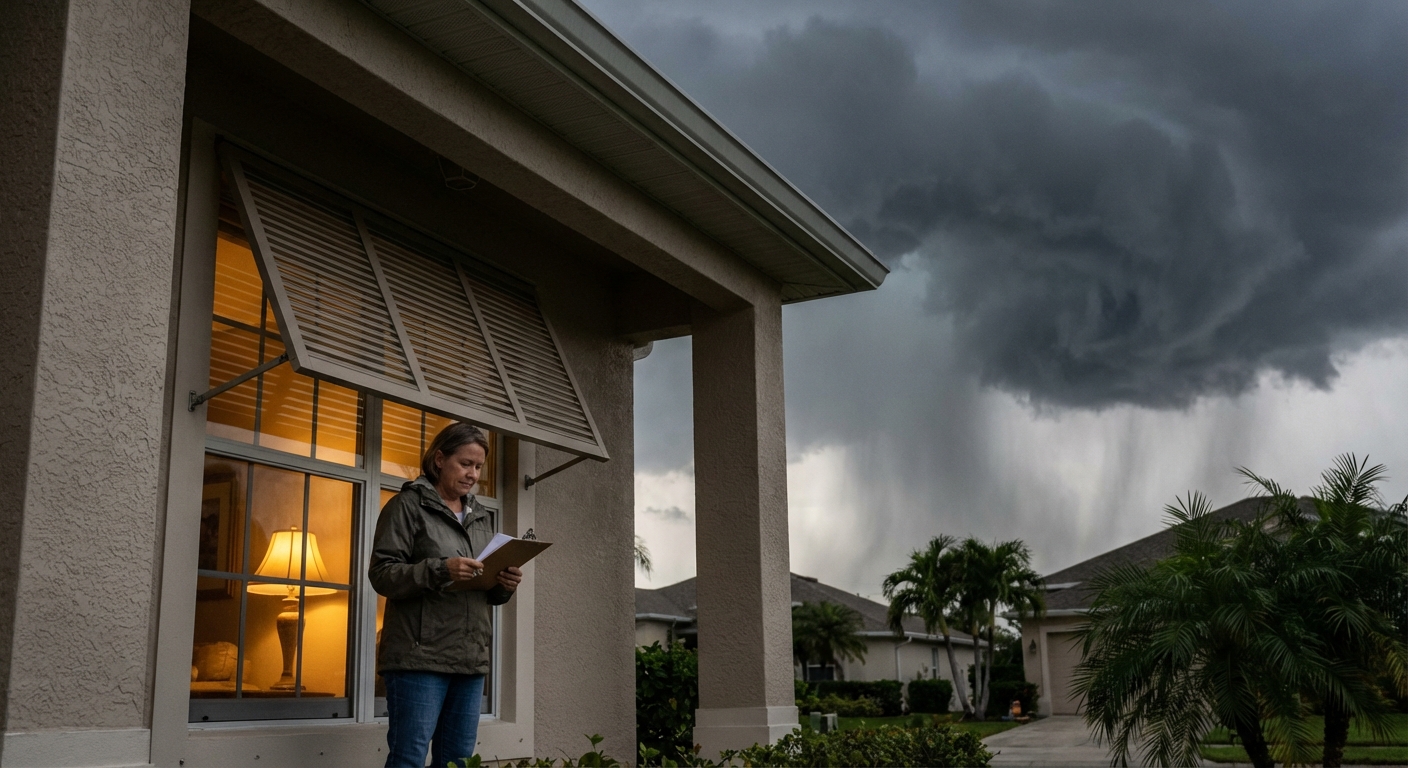
- Hurricane shutters and impact-resistant windows and doors (largest single discount, typically 15% to 30%+)
- Hip roof shape (5% to 10%)
- Roof-to-wall connections (hurricane straps or engineered retrofits, 5% to 15%)
- Secondary water resistance (sealed roof deck)
- FORTIFIED-certified roof systems
The My Safe Florida Home program continues to provide free inspections and matching grants for eligible upgrades, funded with hundreds of millions in recent state budgets. Homeowners in tornado and hail states can find similar credit opportunities in our severe convective storms guide and the broader wind damage coverage overview. If climate risk is driving your premium higher, our climate change and home insurance guide explains the national trends.
Frequently Asked Questions
Does standard homeowners insurance cover hurricane damage?
Yes, but only partially. Standard homeowners insurance covers wind damage, structural damage, and rain that enters through wind-created openings. It does not cover flooding, storm surge, or rising water caused by a hurricane. For complete protection, most coastal homeowners need both homeowners insurance and a separate flood insurance policy.
What is a hurricane deductible and how is it different from a regular deductible?
A hurricane deductible is a separate, percentage-based deductible that applies specifically when your home suffers damage from a named hurricane. Unlike a flat-dollar deductible (e.g., $1,000), a hurricane deductible is typically 1% to 10% of your dwelling coverage. On a $300,000 home with a 5% deductible, you would owe $15,000 before your insurer pays. It only triggers when an official hurricane watch or warning is issued by the National Hurricane Center.
Is flood insurance the same as hurricane insurance?
No, they are two distinct types of coverage. Hurricane coverage (inside your homeowners policy) covers wind-related damage. Flood insurance, typically purchased through the NFIP or private carriers, covers water inundation, storm surge, and rising water. A hurricane can cause both, which is why most coastal homeowners need both policies to be fully protected.
How much does hurricane insurance cost in Florida in 2026?
Florida homeowners insurance is projected to average about $8,458 per year statewide in 2026 on a $300,000 dwelling, the highest in the nation, and coastal counties like Miami-Dade, Broward, and Monroe often run $5,500 to $10,000 or more. For 2026, Citizens has an approved 8.8% average multiperil rate decrease (5.5% for wind-only) with cuts of 11% to 14% in the hardest-hit South Florida counties. Wind mitigation upgrades remain the single most effective way to reduce your premium.
Can hurricane shutters really lower my insurance premium?
Yes, and often dramatically. Installing impact-rated hurricane shutters or windows qualifies homeowners for wind mitigation discounts that can reduce the wind portion of the premium substantially, with combined mitigation upgrades cutting the wind premium by up to 80% to 88%. Under Florida's April 2026 mitigation form, any damaged or unrepaired opening (including garage doors and skylights) can disqualify these credits, so keep all protection in serviceable condition before your inspection.