
Compare Home Insurance Plans in Ohio
Find your best options in less than 2 minutes



What Homeowners Insurance Covers (and Doesn't) for Broken Windows
Whether a baseball just sailed through your living room window or last night's storm left a jagged mess in its wake, the first question most homeowners ask is: will insurance pay for this? The honest answer is that it depends entirely on what caused the damage.
Standard homeowners insurance is built to cover sudden, unexpected damage caused by specific events, known as "covered perils." Home insurance typically helps pay to repair damage from vandalism, hail, fire, theft and wind. Windows are part of your home's structure, so they typically fall under your dwelling coverage (Coverage A). But not every broken window qualifies. Understanding the distinction between covered perils and excluded causes is the key to avoiding a denied claim.
Covered Perils: When Insurance Will Pay
Here are the most common scenarios where your policy is likely to step in:
| Cause of Damage | Typically Covered? | Coverage Type Used |
|---|---|---|
| Windstorm / Hurricane | ✅ Yes | Dwelling Coverage |
| Hail | ✅ Yes | Dwelling Coverage |
| Falling tree branch / debris | ✅ Yes | Dwelling Coverage |
| Vandalism / Break-in | ✅ Yes | Dwelling Coverage |
| Fire or smoke damage | ✅ Yes | Dwelling Coverage |
| Vehicle or aircraft impact | ✅ Yes | Dwelling Coverage |
| Weight of ice, snow, or sleet | ✅ Yes | Dwelling Coverage |
| Neighbor's broken window (your fault) | ✅ Yes | Liability Coverage |
| Wear and tear / aging | ❌ No | Not Covered |
| Seal failure / fogged glass | ❌ No | Not Covered |
| Poor maintenance / neglect | ❌ No | Not Covered |
| Accidental self-caused breakage (standard policy) | ⚠️ Varies | Depends on Insurer |
When Home Insurance Will NOT Cover Broken Windows
Just as important as knowing what's covered is understanding what isn't. Insurers are explicit about these common exclusions:
- Wear and tear: Old, drafty, or deteriorating windows that have simply aged out are a homeowner maintenance responsibility, not an insurer's problem.
- Seal failure: If the seal between your double-pane window fails and causes fogging or condensation between panes, that's a manufacturer or maintenance issue, not a covered peril.
- Cracked or broken latches: Gradual mechanical failure is excluded under virtually all standard policies.
- Renovation or moving accidents: Homeowners insurance typically does not cover accidental breakage you cause to your own house. Breaking a window while renovating or moving furniture is usually excluded under standard HO-3 policies.
- Flood or earthquake damage: Unless you carry separate flood or earthquake insurance, water intrusion or seismic damage to windows is not covered under a standard policy.
This mirrors how structural damage claims work: coverage kicks in for sudden events, not gradual deterioration. Skipping routine home maintenance requirements can also void otherwise valid claims.

Compare Home Insurance Plans in Ohio
Find your best options in less than 2 minutes
Scenario Breakdown: Is Your Window Damage Covered?
Let's walk through the most common real-world scenarios homeowners face:
Storm Damage
A windstorm sends a tree branch crashing through your bedroom window. This is one of the clearest cases of a covered peril. Document the damage with photos, save any weather reports confirming the storm, and file your claim. Similarly, hail damage to windows is covered under most standard policies. Learn more about how tree damage claims work when falling branches are involved, and how wind damage deductibles may apply. Notably, the 2% wind/hail deductible has become the default across Texas and most storm-prone states, and homeowners should understand how wind and hail deductibles affect payouts before filing.
Break-In or Vandalism
If someone forces entry through a window or intentionally smashes your glass, your dwelling coverage applies. You'll want to file a police report immediately, since insurers almost always require this documentation to process vandalism-related claims. Vandalism claims typically raise premiums about 19% on average, so weigh the claim size carefully.
Accidental Damage
This one is tricky and depends heavily on your insurer. Under many standard HO-3 policies, accidentally breaking your own window (say, your child throws a ball through it) may not be covered. Some insurers treat this as excluded self-caused damage, while others with open-peril dwelling coverage will cover it as sudden accidental damage. If you have an HO-5 open-peril policy or a glass breakage endorsement (more on that below), accidental breakage is more likely to be included. Always check your declarations page and see our guide on accidental damage coverage for more detail.
During Moving or Renovation
Breaking a window while moving furniture or renovating is generally not covered unless it was caused by a sudden, unexpected event that qualifies as a covered peril. Most insurers treat this as self-caused accidental damage and deny the claim.
Just like roof replacement coverage, windows are covered based on the cause of damage, not just the fact that damage occurred.

Protect your home with State Farm
Average Rate:
Homeowners who bundle and save with State Farm save an average of $1,000 per year!

You're in Good Hands® with Allstate
Average Rate:
Get comprehensive home coverage with flexible policy options.

Customize your home coverage
Average Rate:
Only pay for the coverage you need with personalized home insurance.

Smart coverage for your home
Average Rate:
Protect what matters most with award-winning home insurance.
The Deductible Dilemma: Is Filing a Claim Worth It?
This is where most homeowners make costly mistakes. Before filing any broken window claim, run the numbers carefully.
Window Replacement Costs in 2026
Window replacement costs in the US in 2026 average roughly $750 to $1,050 per window installed, with many sources clustering around about $1,000 per window. Specifically, Modernize's 2026 analysis, based on more than 1 million real homeowner projects, puts the national average at $1,047 per window, while HomeAdvisor reports replacement costs ranging from $300 to $2,100 per window, with an average of $850. Vinyl replacement windows typically run $800 to $1,600 installed, fiberglass runs $1,100 to $2,200, and wood options run $1,100 to $2,200 or more.
| Window Type | Average Replacement Cost (Installed, 2026) |
|---|---|
| Standard double-hung | $478 – $2,412 |
| Casement window | $589 – $2,993 |
| Sliding window | $652 – $2,668 |
| Picture window | $300 – $1,000 |
| Bay or bow window | $3,554 – $10,245 |
| Custom / specialty glass | $1,000+ |
Most homeowners pay between $750 and $1,050 for a single standard window replacement in 2026, though prices in high-cost markets or for premium materials can run $1,300 or more per window.
Deductible vs. Payout: The Real Math
Many homeowners choose deductibles in the range of $500 to $2,000, with around $1,000 being a common choice, according to the Insurance Information Institute. Deductibles are also climbing fast: Matic's 2026 Home Insurance Predictions report found that the average home insurance deductible rose 22% in 2025, accelerating from an already steep 15% increase in 2024, a roughly 40% cumulative jump in just two years. If your deductible is $1,000 and a single broken window costs $850 to replace, you'd pay the entire amount out of pocket anyway. Filing the claim would accomplish nothing except potentially flagging your record with your insurer. Learn more about the rising home insurance deductible trend.
How Claims Affect Your Premium in 2026
Home insurance premiums are already climbing in 2026. The average annual premium is projected to increase 4% to about $3,057 this year, after jumping 12% in 2025, according to Insurify. A single home insurance claim raises your premium roughly 10% to 40% nationally, depending on state and claim type. NerdWallet's analysis shows filing one claim pushes the average premium from $2,490 to $2,750, a 10% increase, and larger or repeat claims can trigger 20 to 40%+ hikes or non-renewal in high-risk markets.
That means a single claim for a $900 window repair could easily cost you $1,000 to $2,500 more in premiums over the next 3 to 5 years. Similar financial calculus applies to water damage claims, where long-term premium impact often outweighs the payout. Homeowners should also weigh the fact that the top five carriers denied more than 44% of claims in recent WSJ analysis, making the risk of a denied-but-recorded claim very real. Understanding the full home insurance claims process can help you decide whether filing is the right move.
When to file:
- Damage costs significantly exceed your deductible
- Multiple windows were damaged in one event (single deductible applies)
- You have a clean claims history
- The damage is clearly a covered peril
When to pay out of pocket:
- Repair cost is at or below your deductible
- You've filed another claim recently
- The cause may not be covered (risking denial anyway)
How to Document & Prove Your Window Damage Claim
Documentation is everything in an insurance claim. Here's exactly what you'll need:
Step-by-Step Documentation Checklist
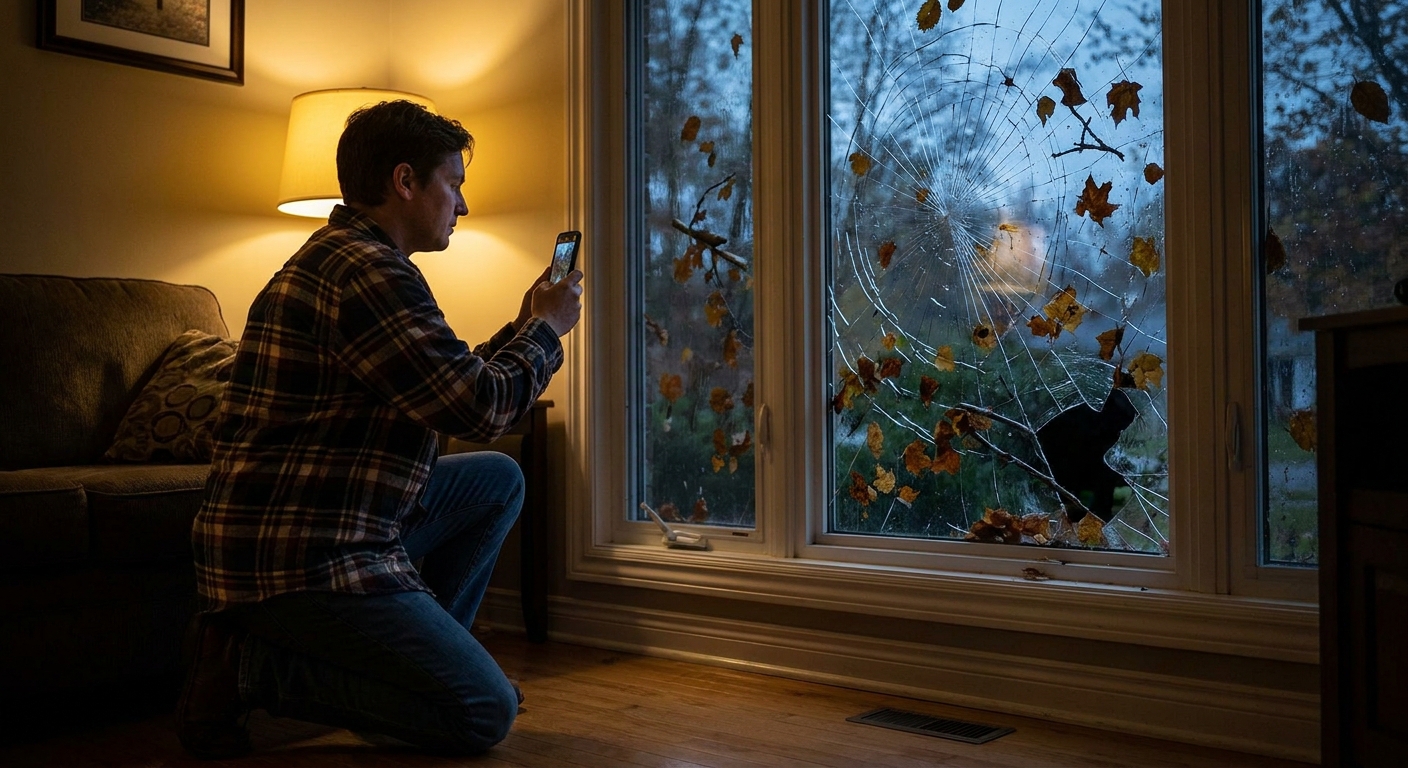
- Photograph everything immediately: capture the broken glass, the window frame, the surrounding area (inside and outside), and any debris that caused the damage.
- Write down the date, time, and cause: be specific and honest. Note what storm system hit, or when you discovered vandalism.
- Save weather reports or news coverage: for storm-related claims, official weather data is powerful proof of a covered peril.
- File a police report: mandatory for vandalism or break-in claims. Do this before touching or cleaning up the damage.
- Get at least two repair estimates: from licensed contractors or window specialists.
- Keep all receipts: including temporary boarding or tarping you do to prevent further damage.
- Document the cause, not just the damage: if a tree branch broke the window, photograph the branch at the scene before removing it.
How Insurers Verify Cause of Damage
Your insurance company will send an adjuster to inspect the damage. They're trained to distinguish sudden impact damage (covered) from gradual deterioration (excluded). Impact-caused breaks have distinct fracture patterns compared to age or seal failure. Supporting your claim with installer reports, weather service data, witness statements, and police reports can make the difference between approval and denial. This documentation strategy is equally important for appliance damage claims and other property insurance situations.
Special Glass Coverage: Endorsements Worth Knowing About
If you have high-value windows like large picture windows, custom glass, skylights, or historic leaded glass, a standard policy's dwelling coverage may not be enough.
Glass Breakage Endorsement (Building Glass Coverage)
A glass breakage endorsement, sometimes called building glass coverage, is an optional add-on that expands your coverage beyond standard peril limitations. In 2026, these endorsements typically cost $20 to $80 per year for basic limits and can include a lower glass-only deductible ($50 to $250) instead of your main homeowners deductible. Some carriers, like Farmers, offer a Residence Glass Coverage endorsement that removes the deductible for accidental window or patio door breaks entirely.
This type of endorsement is particularly valuable for homeowners with custom or older windows, and functions similarly to equipment breakdown coverage used for HVAC and appliance protection.
Replacement Cost vs. Actual Cash Value
One more key distinction: your policy may pay either replacement cost value (RCV) or actual cash value (ACV) for window damage.
- RCV: Pays the full cost to replace the window with a comparable new one, with no depreciation deducted.
- ACV: Pays what the window was worth at the time of damage, factoring in age and depreciation. A 15-year-old window may only pay out a fraction of its replacement cost.
Upgrading to RCV coverage (often available as an endorsement) is worth the additional premium if your home has older windows that could need full replacement after a major storm.
Frequently Asked Questions
Does home insurance cover a broken window from a rock?
If a rock was thrown intentionally, it's covered under vandalism. If it flew up from a lawnmower or passing vehicle, it may be covered as an accidental falling or flying object, but this depends on your specific policy type. Named-peril policies may not include this scenario, while open-peril policies are more likely to cover it. Document the damage thoroughly and contact your insurer to confirm coverage before assuming it applies.
Will homeowners insurance cover a broken window from a storm?
Yes, storm-caused window damage is one of the most clearly covered scenarios under standard homeowners insurance. Windstorms, hail, hurricanes, and falling tree branches are all recognized covered perils under most HO-3 policies. You'll need to document the damage with photos and provide weather data supporting the date and severity of the storm. One deductible applies even if multiple windows were broken in the same storm event, though be aware that percentage-based wind/hail deductibles (typically 2% of dwelling coverage) now apply in Texas and much of the Gulf and Atlantic coasts.
Is it worth filing a home insurance claim for one broken window?
In most cases, filing a claim for a single standard window replacement is not financially advisable. With the average 2026 window replacement costing around $750 to $1,050 and most deductibles set at $1,000, you'll likely owe most or all of the cost out of pocket anyway. Even when the repair does exceed your deductible, 2026 data shows a single claim raises premiums about 10% on average nationally, which can outweigh any payout over time. It usually makes more sense to file when multiple windows are damaged in a single event.
Does homeowners insurance cover broken window seals or fogged windows?
No, broken window seals and fogged or condensation-filled double-pane windows are explicitly excluded from standard homeowners insurance. These are considered gradual deterioration and maintenance issues, not sudden damage from a covered peril. No standard endorsement covers seal failure either. Homeowners should budget for this repair out of pocket, which typically costs $70 to $200 per window for resealing or several hundred dollars for full pane replacement.
What is a glass breakage endorsement and do I need one?
A glass breakage endorsement (also called building glass coverage) is an optional add-on to your homeowners policy that covers window damage from accidental breakage and other scenarios not covered under a standard policy. In 2026, these endorsements typically cost $20 to $80 per year and often include a lower glass-only deductible, or in some cases no deductible at all. It's especially beneficial for homeowners with custom, large, or high-value windows such as picture windows, skylights, or specialty glass doors. If your home has windows that would cost $1,000 or more to replace, the endorsement is likely worth the modest additional premium.