
Compare Home Insurance Plans in Ohio
Find your best options in less than 2 minutes



When Home Insurance Does (and Doesn't) Cover Appliances
Understanding how your homeowners insurance treats appliances comes down to one key distinction: what caused the damage. Standard home insurance is built to protect you from sudden, unexpected events, not the inevitable wear and aging of everyday household equipment. A typical homeowners policy does not cover appliances that simply stop working or break down mechanically or electrically, but it does cover appliances damaged by covered perils like fire, lightning, wind, hail, theft, and vandalism.
Your appliances fall into two coverage buckets depending on how they're installed:
- Personal property coverage for portable plug-in appliances like refrigerators, washers, dryers, and microwaves
- Dwelling coverage for built-in systems like HVAC, furnaces, and water heaters that are permanently attached to your home
Coverage applies only when a covered peril causes the damage. Here's a quick look at what that means in practice:
| Covered Peril | Example Appliance Scenario |
|---|---|
| Fire or lightning | Kitchen fire destroys your refrigerator |
| Theft or vandalism | Washer stolen from an unlocked garage |
| Windstorm or hail | Storm damages an outdoor HVAC unit |
| Smoke damage | Smoke from a house fire ruins appliances |
| Sudden water discharge | Burst pipe soaks your washer and dryer |
All claims are subject to your deductible, and payout is based on either actual cash value (ACV) or replacement cost value (RCV) depending on your specific policy.

Compare Home Insurance Plans in Ohio
Find your best options in less than 2 minutes
What Home Insurance Does NOT Cover: Standard Exclusions
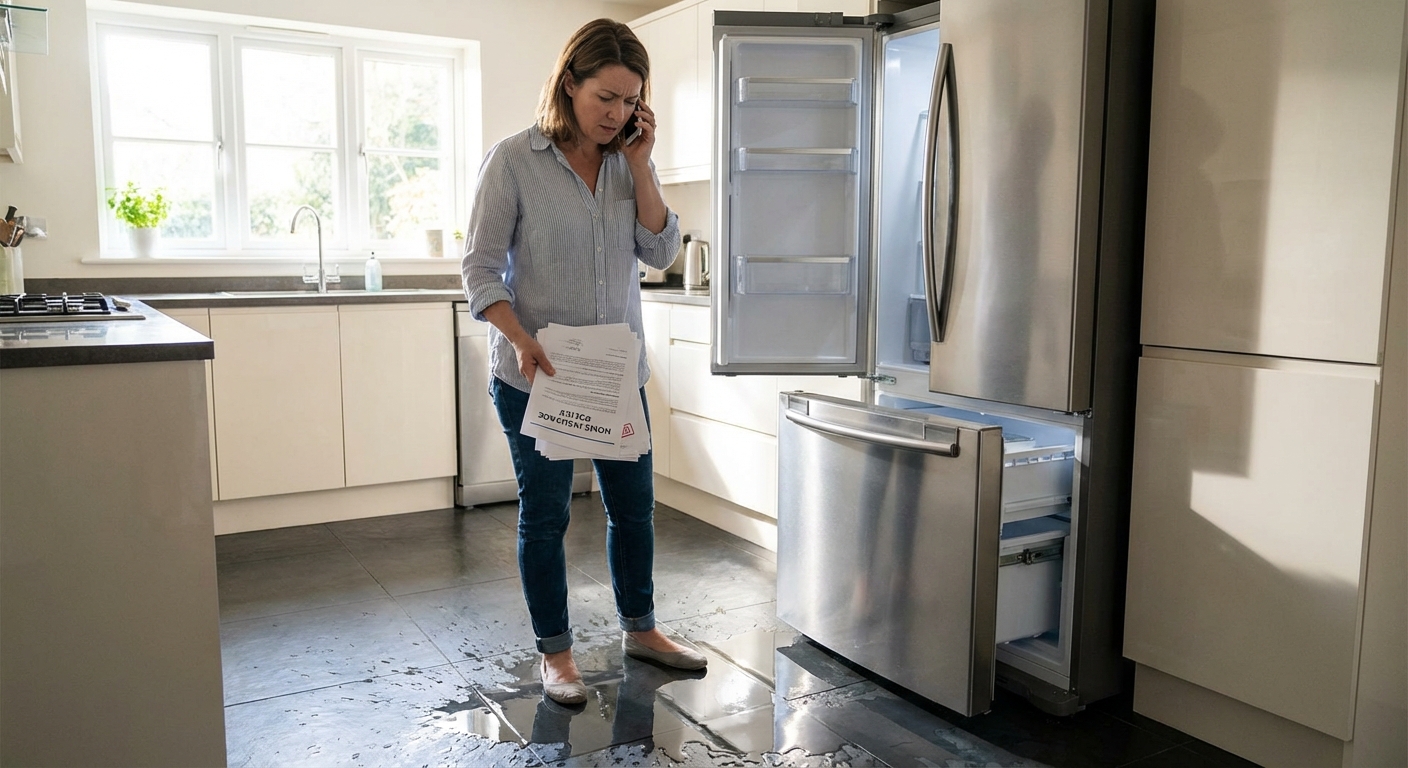
This is where most homeowners get surprised. The majority of everyday appliance failures are explicitly excluded from standard homeowners policies. If a refrigerator compressor burns out, a washing machine's motor fails, or the AC stops due to an internal electrical problem, the base homeowners policy normally does not pay for repair or replacement.
The Big Three Exclusions
1. Mechanical Breakdown
If an appliance fails due to an internal mechanical issue (a seized motor, a failed compressor, a broken pump) that's considered a mechanical breakdown. Home insurance is not designed to cover the natural failure of machinery, regardless of how expensive the repair is. According to 2026 insurance data, a single HVAC compressor failure can run around $4,000 out of pocket without an endorsement.
2. Wear and Tear
Gradual deterioration from regular use is never covered. A dishwasher that becomes inefficient over time, a dryer drum that wears down after years of loads, or an HVAC system that loses efficiency as it ages are all maintenance realities, not insurable events. Learn more about common home insurance exclusions that surprise most homeowners.
3. Neglect and Improper Maintenance
Insurers can and will deny claims where damage resulted from a failure to properly maintain equipment. For example, an air conditioner that stops working because of a clogged air filter would not be covered under equipment breakdown insurance either. A water heater that slowly leaks for months before failing falls squarely into this category.
Other Common Exclusions

Protect your home with State Farm
Average Rate:
Homeowners who bundle and save with State Farm save an average of $1,000 per year!

You're in Good Hands® with Allstate
Average Rate:
Get comprehensive home coverage with flexible policy options.

Customize your home coverage
Average Rate:
Only pay for the coverage you need with personalized home insurance.

Smart coverage for your home
Average Rate:
Protect what matters most with award-winning home insurance.
Covered vs. Not Covered: Real-World Scenarios
To make this concrete, here are side-by-side examples of how actual appliance situations are typically handled under standard homeowners insurance.
What About HVAC Specifically?
Your HVAC system is one of the most expensive items in your home. Homeowners nationwide are spending anywhere from $5,000 to $28,000 for a full HVAC replacement this year, and for a basic central air conditioning and furnace replacement in an average-sized 2,000 square foot home, many homeowners are landing somewhere in the $7,000 to $20,000 range. Recent 2026 contractor data puts the national installed average between $11,590 and $14,100, with many 2,000 to 2,500 square foot homes landing around $13,430. Because HVAC is permanently installed, it falls under dwelling coverage. It's covered if a hailstorm destroys the outdoor condenser unit or a fire damages the system, but if the compressor simply burns out after 10 years of use, you're paying out of pocket. Read our full guide on HVAC and home insurance for more detail.
For AC-specific scenarios, our AC unit coverage explainer walks through central and window unit rules, including 2026 R-454B refrigerant pricing impacts.
Equipment Breakdown Coverage: The Affordable Fix
The good news is that there's a solution specifically designed to fill this gap: the equipment breakdown endorsement. This optional add-on to your existing homeowners policy covers sudden and accidental mechanical, electrical, or pressure system failures, exactly what a standard policy leaves out.
What It Covers
Equipment breakdown coverage can be added to your homeowners insurance policy to help protect you from sudden mechanical, electrical, or pressure system failures in your home. It typically helps cover heating and air conditioning (HVAC) systems, furnaces and boilers, refrigerators and freezers, washing machines and dryers, dishwashers, water heaters, home security systems, riding lawn mowers, pool equipment, well pumps, and smart home devices and home entertainment systems. Insurers in 2026 have expanded coverage to include modern connected devices. Common triggers include:
- Power surges or short circuits (including damage when electricity is restored after an outage)
- Motor burnout
- Sudden mechanical failure (not gradual)
- Electrical arcing
- Ruptures in pressure systems
Covered items typically include refrigerators, dishwashers, ovens, washers, dryers, HVAC systems, furnaces, water heaters, computers, smart home hubs, doorbell cameras, home entertainment systems, and even solar panels depending on the insurer.
Many policies also include food spoilage reimbursement when your refrigerator or freezer breaks down suddenly. Learn more about food spoilage coverage limits and how it can protect your grocery investment.
What It Does NOT Cover
Typical exclusions include normal wear and tear (gradual deterioration of equipment over time), rust, corrosion, or decay (damage caused by aging or environmental exposure), cosmetic damage (dents, scratches, or other issues that don't affect function), and pre-existing conditions (equipment that was already broken or malfunctioning before the policy began). It's designed for sudden failures, not gradual decline.
2026 Cost Breakdown
| Insurer | Approx. Annual Cost | Coverage Limit | Deductible |
|---|---|---|---|
| Nationwide | ~$39 to $45 | $50,000/occurrence | $500 |
| American Family | ~$30 | $100,000 typical | $500 |
| Lemonade | ~$36 | $100,000/occurrence | $500 |
| The Hartford | ~$25 to $50 | Varies by policy | Varies |
| Tower Hill | ~$50 | $100,000/occurrence | $500 |
| Industry Average | ~$25 to $50 | $50,000 to $100,000 | $500 |
Equipment breakdown coverage generally costs from $25 to $50 per year, and frequently has a coverage limit around $50,000 to $100,000 with a common deductible of $500. For most homeowners, adding an equipment breakdown endorsement is one of the most cost-effective add-ons available. Some carriers, like The Hartford, will pay up to 125% of replacement cost when you upgrade to more energy-efficient equipment after a covered claim, and other insurers may pay up to 150% for greener replacements.
Home Insurance vs. Home Warranty for Appliances
These two products are frequently confused, and that confusion can leave homeowners with an unexpected repair bill. A home warranty costs about $60 to $73 per month on average in 2026, though prices can range from as low as $28 to as high as $191 per month. Service fees add to the cost, averaging around $108 per service call, and the typical annual outlay lands between $672 and $876 in premiums alone. Broader industry surveys put the typical premium range at $30 to $90 per month with service fees usually between $75 and $125 per visit.
Here's how the two products compare in 2026:
| Home Insurance | Home Warranty | |
|---|---|---|
| What triggers coverage | Sudden perils (fire, storm, theft) | Wear, tear, and mechanical breakdown |
| Appliance coverage | Only from a covered peril | Breakdowns from normal use |
| Annual cost | Part of your premium | ~$672 to $900/year avg. |
| Per-claim cost | Your deductible | $75 to $150 service fee |
| Excludes | Wear and tear, breakdowns | Pre-existing issues, disasters |
| Best for | Large unexpected losses | Routine appliance failures |
Which Do You Actually Need?
The answer for most homeowners is: both, but for different reasons.
- Home insurance protects you from catastrophic losses like a house fire, a major storm, or theft.
- A home warranty protects you from the predictable reality of aging appliances and systems breaking down from normal use.
They don't overlap. They complement each other. If your washing machine breaks down after 8 years of use, a home warranty handles it. If that same washer is destroyed in a fire, your homeowners insurance handles it. For a deeper comparison, read our full guide on home insurance vs. home warranty.
If you're weighing whether the endorsement alone is enough, our deep dive on what equipment breakdown coverage includes walks through covered systems, sublimits, and green-upgrade allowances in more detail.
Frequently Asked Questions
Does home insurance cover a broken refrigerator?
Only if the refrigerator was damaged by a covered peril such as a house fire, lightning strike, or theft. Standard homeowners insurance does not cover a refrigerator that stops working due to a compressor failure, internal mechanical breakdown, or wear and tear. If you want coverage for those everyday failures, you'll need an equipment breakdown endorsement or a home warranty. Many policies include food spoilage reimbursement with sublimits ranging from $500 to $2,500 when the loss is tied to a covered peril, and some equipment breakdown endorsements offer up to $3,000 for sudden failures.
Does homeowners insurance cover HVAC breakdown?
No, standard home insurance will not pay to repair or replace an HVAC system that breaks down from mechanical failure, age, or lack of maintenance. However, your HVAC is covered under dwelling coverage if it's damaged by a named peril such as a lightning strike, hailstorm, fire, or a fallen tree. With average 2026 HVAC replacement costs landing between $11,590 and $14,100 (and up to $28,000 for premium systems), adding an equipment breakdown endorsement to your homeowners policy is often worth the small annual premium.
Does home insurance cover washer and dryer breakdown?
Washing machines and dryers are covered under personal property only when damaged by a covered peril like a fire, flood from a burst pipe, or theft. If your washer simply stops working after years of use, that's considered a mechanical breakdown or wear and tear, which is excluded from standard policies. An equipment breakdown endorsement or a home warranty would be the appropriate coverage for routine breakdowns.
What is equipment breakdown coverage and is it worth it?
Equipment breakdown coverage is an optional endorsement you can add to your homeowners policy for roughly $25 to $50 per year in 2026. It covers sudden and accidental mechanical or electrical failures in appliances and home systems that a standard policy excludes, including motor burnouts, power surges, and short circuits. Given that a single HVAC compressor repair can cost around $4,000 or more, most homeowners with newer, higher-value appliances or smart home devices will find it well worth the modest annual cost.
What's the difference between appliance insurance and a home warranty?
The terms are sometimes used interchangeably, but a home warranty is a service contract (not insurance) that covers the repair or replacement of appliances and systems that break down from normal wear and tear. Appliance insurance or equipment breakdown coverage is an endorsement added to your homeowners policy and typically covers sudden, accidental failures like electrical surges. In 2026, a home warranty averages about $60 to $73 per month plus a service fee of around $108 per visit, while equipment breakdown coverage is far cheaper but more narrowly focused on sudden failures rather than age-related decline.