
Compare Home Insurance Plans in Ohio
Find your best options in less than 2 minutes



When Home Insurance Covers Structural Damage And When It Doesn't
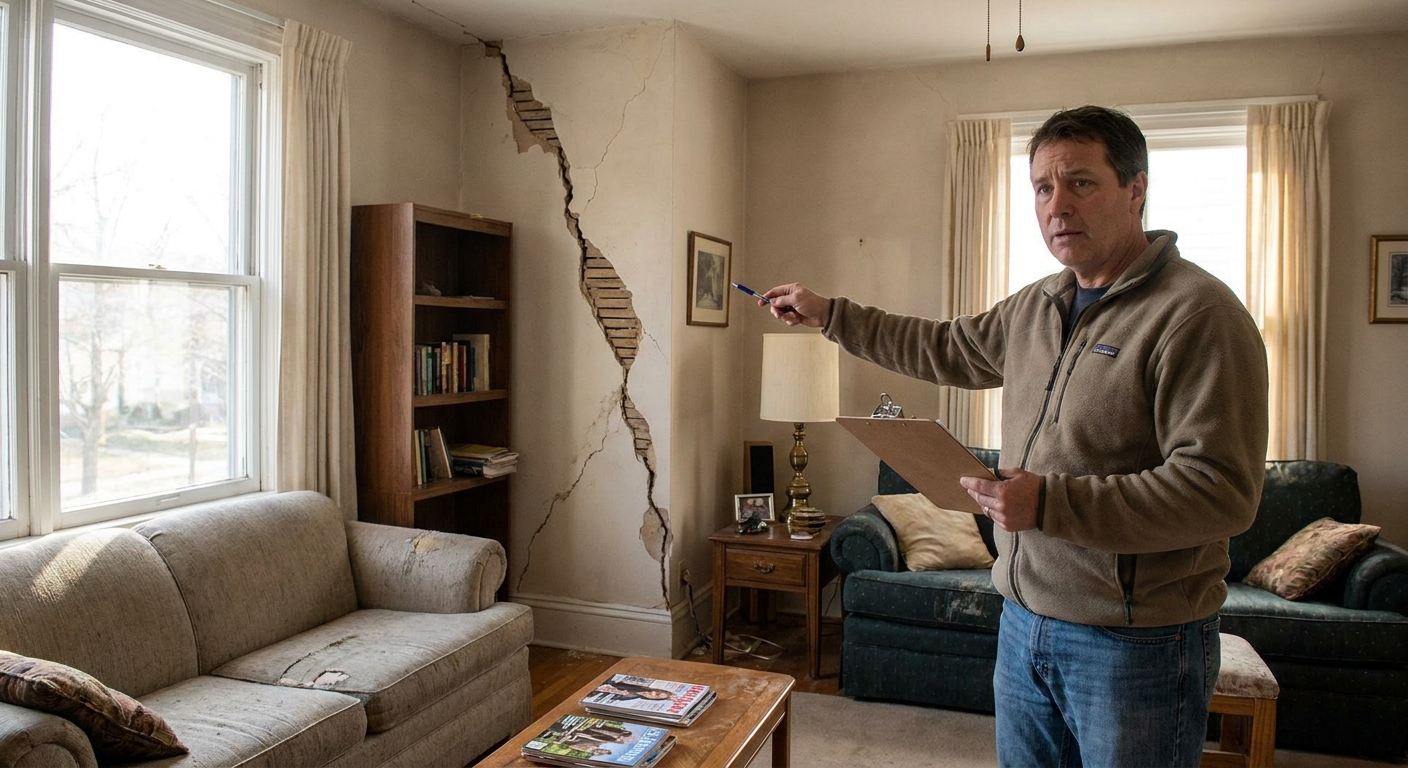
Does home insurance cover structural damage? The short answer is: sometimes. Standard homeowners insurance covers structural damage caused by sudden and accidental events, but it draws a hard line at gradual deterioration, neglect, and earth movement. Knowing which side of that line your damage falls on can mean the difference between a fully covered repair and a five-figure out-of-pocket bill. With foundation repair now averaging around $5,175 nationally in 2026 (typical range $2,225 to $8,133) and severe structural work involving piers or full replacement running $15,000 to $100,000+, the stakes are only rising.
Covered Events: What Triggers a Valid Structural Claim
Homeowners insurance dwelling coverage (Coverage A) protects your home's structure (walls, roof, floors, attached structures) when damage is caused by a covered peril. The most common covered events that can cause structural damage include:
| Covered Event | Example of Structural Damage |
|---|---|
| Fire or lightning | Burned load-bearing beams, fire-weakened framing |
| Windstorm or hail | Roof collapse, blown-out walls from tornado |
| Weight of ice or snow | Roof cave-in from excessive snow load |
| Vehicle impact | A car strikes your garage, cracking the foundation wall |
| Sudden water damage | Burst pipe floods subfloor, warping structural joists |
| Explosion | Gas explosion damages load-bearing walls |
| Falling objects | Tree branch crashes through roof framing |
Understanding water damage coverage is particularly important, since burst pipes are one of the most common structural damage triggers, and coverage depends entirely on whether the water event was sudden and accidental.
What Home Insurance Does NOT Cover
Just as important is knowing what's excluded. Standard policies will not cover structural damage resulting from:
- Foundation settling or earth movement: Natural soil shifts, subsidence, and settling are universally excluded from standard policies. Learn more about foundation coverage exclusions and what it takes to qualify for a covered foundation claim.
- Wear and tear or gradual deterioration: Damage that develops slowly over time is considered a maintenance issue, not a covered loss.
- Poor construction or design defects: If the structure was improperly built, that's a contractor liability issue, not your insurer's problem.
- Neglect or lack of maintenance: Failing to address known issues (like a leaking roof) that eventually causes structural damage can result in full claim denial. Avoiding claim denials starts with staying on top of routine upkeep, especially now that the five largest carriers close more than 44% of claims without payment (Farmers alone at 52%, USAA at 51%, Allstate at 47%).
- Floods and earthquakes: These require entirely separate policies. Standard dwelling coverage does not apply.
Covered vs. Excluded: Side-by-Side Scenarios

Compare Home Insurance Plans in Ohio
Find your best options in less than 2 minutes
Structural Damage vs. Cosmetic Damage: Why It Matters More in 2026
Insurers make a critical distinction between structural (functional) damage and cosmetic damage, and it directly affects whether your claim gets paid. According to a 2026 ZestyAI analysis, cosmetic damage and anti-matching provisions among the top 10 carriers jumped from 20% adoption in 2015 to 90% in 2025, and across roughly 60 carriers reviewed in catastrophe-exposed states, 49% now include cosmetic damage exclusions.
- Structural damage compromises your home's safety, stability, weather resistance, or material longevity. Examples include cracked foundations, sagging roofs, rotted support beams, or a compromised roofing membrane that allows water intrusion.
- Cosmetic damage affects only the appearance of your home (dents on metal roofing, surface scratches, minor discoloration) without impairing function or integrity.
Coverage typically turns on whether the damage affects the roof's ability to act as a barrier, not whether the roof looks damaged. If hail dents your metal roof but does not puncture it or cause a leak, most 2026 policies will deny the claim under a cosmetic exclusion. Illinois, Minnesota, and other hail-belt states have seen a notable rise in these exclusions, along with a broader shift from Replacement Cost Value (RCV) to Actual Cash Value (ACV) for older roofs. ZestyAI's 2026 review found ACV roof endorsements have jumped six-fold in the past decade, and 93% of carriers in catastrophe-exposed states now apply percentage-based wind and hail deductibles.
There is also meaningful regulatory and legal pushback. Connecticut's Insurance Department reaffirmed in February 2026 that aerial images showing cosmetic conditions like natural discoloration or streaking should not, by themselves, be used to refuse renewal. In August 2026, the Eighth Circuit rejected the idea that a cosmetic exclusion applies automatically just because a roof isn't leaking, focusing instead on whether present functional performance is impaired. If your roof replacement claim is denied as "cosmetic," you have the right to request an independent engineering assessment. Hail-prone homeowners should also read up on hail damage coverage before filing.

Protect your home with State Farm
Average Rate:
Homeowners who bundle and save with State Farm save an average of $1,000 per year!

You're in Good Hands® with Allstate
Average Rate:
Get comprehensive home coverage with flexible policy options.

Customize your home coverage
Average Rate:
Only pay for the coverage you need with personalized home insurance.

Smart coverage for your home
Average Rate:
Protect what matters most with award-winning home insurance.
How Insurers Investigate Structural Damage Claims
When you file a structural damage claim, your insurer doesn't simply take your word for it. Denial rates have climbed sharply. A May 2026 Wall Street Journal analysis found the five biggest home insurers didn't pay out on more than 44% of claims resolved in 2025, up from about 36% a decade ago, and a Weiss Ratings review identified 15 large U.S. insurers that closed 49.7% or more of their 2025 homeowner claims with no payment. Here's what to expect during the investigation:
The Claims Investigation Process
1. Initial File Review The insurer documents the reported cause, date, and location of damage and reviews your submitted photos and description for consistency with your policy's covered perils.
2. On-Site Inspection by an Adjuster or Engineer A field adjuster, and in complex cases a forensic engineer, will physically inspect your property, looking at:
- Structural integrity of walls, roof framing, floors, and foundation
- Signs of the triggering event (impact marks, water staining patterns, storm damage patterns)
- Age indicators: fresh breaks vs. worn or weathered edges
- Hidden damage using tools like moisture meters, thermal imaging cameras, and drone aerial imagery
3. Evidence Review & Causation Analysis Investigators review your maintenance history, construction records, prior claims (via the CLUE report), and weather data to establish whether the damage was sudden or gradual.
4. Internal Review & Decision Post-inspection, the claim estimate goes through supervisory review, where scopes may be narrowed or additional documentation requested. Many states require insurers to make a decision within 15 to 60 days of receiving full documentation.
Proving Sudden Damage vs. Pre-Existing Conditions
One of the most common battlegrounds in structural claims is whether the damage is new or pre-existing. Insurers now use AI tools, drone footage, and satellite imagery to compare property conditions across years, so building a strong evidence trail matters more than ever.
Build Your Evidence Before Damage Occurs
| Documentation Type | What It Proves |
|---|---|
| Annual photo/video walkthrough | Pre-loss condition of structure |
| Maintenance receipts & contractor invoices | Active upkeep, no known neglect |
| Home inspection reports | Baseline condition at purchase |
| Weather service records | Confirms storm event, date, and severity |
| Neighbor or contractor witness statements | Third-party confirmation of sudden event |
What Adjusters Look For to Deny Pre-Existing Claims
- Mold or rotting wood behind walls, which takes considerable time to develop
- Moss growth or multiple missing shingles, indicating prolonged exposure
- Multiple patches or prior repairs, suggesting recurring problems rather than sudden damage
- Thermal imaging showing moisture intrusion patterns inconsistent with a recent event
If your claim is disputed, you can hire a public adjuster or independent structural engineer to provide a second opinion. Understanding what your policy doesn't cover can also help you navigate disputes more effectively.
Common Reasons Structural Claims Are Denied
Be aware that structural exclusions are only part of the picture. Related risks like tree damage from storms, basement flooding, and ice dam damage all have their own coverage nuances that can affect structural claims.
Optional Coverages That Can Fill the Gaps
Ordinance or Law Coverage
When a covered peril damages your home, local building codes may require you to rebuild damaged areas to current standards, even if that means upgrading undamaged portions of the structure. Standard dwelling coverage won't pay for those upgrades. That's where ordinance or law coverage steps in.
This endorsement typically covers three scenarios:
- Upgraded repairs to damaged areas (new electrical wiring, HVAC standards, fire-rated materials)
- Demolition of undamaged portions if codes require tearing down the entire structure
- Debris removal costs for required demolition
Most policies include ordinance coverage at 10% of your dwelling limit by default, with the option to increase to 25%, 50%, or even 100% by endorsement. On a $400,000 home, 10% coverage provides $40,000 toward code-compliance upgrades, while 25% would provide $100,000 and 50% would provide $200,000. The Zebra estimates ordinance or law coverage averages about $66 per year for $40,000 of coverage, while most homeowners pay roughly $50 to $150 per year to add or increase the endorsement. Florida is especially strict: F.S. § 627.7011(5) requires insurers to offer 25% and 50% limits, and absent a written refusal, the policy is deemed to include 25% automatically. For older homes and areas with strict updated codes (seismic, wildfire, energy efficiency), boosting this limit is often one of the highest-value endorsements you can add.
Other Endorsements Worth Considering
- Sinkhole insurance: Covers ground movement and structural damage from sinkholes, excluded from standard policies
- Earthquake insurance: Covers structural damage from seismic events, especially critical in California and the Pacific Northwest
- Service line coverage: Protects underground utility lines that can shift and affect your home's structure
- Water backup endorsement: Covers sewer and drain backups that can lead to water damage claims and structural rot
Reviewing your dwelling coverage limits is equally important. If your home is underinsured, even a fully approved structural claim may leave you short of the funds needed to rebuild, especially as construction costs continue to outpace inflation. Learn more about Coverage A through F basics to make sure your limits reflect current rebuild costs.
Frequently Asked Questions
Does home insurance cover foundation structural damage?
Home insurance covers foundation damage only when it's caused by a covered peril, such as a burst pipe, explosion, or falling object that directly impacts the foundation. The vast majority of foundation problems (settling, soil movement, hydrostatic pressure) are excluded. With average foundation repair costs running about $5,175 in 2026 and severe pier-and-underpinning work reaching $15,000 to $45,000, this is a critical gap to understand. Learn more in our guide to foundation coverage and exclusions.
What's the difference between structural damage and cosmetic damage in an insurance claim?
Structural damage compromises your home's safety, stability, or ability to resist the elements (sagging roofs, cracked load-bearing walls, rotted floor joists). Cosmetic damage is purely aesthetic (dents, discoloration, or surface scratches that don't affect function). Insurers will cover structural damage from covered perils, but 90% of top 10 carriers now include cosmetic exclusions that limit payouts for appearance-only damage, especially on metal or impact-resistant roofs. Always get an independent assessment if you believe functional damage is being misclassified.
Can my structural damage claim be denied even if a storm caused it?
Yes. Claims are still denied if documentation is inadequate, the damage is deemed pre-existing, or maintenance neglect is found to be a contributing factor. For example, if your roof was already in poor condition before a storm hit, the insurer may argue the storm only worsened a pre-existing problem. With Farmers closing 52% and USAA 51% of claims without payment in 2025 per WSJ reporting, strong pre-loss documentation (photos, maintenance records, inspections) is your best defense against this outcome.
Does ordinance or law coverage pay for building code upgrades after structural repairs?
Yes. Ordinance or law coverage is specifically designed to pay for code-required upgrades when repairing or rebuilding after a covered loss. This includes upgraded electrical, plumbing, insulation, and even the demolition of undamaged portions if local codes require full teardown. Standard dwelling coverage does not include these costs, and adding or increasing the endorsement typically costs only about $50 to $150 per year for meaningful coverage.
How long do I have to file a structural damage claim?
Most policies require you to file within 30 to 90 days of discovering the damage, though this varies significantly by insurer and state. Under Florida Statute § 627.70132, homeowners must file the initial property claim within 1 year of the date of loss and any supplemental claim within 18 months, while Oklahoma's HB 3495 now allows 24 months for hidden hail damage claims. Filing late is a leading cause of claim denial, so report damage as soon as it's safe to do so, take photos immediately, and follow up in writing.