
Compare Home Insurance Plans in Ohio
Find your best options in less than 2 minutes



What Homeowners Insurance Actually Covers (and Why It's Limited)
Foundation damage is one of the most expensive structural repairs a homeowner can face, and also one of the most misunderstood from an insurance perspective. The short answer: homeowners insurance may cover foundation damage, but only when a sudden, accidental covered peril is the direct cause. Most foundation problems don't qualify.
Your standard HO-3 or HO-5 policy treats your foundation just like any other part of the dwelling structure. If a covered event causes the damage, Coverage A (dwelling coverage) kicks in, typically up to your full dwelling limit. But the moment the cause shifts to gradual deterioration, earth movement, poor construction, or neglect, that coverage disappears entirely. This is the same logic that applies to most structural damage claims.
Covered Perils vs. Excluded Causes
Understanding this single distinction is the most important thing you can take away from this guide.
What IS Covered
Foundation damage is typically covered when it results directly from one of these sudden, accidental events:
| Covered Peril | Example Scenario |
|---|---|
| Burst pipes / plumbing rupture | A pipe under your slab suddenly bursts, eroding soil and cracking the foundation |
| Fire or lightning | A fire weakens the structural base of the home |
| Windstorm or tornado | High winds shift or collapse part of the structure onto the foundation |
| Falling objects | A tree crashes into your home during a storm, damaging the foundation |
| Explosion | A gas explosion cracks the slab or foundation walls |
| Vehicle or aircraft impact | A vehicle crashes into the base of your home |
| Vandalism | Deliberate damage to the foundation structure |
| Weight of ice, snow, or sleet | Excess weight causes structural failure on the foundation |
What Is NOT Covered
The following causes are explicitly excluded in virtually every standard homeowners insurance policy, and they represent roughly 85% of real-world foundation problems:
- Settling and soil movement. Natural ground shifting over time is excluded under "earth movement" clauses
- Gradual deterioration and wear and tear. Foundations degrade over decades; insurers won't pay for age-related damage
- Flooding. External water intrusion and hydrostatic pressure require a separate flood insurance policy
- Earthquakes. Earth movement from seismic activity is a hard exclusion; requires a separate earthquake policy
- Sinkholes. Excluded from standard policies in most states (Florida has specific rules covered below)
- Poor construction or design defects. Builder errors or pre-existing issues are not insurable events
- Tree root intrusion. Slow structural compromise from roots is considered gradual damage
- Pest or animal damage. Termite or rodent damage to your foundation is not covered
- Neglect or improper drainage. If you failed to maintain gutters, grading, or drainage, expect a denial
For a broader look at what's commonly left out of standard policies, see our breakdown of common home insurance exclusions and our guide to water damage coverage that protects your claims.

Compare Home Insurance Plans in Ohio
Find your best options in less than 2 minutes
Foundation Water Damage and Slab Leak Coverage
Two scenarios that create real coverage complexity are foundation water damage and slab leaks, because the cause matters enormously.
Foundation Water Damage
Water damage to a foundation is only covered when the source is a sudden, internal plumbing event, such as a pipe bursting under or near the slab. If a sudden rupture causes water to saturate the soil beneath your foundation and crack the slab, your insurer may cover the resulting structural damage. However, if the water comes from external flooding, rising groundwater, or a slow leak you ignored for months, the claim will be denied. Learn more about the full rules around covered water damage events.
Slab Leak Coverage
A slab leak (a leak in the plumbing pipes running beneath your concrete slab) is one of the more nuanced scenarios in home insurance foundation coverage. Based on 2026 Angi, HomeAdvisor, and This Old House data, the average slab leak repair now runs about $2,280, with a typical range of $630 to $4,400, and tough-to-access leaks reaching $6,750. Detection alone runs $150 to $600 in most markets. In high-cost metros like Dallas, direct slab repair jobs commonly land between $7,000 and $9,000, and full tunnel repairs run $8,400 to $9,200 per 10 linear feet. Here's how coverage typically breaks down:
The key nuance: your insurer will likely cover the resulting damage (damaged flooring, drywall, structural elements) but will not pay to repair or replace the pipe itself. That's treated as a plumbing maintenance issue. A service line coverage endorsement may help cover underground pipe repairs.

Protect your home with State Farm
Average Rate:
Homeowners who bundle and save with State Farm save an average of $1,000 per year!

You're in Good Hands® with Allstate
Average Rate:
Get comprehensive home coverage with flexible policy options.

Customize your home coverage
Average Rate:
Only pay for the coverage you need with personalized home insurance.

Smart coverage for your home
Average Rate:
Protect what matters most with award-winning home insurance.
How to Maximize Your Chances of a Covered Claim
If you believe a covered peril caused your foundation damage, here's how to give your claim the best possible shot at approval, especially given that nearly half of homeowner claims at top insurers are now closed without payment.
Step 1: Review Your Policy First
Before you do anything, pull out your declarations page and read the perils listed under Coverage A. Confirm the cause of damage is listed as a covered event and not excluded.
Step 2: Document Everything Immediately
Take timestamped photos and video of all visible damage, the source of the problem (burst pipe, fallen tree, etc.), and surrounding areas. The faster you document, the stronger your claim.
Step 3: Get a Structural Engineer's Report
This is arguably the most important step. A licensed structural engineer or foundation specialist can produce a report that attributes the damage to a specific, sudden cause. With insurers using more automated claim evaluation tools and applying exclusions more aggressively in 2026, an independent engineering report is often the single piece of evidence that flips a denial into an approval.
Step 4: File Promptly and Be Specific
When filing, describe the event clearly: date, time, what happened, and which covered peril applies. Vague claims invite denial. Attach your documentation, photos, and any contractor or engineer report.
Step 5: Request a Supplemental Inspection If Denied
If your claim is denied, you can appeal. Bring additional supporting evidence, and consider requesting an independent adjuster or public adjuster to reassess. Our guide on common exclusions walks through the most frequent denial reasons and how to counter them. Your state's insurance department can also be a resource if you believe the denial was improper.
The Cost Reality: What You'll Pay Without Coverage
Because most foundation damage is excluded from standard policies, the majority of homeowners pay for repairs completely out of pocket. Here's what you can expect based on 2026 data from Angi, NerdWallet, This Old House, and HomeAdvisor:
| Repair Type | Average Cost Range (2026) |
|---|---|
| Minor crack repair | $250 to $800 |
| Waterproofing / sealing | $2,000 to $7,300 |
| Slab jacking / mudjacking | $550 to $1,450 |
| Bowing or leaning walls | $4,000 to $12,000 |
| Piering / underpinning (per pier) | $1,000 to $3,000 |
| Foundation lifting | $20,000 to $23,000 |
| Full foundation replacement | $20,000 to $100,000+ |
National average for foundation repairs in 2026: about $5,179, with a typical range of $2,224 to $8,134 per project, according to This Old House and Angi's latest 2026 pricing data (Fixr and HomeAdvisor cluster within $50 of that figure). Severe structural cases with extensive pier installation commonly run $15,000 to $45,000, and major overhauls can exceed $30,000 with full replacements reaching six figures. Regional factors, soil conditions, and foundation type (slab, pier and beam, crawl space, or basement) all influence the final number. Foundation repair costs range from $1,800 to $4,500 in lower-cost markets like the rural Midwest and South, but climb to $6,000 to $12,000 or more in high-cost markets like California, New York, and Massachusetts.
State-Specific Considerations
Your location dramatically affects what foundation coverage is available and how urgent it is to act.
Texas is ground zero for foundation problems in the U.S., due to expansive clay soils that swell and shrink with moisture. Standard policies in Texas exclude settling, soil movement, and shrinkage, same as everywhere else. However, Texas insurers offer the HO-04-68 Foundation Coverage endorsement (and similar HO-143TX riders) that covers settling, cracking, shrinking, bulging, or expansion of the foundation, floor slab, or footings caused by seepage or leakage of water or steam from plumbing, heating, A/C, or automatic fire sprinkler systems. The standard ISO/TDI form caps payouts at 15% of your Coverage A limit (so $60,000 on a $400,000 dwelling). Some 2026 carrier filings further cap the benefit at $25,000, and limit older homes (over 35 years) to just $10,000, so read your endorsement carefully. Annual cost runs roughly $100 to $500, with most North Texas homeowners paying $150 to $400 (some HO-143TX quotes reach $500 for higher-risk properties). Stacked with water backup and service line coverage ($20 to $50/year), a Texas homeowner can build a full foundation protection stack for $200 to $600 a year, versus $6,000 to $20,000 in out-of-pocket exposure on a single uncovered event. Also note that Texas saw about 47% of homeowner claims closed without payment in 2024, so documentation is doubly critical.
Florida has unique sinkhole risks. Under Florida Statute 627.706, all residential insurers must include mandatory coverage for Catastrophic Ground Cover Collapse (CGCC) in every policy at no additional charge, but the bar is extremely high. CGCC only triggers when all four conditions are met: an abrupt collapse of the ground cover, a depression clearly visible to the naked eye, structural damage to the covered building including the foundation, and the insured structure being condemned and ordered vacated by a government agency. For broader protection, Florida insurers must also offer an optional sinkhole loss endorsement (under §627.706 or the limited §627.7151 sinkhole loss product), which covers structural and foundation damage from sinkhole activity before the home is condemned. The trade-off: sinkhole endorsements carry a separate deductible of 1%, 2%, 5%, or 10% of dwelling coverage, and every sinkhole claim requires testing and certification by a licensed professional engineer or geologist. If you live in a high-risk county like Hernando, Pasco, or Hillsborough, see our full sinkhole insurance guide before deciding.
California is the highest-seismic-risk state in the nation, yet standard homeowners insurance does not cover earthquake-related foundation damage. California homeowners must purchase a separate policy, typically through the California Earthquake Authority (CEA), which is still operating under its prior 6.8% rate filing with no new 2026 rate hike approved as of this update. CEA dwelling deductibles range from 5% to 25% of Coverage A. The Earthquake Brace + Bolt (EBB) program offers grants of up to $3,000 toward code-compliant retrofits for qualifying pre-1980 raised-foundation homes, with a supplemental grant of up to $7,000 for income-eligible households (annual household income at or under about $94,480), bringing total funding to as much as $10,000. Completing a qualifying retrofit can also earn a CEA premium discount of up to 25% on your earthquake policy (21% for properly braced mobile homes). Get the full breakdown in our earthquake insurance guide. Flood damage to foundations is also excluded and requires a separate flood policy, which we cover in our basement flooding guide.
Frequently Asked Questions
Does homeowners insurance cover foundation cracks?
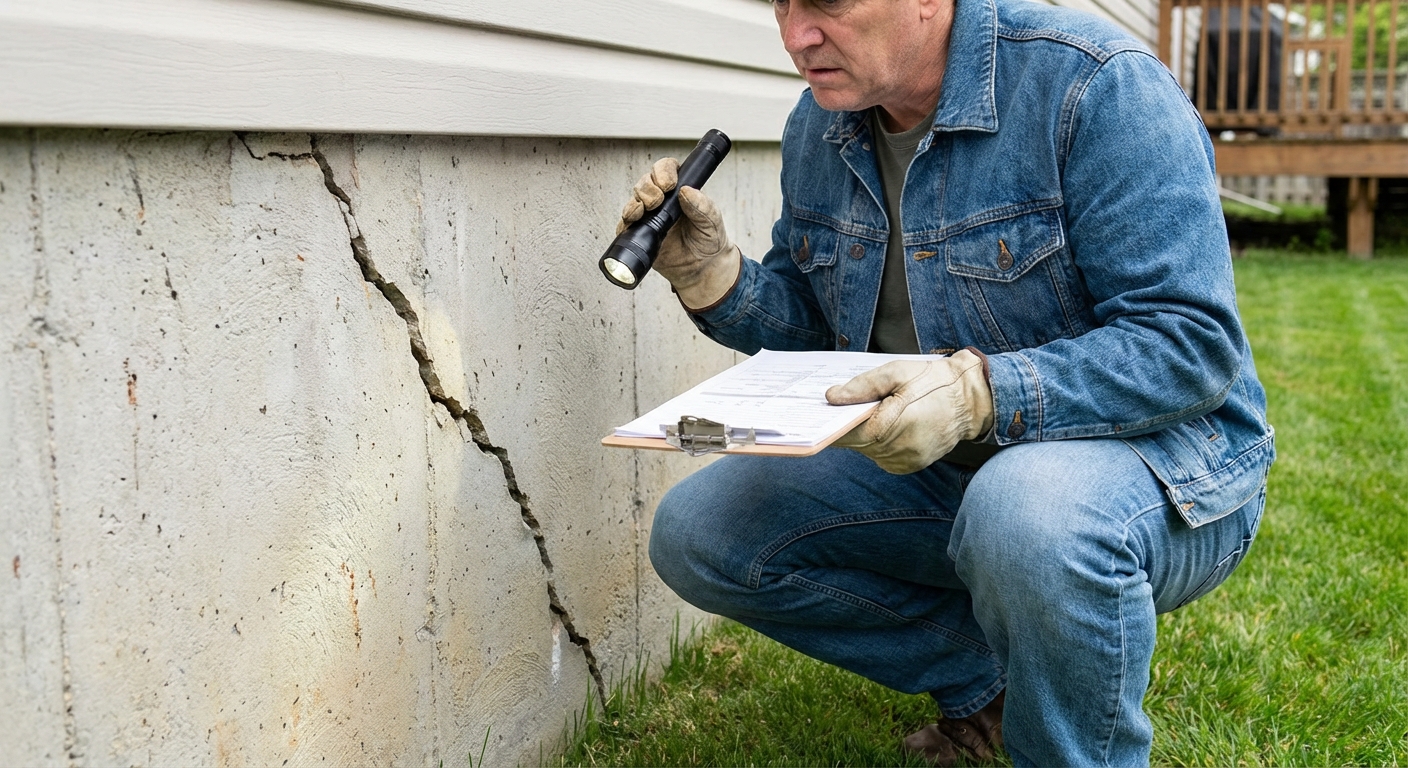
Foundation cracks are only covered when caused directly by a sudden, covered peril such as a burst pipe, explosion, or storm event. Cracks that result from settling, soil movement, aging concrete, or poor construction are explicitly excluded from standard homeowners insurance policies, and industry sources estimate 90% of settlement-related claims are denied on first submission. If you notice new cracks after a specific incident, document everything immediately and file a claim quickly. In most cases, foundation cracks are treated as a maintenance issue, not an insurable loss.
Will insurance pay for foundation issues caused by a burst pipe?
Yes, in most cases. If a pipe bursts suddenly and the resulting water damage leads to foundation damage, your dwelling coverage (Coverage A) can help pay for the structural repairs. The key word is sudden: the event must be accidental and unexpected, not the result of a slow, unnoticed leak. Your insurer will likely cover the resulting water and structural damage, but not the cost of repairing the burst pipe itself.
What is a foundation endorsement, and do I need one?
A foundation endorsement is an optional add-on to your homeowners policy that expands coverage for foundation-related events beyond standard policy limits. Texas offers the HO-04-68 endorsement for water seepage under slabs, capped at 15% of Coverage A (with some carriers further capping at $25,000, or $10,000 for homes older than 35 years) and costing $100 to $500 per year in 2026. Florida insurers must offer a sinkhole loss endorsement for broader ground-collapse protection. These riders are especially valuable in high-risk areas where a single repair can cost $10,000 or more.
Is slab leak damage covered by home insurance?
Slab leak coverage depends entirely on what caused the leak. If a pipe beneath your slab bursts suddenly and unexpectedly, your homeowners policy may cover the resulting water damage to your floors, walls, and foundation structure (with the average 2026 slab leak repair running $2,280). However, it will not pay to repair the pipe itself, and gradual leaks from aging or corroded pipes are typically excluded. A service line endorsement (typically $20 to $50/year in 2026) can help fill this gap.
Does home insurance cover foundation damage from earthquakes or sinkholes?
Standard homeowners insurance does not cover foundation damage caused by earthquakes or sinkholes; these are excluded under earth movement clauses. To be protected, you need separate policies or endorsements. In California and other high-seismic states, a dedicated CEA earthquake policy is essential and offers retrofit discounts of up to 25% plus grants up to $10,000 through Earthquake Brace + Bolt for income-eligible homeowners. In Florida, mandatory CGCC coverage provides limited protection, but a voluntary sinkhole loss endorsement offers much broader coverage. See our earthquake insurance and sinkhole insurance guides for more.