
Compare Home Insurance Plans in Ohio
Find your best options in less than 2 minutes



What Does Earthquake Insurance Cover?
Earthquake insurance fills a major gap that your standard homeowners policy leaves wide open. Most homeowners don't realize that earthquakes are explicitly excluded from standard home insurance until it's too late. To understand the full list of what your basic policy ignores, see our guide on common home insurance exclusions. A separate earthquake policy, or an endorsement added to your existing policy, typically covers three core areas:
Dwelling Coverage
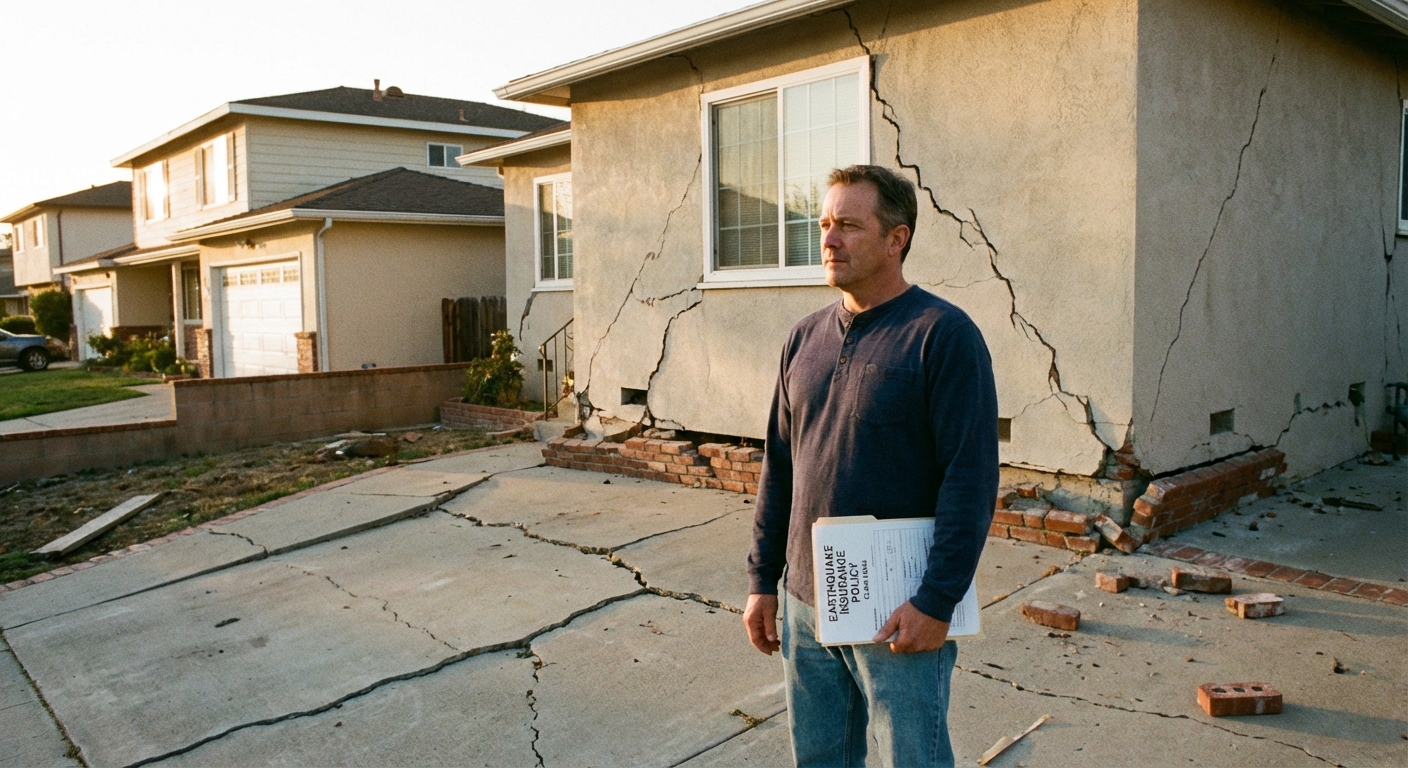
This is the backbone of any earthquake policy. It pays to repair or rebuild the physical structure of your home after damage from ground shaking, surface ruptures, soil liquefaction, landslides, or slope failure. This includes your foundation, walls, roof, built-in appliances, attached garages, and decks. Coverage limits should reflect your home's replacement cost, not its market value (those two numbers can be very different). Some policies also include optional riders for building code upgrades (now up to $30,000 under the CEA) or emergency repairs needed immediately after a quake. Earthquake-related foundation damage is one of the most expensive losses a homeowner can face, often exceeding $25,000 even without total collapse.
Personal Property Coverage
This covers your household belongings (furniture, electronics, clothing, and appliances) that are damaged in a quake event. Under a CEA Homeowners Choice policy in 2026, personal property coverage can be selected from $5,000 up to $200,000, though many carriers still default to $5,000 or $25,000. High-value or fragile items like artwork, ceramics, or dishes may need additional riders.
Additional Living Expenses (ALE)
Also called "loss of use" coverage, ALE pays for the increased costs of daily living while your home is being repaired or is uninhabitable. This can include hotel stays, meals, laundry, storage, furniture rental, and temporary housing. Depending on the insurer, ALE benefits can range from $1,500 to over $100,000. Under the CEA's Homeowners Choice policy, loss-of-use coverage is available up to $100,000 with no separate deductible, an important distinction that makes ALE the most immediately usable part of the policy. For coverage gaps that mirror flood insurance, which also requires a separate policy, this kind of protection can mean the difference between financial survival and disaster.

Compare Home Insurance Plans in Ohio
Find your best options in less than 2 minutes
Understanding Earthquake Insurance Deductibles
This is where most homeowners get a serious surprise. Earthquake insurance deductibles are almost always percentage-based, not a flat dollar amount like the $1,000 or $2,000 deductible you may have on your homeowners policy.
Typical earthquake deductibles range from 5% to 25% of your dwelling's insured value, with 15% being the standard and most commonly selected CEA option in 2026. The California Earthquake Authority offers deductibles of 5%, 10%, 15%, 20%, and 25% (in 5% increments). What does that actually look like?
| Home Insured Value | 5% Deductible | 10% Deductible | 15% Deductible | 20% Deductible |
|---|---|---|---|---|
| $200,000 | $10,000 | $20,000 | $30,000 | $40,000 |
| $400,000 | $20,000 | $40,000 | $60,000 | $80,000 |
| $600,000 | $30,000 | $60,000 | $90,000 | $120,000 |
| $800,000 | $40,000 | $80,000 | $120,000 | $160,000 |
This means earthquake insurance is designed primarily to protect you from catastrophic losses, not minor cracks or cosmetic damage. If your $500,000 home suffers $35,000 in quake damage and your deductible is 10% ($50,000), you receive nothing from your insurer.
Lower deductibles (like 5%) come with higher annual premiums but significantly reduce your out-of-pocket exposure after a major event. Higher deductibles reduce your premiums but shift enormous financial risk back to you. Under the CEA's standard policy, the deductible applies separately to dwelling, contents, and loss-of-use coverage, though ALE has no deductible at all under Homeowners Choice.

Protect your home with State Farm
Average Rate:
Homeowners who bundle and save with State Farm save an average of $1,000 per year!

You're in Good Hands® with Allstate
Average Rate:
Get comprehensive home coverage with flexible policy options.

Customize your home coverage
Average Rate:
Only pay for the coverage you need with personalized home insurance.

Smart coverage for your home
Average Rate:
Protect what matters most with award-winning home insurance.
Who Needs Earthquake Insurance? Risk Zones Explained
Standard homeowners policies from any insurer exclude earthquake damage. So the question isn't really "should I add earthquake insurance?" but rather "how high is my risk, and can I afford not to have it?"
Highest-Risk States and Regions
The USGS 2023 National Seismic Hazard Model (the first unified 50-state assessment, and still the current basis for U.S. building codes and hazard maps in 2026) estimates that roughly 75% of the U.S. faces the potential for damaging earthquake shaking over the next 100 years, and 37 states have recorded quakes above magnitude 5 in the last 200 years. Southern Alaska, California, and Hawaii have a greater than 95% probability of experiencing damaging seismic activity within a century. The updated model also flagged higher potential shaking in Atlantic Coast cities like Washington, D.C., Philadelphia, New York, and Boston. Risk is still far from evenly distributed:
| State/Region | Hazard Level | Key Risk Factor |
|---|---|---|
| California | 🔴 Very High | San Andreas, Hayward, San Jacinto faults; >99% chance of M6.7+ in 30 yrs |
| Alaska | 🔴 Very High | Alaskan-Aleutian Megathrust; M7.3 and M7.0 events in 2025 |
| Hawaii | 🔴 High | Volcanic activity and frequent seismic events |
| Pacific Northwest (WA/OR) | 🟠 High | Cascadia Subduction Zone, potential M9+ megathrust |
| Nevada | 🟠 Medium-High | Active Basin and Range faulting |
| New Madrid Zone (MO, AR, TN, IL) | 🟠 Medium | Memphis area is among USGS's highest-risk inland populations |
| Charleston, SC area | 🟡 Moderate | Historical M7+ event in 1886; hazard raised in 2023 NSHM |
| Oklahoma/Texas | 🟡 Moderate | Induced seismicity from wastewater injection |
| Northeast Corridor (NY, DC, Boston) | 🟡 Low-Moderate | Reclassified upward in the 2023 NSHM |
In 2025, Alaska recorded a magnitude 7.3 offshore quake on July 16 (the strongest U.S. earthquake of the year) and a magnitude 7.0 near the Hubbard Glacier on December 6, along with more than 2,200 total earthquakes in the state. The July 29, 2025 M8.8 Kamchatka earthquake in Russia also generated a Pacific-wide tsunami that caused about $1 million in property damage in Crescent City, California, a reminder that seismic risk extends well beyond direct shaking. If you live in Washington state, Oregon, California, or the New Madrid Seismic Zone, earthquake insurance deserves serious consideration. Even in "moderate" zones, a single major event can cause total losses that no emergency fund can cover alone.
How Much Does Earthquake Insurance Cost in 2026?
Annual premiums vary widely based on your state, proximity to fault lines, home age, construction type, and the deductible you choose. The CEA's 6.8% rate increase implemented in the last cycle is still reflected in 2026 premiums, and no new statewide CEA rate filing has been approved for 2026 as of August. Here's a 2026 breakdown based on current market data:
| State/Region | Risk Level | Avg. Annual Premium (2026) |
|---|---|---|
| California (Bay Area, high-risk zones) | Very High | $1,800 – $5,000+ |
| California (statewide average) | Very High | $1,248 – $2,744 |
| Alaska | Very High | $700 – $1,500+ |
| Pacific Northwest (WA/OR) | High | $300 – $800 |
| Nevada | Medium-High | $400 – $900 |
| Missouri / New Madrid Zone | Medium | $300 – $600 |
| Texas | Moderate | $500 – $800 |
| East Coast | Low | Under $300 |
In California, current CEA data shows earthquake insurance averages roughly $3.54 per $1,000 of coverage, translating to about $1,770/year on a $500,000 home or roughly $2,478 on a $700,000 home. Premiums can climb dramatically in high-risk Bay Area ZIP codes, where San Francisco policies routinely run $2,500 to $5,000+ per year. Sacramento and the Central Valley, by contrast, often stay in the $800 to $2,000 range on comparable homes.
The California Earthquake Authority (CEA): How It Works
The California Earthquake Authority is a publicly managed, privately funded nonprofit that sells residential earthquake insurance to Californians through participating private insurance agents. As of 2026, the CEA controls roughly two-thirds of California's residential earthquake insurance market with approximately 1 million policies in force. Yet only about 10% to 13% of California homeowners currently carry earthquake coverage, leaving the vast majority financially exposed. In June 2026, the CEA also secured a $425 million Sutter Re catastrophe bond to strengthen its reinsurance backing, which helps stabilize future rate pressure.
Here's how the CEA functions in 2026:
- You purchase through your insurance agent, not directly from the CEA
- Premiums are set actuarially and adjusted based on updated seismic models and reinsurance costs
- Claims are paid from reserves built from premiums, reinsurance, and state-backed bonds if reserves are depleted
- Dwelling coverage equals your underlying homeowners Coverage A limit (up to about $3 million)
- Personal property limits are selectable from $5,000 to $200,000
- Loss of Use (ALE) covers up to $100,000 with no deductible
- Building code upgrade coverage starts at $10,000 and can be increased to $20,000 or $30,000
- First $1,500 of emergency repairs has no deductible applied
CEA vs. Private Earthquake Insurance
For California homeowners, the CEA is often the primary (and sometimes only) practical option in high-hazard zones, since many private insurers won't take on significant seismic risk. Outside California, private earthquake insurance policies (often added as an endorsement) are the norm. If you rent rather than own, you can still protect your belongings through a renters insurance policy with an earthquake endorsement, or a dedicated HO4 renters policy add-on.
Is Earthquake Insurance Worth It?
There's no universal answer, but here's a clear framework for making the decision based on your personal situation:
Use This 3-Factor Test to Decide
1. Location Risk Look up your home's seismic hazard rating on the USGS 2023 National Seismic Hazard Model. If you're near an active fault or in a known seismic zone (California, Pacific Northwest, New Madrid), earthquake insurance is a strong candidate. If you're in a low-hazard zone with little seismic history, the math may not favor it. Remember: the 2023 update raised hazard estimates for parts of the Northeast, including New York City where hazard essentially doubled at short spectral periods compared to older models.
2. Home Value and Replacement Cost The higher your home's replacement cost, the higher your premium and your deductible exposure. For a $600,000 home with a 15% deductible (the CEA's most common selection), you'd need $90,000 on hand before insurance kicks in. If you couldn't cover that from savings, insurance becomes more essential, not less. This is especially important for homes with complex structural damage exposure where rebuild costs can climb fast.
3. Your Financial Situation Ask yourself: "If an earthquake destroyed 60% of my home, could I rebuild without insurance?" For most homeowners, the answer is no. Earthquake insurance is most valuable when the cost of a policy is modest relative to the financial devastation it prevents. If you're also a landlord, consider how earthquake damage could impact rental income, something landlord insurance also addresses. Since the 2025 registration cycle, the EBB program has also expanded to include certain rental and non-owner-occupied properties, so landlords may now qualify for retrofit grants that were previously limited to owner-occupants.
Frequently Asked Questions
Does homeowners insurance cover earthquakes? No. Standard homeowners insurance policies explicitly exclude earthquake damage. Whether you have a basic HO-3 policy or a premium comprehensive HO-5 policy, earthquake-caused damage to your dwelling, personal property, and additional living expenses requires a separate earthquake insurance policy or specific endorsement. However, if an earthquake causes a fire, your standard homeowners policy typically does cover the fire damage.
What is a typical earthquake insurance deductible? Earthquake deductibles are almost always percentage-based, typically ranging from 5% to 25% of your home's insured dwelling value, with 15% being the standard and most commonly selected CEA option in 2026. A 10% deductible on a $400,000 home means you pay the first $40,000 out of pocket before your insurer pays anything. In California, homes with Coverage A above $1 million or pre-1980 raised-foundation homes without verified retrofits are restricted to 15%, 20%, or 25% only.
How does the California Earthquake Authority (CEA) work? The CEA is a state-created, privately funded nonprofit that sells earthquake insurance to California homeowners through participating insurance agents. It writes roughly two-thirds of California's residential earthquake policies and covers dwelling limits equal to your underlying homeowners Coverage A, personal property from $5,000 up to $200,000, and up to $100,000 in loss-of-use coverage with no deductible. Retrofitted homes can qualify for premium discounts of up to 25%.
Is earthquake insurance worth buying in a low-risk state? In most low-risk states, earthquake insurance is inexpensive (often under $300/year) and the likelihood of a major quake is slim. Whether it's worth it depends on your risk tolerance and financial situation. Even in moderate-risk zones like the New Madrid Seismic Zone or the newly reclassified Northeast Corridor, premiums have been rising as seismic risk awareness grows, but coverage often remains affordable enough to be worth considering.
Can renters get earthquake insurance? Yes. Renters can purchase earthquake insurance to protect their personal belongings and cover additional living expenses if their rental unit becomes uninhabitable after a quake. Since renters don't need dwelling coverage (that's the landlord's responsibility), earthquake coverage for renters is typically much less expensive than for homeowners, making it an easy add-on worth considering in high-risk areas.