
Compare Home Insurance Plans in Ohio
Find your best options in less than 2 minutes



What Is Sinkhole Insurance?
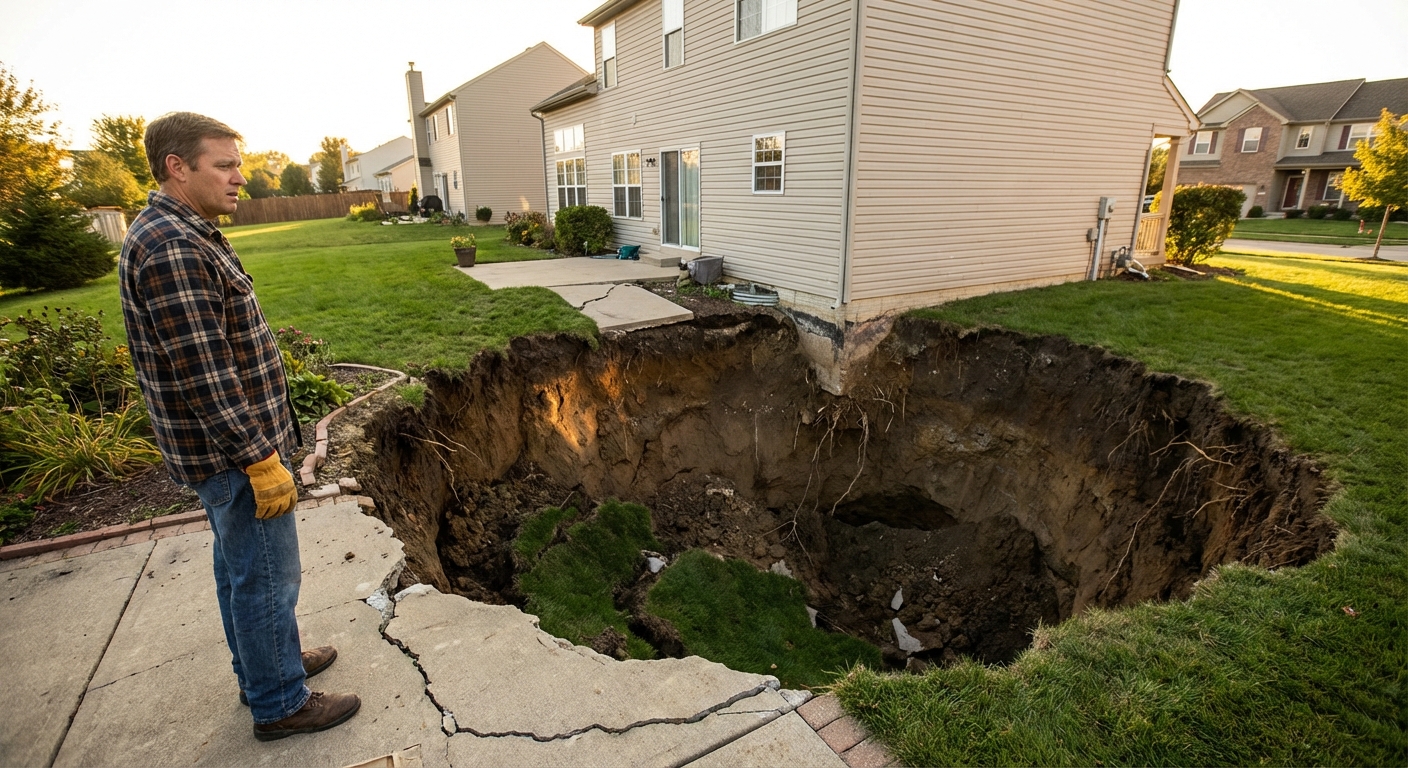
Sinkhole insurance is a specialized endorsement (sometimes called a rider) that you add to your existing homeowners policy to cover structural damage caused by sinkholes. It is not included in a standard policy. Most homeowners insurance policies classify sinkholes as a form of "earth movement," placing them in the same excluded category as earthquakes and landslides. Without a dedicated sinkhole endorsement, a claim for this type of damage will almost certainly be denied.
Understanding why this gap exists starts with understanding what a sinkhole actually is. Sinkholes form when underground bedrock (most commonly limestone or carbonate rock) slowly dissolves due to contact with slightly acidic groundwater. Over time, this creates hidden underground voids. When the land above can no longer support its own weight, the surface collapses, sometimes suddenly and catastrophically, other times gradually over months or years. Heavy rainfall, drought, leaking water pipes, groundwater pumping, and construction activity can all trigger or accelerate sinkhole formation.
How It Differs from Standard Homeowners Insurance
Standard homeowners insurance (HO-3 policies) covers a defined list of "named perils" such as fire, windstorm, hail, and theft. Earth movement, including sinkhole activity, is almost universally excluded. This is a critical distinction that catches many homeowners off guard, especially in sinkhole-prone states. Sinkholes fall into a broader group of common home insurance exclusions that homeowners routinely misunderstand until a claim is filed.
| Feature | Standard Homeowners Policy | Sinkhole Endorsement |
|---|---|---|
| Sinkhole structural damage | ❌ Not covered | ✅ Covered |
| Foundation repair from sinkholes | ❌ Not covered | ✅ Covered |
| Ground stabilization | ❌ Not covered | ✅ Covered |
| Additional living expenses (displacement) | Depends on cause | ✅ Often included |
| Pre-existing sinkhole damage | ❌ Not covered | ❌ Not covered |
| Man-made sinkholes (e.g., mining collapse) | ❌ Not covered | ❌ Excluded |
Learn more about how foundation damage is handled under a standard homeowners policy, since sinkhole-caused foundation issues are one of the most costly and misunderstood coverage gaps homeowners face.

Compare Home Insurance Plans in Ohio
Find your best options in less than 2 minutes
Sinkhole Loss Coverage vs. Catastrophic Ground Cover Collapse
This is where things get particularly important for homeowners in Florida, the state with the highest sinkhole activity in the nation. Under Florida Statute 627.706, which remains the controlling law in 2026, the state creates two distinct types of sinkhole-related coverage, and most people don't know the difference.
Catastrophic Ground Cover Collapse (CGCC)
Catastrophic Ground Cover Collapse (CGCC) coverage is automatically included in all standard Florida homeowners insurance policies at no additional cost. Every insurer authorized to transact property insurance in Florida must provide coverage for a catastrophic ground cover collapse, while broader sinkhole loss coverage must be made available for an additional premium and is not automatically included. However, CGCC only kicks in when all four of the following conditions are met simultaneously:
- Abrupt collapse of the ground cover
- A depression in the ground clearly visible to the naked eye
- Structural damage to the covered building, including the foundation
- The insured structure is condemned and ordered to be vacated by a government authority
In practice, most sinkhole events in Florida do not meet all four criteria. The statute is explicit that damage consisting merely of the settling or cracking of a foundation, structure, or building does not constitute a loss resulting from a catastrophic ground cover collapse. That means gradual settling, wall cracks, and foundation shifts (the most common forms of sinkhole damage) fall short of the CGCC threshold.
Sinkhole Loss Coverage (Optional Endorsement)
Sinkhole loss coverage is the broader, optional endorsement that Florida homeowners can add to their policy for an additional premium. Florida law requires insurers to "make available" this coverage, but purchasing it remains the homeowner's choice. This endorsement covers structural damage from confirmed sinkhole activity, even when it doesn't rise to the level of a catastrophic collapse. It includes:
- Structural damage to your home's walls, floors, and ceilings
- Foundation repair costs
- Land stabilization and ground remediation
- In some cases, personal property loss and additional living expenses
This same distinction applies in other states like Tennessee, which requires insurers to offer sinkhole coverage. Under Tennessee Code Ann. § 56-7-130, every insurer offering homeowner property insurance in the state must make coverage available for insurable sinkhole losses, including contents of personal property, and the insurer may require an inspection before issuing coverage. If you live outside Florida or Tennessee, your standard policy almost certainly provides no sinkhole coverage whatsoever, not even a CGCC equivalent.
Just as earthquake insurance must be purchased as a separate policy or endorsement, sinkhole coverage requires a proactive step to add it before damage occurs. Learn more about how structural damage claims are evaluated once earth movement is involved.

Protect your home with State Farm
Average Rate:
Homeowners who bundle and save with State Farm save an average of $1,000 per year!

You're in Good Hands® with Allstate
Average Rate:
Get comprehensive home coverage with flexible policy options.

Customize your home coverage
Average Rate:
Only pay for the coverage you need with personalized home insurance.

Smart coverage for your home
Average Rate:
Protect what matters most with award-winning home insurance.
What Sinkhole Insurance Covers and What It Doesn't
What's Covered
When a licensed professional geologist or geotechnical engineer confirms that your property has sustained sinkhole-related damage, a sinkhole endorsement will generally pay for:
- Structural damage to walls, floors, ceilings, roof, and other structural components compromised by sinkhole activity
- Foundation repair including stabilization, underpinning, grouting, and other engineering solutions to restore your home's structural integrity
- Ground and land stabilization covering the soil remediation or compaction grouting needed to fill or stabilize the underlying void
- Additional living expenses for temporary housing costs if the damage renders your home uninhabitable during repairs
What's NOT Covered
Even with a sinkhole endorsement, certain situations are excluded:
- Pre-existing damage. If the damage existed before the policy was issued, it won't be covered
- Man-made sinkholes. Collapses caused by mining operations, improperly compacted fill, or broken utility infrastructure are typically excluded (though sewer line coverage may help with pipe-related ground damage)
- Gradual soil erosion. Surface erosion or soil shrinkage unrelated to sinkhole activity is not covered
- Mine subsidence. Damage from underground mining voids requires separate mine subsidence insurance
- Surrounding land only. Most policies cover your structure, not the open land around your home
Sinkhole Insurance Cost, Who Needs It & How to Get It
How Much Does Sinkhole Insurance Cost in 2026?
The cost of sinkhole insurance varies dramatically based on your location, your home's value, and how close you are to known sinkhole activity. Florida homeowners face the highest premiums because the state accounts for the vast majority of U.S. sinkhole insurance claims. In Florida, sinkhole insurance premiums are commonly cited at about $2,000 to $4,000 per year for full sinkhole coverage in 2026, though some sources describe typical premiums closer to $1,000 to $3,000 depending on location and risk factors. Florida's Office of Insurance Regulation reported 263 sinkhole claims closed in 2025, with indemnity payouts that varied widely by claim duration and litigation status.
| Location | Estimated Annual Cost (2026) |
|---|---|
| North Florida (lower-risk counties) | $100 – $500/year |
| Central Florida (statewide average) | $1,000 – $3,000/year |
| Florida high-risk counties (Pasco, Hernando, Hillsborough) | $2,000 – $4,000+/year |
| Other high-risk states (TX, KY, AL, PA, TN, MO) | $100 – $500/year |
| Low-risk states | Often unavailable or minimal cost |
In the most sinkhole-prone Florida counties such as Hernando, Pasco, Hillsborough, Polk, Citrus, Marion, and Sumter, carriers may price sinkhole coverage steeply or even decline it after prior sinkhole activity. In some high-risk counties the sinkhole endorsement premium alone can exceed the base homeowners insurance premium, which averages roughly $2,400 to $3,000 statewide in 2026 and can climb higher in coastal counties. Meanwhile, sinkhole repair costs typically run $10,000 to $25,000 for minor foundation work, with severe structural cases climbing to $50,000, $200,000, or in extreme scenarios, well into the millions.
Under Florida Statute 627.706, a residential sinkhole policy may use a deductible of 1%, 2%, 5%, or 10% of dwelling limits, with corresponding premium discounts, and the insurer may require a pre-issuance inspection before issuing sinkhole loss coverage. On a $300,000 home, a 10% deductible means you'd pay $30,000 out of pocket before the policy kicks in.
Which States Are Most at Risk?
According to the U.S. Geological Survey and the American Geosciences Institute, sinkhole risk is concentrated in areas with underlying karst terrain, meaning limestone and carbonate bedrock susceptible to dissolution. Sinkhole damage has historically been highest in Florida, Texas, Alabama, Missouri, Kentucky, Tennessee, and Pennsylvania. A 2023 USGS-linked national susceptibility study adds important nuance:
- 🟠 Florida. Most sinkhole claims in the nation, with "Sinkhole Alley" in west-central Florida producing the highest frequency; Florida has the largest total area classified as high or very high sinkhole susceptibility
- 🟠 Kentucky. Leading sinkhole hot spots in the U.S. include counties in Kentucky, Tennessee, Missouri, and north central Florida, including the Mammoth Cave karst system
- 🟠 Tennessee. Contains large amounts of high/very-high susceptibility land; insurers required to offer coverage
- 🟠 Missouri. Extensive cave and karst systems throughout the Ozarks
- 🟠 Texas. Widespread karst geology, particularly in the central Hill Country region
- 🟠 Alabama. Significant karst coverage, with frequent sinkhole reports
- 🟠 Pennsylvania. Growing concern; House Bill 589, the Landslide and Sinkhole Insurance Program legislation, passed the Pennsylvania House with strong bipartisan support on September 29, 2025 and moved to the state Senate for consideration, where it remains pending as of mid-2026
The USGS estimates sinkhole damage across the country averages at least $300 million per year over the last 15 years, though there is no comprehensive national tracking system. Homeowners in these states should seriously evaluate their coverage. Much like flood insurance and water damage coverage, sinkhole coverage is one of those protections that isn't needed until it absolutely is.
Is Sinkhole Insurance Required?
Sinkhole insurance is not federally required, but state law does influence what insurers must offer:
- Florida. Insurers must include CGCC in all standard policies at no additional premium and must "make available" optional sinkhole loss coverage to homeowners
- Tennessee. Insurers are required to offer sinkhole coverage as an add-on, though homeowners are not required to purchase it
- Pennsylvania. Pending House Bill 589 would create a Landslide and Sinkhole Insurance Program with an initial $10 million transfer from the state's General Fund to the insurance fund for fiscal year 2025-26, allowing the program to provide state-run coverage for landslides and sinkholes to fill a gap left by private insurance
- All other states. Sinkhole coverage is purely optional and availability varies by insurer
How to Add Sinkhole Coverage to Your Policy
Adding sinkhole insurance is a straightforward process:
- Contact your current insurer or agent. Ask if a sinkhole endorsement is available in your state and get a quote for the added premium
- Schedule a structural inspection. Most carriers in high-risk areas require an inspection of your property by an approved provider before approving the endorsement
- Review the terms. Confirm the deductible structure, what perils are covered, and any exclusions specific to your policy
- Add the endorsement. If the inspection clears your property and you accept the quoted premium, the endorsement is added to your existing homeowners policy
If your current insurer doesn't offer sinkhole coverage, you may need to shop for a new homeowners policy with a carrier that does. It's also worth reviewing whether your existing policy has other gaps you didn't know about, much like basement flooding coverage limits that leave big out-of-pocket costs, or septic system coverage exclusions that surprise many homeowners after a claim is denied.
Frequently Asked Questions About Sinkhole Insurance
Does regular homeowners insurance cover sinkholes? No, standard homeowners insurance (HO-3 policies) explicitly excludes earth movement, which includes sinkhole activity. The only exception in Florida is the mandatory Catastrophic Ground Cover Collapse (CGCC) coverage, but that applies only to extreme events where the home is condemned and ordered vacated. For broader protection, you'll need to add a sinkhole loss coverage endorsement to your policy.
How do I know if I need sinkhole insurance? If you live in a high-risk state like Florida, Texas, Kentucky, Tennessee, Alabama, Missouri, or Pennsylvania, you should strongly consider adding sinkhole coverage. Your risk is higher if your home sits on or near limestone or carbonate bedrock, if neighbors have reported sinkhole activity, or if your area has a history of ground subsidence. A licensed geological inspection can help assess your specific property's risk.
What's the difference between sinkhole insurance and earthquake insurance? Both are endorsements that cover types of "earth movement" excluded from standard homeowners policies, but they cover very different events. Sinkhole insurance covers underground void collapses caused by dissolving bedrock, while earthquake insurance covers structural damage from seismic activity. In some states, these can be purchased together, while in others you may need separate endorsements.
What happens if my home has existing sinkhole damage? Can I still get covered? Generally, no. Insurance is designed to protect against future unknown losses, not pre-existing conditions. If an inspection reveals existing sinkhole activity or prior damage, most insurers will deny the endorsement. In some cases, after a paid sinkhole insurance claim, you may still be able to obtain coverage going forward, but terms will vary significantly by insurer.
What does the claims process look like for a sinkhole? When you file a sinkhole claim, your insurer will typically send out a licensed professional geologist or geotechnical engineer to test and confirm that sinkhole activity is the cause of the damage. If confirmed, your insurer will determine the scope of repairs, which may include foundation underpinning, compaction grouting to stabilize the ground, and structural repairs to the dwelling. The process can take several months, and your deductible (1% to 10% of dwelling coverage) will apply before the insurer pays out.