
Compare Home Insurance Plans in Ohio
Find your best options in less than 2 minutes



What Is Service Line Coverage?
Service line coverage is an optional endorsement you can add to your homeowners insurance policy that protects the underground utility lines running between your home and the street or property line. These are the lines you own and are legally responsible for. The moment a pipe leaves the city's main and enters your property, it becomes your problem. This coverage typically applies to:
| Service Line Type | What It Covers |
|---|---|
| Water Supply Lines | Underground pipes delivering fresh water from the municipal main to your home |
| Sewer/Drain Lines | Underground pipes carrying wastewater away from your home |
| Natural Gas Lines | Underground gas pipes supplying your furnace, stove, or water heater |
| Electrical Lines | Underground power cables delivering electricity to your home |
| Communications Lines | Cable, fiber optic, internet, and telephone lines |
| Ground Loop Piping | Geothermal heat pump piping (covered by some insurers) |
When one of these lines fails, coverage typically pays for the diagnosis, excavation, repair or full replacement of the damaged line, plus landscaping restoration, debris removal, permits, and even temporary housing if the damage makes your home unlivable. Some insurers, like Liberty Mutual and The Hanover, also include the cost of using environmentally friendly materials and expediting expenses to speed up the work. The Hanover, for example, will pay up to 150% of the like-for-like replacement cost when green materials are used, and Nationwide's endorsement specifically includes outdoor property (trees, shrubs, plants, lawns, sidewalks) plus additional living expenses and loss of rental income if the home has to be vacated during repairs.

Compare Home Insurance Plans in Ohio
Find your best options in less than 2 minutes
Why Homeowners Insurance Doesn't Cover Service Lines
This is one of the most surprising gaps in standard home insurance, and one of the most expensive ones to discover after the fact. Standard homeowners policies (including the widely used HO-3 form) are built around sudden and accidental damage. Service line failures are almost always the result of gradual deterioration, which insurers classify as a maintenance issue rather than a covered peril.
Here's what a standard policy excludes when it comes to service lines:
- Wear and tear when pipes corrode or weaken over decades
- Tree root intrusion when roots slowly infiltrate and crush pipe joints
- Ground movement when soil settles or shifts and cracks buried pipes
- Freezing and frost heave when water expands inside a pipe and causes it to rupture
- Mechanical or electrical breakdown of underground lines
- Rodent or vermin damage to underground cables and pipes
These are exactly the causes most likely to damage your service lines, and none of them are covered without the endorsement. Learn more about water damage coverage so you can identify all the gaps in your current policy. It's also worth reviewing the most common home insurance exclusions so nothing else catches you off guard.

Protect your home with State Farm
Average Rate:
Homeowners who bundle and save with State Farm save an average of $1,000 per year!

You're in Good Hands® with Allstate
Average Rate:
Get comprehensive home coverage with flexible policy options.

Customize your home coverage
Average Rate:
Only pay for the coverage you need with personalized home insurance.

Smart coverage for your home
Average Rate:
Protect what matters most with award-winning home insurance.
Common Causes of Service Line Damage
Understanding what damages service lines helps you assess your own risk level. These are the most frequent culprits cited by insurers and plumbing contractors in 2026:
Tree Root Intrusion
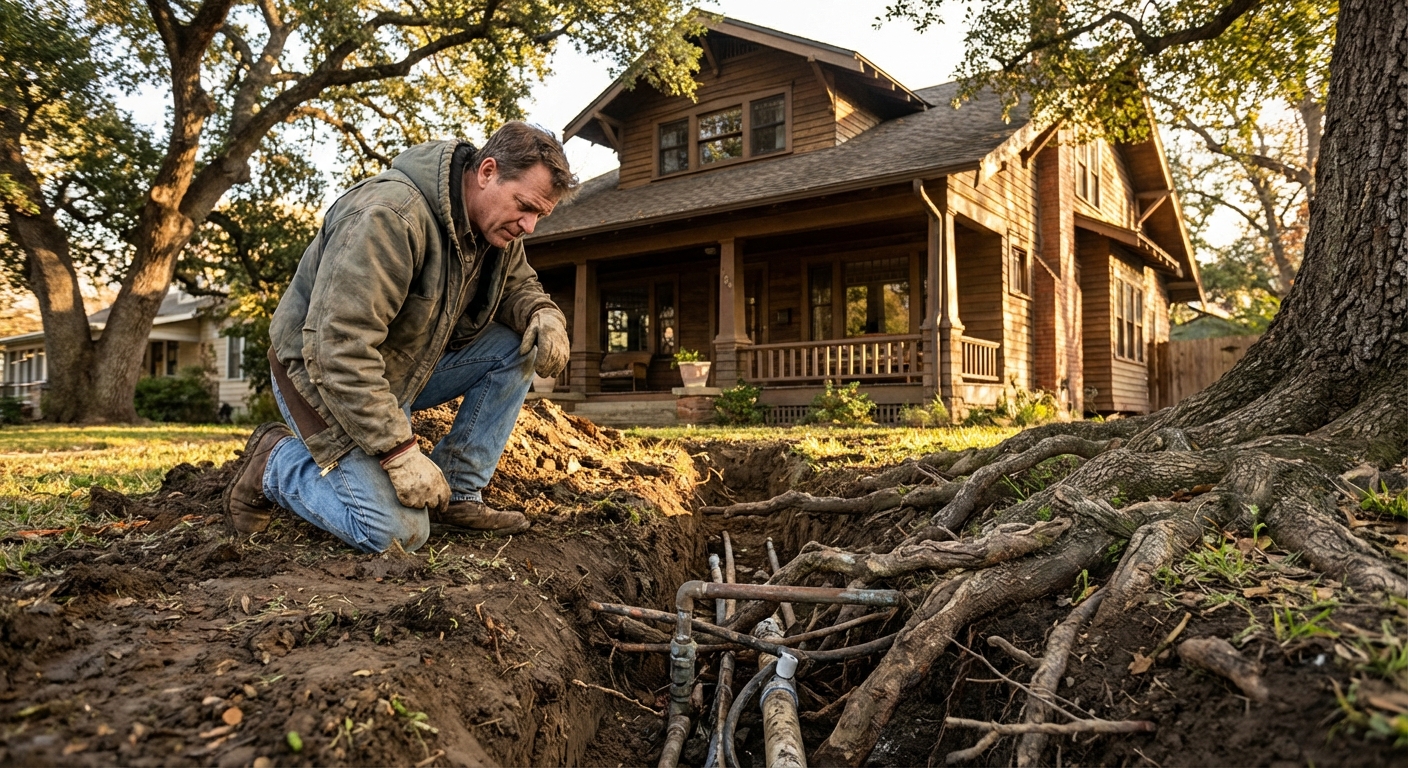
Tree roots remain a leading cause of sewer and water line damage, and industry sources consistently rank root intrusion as one of the single most common causes of residential sewer failures. Roots are naturally drawn to the moisture and nutrients in or near pipes, and even hairline cracks in older pipes can allow roots to infiltrate and grow over time. Once a root breaches the pipe, it grows inside and acts as a net that catches debris, eventually creating a major blockage. Mature trees with extensive root systems can entangle and deform pipes, sometimes requiring full excavation to repair.
Pipe Age and Material Deterioration
Homes built before 1980 are especially vulnerable. Older pipe materials like clay, cast iron, Orangeburg, galvanized steel, and lead were not designed to last indefinitely. Industry data shows that cast iron lines commonly corrode from the inside out, while Orangeburg pipe fails on a predictable timeline. Galvanized steel typically lasts 20 to 50 years, brass 40 to 70 years, and copper about 50 years. The average U.S. water and sewer pipe is now about 45 years old, and a 2024 Utah State University study found that the average age of a failing water main is 53 years, up from 47 years in 2012. Roughly 20% of all U.S. water and sewer pipes (over 452,000 miles) are already past their useful life, and about half of American homes are more than 40 years old, so a huge share of properties are relying on infrastructure at or beyond its designed lifespan.
Freezing and Frost Heave
In colder climates, freezing temperatures can cause standing water inside pipes to expand with enough force to split them. Frost heave (where frozen ground literally shifts soil upward) can also stress or misalign buried lines. This is one of the frozen pipe scenarios standard policies do not cover for underground service lines.
Ground Settling and Soil Movement
Soil naturally shifts over time due to moisture content changes, expansive clay (which can swell up to 30% when wet), or nearby construction activity. This movement puts stress on rigid pipes, causing them to separate at joints, develop "bellies," or crack entirely. Soil movement is now considered a leading cause of sewer line failures under slab foundations, particularly in the southern and southwestern U.S. where expansive clay soils are common.
High Water Pressure and Water Hammer
Municipal pressure spikes and water hammer from rapid valve closures can stress pipe joints and fittings beyond their rated tolerance. If your home sits at the low end of a pressure zone or near a pump station, this is a real risk factor. The U.S. now experiences an estimated 240,000 water main breaks per year (roughly one every two minutes), and pressure fluctuations that follow those breaks can accelerate wear on your private service lines too.
Rodent and Vermin Damage
Burrowing animals, insects, and rodents can chew through buried electrical cables and damage softer pipe materials. This cause is explicitly listed by carriers including Kin, Hanover, Secura, and Westfield as a covered peril under their service line endorsements.
How Much Does Service Line Coverage Cost in 2026?
Service line coverage remains one of the most affordable endorsements you can add to a homeowners policy. According to 2026 data from NerdWallet, The Hanover, Liberty Mutual, Safeco, Nationwide, Benzinga, and other carriers, most homeowners pay between $20 and $60 per year, with the modal cluster sitting at $30 to $50 annually and the broader market spanning $20 to $100 depending on insurer, home age, location, and coverage limit. Newer homes can qualify for premiums as low as $9 annually.
| Coverage Detail | Typical 2026 Range |
|---|---|
| Annual Premium | $20 to $60/year (up to $100 for higher limits) |
| Coverage Limit | $10,000 to $25,000 per occurrence |
| Common Deductible | $500 |
| Average Service Line Repair | $3,000 to $4,000 (national average) |
| Full Sewer Line Replacement | $3,000 to $10,000 (higher in major metros) |
Here's how a few major insurers stack up in 2026:
| Insurer | Coverage Limit | Deductible | Approximate Cost |
|---|---|---|---|
| Safeco (Liberty Mutual) | $12,000 | $500 | ~$30/year |
| The Hanover | Up to policy limit (150% with green materials) | $500 | Varies |
| Nationwide | ~$10,000 (state-dependent) | $500 | Varies |
| American Family | $10,000 | $500 | ~$20/year |
| Progressive (partner carriers) | Up to $10,000 | $500 | Varies |
For broader context, 2026 cost data from Angi, HomeAdvisor, HomeGuide, and Four Seasons puts the national average for sewer line repair or replacement at roughly $3,319, with most homeowners spending between $1,388 and $5,323, and full replacement projects commonly running $3,000 to $10,000. Modernize reports an average around $5,000, while Trueplumber's 2026 data shows full replacements often hit $3,500 to $12,000 in older neighborhoods with clay or cast iron pipes. Plumbing Price Guide places 2026 full replacements as high as $25,000 for complex jobs, and in cities like NYC or on properties requiring roadway excavation, deep jobs can push $20,000 to $30,000. Paying $30 to $50 a year to avoid that risk is a straightforward financial decision for most homeowners.
Service Line Coverage vs. Water Backup Coverage
These two endorsements are frequently confused and frequently lumped together, but they protect against very different things.
In short: if a sewer line under your yard cracks and needs to be dug up and replaced, service line coverage pays for it. If that same damaged sewer line causes a backup that floods your basement with sewage, water backup coverage pays for the interior cleanup and damage. Ideally, you carry both, because both situations can happen together.
For a deeper look at how these two endorsements interact, our guide on home insurance and sewer lines walks through real claim scenarios. And if your basement is your biggest concern, learn how basement flooding coverage fits into the picture.
Who Needs Service Line Coverage Most?
While any homeowner can benefit from this endorsement, certain situations make it nearly essential:
Owners of Older Homes
If your home was built before 1980, your service lines may be made from materials that are now well past their expected lifespan. Roughly half of American homes are more than 40 years old, and about one-third are over 50, which means a huge share of properties are connected by aging private service lines. Clay sewer pipes, cast iron water lines, Orangeburg pipe, and galvanized steel are all prone to cracking, collapsing, and corroding, and replacement can be very costly. Owners of older homes should also know how their policy treats plumbing coverage versus underground utility lines, since any line repair may need to meet current building codes that go beyond a simple like-for-like replacement.
Homes Surrounded by Mature Trees
Large, established trees with deep, wide root systems are beautiful and dangerous to underground pipes. If your property has mature oaks, maples, willows, or similar species anywhere near where your lines run, you are at meaningfully higher risk.
Homeowners in Freeze-Thaw Climates
If you live in the Midwest, Northeast, or any region with harsh winters, the annual freeze-thaw cycle is a consistent stress factor on buried lines. Frost heave and pipe freezing are covered under a service line endorsement but not under a standard policy.
Homeowners with Wells or Septic Systems
While the well or septic system itself is excluded from service line coverage, the underground pipes connecting your home to them are typically covered. If you rely on a private well system or have a septic system, this endorsement adds an important layer of protection for the lines in between.
Homeowners Without a Home Warranty
Some home warranty plans offer limited service line protection, but the coverage limits are often much lower and network restrictions can limit who performs repairs. A service line endorsement through your insurer is generally more comprehensive. Pairing it with equipment breakdown coverage gives you broad protection for both your underground lines and your home's major systems. If you're evaluating multiple add-ons at once, our guide to home insurance endorsements walks through which ones offer the best value in 2026.
Frequently Asked Questions
Does homeowners insurance cover sewer line repair in 2026?
No, standard homeowners insurance does not cover sewer line repair. Damage to underground sewer lines is typically caused by gradual deterioration, root intrusion, or ground movement, all of which are excluded from a standard HO-3 policy. You need to add a specific service line endorsement to get this protection. Without it, sewer line repairs that average $3,319 nationally and often run $3,000 to $10,000 in 2026 are entirely out-of-pocket expenses.
How much does service line coverage cost per year?
Service line coverage is very affordable in 2026, ranging from about $20 to $60 per year depending on your insurer and the coverage limit you choose. Newer homes can sometimes qualify for rates as low as $9 a year, while higher limits can push premiums to $80 or $100. Most policies offer limits between $10,000 and $25,000 per occurrence with a $500 deductible. Given that a single repair averages $3,000 to $4,000 and can easily reach $20,000 or more in high-cost metros, the annual premium represents excellent value.
What is the difference between service line coverage and water backup coverage?
Service line coverage pays to repair or replace exterior underground utility lines (water, sewer, gas, electric) that run from your home to the street. Water backup coverage pays for interior damage caused by a sewer, drain, or sump pump backing up inside your home. They cover different parts of the same problem, so ideally you would carry both endorsements since a damaged line can cause both an exterior repair need and an interior backup event at once.
Do I need service line coverage if I have a home warranty?
A home warranty can sometimes offer limited protection for service lines, but coverage limits tend to be lower and claim processes may be more restricted compared to an insurance endorsement. If your home warranty doesn't explicitly cover exterior service lines with sufficient limits, adding a service line endorsement to your homeowners policy is a smart and affordable complement. You may also want to explore how burst pipe coverage treats interior pipes versus the underground lines on your property.
Who is most at risk for service line damage?
Homeowners in older homes (built before 1980) are at the highest risk due to aging pipe materials like clay, cast iron, Orangeburg, and galvanized steel that now commonly show peak failure rates. Properties with mature trees nearby face elevated risk from root intrusion (a leading cause of sewer failures), and homes in freeze-thaw climates face annual stress from frost heave and freezing pipes. If your home has any of these risk factors, the case for adding service line coverage is especially strong. Homeowners concerned about broader structural risks may also want to review foundation coverage, since ground movement can affect both foundations and buried service lines.