
Compare Home Insurance Plans in Ohio
Find your best options in less than 2 minutes



What Is Ordinance or Law Coverage?
Ordinance or law coverage is a homeowners insurance protection that pays for the additional costs of rebuilding or repairing your home to meet current building codes after a covered loss. It exists because building codes change constantly, and your home was built to the standards in place at the time of construction, not today's requirements.
Here's the problem: standard homeowners insurance is designed to restore your home to its pre-damage condition. But if your home is 30, 40, or 50+ years old, a lot has changed. Local governments may now require updated electrical wiring, fire suppression systems, energy-efficient insulation, elevated foundations, or wind-resistant roofing. These upgrades go above and beyond a like-for-like repair, and without ordinance or law coverage, you pay for that gap out of pocket.
Most standard policies include some baseline ordinance or law coverage, typically capped at 10% of your dwelling limit. But for many homeowners, especially those in older or historic homes, that's no longer enough in 2026. Residential building material prices, excluding energy, rose 4.4% year over year in May 2026, the fastest pace in over three years, while total inputs to new residential construction were up 6.9% year over year. Tariff-sensitive categories like steel, aluminum, and copper are running even higher, with metal molding and trim up 42.9% year over year.

Compare Home Insurance Plans in Ohio
Find your best options in less than 2 minutes
What Standard Home Insurance Covers vs. What It Doesn't
Understanding the gap is the key to understanding why this endorsement matters. Your standard dwelling coverage (Coverage A) will pay to repair or replace what was damaged. That's it.
| Scenario | Standard Policy | With Ordinance or Law Coverage |
|---|---|---|
| Fire damages your kitchen | ✅ Covers kitchen repairs | ✅ Also covers required electrical upgrades |
| Storm destroys 60% of your home | ✅ Covers the damaged 60% | ✅ Also covers cost to demolish & rebuild the remaining 40% |
| Roof damage requires code-compliant rebuild | ✅ Covers like-for-like roof | ✅ Covers upgraded materials now required by code |
| Undamaged plumbing must be updated during repairs | ❌ Not covered | ✅ Covered up to your policy limit |
| Flood or earthquake triggers code requirement | ❌ Not covered | ❌ Not covered (perils must be in base policy) |
What standard insurance won't cover:
- The cost to demolish structurally sound portions of your home that code requires be torn down
- Upgraded materials, systems, or design features mandated by local ordinance
- Accessibility improvements (e.g., wider doorways, ramp installations) now required by code
- Energy-efficiency upgrades required during a permitted rebuild

Protect your home with State Farm
Average Rate:
Homeowners who bundle and save with State Farm save an average of $1,000 per year!

You're in Good Hands® with Allstate
Average Rate:
Get comprehensive home coverage with flexible policy options.

Customize your home coverage
Average Rate:
Only pay for the coverage you need with personalized home insurance.

Smart coverage for your home
Average Rate:
Protect what matters most with award-winning home insurance.
The Three Types of Ordinance or Law Coverage
Most policies break ordinance or law protection into three distinct components, sometimes called Coverage A, B, and C (not to be confused with your standard policy's Coverage A for dwelling). Understanding each one helps you know exactly what you're buying.
Coverage A: Demolition of the Undamaged Portion
When a fire, storm, or other covered event damages more than a certain percentage of your home (commonly 50%), local ordinances often require that the entire structure be demolished and rebuilt, not just the damaged section. Coverage A pays the cost of tearing down and removing the structurally sound parts you're legally required to destroy.
Coverage B: Increased Cost of Construction
This is the most commonly used component. After a covered loss, repairs that require permits must comply with today's building codes. Coverage B pays the difference between what it costs to rebuild to the original specs vs. what it costs to meet current standards. This can include:
- Updated electrical panels and wiring
- Improved plumbing and pipe materials
- Fire-rated walls or sprinkler systems
- Wind-resistant roofing, hurricane straps, or roof-to-wall connections
- Insulation and energy-efficiency upgrades
Coverage C: Value of the Undamaged Portion
If your insurer pays for the damaged section of your home but local code forces you to tear down or abandon the undamaged portion, Coverage C reimburses you for the lost value of those intact sections. Without it, you're simply losing that part of your investment with no compensation. For a broader breakdown of how these protections fit alongside other parts of your policy, see our complete guide to coverages A through F.
Real-World Scenarios Where Ordinance or Law Coverage Applies
These aren't edge cases. They happen regularly, especially in areas prone to storms, fires, and aging housing stock. Understanding building code compliance coverage is critical for any homeowner with a permitted rebuild ahead of them.
Scenario 1: House Fire With Code Upgrades Required
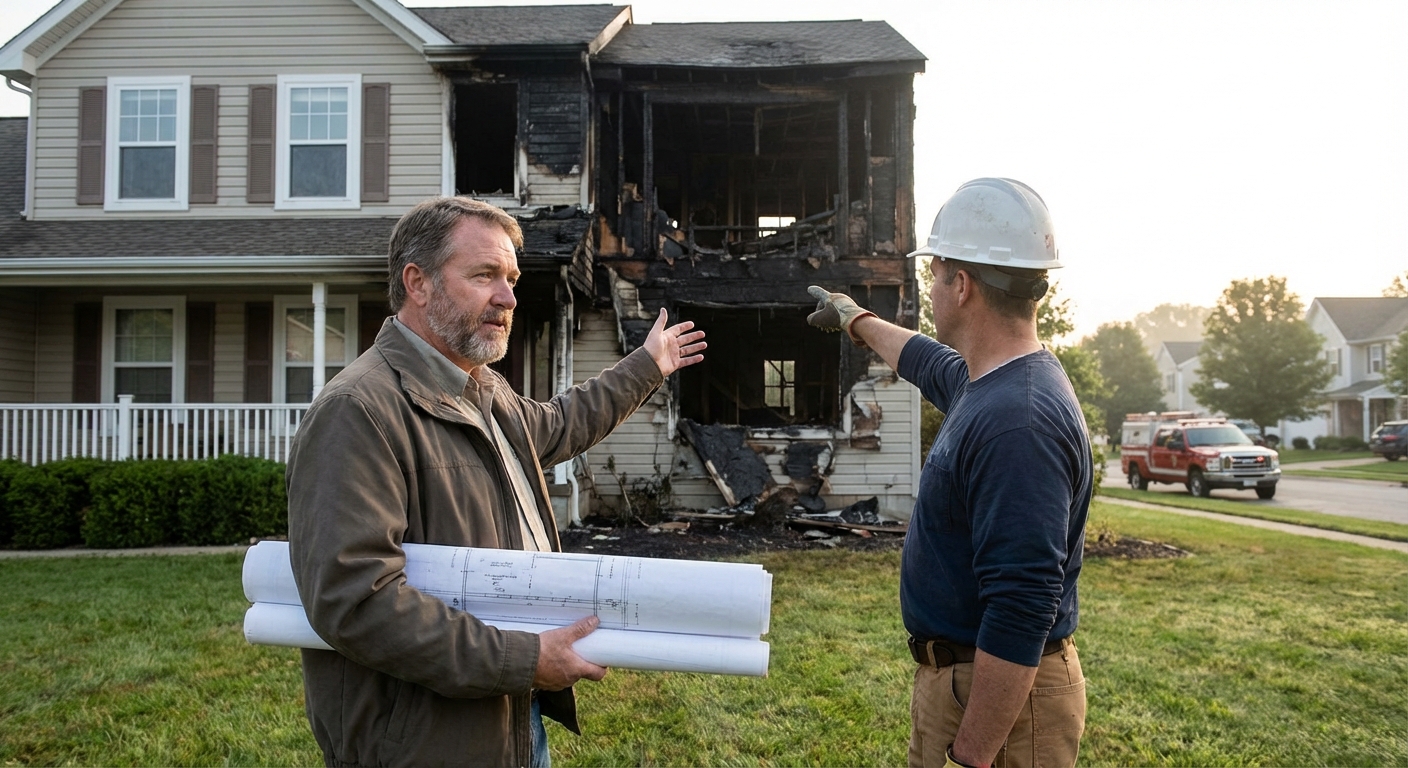
A homeowner's 1965 kitchen catches fire. The damage is significant but contained. When the contractor pulls permits to begin repairs, the city inspector flags outdated knob-and-tube wiring throughout the kitchen, a code violation that must be resolved before the permit is approved. The standard policy pays for fire damage. The ordinance or law endorsement covers the rewiring costs. This is a common issue when insuring older detached structures, where original electrical and plumbing systems rarely meet modern code.
Scenario 2: Storm Destroys More Than Half the Home
A severe thunderstorm collapses the roof and two walls of a 1978 home. Damage is assessed at 55% of the home's value, over the city's 50% threshold. Local ordinance now mandates a full teardown and rebuild to current code, not a repair. Without ordinance or law coverage:
- The homeowner receives payment only for the damaged 55%
- They personally absorb the cost to demolish the remaining 45%
- They pay out of pocket for all code-mandated upgrades during the rebuild
With the right dwelling coverage amount and an ordinance or law endorsement, all three costs are addressed.
Scenario 3: Florida Roof Replacement After Wind Damage
On May 19, 2025, Florida Governor Ron DeSantis signed House Bill 715 into law (Chapter 2025-40), expanding the scope of work licensed roofing contractors can perform to include the evaluation and enhancement of roof-to-wall connections for structures with wood roof decking. The upgrades must be installed and inspected in accordance with the Florida Building Code and the Office of Insurance Regulation's uniform mitigation verification inspection form. Code-required structural strengthening can add thousands of dollars beyond a like-for-like roof replacement, and ordinance or law coverage is specifically designed to absorb those costs. Properly documented roof-to-wall upgrades may also qualify you for wind mitigation premium credits. For a broader look at how insurers handle structural work, review structural damage coverage rules.
Who Needs Ordinance or Law Coverage the Most?
While any homeowner can benefit, some properties carry significantly more exposure than others.
| Homeowner Type | Risk Level | Why |
|---|---|---|
| Homes built before 1990 | 🔴 High | Outdated electrical, plumbing, and structural standards |
| Historic or architecturally significant homes | 🔴 High | Restoration requirements plus modern code compliance |
| Florida homes | 🔴 High | Strict hurricane codes; roof-to-wall provisions under HB 715 |
| California homes | 🔴 High | 2025 Title 24 effective January 1, 2026, plus standalone WUI Part 7 |
| Homes in areas with recent code updates | 🟡 Moderate | Recent changes may not yet be reflected in your rebuild cost |
| Newer homes (built after 2015) | 🟢 Lower | Already built closer to current code, but not risk-free |
If you own an older home, you should also understand your home's true rebuild cost versus market value. With construction inflation still pushing prices higher in 2026, market value and rebuild cost can diverge dramatically once code upgrades are factored in. Many homeowners ask how much coverage they really need, and the answer often changes year to year.
California homeowners have a new WUI code to plan around. Effective January 1, 2026, the 2025 California Building Standards Code (Title 24) applies to all building permit applications submitted on or after that date, and the cycle includes a new standalone Wildland-Urban Interface (WUI) Code as Part 7 that replaces the previous Chapter 7A provisions. AB 130 freezes further residential building code updates until 2031, meaning the 2025 Title 24 requirements will be the baseline for the next five years. For older homes in wildfire or seismic zones, buying limits well above the standard 10% floor is often worth it, particularly if you'd otherwise fall back on an HO8 policy for older homes.
Florida homeowners face unique pressure. Florida Statute § 627.7011 requires every authorized homeowners insurer to offer law and ordinance coverage at two limits: 25% of the Coverage A dwelling limit and 50% of the Coverage A dwelling limit. If you don't make a written selection or refusal on the Office-approved form, the policy is deemed to include the 25% option by default. Combined with Florida's strongest-in-the-nation hurricane code and the roof "25% rule" (repairs affecting more than 25% of a roof can trigger a full replacement to current code), owners of pre-2002 homes should generally carry the maximum available. If you have a detached garage, workshop, or shed, also confirm your other structures coverage is high enough to absorb code triggers on those buildings.
How Much Does Ordinance or Law Coverage Cost?
The good news: this is one of the most cost-effective endorsements available in homeowners insurance. Insurify projects the national average annual homeowners premium will reach roughly $3,057 by the end of 2026, a 4% increase after jumping 12% in 2025. Against that backdrop, ordinance or law coverage remains remarkably affordable.
On average, homeowners pay about $66 per year for every $40,000 of coverage, and increasing the limit from the default 10% to 25% typically adds $40 to $120 per year depending on the insurer, your ZIP code, and your home's age. For a typical $300,000 dwelling limit, adding 25% ordinance or law coverage (roughly $75,000 in extra protection) usually adds around $100 to $150 per year.
| Coverage Level | Example (on $300,000 dwelling) | Best For |
|---|---|---|
| 10% (standard default) | $30,000 | Newer homes, minor exposure |
| 25% (recommended minimum for older homes; FL default) | $75,000 | Homes built 1980-2010 |
| 50% (maximum protection) | $150,000 | Pre-1980 homes, historic properties, strict-code states |
Ordinance or law coverage is usually offered as a percentage of your dwelling coverage limit. The standard amount included in many homeowners policies is 10% of your dwelling coverage. However, some insurers may offer additional coverage equal to 25%, 50%, or even 100% of your dwelling limit. The exact premium increase varies by insurer, your location, your home's age, and the limit you select.
Pro tip: Request quotes at both 25% and 50% of your dwelling coverage limit. The difference in annual premium is often surprisingly small, while the protection gap between those two levels can be tens of thousands of dollars. If your home is significantly older, also explore whether guaranteed replacement cost coverage is available, since these two endorsements work well together. Homeowners doing math on rebuild cost should also review our rebuild cost vs. home value guide.
For homeowners keeping pace with rising rebuild math, our construction cost inflation guide explains how to keep your limits ahead of the curve, since a full rebuild triggered by ordinance compliance could leave you displaced for months longer than a standard repair would. Also worth reviewing: the 80% coinsurance rule, which can further reduce your payout if your base dwelling limit isn't kept current.
Frequently Asked Questions
Is ordinance or law coverage included in standard homeowners insurance?
Most standard homeowners policies include a limited amount of ordinance or law coverage, typically 10% of your dwelling coverage limit. In Florida, policies are deemed to include 25% unless you sign a written refusal on the Office-approved form, and other states have their own defaults. You can purchase additional coverage as an endorsement to raise the limit to 50% or even 100% of your dwelling coverage. Always review your declarations page to confirm what's currently included.
Does ordinance or law coverage apply to all types of damage?
No. Ordinance or law coverage only activates when a covered peril under your base homeowners policy causes the initial damage. For example, if fire is covered but flood is not, and your home is damaged by flooding that triggers a code-compliance rebuild, the ordinance or law endorsement won't apply. Your base policy's covered perils are the foundation, and this coverage extends what happens after that trigger.
How do I know if my home is likely to trigger ordinance or law coverage?
The most reliable indicator is your home's age. Homes built before 1990 are most likely to face significant code compliance requirements during repairs, since building codes for electrical, plumbing, structural loads, insulation, and fire safety have evolved substantially since then. If you live in a state with strict building codes (California under the 2025 Title 24, Florida under its hurricane code, and many coastal states), the exposure increases further regardless of home age.
Will ordinance or law coverage pay for the entire rebuild if my home is a total loss?
Not on its own. Ordinance or law coverage is a supplemental endorsement that works alongside your main dwelling coverage. It covers the extra costs driven by code compliance, not the full cost of rebuilding. That's why having adequate dwelling coverage is critical. The two work in tandem: dwelling coverage pays for like-for-like replacement, and ordinance or law coverage fills the gap between that and what current code actually requires.
Can renters or condo owners benefit from ordinance or law coverage?
Condo owners may have limited ordinance or law exposure through their HO-6 policy, particularly for interior improvements and betterments. Florida condo associations are also under updated rules requiring more regular replacement-value appraisals of master policies, which helps ensure the building can be rebuilt to code. Review your condo docs carefully to avoid overlap or gaps. Renters generally do not need this coverage since they don't own the building.