
Compare Home Insurance Plans in Ohio
Find your best options in less than 2 minutes



The Big Picture: Why Home Insurance Has Exclusions
Home insurance is designed to protect you from sudden and accidental losses, not from every possible risk under the sun. Insurers carve out exclusions for three primary reasons:
- Catastrophic or uninsurable risk. Events like floods or wars could trigger simultaneous massive claims that would bankrupt an insurer.
- Preventable or gradual damage. Wear and tear, neglect, and pest infestations are considered a homeowner's responsibility to manage.
- High moral hazard. Intentional acts or business activities create incentives for fraud.
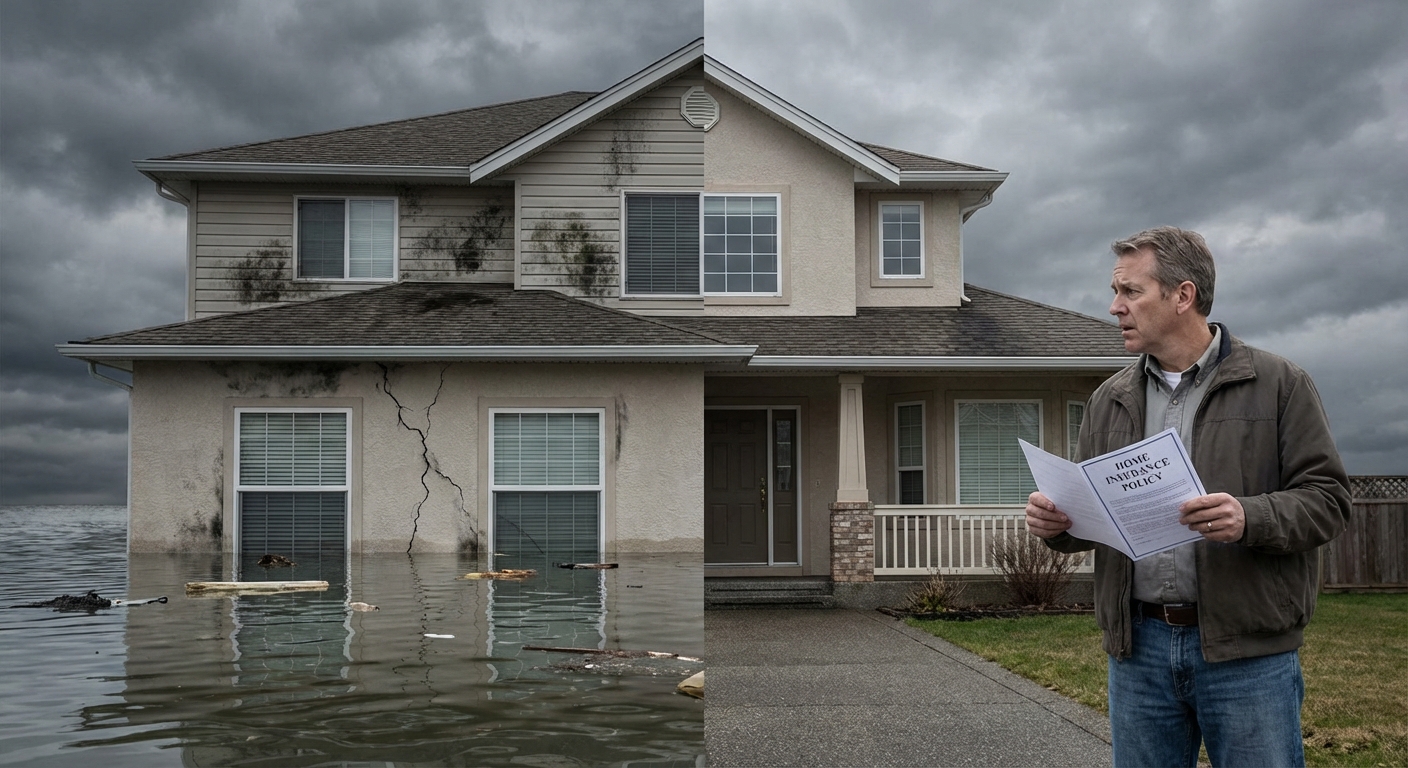
Understanding why exclusions exist helps you recognize which ones you can address with add-ons and which ones require a separate policy entirely. As the 2026 market has tightened, insurers have narrowed wording around water damage, mold, and maintenance-related losses, shifting more risks into endorsements, sublimits, or separate policies. A May 2026 Wall Street Journal analysis of NAIC data found the five largest home insurers (State Farm, Allstate, Liberty Mutual, USAA, and Farmers) closed over 44% of claims resolved in 2025 without payment, up from about 36% a decade ago. A separate April 2026 Weiss Ratings review identified 15 large US insurers that each denied at least 50% of homeowner claims in 2025, led by Mid-Century of Texas at 78.4%, Lemonade at 64%, and Spinnaker at 61%. The industry-wide weighted average now sits at 41.3% of claims closed with no payment.

Compare Home Insurance Plans in Ohio
Find your best options in less than 2 minutes
The 15 Most Common Home Insurance Exclusions
1. Flood Damage
Standard homeowners policies do not cover flooding, including storm surge, overflowing rivers, heavy rain runoff, or flash floods. This is the single biggest coverage gap that catches homeowners off guard.
Why it's excluded: Floods are widespread events that affect thousands of homes simultaneously, creating catastrophic claims that standard insurers can't absorb.
Alternative: Purchase a separate flood insurance policy through the National Flood Insurance Program (NFIP) or a private insurer. The 2026 NFIP national average now runs roughly $926 to $976 per year (about $78 to $81/month). Low-risk Zone X properties average around $475/year, moderate-risk zones about $650/year, high-risk A/AE zones $1,850/year, and very-high-risk V/VE zones can run $3,200+ per year. Under FEMA's Risk Rating 2.0, premiums now reflect a property's specific flood risk rather than just its zone designation, with annual increases still capped at 18%. Get the full breakdown in our water damage coverage guide.
2. Earthquake Damage
Earthquake damage, including cracked foundations, collapsed walls, and broken pipes caused by seismic activity, is excluded from every standard home policy.
Why it's excluded: A single major earthquake can destroy thousands of homes simultaneously, creating liability that no single insurer could manage.
Alternative: Add an earthquake endorsement or purchase a standalone earthquake policy. Annual costs range from around $250 on the East Coast to $800 to $3,500+ in California, with CEA rates now averaging about $3.54 per $1,000 of coverage (roughly $1,770/year for a $500,000 home). Bay Area premiums typically run $1,800 to $3,500/year, while Los Angeles homeowners average $1,200 to $2,800. Retrofit discounts of up to 25% are available for eligible older homes with brace-and-bolt work.
3. Land Movement (Sinkholes, Mudslides, Landslides, Subsidence)
Even if an earthquake didn't cause it, any movement of the ground beneath your home, including sinkholes, mudslides, soil settling, and land subsidence, is typically excluded.
Why it's excluded: These are location-specific, highly predictable geological risks. Insurers view them similarly to flood risk.
Alternative: Earthquake policies often include some earth movement coverage. In Florida and Tennessee, insurers must offer optional sinkhole coverage, which is critical given Florida has the highest incidence of sinkholes in the US. Learn more about how structural damage coverage actually works before you file a claim.
4. Sewer Backup & Sump Pump Failure
Water that backs up through a drain, sewer line, or a failed sump pump is not covered under a standard policy, even though it can cause tens of thousands of dollars in basement damage. Understand more in our full breakdown of water damage coverage gaps and basement flooding scenarios.
Why it's excluded: Sewer backup results from either infrastructure failures or maintenance neglect, neither of which is considered a sudden, accidental peril.
Alternative: A water backup endorsement typically costs $50 to $250 per year, with basic $5,000 coverage available for as little as $30 to $75 annually. Coverage limits usually range from $5,000 to $25,000 per occurrence, though some carriers offer $50,000 or more. Average claims run $3,000 to $15,000, and severe cases involving finished basements can exceed $50,000. For homes with finished basements, home offices, or rec rooms, most agents now recommend a minimum of $25,000 in backup coverage. Learn more about plumbing-related coverage and how it interacts with backup endorsements.
5. Wear & Tear / Deterioration
If your roof slowly deteriorates over 20 years and eventually leaks, your insurer won't pay. Neither will they cover aging pipes, crumbling foundations, or worn-out HVAC systems. Many carriers now switch to actual cash value (ACV) settlement on roofs older than 15 years, and coverage restrictions typically begin around 10 to 20 years depending on state and roofing material. The March 2026 FHFA Lender Letter LL-2026-03 also allows Fannie Mae and Freddie Mac to accept ACV-only roof coverage on the loans they back, giving carriers cover to shift more depreciation risk onto homeowners. Florida's new HB 815, effective July 2026, restricts age-only nonrenewal for roofs under 15 years old.
Why it's excluded: Gradual deterioration is a maintenance issue, not an insurable peril. Policies cover sudden damage, not inevitable aging.
Alternative: There's no insurance for wear and tear. A home warranty can cover repair or replacement of major systems and appliances due to age. Learn how maintenance requirements affect your claims and see our full guide on old roof age requirements in the current market.
6. Neglect & Failure to Maintain
If a small roof leak goes unaddressed for months and causes structural rot, the insurer can deny the entire claim, even for the portion that might otherwise have been covered. Insurers now use drones, satellite imagery, and AI to assess property condition (about 85% of the top 25 US property insurers use aerial imagery). The 2026 Weiss Ratings analysis found 15 large US insurers closed at least 50% of homeowner claims with no payment in 2025, and industry-wide the weighted average hit 41.3%.
Why it's excluded: Homeowners have a legal duty to mitigate damage. Ignoring known problems is considered negligence, not a covered peril.
Alternative: Keep a maintenance log, schedule annual inspections, and document all repairs with dated photos. If your claim is denied, review our guide on what to do after a home insurance denial to prepare your appeal.
7. Mold from Chronic Moisture
Mold caused by long-term humidity, leaking pipes that went unaddressed, or poor ventilation is generally not covered unless it results directly from a sudden covered event (like a burst pipe). Most policies now cap mold coverage between $1,000 and $10,000, with $5,000 being the most common sublimit.
Why it's excluded: Insurers consider chronic mold a maintenance failure. In recent years, policies have tightened mold language significantly to reduce claims abuse.
Alternative: A limited mold endorsement can add some remediation coverage, and water backup endorsements often include minor mold cleanup when the mold is directly caused by a covered backup. The best defense, however, is moisture control. Use dehumidifiers, fix leaks immediately, and ensure proper ventilation.
8. Pest Infestations
Termites, rodents, cockroaches, bed bugs, none of these are covered by a standard home policy, even if they cause structural damage.
Why it's excluded: Pest infestations are considered gradual and preventable with proper maintenance and routine inspections.
Alternative: Regular pest control contracts, annual termite inspections, and a home warranty that includes pest treatment are your best options. See our full breakdown of rodent and wildlife damage coverage for the narrow exceptions where ensuing damage may still be covered.
9. Certain Dog Breeds
Your homeowners policy includes personal liability coverage if your dog bites someone. But if you own a breed on the insurer's exclusion list, that bite claim may be denied entirely. Pit bulls, Rottweilers, and Doberman pinschers appear on nearly every insurer's banned list, and the average dog bite claim ran $65,450 per claim in 2025 (down 5.5% from $69,272 in 2024), with US insurers paying a record $1.86 billion across 28,450 dog-related claims, a 25.6% year-over-year jump in claim volume.
Commonly excluded breeds include:
| Breed Group | Examples |
|---|---|
| Fighting/Protection Breeds | Pit Bull, Rottweiler, Doberman Pinscher |
| Working Breeds | German Shepherd, Akita, Chow Chow |
| Large/High-Risk Breeds | Great Dane, Mastiff, Alaskan Malamute |
| Wolf Hybrids | Any wolf-dog crossbreed |
Why it's excluded: These breeds are statistically associated with higher dog bite claims and more severe injuries, creating elevated liability risk.
Alternative: Seek out breed-blind insurers. State Farm, USAA, Nationwide, Amica, Chubb, and Fireman's Fund evaluate individual bite history rather than breed. As of 2026, six states clearly restrict breed-based insurance discrimination: New York, Nevada (SB166, effective October 1, 2025), Illinois, Michigan, Pennsylvania, and Colorado (HB25-1207, effective January 1, 2026), with additional states including Minnesota having older statutes on the books. Get the full playbook in our dog breeds and home insurance guide and see how dog bite liability claims actually work. You can also add a personal umbrella policy for broader liability protection.
10. Business Liability & Property
If you run a business from home, even a part-time Etsy shop, daycare, or consulting practice, your standard policy typically limits business property coverage to around $2,500 and provides zero liability coverage for business-related activities.
Why it's excluded: Business risks are commercially underwritten and require different actuarial models than personal homeowners coverage.
Alternative: Add a home-based business endorsement or business pursuits endorsement for a few hundred dollars per year. For larger operations, a separate Business Owner's Policy (BOP) is recommended.
11. Intentional Damage
If you or a household member intentionally damages your own property, or a neighbor's, your insurer will deny the claim.
Why it's excluded: This is a fundamental principle of insurance: coverage is for accidental losses. Covering intentional acts would create enormous moral hazard and invite fraud. See how accidental damage coverage differs on HO-3 vs HO-5 forms.
Alternative: There is no insurance for deliberate destruction. This exclusion is absolute.
12. Nuclear Hazard
Damage caused by nuclear radiation, radioactive contamination, or nuclear reaction is excluded from every standard home insurance policy in the US.
Why it's excluded: The potential for catastrophic, widespread liability makes nuclear risk completely uninsurable in the private market.
Alternative: The federal Price-Anderson Nuclear Industries Indemnity Act provides a government-backed compensation system for nuclear incidents, though it is limited and complex.
13. War & Government Action
Damage resulting from declared or undeclared war, military conflict, insurrection, or government seizure of property is universally excluded.
Why it's excluded: These are systemic catastrophic events beyond the scope of private insurance markets.
Alternative: No private alternative exists. Some federal disaster relief programs may provide limited assistance after certain government-declared events.
14. Ordinance or Law (Building Code Upgrades)
If your home is destroyed and local codes now require upgraded wiring, plumbing, or structural standards to rebuild, your standard policy may only pay for like-for-like replacement, not the additional cost to meet new codes.
Why it's excluded: Standard policies are designed to restore your home to its pre-loss condition, not to upgrade it.
Alternative: Add an Ordinance or Law endorsement, which covers the extra cost of bringing your rebuild up to current building codes. Standard policies typically include 10% of dwelling coverage by default, and it can be upgraded to 25% to 100%. This is especially important for older homes.
15. Vacant or Unoccupied Homes
If your home sits vacant for 30 to 60+ days (the threshold varies by policy), your coverage may be significantly reduced or voided entirely for many perils.
Why it's excluded: Vacant homes face higher risks of vandalism, squatters, undetected water leaks, and fire, with no occupant to respond quickly. Industry data shows vacant properties are roughly three times more likely to be vandalized than occupied ones.
Alternative: Purchase a vacant home insurance policy or notify your insurer before extended absences to arrange a vacancy permit. These specialty policies average around $4,200 per year in 2026 (roughly 50% to 60% more than the standard $2,800 average), though most single-family properties land between $1,500 and $3,000 depending on state, vacancy length, and property condition.

Protect your home with State Farm
Average Rate:
Homeowners who bundle and save with State Farm save an average of $1,000 per year!

You're in Good Hands® with Allstate
Average Rate:
Get comprehensive home coverage with flexible policy options.

Customize your home coverage
Average Rate:
Only pay for the coverage you need with personalized home insurance.

Smart coverage for your home
Average Rate:
Protect what matters most with award-winning home insurance.
How to Plug Your Coverage Gaps: A Quick Reference
| Gap | Best Solution | Estimated 2026 Annual Cost |
|---|---|---|
| Flood damage | NFIP or private flood insurance | $475 to $3,200+ ($926 to $976 avg.) |
| Earthquake damage | Standalone earthquake policy | $250 to $3,500+ |
| Sewer backup | Water backup endorsement | $50 to $250 |
| Business liability | Home business endorsement | $25 to $500 |
| Building code upgrades | Ordinance or Law endorsement | $50 to $150 |
| Wear and tear | Home warranty plan | $400 to $700 |
| Vacant home | Specialty DP-1/DP-3 policy | $1,500 to $4,200 |
Understanding your accidental damage coverage options and reviewing your plumbing coverage limits will also help you spot exclusions before they show up on a claim.
Frequently Asked Questions
Does home insurance cover roof damage from age?
No. If your roof fails due to age, wear, or gradual deterioration, your homeowners policy will not cover it. Most carriers now restrict coverage on roofs older than 15 to 20 years, and many settle claims on older roofs at actual cash value rather than full replacement cost, especially after the March 2026 FHFA Lender Letter LL-2026-03 allowing ACV-only roofs on Fannie Mae and Freddie Mac loans. Regular roof inspections and timely repairs are the best way to keep your coverage intact.
Will home insurance cover mold removal?
It depends on the source of the mold. If mold develops as a direct result of a covered sudden event like a burst pipe, your policy may cover remediation up to its mold sublimit (typically $1,000 to $10,000, with $5,000 the most common). However, mold caused by long-term humidity, gradual leaks, or neglected maintenance is almost always excluded. A mold or water backup endorsement can provide additional protection, but prevention through proper ventilation and moisture control is your best defense.
What happens if my dog bites someone and the breed is excluded?
If your insurer has a breed exclusion and your pet bites a guest, your liability claim can be denied entirely. You would then be personally responsible for medical bills, legal fees, and any judgments against you, which averaged $65,450 per bite claim in 2025 and can reach six figures. Options include switching to a breed-blind insurer (State Farm, USAA, Nationwide, Amica, Chubb, or Fireman's Fund), adding a personal umbrella policy, or living in a breed-blind state like New York, Nevada, Illinois, Michigan, Pennsylvania, or Colorado.
Is flood insurance worth it if I'm not in a high-risk flood zone?
Yes, in many cases. FEMA reports that a significant share of NFIP flood claims come from properties outside high-risk Special Flood Hazard Areas, and premiums in low or moderate risk zones average about $475 to $650 per year. Given that just 1 inch of floodwater can cause up to $25,000 in damage, the coverage gap is enormous relative to the modest premium. Lock in a policy while NFIP pricing is stable rather than waiting for the next disaster.
Can I add all these endorsements to any home insurance policy?
Most endorsements like water backup, ordinance or law, and scheduled personal property can be added to standard HO-3 or HO-5 policies through your existing insurer. However, availability and pricing vary by company and state, and some insurers don't offer certain endorsements at all. For major gaps like flood and earthquake, you'll need completely separate policies regardless of who your homeowners insurer is.