
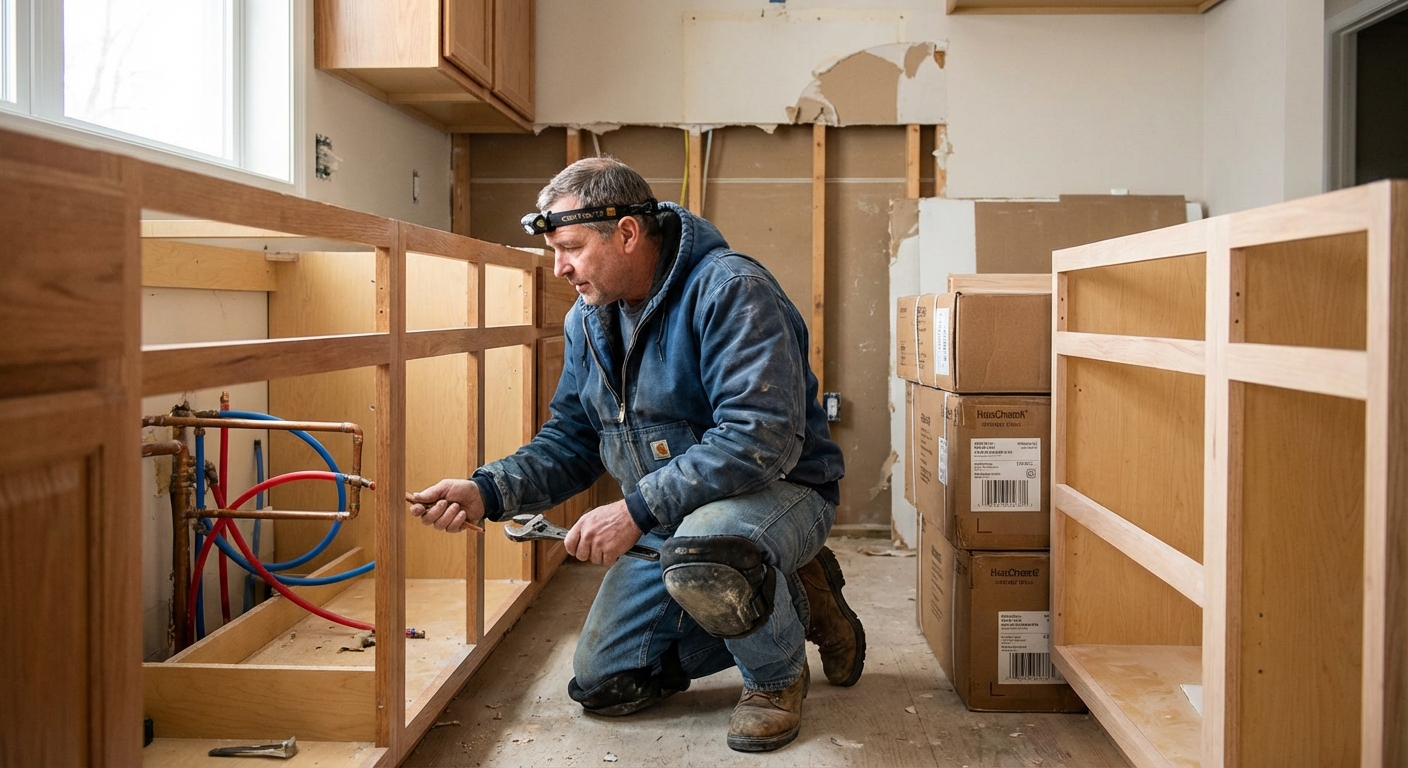
Moving vs. Keeping Your Kitchen Plumbing Layout
One of the first (and most consequential) decisions in any kitchen remodel is whether to move your existing plumbing or work around it. It's not just a design question, it's a budget question.
Keeping fixtures in place is the most cost-effective approach. Your sink, dishwasher, and refrigerator water line stay connected to existing supply and drain lines, which means no rerouting, no wall or floor demolition for pipe access, and no new venting. For homeowners on a tighter budget, designing the new kitchen around the existing plumbing footprint can save thousands.
Moving plumbing, on the other hand, opens the door to a more functional layout, but it comes at a real cost. Here's what to expect in 2026:
| Fixture | Minor Move (< 3 ft) | Major Move (across room/to island) |
|---|---|---|
| Kitchen Sink | $1,500 – $4,000 | $3,000 – $6,500+ |
| Dishwasher | $500 – $1,500 | $1,500 – $3,000+ |
| Refrigerator Water Line | $500 – $1,000 | $1,000 – $2,000+ |
Current 2026 remodeler data shows that moving a sink, dishwasher, or gas range even a few feet can add anywhere from $1,500 to $6,500+ per fixture, with the exact cost depending heavily on foundation type. National cost guides put sink relocation plumbing labor at roughly $1,500 to $4,000, while Southern California remodelers commonly report $3,000 to $8,000 in added plumbing costs when a full layout change involves moving the sink, dishwasher, or refrigerator water line.
These figures cover labor and materials but typically exclude drywall repair, flooring patches, permits, and finishing work. Homes on concrete slab foundations face higher costs, since pipes must be accessed by breaking through concrete rather than through a crawl space or basement. Slab jobs often add hundreds of dollars for ground-penetrating radar scanning and $1,700 or more for cutting and trenching an access path before any plumbing labor begins.
For more perspective on how plumbing placement impacts your overall project, see our guide on the plumbing rough-in process and how bathroom plumbing layout planning applies similar cost principles.

Find Trusted & Licensed Plumbers in Ohio
Get matched with companies for your specific needs
Kitchen Island Plumbing, Upgrades & Gas Lines
Adding a Sink to Your Kitchen Island
A kitchen island with a sink is a highly desirable feature, and one of the trickiest plumbing jobs in a remodel. Unlike a wall-mounted sink, an island has no nearby wall to run a traditional vent stack, which forces the plumber to route everything through the floor.
What's required:
- Drain line: A horizontal waste pipe sloped ¼ inch per foot, running through the subfloor to connect to the main stack
- Supply lines: Hot and cold water routed through the floor to the faucet location
- Venting: Every sink needs a vent. Two options are typically used:
- Island fixture vent (loop vent): The 2024 International Plumbing Code specifically permits residential kitchen sinks (including those with dishwasher and food waste grinder connections) to use an island fixture vent that rises vertically above the drainage outlet before offsetting horizontally or vertically downward.
- Air Admittance Valve (AAV): Allowed in many jurisdictions as a mechanical alternative, but verify local codes and required ASSE listings before specifying this option.
2026 island plumbing costs by scope, based on current remodeler data:
| Island Plumbing Scope | Typical 2026 Cost |
|---|---|
| Prep sink only (no dishwasher) | $1,500 – $3,000 |
| Full-size sink | $2,000 – $5,000 |
| Sink + dishwasher | $3,000 – $5,500 |
| Sink + dishwasher + disposal | $3,500 – $7,000 |
Angi's 2026 kitchen island data puts plumbing pipe work alone at $500 to $1,900 for a new island, on top of the sink, faucet, and cabinetry costs.
The 2024 IPC requires vent pipes to be at least 1¼ inches in diameter and no less than one-half the diameter of the drain served. Vents exceeding 40 feet in developed length must be increased by one nominal pipe size for the entire run. Always pull a permit and schedule a rough-in inspection before closing up floors or cabinets.
For related guidance, our dishwasher plumbing connection guide and kitchen sink installation breakdown are helpful complements when planning island appliance hookups.
Upgrading Galvanized Pipes While Walls Are Open
If your home was built before the 1970s and still has galvanized steel pipes, a kitchen remodel is the perfect time to replace them. Once walls are already open, the incremental labor cost to repipe is far lower than doing it as a standalone project later.
Galvanized pipes corrode from the inside out, causing low water pressure, rust-colored water, and eventual leaks. Here's what 2026 replacement costs look like:
| Pipe Material | Cost Per Linear Foot | Kitchen-Only Estimate |
|---|---|---|
| PEX | $0.40 – $4.00 | $800 – $2,500 |
| Copper | $2.00 – $12.00 | $1,500 – $4,000+ |
PEX is the preferred choice for most remodel situations. It's flexible (requiring fewer wall cuts), freeze-resistant, corrosion-proof with a lifespan of 80 to 100 years, and typically costs meaningfully less than copper because the raw material is cheaper and installation is significantly faster. Labor can account for as much as 70% of the total repipe bill, so PEX's flexibility translates directly into savings. Copper remains a premium option where local codes or preference require it, but whole-home PEX repipes commonly run $4,000 to $8,500 for a 1,500 sq ft home, while copper for the same home lands around $9,000 to $12,000.
Learn more about what aging pipes can hide from our guides on plumbing for house flipping and when plumbing permits are required.
Gas Line Work for Ranges & Cooktops
Switching from an electric range to gas, or relocating an existing gas range, requires extending or rerouting the gas supply line. This is not a DIY task. Most jurisdictions require a licensed plumber or gas fitter to handle gas line work, and for good reason: improper installation can cause fires, explosions, or carbon monoxide poisoning.
What the job involves:
- Tapping into the nearest gas supply line using a tee fitting
- Running new black iron or CSST (corrugated stainless steel tubing) to the appliance location
- Installing a dedicated shut-off valve near the range
- Pressure-testing all connections before use
2026 gas line costs for a kitchen range or cooktop typically run:
- Simple, short run with good access: $400 to $800
- Typical remodel with moderate distance: $600 to $1,200
- Complex retrofit (slab, long run, closed walls, meter upgrade): $1,200 to $2,500+
Thumbtack's 2026 data shows stove or oven gas line installations averaging $376 to $1,278, with most homeowners paying around $470. Homewyse pegs national gas line installation at $864 to $1,060 per piping run in mid-2026, and Angi estimates $15 to $25 per linear foot for rerouting existing lines, meaning a typical 30-foot run lands in the $450 to $750 range for a straightforward move.
Permits, Inspections & Timeline
Do You Need a Permit for Kitchen Plumbing?
Yes. In almost every US jurisdiction, any plumbing work that involves moving, adding, or altering supply lines, drain lines, vent pipes, or gas lines requires a permit. This includes:
- Relocating a sink, dishwasher, or refrigerator water line
- Adding a prep sink or island plumbing
- Upgrading or replacing existing supply pipes
- Running or extending a gas line
Cosmetic work like swapping out a faucet or replacing a countertop without touching the plumbing typically does not require a permit. Standalone plumbing permit fees in 2026 commonly run $50 to $500, but bundled multi-trade kitchen remodel permits (plumbing, electrical, building) frequently total $1,500 to $4,000 for mid-range projects in higher-cost markets.
The permit process generally follows these steps:
- Submit an application with project scope to your local building department
- Receive permit approval (timeline varies by municipality)
- Schedule a rough-in inspection before walls are closed
- Complete work and schedule a final inspection
- Receive sign-off and certificate of completion
Our guide on the new construction plumbing process can help you understand what permit fees and inspection costs to factor into your quotes.
How Plumbing Affects Your Remodel Timeline
Plumbing rough-in work typically takes 1 to 2 weeks once demolition is complete. However, complexity matters:
| Project Type | Estimated Timeline |
|---|---|
| Minor cosmetic updates (no plumbing changes) | 3 – 6 weeks total |
| Standard remodel with minor plumbing moves | 6 – 12 weeks total |
| Major remodel with new layout, island, gas work | 10 – 20+ weeks total |
Plumbing inspections are a mandatory checkpoint that must pass before drywall can go up, meaning any failed inspection or re-inspection can push your entire project back by days or weeks. Plan for this in your scheduling.
For context on how plumbing complexity compares across different types of builds, see our plumbing for home additions and ADU plumbing requirements guides.
How Plumbing Decisions Shape Your Overall Budget
Plumbing is one of the highest-leverage cost drivers in a kitchen remodel. In 2026, national data from Hanley Wood Market Intelligence and Angi shows the average kitchen remodel costs about $27,000, with most projects landing between $14,600 and $41,600, and mid-range projects now commonly running $35,000 to $70,000. Full renovations reach $60,000 to $100,000+ in many markets. Keeping fixtures in their existing locations can save $3,000 to $8,000 compared to moving them.
When all plumbing work is factored in (fixture relocation, pipe upgrades, island plumbing, gas lines, and permits), it's common for plumbing to represent 5 to 15% of a total kitchen remodel budget, tilting toward the higher end when major relocations or gas work are involved. On a $40,000 mid-range remodel, that's $2,000 to $6,000 in plumbing alone.
See our faucet replacement cost guide for a closer look at fixture-level pricing that fits into your remodel budget.
Frequently Asked Questions
How much does it cost to move a kitchen sink during a remodel in 2026?
Moving a kitchen sink typically costs $1,500 to $4,000 for a minor shift along the same wall, and $3,000 to $6,500 or more for a major relocation across the room or to an island. These 2026 estimates cover labor and materials but exclude wall or floor repairs, permit fees, and finishing work. The cost rises significantly on slab foundations, where concrete must be broken to access the drain line. Always get multiple licensed plumber quotes before finalizing your layout decisions.
Do I need a permit to move plumbing in a kitchen remodel?
Yes, in nearly all US jurisdictions, moving or altering kitchen plumbing (including supply lines, drain lines, vent pipes, or gas lines) requires a permit. Skipping this step can result in fines, complications during home sales, and potential insurance claim denials. Your licensed plumber will typically pull the permit on your behalf and schedule required inspections. Always check with your local building department for jurisdiction-specific requirements.
Can I add a sink to a kitchen island?
Yes, but it requires careful planning. Island sinks have no nearby wall for traditional venting, so drain and supply lines must be routed through the floor, and venting must be handled via an island fixture vent (loop vent) or an air admittance valve where allowed by local code. The 2024 IPC specifically permits island fixture venting for residential kitchen sinks including those with dishwasher and disposal connections. Homes with slab foundations face significantly higher costs due to the need to core through concrete.
Is it worth replacing galvanized pipes during a kitchen remodel?
Absolutely. If your home has galvanized pipes, a remodel is the most cost-effective time to replace them since walls and floors are already open. Galvanized pipes corrode internally, causing rust, low water pressure, and eventual leaks. PEX is the most popular replacement material at $800 to $2,500 for kitchen-only sections in 2026, while copper can cost several times more. Replacing aging pipes now prevents far more expensive emergency repairs later and can improve your home's resale value.
How does kitchen plumbing affect the overall remodel timeline?
Plumbing rough-in work typically takes one to two weeks, but it's a mandatory checkpoint since walls cannot be closed until a rough-in inspection is passed. For major remodels involving layout changes, island plumbing, and gas work, the total project timeline can stretch to 10 to 20+ weeks. Any failed inspection or mid-project plumbing change can delay your entire schedule. Locking in your plumbing plan before demolition starts is one of the best ways to keep your timeline on track.