
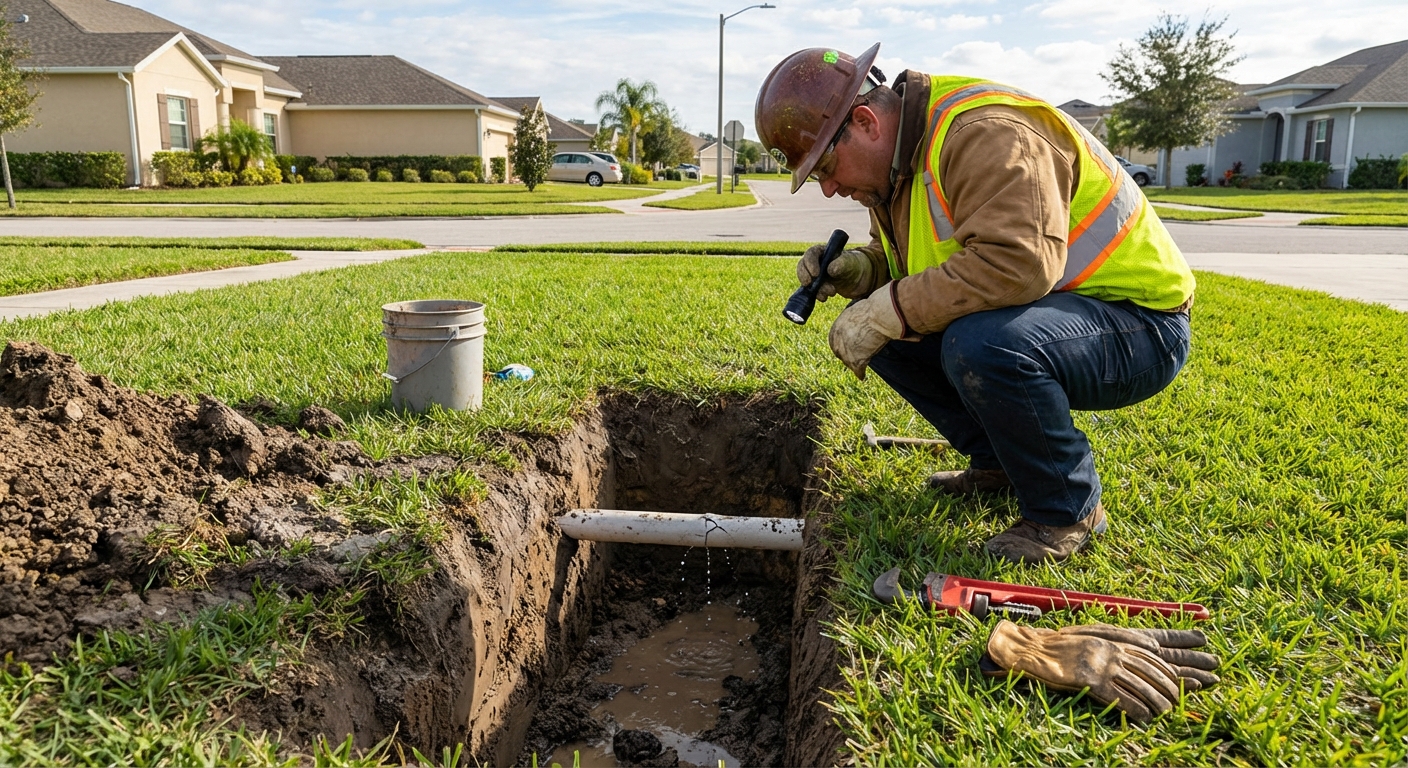
What Is a Main Water Line?
The main water line, also called a service line, is the primary underground pipe that runs from the municipal water main at the street to your home. It carries pressurized water at roughly 40 to 60 psi through a pressure regulator and main shutoff valve, then branches into cold and hot water supply lines that reach every faucet, appliance, toilet, and outdoor spigot in your home.
Most residential service lines are buried 3 to 8 feet underground and are made from copper, PEX, PVC, galvanized steel, or (in older homes) lead. Because the pipe is underground and out of sight, problems can go unnoticed for months, driving up your water bill and silently damaging your property.

Find Trusted & Licensed Plumbers in Ohio
Get matched with companies for your specific needs
Warning Signs Your Main Water Line Has a Problem
Catching a main water line problem early can be the difference between a minor repair and a full replacement. Here are the most common red flags to watch for:
Low Water Pressure
If water pressure drops suddenly throughout your entire home, not just one faucet, it's a strong signal that the service line may be leaking, corroded, or partially blocked. A low water pressure issue that affects every fixture simultaneously almost always points to the main line rather than an individual plumbing branch.
Unexplained Wet Spots or Soggy Yard
Puddles in your yard, sinkholes, or consistently soggy patches of grass near the water meter or foundation, especially when it hasn't rained, are classic signs of an underground leak. Water from a cracked or broken pipe will saturate the surrounding soil and eventually reach the surface.
Sudden Spike in Your Water Bill
If your monthly water bill spikes with no change in your usage habits, an undetected leak in your service line could be running your meter 24/7. Even a small leak can waste thousands of gallons per month. A water line leak detection professional can pinpoint the exact location without unnecessary digging.
Water Quality Issues
Discolored, cloudy, or foul-smelling water coming from your taps can indicate a break in the line that is allowing groundwater, dirt, or sediment to contaminate your supply. Rusty or brown water may also signal internal pipe corrosion. If you notice a change in water quality, have your line inspected immediately. Addressing contamination may also require a water filtration system as a precautionary measure.
| Warning Sign | Likely Cause | Urgency |
|---|---|---|
| Low pressure throughout house | Leak, break, or blockage in service line | High |
| Soggy yard / sinkholes near meter | Underground leak saturating soil | High |
| Unexplained high water bill | Undetected continuous leak | Medium-High |
| Discolored or cloudy water | Contamination from break or pipe corrosion | Very High |
| Hissing sounds near foundation | Pressurized water escaping cracked pipe | High |
Repair vs. Replacement: Which Does Your Line Need?
Deciding between a targeted repair and a full main water line replacement depends on several factors:
Choose repair when:
- The damage is localized to one section of pipe
- The pipe material is in otherwise good condition
- The line is relatively new (less than 20 to 25 years old)
- The break was caused by a one-time event (tree root, freeze, accidental puncture)
Choose replacement when:
- The line is old, corroded, or made of lead or galvanized steel
- You've had repeated leaks or repairs in recent years
- A plumbing camera inspection reveals widespread pipe deterioration
- The cost of ongoing repairs is approaching the cost of full replacement
A thorough plumbing inspection using video camera technology can identify the true condition of your line before you commit to either path, potentially saving you thousands.
New EPA Lead Service Line Rules to Know
If your home has a lead or galvanized steel service line, federal rules may now be working in your favor. Under the EPA's Lead and Copper Rule Improvements (LCRI), community water systems must inventory all service lines and develop a full replacement plan, with most utilities required to replace all lead service lines within about 10 years. By November 1, 2027, your water utility must have a formal lead service line replacement plan in place, with full nationwide replacement targeted by 2037.
What this means for homeowners: many utilities now offer to replace the private portion of your lead line at little or no direct cost, often funded through federal grants, state programs, or rate-based recovery. Call your water utility and ask whether your address is in their inventory and what their cost-share policy is before you pay out of pocket.
Excavation vs. Trenchless Methods
Once you've decided to repair or replace, the next choice is how the work gets done.
Trenchless pipe lining (CIPP) involves inserting a resin-coated liner into the existing pipe, which hardens to form a new pipe wall from the inside. Pipe bursting pulls a new pipe through the old one, breaking the old pipe outward as it goes. Both methods start with a camera inspection and pipe cleaning.
Traditional excavation remains the right call when pipes are fully collapsed, severely misaligned, or in areas where surface disruption is minimal. For most homeowners with yards, driveways, or mature landscaping, trenchless is the preferred option. Learn more about how sewer line repair methods compare; many of the same trenchless principles apply to water lines.
Main Water Line Repair Costs in 2026
Typical Cost Ranges
| Service | 2026 Cost Range | Average |
|---|---|---|
| Minor leak repair (accessible) | $350 - $700 | ~$500 |
| Main water line repair (general) | $400 - $1,700 | ~$1,025 |
| Cracked or broken pipe repair | $500 - $5,000 | ~$1,200 |
| Corroded pipe repair | $600 - $5,000 | ~$1,500 |
| Full line replacement (traditional) | $1,860 - $3,720 | ~$2,000 |
| Full line replacement (trenchless) | $4,000 - $15,000 | ~$7,500 |
For replacements, costs are priced per linear foot and range from $50 to $250 per linear foot in 2026 depending on method and materials. Trenchless replacement typically runs $70 to $250 per linear foot, while traditional excavation often starts lower per foot but adds significant restoration costs. Labor rates for underground water line work typically run $75 to $150 per hour, with major metro areas trending higher.
In a high cost-of-living city like New York, a residential water service installation on a side street can run $6,000 to $10,000 in 2026, with higher costs in dense urban cores due to traffic, depth, and permitting requirements.
Key Factors That Affect Your Cost
- Pipe length and depth: Deeper, longer runs cost more to access and repair
- Pipe material: PEX is the most affordable; copper costs roughly 2 to 3 times more
- Repair method: Trenchless costs more upfront but saves on restoration expenses
- Local labor rates: High cost-of-living areas can push replacement well above $250/ft
- Damage severity: A simple patch versus a full-line replacement is a dramatic cost difference
- Lead pipe replacement: A full lead service line replacement averages about $4,700, ranging from $1,200 to $12,300 per line according to EPA estimates (though utility programs may now cover much of this)
Who's Responsible: Homeowner vs. City
This is one of the most misunderstood aspects of main water line issues. Here's how responsibility is typically divided:
The city or municipality is responsible for:
- The large public water main running under the street
- Any portion of the line on public property (street, sidewalk, easement)
- Breaks or damage that occur at the water main connection point
The homeowner is responsible for:
- The private service line from the connection point (typically the curb stop or property line) all the way to your home
- All repair and replacement costs for this section of pipe
- Any water damage to your property resulting from your service line failure
The exact boundary varies by municipality and is often at the curb stop, property line, or meter box. Contact your local water utility to get the exact demarcation for your address.
Does Homeowners Insurance Cover It?
Standard homeowners insurance does not cover main water line repairs or replacements in 2026. Coverage is typically limited to sudden and accidental damage inside the home (such as a burst pipe that floods your living room), not the underground service line leading to it. Damage from age, wear and tear, corrosion, or gradual deterioration is also excluded.
However, several options exist to protect yourself:
Ask your insurance agent about a service line coverage endorsement. Insurers like Liberty Mutual, Progressive, Travelers, and SageSure offer this as an affordable add-on. You can also check whether your water utility offers a standalone water line protection plan. It's a small monthly cost compared to a $2,000 to $15,000 surprise repair bill.
Emergency Procedures for a Main Line Break
If your main water line bursts or you suspect a major leak, act fast to minimize damage.
Step 1: Shut off the main water supply immediately. Your main shutoff valve is typically located in the basement, garage, crawl space, or near the water meter. Turn it clockwise until it stops. If the valve is stuck, call your water utility to shut off at the street.
Step 2: Turn off your water heater. For electric heaters, flip the breaker. For gas, set the thermostat to "pilot." This prevents the tank from running dry and overheating.
Step 3: Cut power to affected areas. If water is near any electrical outlets, appliances, or panels, shut off the relevant breakers immediately to prevent electrocution.
Step 4: Drain remaining water from pipes. Open all faucets and flush toilets to release residual pressure from the system.
Step 5: Document everything. Take photos and video of all damage before cleanup begins. This documentation is critical for any homeowners insurance claim or utility dispute.
Step 6: Call an emergency plumber. An emergency plumber can respond quickly to assess the damage and begin repairs. Provide the plumber with the location of the leak, current water status, and visible damage details.
Frequently Asked Questions
How do I know if my main water line is leaking underground?
The most reliable signs are a sudden drop in water pressure throughout the entire house, unexplained increases in your monthly water bill, and soggy or wet patches in your yard, particularly near the water meter or along the path of the service line. You may also hear a faint hissing sound near your foundation. A professional leak detection service can confirm a leak and pinpoint its location using acoustic sensors or thermal imaging without digging up your yard.
How long does main water line repair or replacement take?
A targeted repair for a localized leak can often be completed in a single day. Full replacement using traditional excavation can take 2 to 5 days, depending on pipe length and soil conditions. Trenchless replacement is generally faster, often completed in 1 to 2 days, because it requires minimal digging and surface restoration.
Will the EPA's new lead service line rules pay for my replacement?
Possibly. Under the 2024 Lead and Copper Rule Improvements, water utilities must inventory and plan to replace all lead service lines within roughly 10 years. Many systems now offer free or heavily subsidized replacement of the private portion of your line, funded through federal grants, state programs, or rates. Contact your water utility and ask about their lead service line replacement plan and cost-share policy before paying for replacement on your own.
Is trenchless water line repair worth the higher upfront cost?
In most cases, yes. While trenchless methods cost more upfront, often $70 to $250 per linear foot, they eliminate the expense of restoring your yard, driveway, or landscaping after digging. When you factor in total project cost, trenchless repair frequently comes out 30% to 50% less expensive overall than traditional excavation with full restoration. It's also typically completed faster and causes less disruption. Learn more about how repair methods compare for underground pipes.
What pipe material should I choose for a main water line replacement?
PEX (cross-linked polyethylene) has become the dominant choice in 2026 for water line replacement due to its flexibility, freeze resistance, corrosion resistance, and affordable cost (often half the price of copper). Copper remains the premium option with a 50+ year lifespan and excellent durability, but costs roughly 2 to 3 times more and can corrode in acidic soils. Standard PVC is generally not recommended for pressurized potable water lines and is reserved for drains and waste. Your plumber can recommend the best material based on your local soil conditions, water chemistry, and budget.