
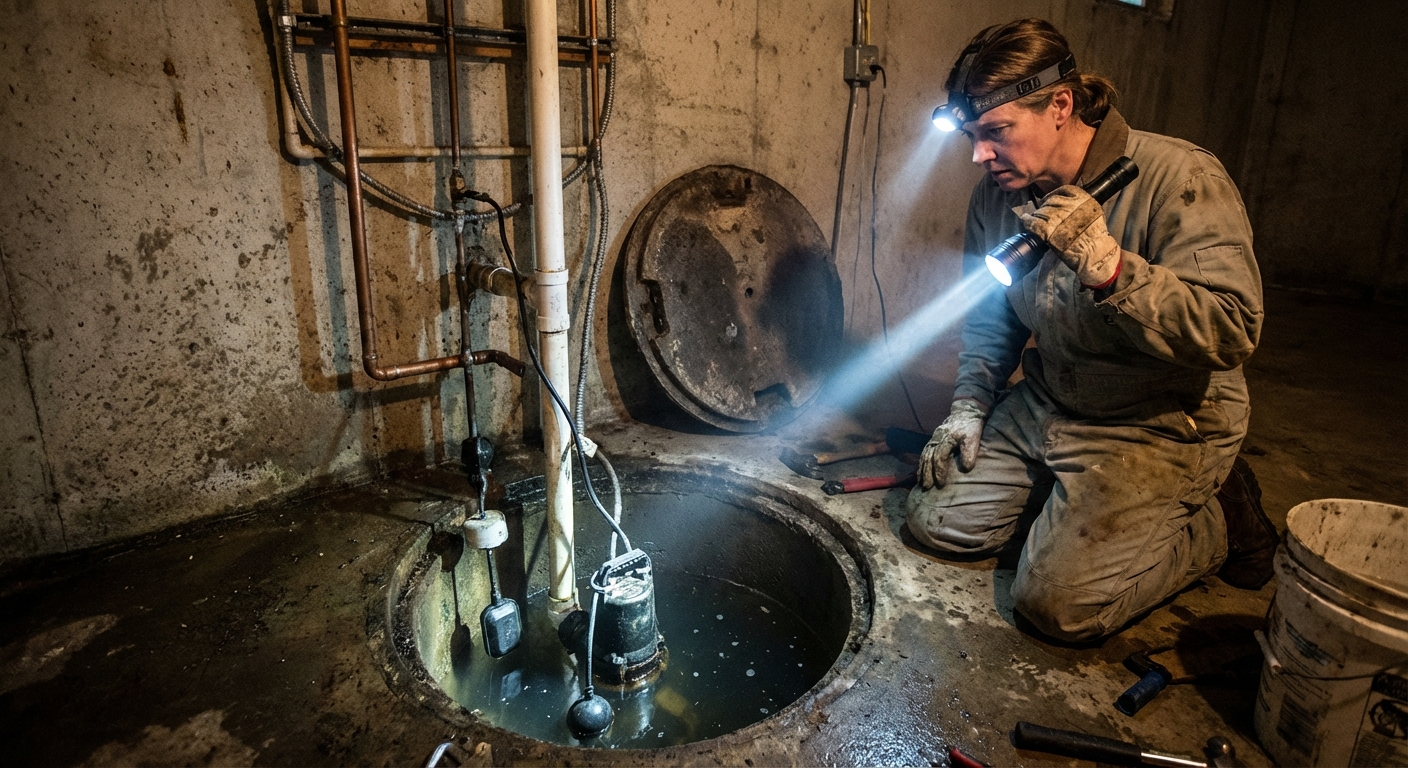
What Does a Sewage Ejector Pump Actually Do?
If you have a bathroom, laundry room, or any plumbing fixture in your basement, you almost certainly depend on a sewage ejector pump to keep things functioning. Unlike upper-floor plumbing that relies on gravity to drain into the main sewer line, basement fixtures sit below that line. A sewage ejector pump solves this by collecting wastewater in a sealed underground pit and forcibly pumping it upward through a discharge pipe until it reaches the main drain.
Here's the basic operating cycle:
- Collection - Wastewater from basement drains flows into a sealed basin (typically 18-30 inches deep) installed below the basement floor.
- Activation - When the water level reaches a preset trigger point, a float switch activates the pump motor.
- Grinding & Lifting - The impeller spins at high speed, breaking down solid waste into a slurry that is forced up through the discharge pipe and check valve into your home's main drain line.
- Shut-Off - Once water drops to the lower threshold (usually around 2-3 inches), the pump shuts off automatically.
- Venting - A vent pipe runs from the basin to your roof or existing vent stack to safely release sewer gases.
Without this pump working properly, waste has nowhere to go, and that's when serious, expensive problems begin.

Find Trusted & Licensed Plumbers in Ohio
Get matched with companies for your specific needs
Common Ejector Pump Problems & What's Causing Them
Ejector pump issues rarely happen without warning. According to 2026 service data, the most frequent failures involve clogs and blockages, float switch problems, motor overheating, electrical or control-panel faults, and mechanical wear like damaged impellers and worn bearings. Here are the five most common issues homeowners face, what causes them, and how to recognize them early.
Pump Won't Turn On
This is one of the most urgent ejector pump failure symptoms. If the pump won't activate despite rising water in the pit, check for:
- Tripped circuit breaker or blown fuse
- Pump accidentally unplugged
- Faulty or stuck float switch
- Burned-out motor from age or overheating
First step: Head to your breaker panel and check for any tripped breakers before assuming the pump itself is the problem. If power is confirmed, the float switch is the most likely culprit.
Pump Runs Constantly or Short-Cycles
An ejector pump running constantly is a major red flag. It puts enormous strain on the motor and dramatically shortens pump lifespan. Common causes include:
- Stuck float switch that can't drop to the "off" position
- Failed check valve allowing discharged water to flow back into the pit, triggering the pump again immediately
- Clog or blockage in the discharge line forcing the pump to work harder
- Undersized pump overwhelmed by water volume
Unusual Noises During Operation
A healthy ejector pump produces a consistent low hum. Any deviation from that is a warning sign:
| Sound | Likely Cause |
|---|---|
| Grinding or rattling | Debris caught in impeller |
| Banging or clanking | Loose components or pipe vibration |
| Loud gurgling | Check valve failure or air in the line |
| High-pitched whining | Motor bearing wear |
Sewage Odors in the Basement
Persistent sewage smells almost always mean waste isn't being fully evacuated, either because the pump is struggling, there's a clog in the pit, or the basin lid seal has been compromised. A properly functioning, sealed ejector system should be virtually odor-free at the pit level.
Sewage Backups
Backups are the worst-case scenario and usually result from:
- Flushing non-flushable items (wipes, paper towels, feminine hygiene products, dental floss)
- Grease buildup coating the pit walls and float
- A completely failed pump motor
- A clogged or collapsed discharge pipe
Learn more about sewer line issues that can compound backup problems when your ejector fails.
How to Troubleshoot Float Switches & Check Valves
These two components are responsible for the majority of ejector pump problems. Here's how to diagnose each one safely.
Troubleshooting the Float Switch
The float switch is a buoyancy-activated trigger. If it gets tangled, stuck, or fails electrically, the pump either won't start or won't stop.
Step-by-step:
- Test power first - Confirm the circuit breaker hasn't tripped and the pump is plugged in.
- Manual lift test - With power on, manually lift the float by hand. If the pump activates, the switch mechanism works; the issue is likely the float getting stuck.
- Check for obstructions - Open the basin lid and look for debris, cords, or buildup preventing free float movement.
- Clean and reposition - Wipe away grease and debris. Adjust the float's position so it moves freely up and down along the tether.
- Test continuity - With power off, use a multimeter on the float switch terminals. You should read continuity (closed circuit) when the float is raised and no continuity when lowered (for a standard pump-down configuration).
- Replace if needed - Float switches are inexpensive ($15-$50) and straightforward to swap out. Replace mechanical floats every five years as a preventive measure.
Troubleshooting the Check Valve
The check valve sits on the discharge pipe above the pump and allows water to flow only one direction, out. A failed check valve lets discharged water fall back into the pit, causing constant pump cycling.
Check valve test: With power off and the pit partially drained, loosen the band clamps and remove the valve. Blow through it - it should allow airflow in one direction only. Shake it gently; if you hear a loose rattle, the internal flap or ball may be broken. Replace the valve if it fails either test.
For stubborn clogs that aren't related to the pump itself, professional drain cleaning may help clear the discharge line and restore proper flow.
Repair vs. Replacement: What Makes Financial Sense in 2026?
Typical Ejector Pump Repair Costs
| Repair Type | Average Cost (2026) |
|---|---|
| Float switch replacement | $80 – $175 (parts + labor) |
| Check valve replacement | $100 – $225 |
| Clog removal / snaking | $125 – $550 |
| Impeller cleaning or repair | $175 – $275 |
| Motor repair | $225 – $450 |
Plumber labor in 2026 typically runs $50-$200 per hour, with most residential service calls landing in the $80-$120 per hour range. A typical non-emergency service visit (service call fee plus 1-2 hours of labor) often totals $250-$400 before parts. If you need after-hours service, expect to pay significantly more. Emergency plumber rates run 1.5 to 3 times standard rates and total emergency calls commonly run $400-$800+. Learn more about emergency plumber rates and the surcharges to plan for.
Ejector Pump Replacement Costs
According to 2026 cost data, full sewage ejector pump replacement averages around $2,300 to $2,500 nationally, with most homeowners spending between $850 and $3,500 depending on pump type, basin condition, and labor. Brand-new installations that require a new pit, drain lines, and slab work can run as high as $6,500.
| Pump Material | Average Unit Cost | Total Installed Range |
|---|---|---|
| Plastic | $350 | $850 – $1,400 |
| Plastic & Cast Iron | $475 | $1,200 – $2,000 |
| Stainless Steel | $575 | $1,500 – $2,500 |
| Cast Iron | $1,200 | $2,000 – $3,500+ |
Grinder pumps (which fully liquefy waste before pumping) are more robust and cost more to install, with residential systems typically running $3,000-$6,000, and complex outdoor or engineered installations climbing higher.
When to Repair vs. Replace
The average sewage ejector pump lasts 7 to 10 years with proper maintenance, though higher-quality units paired with annual inspections can stretch toward 15 years. If yours is approaching the upper end of that range and requiring repairs, replacement is almost always the smarter long-term investment.
A plumbing inspection can help assess the overall health of your system and catch related issues, like sewer line problems, before they escalate into more expensive repairs.
Ejector Pump Maintenance Tips & Emergency Procedures
Routine Maintenance Schedule
Consistent maintenance is the single best way to prevent ejector pump problems. Plumbing pros recommend annual professional inspections at minimum. Follow this schedule:
| Frequency | Task |
|---|---|
| Monthly | Inspect battery backup terminals; clean any corrosion |
| Quarterly | Pour a bucket of water into the basin to test float activation; vacuum debris from pit |
| Annually | Have a plumber inspect discharge lines, float switch, check valve, seals, and motor |
| Every 5 years | Replace float switch as a precautionary measure |
Key preventive habits:
- Never flush wipes, paper towels, cotton swabs, or feminine hygiene products, even "flushable" wipes cause clogs
- Keep grease and cooking oils out of all drains
- After using the garbage disposal, run 2-3 gallons of water to flush particles through the system
- Avoid harsh drain chemicals that can degrade seals and impellers
Similar to how you'd approach sump pump maintenance to prevent basement flooding, consistent ejector pump care pays dividends by avoiding emergency repairs.
If you notice problems starting at the washing machine drain first, check our guide to washing machine drain problems. These can sometimes place extra strain on your ejector system.
What to Do When Your Ejector Pump Fails
If your pump has already failed or you suspect it has, act quickly:
- Stop using all basement fixtures immediately. Every flush, shower, or laundry load adds more waste to a basin that can't discharge it.
- Avoid flushing upstairs toilets if possible. In serious backups, waste can find its way to the nearest low point.
- Shut off the water supply if there is active leaking or flooding near the pump basin.
- Cut power to the area if water is near any electrical outlets, appliances, or wiring.
- Ventilate the space. Open windows and use fans to reduce dangerous sewer gas buildup.
- Call a licensed plumber for emergency service. Raw sewage is a biohazard, and professional cleanup and diagnosis are not optional.
Do not attempt to access or repair the pump yourself if the basin is near overflowing or if sewage has escaped onto the floor. Contact an emergency plumber who can safely handle the situation day or night.
Also consider reviewing your septic or sewer system maintenance routine. A neglected main line can put additional back-pressure on your ejector system and trigger failure.
Frequently Asked Questions
How long does a sewage ejector pump last?
Most sewage ejector pumps last between 7 and 10 years, with higher-quality units occasionally reaching 15 years when paired with consistent care. Pumps in homes with heavy basement usage tend to wear faster. Regular maintenance, particularly quarterly float tests and annual professional inspections, can push pump lifespan toward the upper end of that range.
Can I replace an ejector pump myself?
Replacing an ejector pump is technically a DIY-possible task for experienced homeowners familiar with plumbing and basic electrical work. However, it involves handling raw sewage, working with electrical connections near water, and ensuring proper sealing of the pit cover to prevent sewer gas leaks. Most homeowners are better served by hiring a licensed plumber to ensure the job is done safely, legally, and to code.
Why does my ejector pump smell even when it's working?
A properly sealed ejector pit should be odor-free during normal operation. If you're smelling sewage, the most common causes are a cracked or improperly seated pit lid, a missing or degraded wax or rubber seal on the lid, or a failed vent pipe that's directing sewer gases back into the basement rather than outside. Have a plumber inspect the basin seal and vent line if odors persist.
What should I never flush into an ejector pump system?
Ejector pumps are not designed to handle anything other than human waste and toilet paper. Never flush baby wipes (even "flushable" varieties), paper towels, cotton swabs, dental floss, feminine hygiene products, cat litter, or grease. These items cause clogs, damage the impeller, and can lead to complete pump failure. The same rule applies to laundry, so use a lint trap on your washing machine discharge hose to keep fibers out of the basin.
Does homeowner's insurance cover ejector pump failure?
Most standard homeowner's insurance policies in 2026 do NOT cover ejector pump failure or the resulting sewage backup damage unless you've specifically added a "water backup," "sewer backup," or "sump pump overflow" endorsement to your policy. This endorsement typically costs $50-$250 per year and covers cleanup and damage repair (drywall, flooring, personal property) caused by backed-up sewage, but generally will not pay to replace the failed pump itself. Given that a sewage backup cleanup can cost $3,000-$10,000+, this add-on is well worth considering for any home with basement plumbing.