
Compare Home Insurance Plans in Ohio
Find your best options in less than 2 minutes



How Fences Are Covered Under Coverage B
On a standard homeowners policy, your fence isn't lumped in with your house. It sits under a separate part of the policy called Coverage B, or "other structures." This is the section that protects detached items on your property like sheds, detached garages, gazebos, and, most commonly, fences and gates.
The Coverage B limit is almost always calculated as a percentage of your dwelling coverage. Most standard policies default to 10% of your Coverage A limit, so a home insured for $400,000 typically has $40,000 available for all other structures combined. That pool has to cover your fence and every other detached structure on the lot, which matters if you have a detached garage or workshop competing for the same limit.
Two important nuances to know before you file:
- Open perils vs. named perils: Some policies protect other structures against any cause of loss that isn't specifically excluded (open perils). Others only pay for damage from perils explicitly listed in the policy, such as fire, wind, hail, or vandalism (named perils).
- Sudden and accidental only: Every policy requires the damage to be sudden and accidental. A fence panel that finally gave up after 15 years of rain isn't a claim. A fence panel that snapped in a 70-mph gust last Tuesday is.
For a deeper look at how this coverage bucket works across all detached structures, our guide to other structures coverage breaks down the limits, endorsements, and when to buy more.

Compare Home Insurance Plans in Ohio
Find your best options in less than 2 minutes
Which Fence Damage Perils Are Covered
The good news: most of the disasters that actually take out a fence are covered under a standard homeowners policy. As long as the cause is sudden and accidental, and the peril isn't excluded, your fence claim should be valid.
Here's how the most common fence-damage scenarios typically break down:
| Cause of Damage | Typically Covered? | Notes |
|---|---|---|
| Wind and tornadoes | Yes | May carry a separate wind/hurricane deductible |
| Hail and lightning | Yes | Cosmetic-only damage sometimes excluded |
| Fire | Yes | Includes fire that spreads from the home or a neighbor |
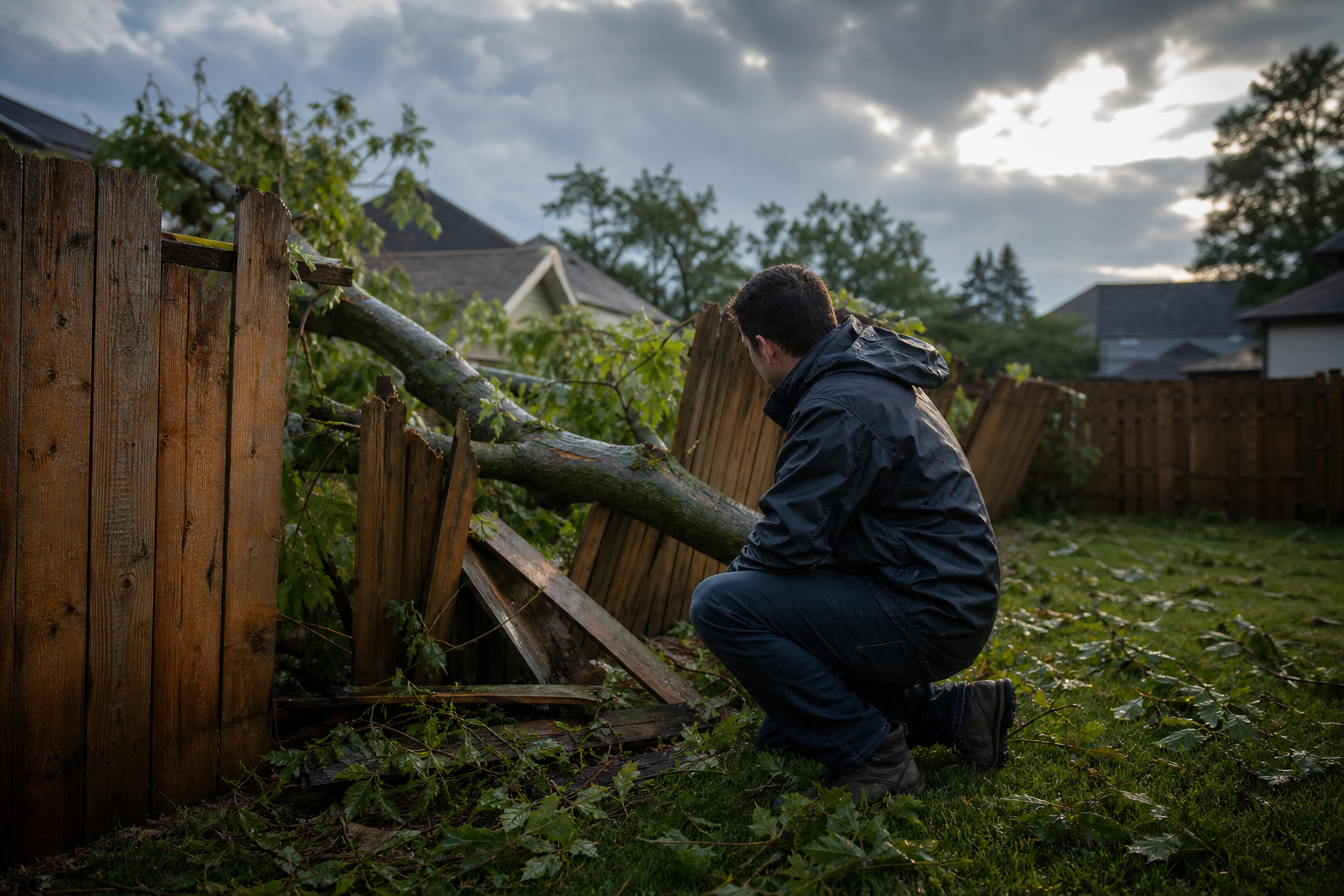
| Falling tree (any owner's tree) | Yes | Your policy pays regardless of whose tree fell |
| Vehicle impact | Yes | Driver's auto insurance is primary |
| Vandalism and malicious mischief | Yes | Police report almost always required |
| Wear, rot, and age | No | Considered maintenance |
| Termite or pest damage | No | Maintenance exclusion |
| Flood or storm surge | No | Requires separate flood policy |
| Earthquake | No | Requires earthquake endorsement |
| Ice or snow weight alone | Usually no | Only if the house also collapses onto the fence |
| Intentional damage by you | No | Excluded by every policy |
Wind is by far the most common trigger for fence claims. If you live in a hurricane state or tornado alley, be aware that as of 2026, nineteen states and the District of Columbia have some form of hurricane or named storm deductible in place, including Alabama, Connecticut, Delaware, Florida, Georgia, Hawaii, Louisiana, Maine, Maryland, Massachusetts, Mississippi, New Jersey, New York, North Carolina, Pennsylvania, Rhode Island, South Carolina, Texas, and Virginia. These use percentage-based deductibles instead of your flat dollar amount, which can dramatically change the math on a claim. Our guide to wind damage coverage explains how those percentage deductibles work and how the New York DFS hurricane deductible rule effective February 2, 2026 changed the game for East Coast homeowners.
Vandalism claims (spray paint, kicked-in pickets, cut chain link) are also covered, but insurers almost universally require a police report. For a fuller breakdown of those claims, see our article on home insurance vandalism coverage.

Protect your home with State Farm
Average Rate:
Homeowners who bundle and save with State Farm save an average of $1,000 per year!

You're in Good Hands® with Allstate
Average Rate:
Get comprehensive home coverage with flexible policy options.

Customize your home coverage
Average Rate:
Only pay for the coverage you need with personalized home insurance.

Smart coverage for your home
Average Rate:
Protect what matters most with award-winning home insurance.
What's Excluded: Rot, Wear, and Gradual Damage
The single biggest reason fence claims get denied is that the damage isn't "sudden." Insurance is designed to pay for events, not maintenance.
If an adjuster looks at your fence and sees any of the following, expect a denial:
- Wood rot, mildew, or fungus that developed over months or years
- Rust on chain link or metal panels
- Leaning posts caused by soil erosion or freeze-thaw cycles
- Termite tunnels or carpenter ant damage
- Warped or cracked boards from sun exposure
- Sagging from poor original installation
Even after a storm, adjusters look for pre-existing decay. If a 20-year-old cedar fence blew down and the posts snapped where they'd already rotted at the ground line, the insurer may argue the wind was just the final straw. Documenting your fence when it's in good condition (dated photos every year or two) makes this dispute much easier to win, especially given that April 2026 Weiss Ratings data shows the top five insurers now close over 44% of claims without payment.
Other categorical exclusions to know:
- Flood: Not covered under any standard homeowners policy. Requires an NFIP or private flood policy.
- Earthquake and earth movement: Excluded unless you buy a separate endorsement or policy.
- Business use: If part of your fence encloses a home-based business yard, that section may not qualify for Coverage B.
- Intentional acts: Damage caused deliberately by you or a household member is never covered.
For a broader look at what your policy won't pay for, review our list of common home insurance exclusions.
Deductibles, ACV, and What You Actually Get Paid
Even when a fence claim is covered, two things quietly shrink your payout: your deductible, and how your insurer values the damaged fence.
How the deductible works
Your standard homeowners deductible (typically $1,000 to $2,500) is subtracted from the approved repair estimate before the insurer cuts a check. So if the adjuster approves $3,000 of fence damage and you have a $1,000 deductible, you get $2,000.
If your policy carries a percentage-based wind or hurricane deductible, that number can jump dramatically. Hurricane deductibles are typically a percentage of your home's dwelling coverage limit, usually ranging from 1% to 15%, though they can be higher in high-risk coastal areas. In Florida, most policies apply a separate hurricane deductible for windstorm losses, and if Coverage A is $450,000 and the hurricane deductible is 2%, the hurricane deductible is $9,000; if Coverage A is $450,000 and the hurricane deductible is 5%, the hurricane deductible is $22,500. Texas, Oklahoma, and Kansas have largely standardized on a 2% wind and hail deductible for 2026, and the Texas FAIR Plan eliminated the 1% option effective July 1, 2026.
Actual cash value vs. replacement cost
This is where most homeowners get an unpleasant surprise. If your fence was damaged by wind and you have wind coverage, your policy will probably pay for the damage. Policies usually pay actual cash value for fences. That means your company will deduct depreciation based on your home's age and condition. ACV means the insurer starts with the replacement cost, then subtracts depreciation based on the fence's age and expected useful life.
For a wood fence, insurers commonly assume a useful life of around 10 to 15 years. Here's how that math typically plays out:
Example: Your 6-year-old wood fence is destroyed by wind. In 2026, installing a wood fence costs homeowners about $3,235, or between $1,920 and $4,840, but a longer run of privacy fence can easily hit $6,000 to $9,000. Assume a contractor quotes $8,000 to rebuild yours. Your insurer uses a 10-year useful life, so the fence has 40% of its life remaining.
- ACV settlement: $8,000 × 40% = $3,200, minus your $1,000 deductible = $2,200 payout.
- RCV settlement: Insurer initially pays the ACV ($3,200 - $1,000 = $2,200). Once you rebuild and submit receipts, they release the remaining $4,800 in recoverable depreciation. Total payout = $7,000.
The difference: $4,800 out of your pocket, on the same $8,000 fence.
The ACV vs. RCV distinction shows up on most claim types. Our full walkthrough of Coverages A through F explains where you can request replacement cost settlement for other structures.
Neighbor Trees, Cars, and Shared Fences
Fence claims get complicated fast when someone else's tree, car, or property is involved. Here's how the responsibility usually shakes out.
A neighbor's tree falls on your fence
Insurance follows the damaged property, not the tree. If your neighbor's healthy oak blows over in a storm and crushes your fence, your homeowners policy pays for the fence under Coverage B (minus your deductible). This surprises people, but it's the near-universal rule.
The exception: if the tree was visibly dead, diseased, or hazardous, and you can prove the neighbor knew and did nothing, their liability coverage may be on the hook. In that case, your insurer often pays you first, then goes after the neighbor's insurer through subrogation to recover the cost, sometimes including your deductible.
Most policies also pay a small sublimit (commonly $500 to $1,000) toward removing the tree off your damaged fence. Our guide to tree damage claims walks through the negligence standard and debris removal limits in detail, including 2026 removal costs of $850 to $906 standard and $2,000 to $8,000 for emergency work.
A car hits your fence
Here the order flips. The at-fault driver's auto liability insurance is primary. You file a third-party property damage claim against their policy, and they pay to repair or replace the fence.
Your homeowners policy is the backup:
- If the driver is uninsured or fled the scene, your Coverage B kicks in.
- If the driver's liability limit is too low to cover the full damage, your policy can fill the gap.
Either way, expect to pay a deductible if your homeowners policy is involved. The same primary/secondary rule shows up in our guide on driveway damage from vehicles.
Shared boundary fences
If a fence sits directly on the property line, it's often considered jointly owned. In states with "good neighbor" laws (California's Civil Code 841 is the most well-known), boundary fences are presumed shared, and each neighbor is generally responsible for 50% of reasonable repair costs after proper written notice. Other states, like Texas, impose no automatic cost-sharing duty.
For insurance purposes, though, each homeowner files with their own carrier. Your insurer pays for your side; their insurer pays for theirs. If one neighbor caused the damage (a fallen dead tree, a car, a contractor mishap), their liability coverage may pay the whole thing. Learn more about how liability coverage works when a neighbor's negligence damages your property.
When Filing a Fence Claim Isn't Worth It
Not every covered claim is a smart claim. Filing has real costs beyond your deductible, and for fences, the math often doesn't work.
Run this quick check before you call your insurer:
- Get 2-3 repair quotes from local fence contractors.
- Subtract your deductible from the highest quote.
- Estimate depreciation if your policy pays ACV (fence age ÷ useful life).
- Compare what you'd actually receive to your out-of-pocket repair cost.
Home insurance rates typically increase by double digits after a claim. Across the country, a single claim can raise your premium anywhere from 18% to 28%, depending on your state and the type of claim. A second claim within a few years leads to even sharper jumps up to 49% higher, and the record can stay on your CLUE report for up to seven years. Meanwhile, Insurify projects the average annual premium will increase 4% to about $3,057 this year, after jumping 12% in 2025, so a claim-driven surcharge stacks on top of already-rising base rates. If the average fence repair cost is $613, including materials and labor, and most homeowners pay between $304 and $942 depending on the extent of damage, the fence's material, its size, and more, and your deductible is $1,000, filing simply doesn't pencil out. Pay the contractor directly and skip the claim.
Even wood-fence-specific data tells the same story: the average cost to repair a wood fence is $610, with wood fence repairs costing $304 to $938 for most homeowners, with smaller fixes starting around $50 and complex work reaching $5,450. Only that top-end tier is worth filing on a $1,000 deductible policy.
For a broader look at claim-worth calculations across scenarios, our guide on other structures coverage has a similar framework you can apply.
Frequently Asked Questions
Does homeowners insurance cover fence replacement or just repair?
Both. If the damage is covered and repairing is impractical (for example, an entire 100-foot run of privacy fence is destroyed by a tornado), your insurer pays for replacement up to your Coverage B limit. If only a few panels are damaged, they'll pay for repair. The valuation method (ACV or RCV) determines how much depreciation is deducted from either amount.
How much does home insurance pay for a fallen fence?
The payout equals the covered damage amount, minus your deductible, minus any depreciation if you have ACV coverage. For an average wood fence repair costing $304 to $938 in 2026, most homeowners with a $1,000 deductible won't clear the threshold at all. Larger storm-damage jobs of $2,500 to $8,000 typically net a homeowner with an ACV policy on a mid-age fence somewhere between $500 and $3,500 after all the deductions.
Do I need to report the neighbor if their tree damaged my fence?
You don't have to, but it usually helps. Tell your neighbor before filing so they're not blindsided by a subrogation letter from your insurer. If the tree was clearly hazardous, put your concerns to them in writing (text or email works) so there's a documented record if you later need to prove negligence to shift the claim to their liability coverage.
Will filing a fence claim raise my home insurance rates?
Yes, in most cases. A single property damage claim can raise premiums 18% to 28% at renewal and stays on your CLUE report for five to seven years. Multiple claims within a short window can push a second-claim surcharge as high as 49%, and can also make you harder to insure in a market where carriers are already non-renewing high-risk policies. If your out-of-pocket cost after deductible and depreciation is small, paying for the repair yourself is usually the cheaper long-term move.
Is a fence claim considered a separate deductible from my house?
No. In a single loss event (like one windstorm), your standard homeowners deductible applies once, even if the fence, roof, and shed were all damaged. However, wind or hurricane percentage deductibles may apply differently than your standard deductible, and separate loss events each carry their own deductible.