
Compare Home Insurance Plans in Ohio
Find your best options in less than 2 minutes



What Vandalism and Malicious Mischief Actually Mean
In insurance terms, vandalism and malicious mischief (often abbreviated VMM) refer to intentional acts by a third party that damage or deface your property. The standard ISO HO-3 policy explicitly lists "vandalism or malicious mischief" as a covered peril, and coverage extends across your dwelling, other structures, and personal property. Because most policies do not define these terms, courts generally interpret them by their ordinary meaning.
Commonly covered acts include:
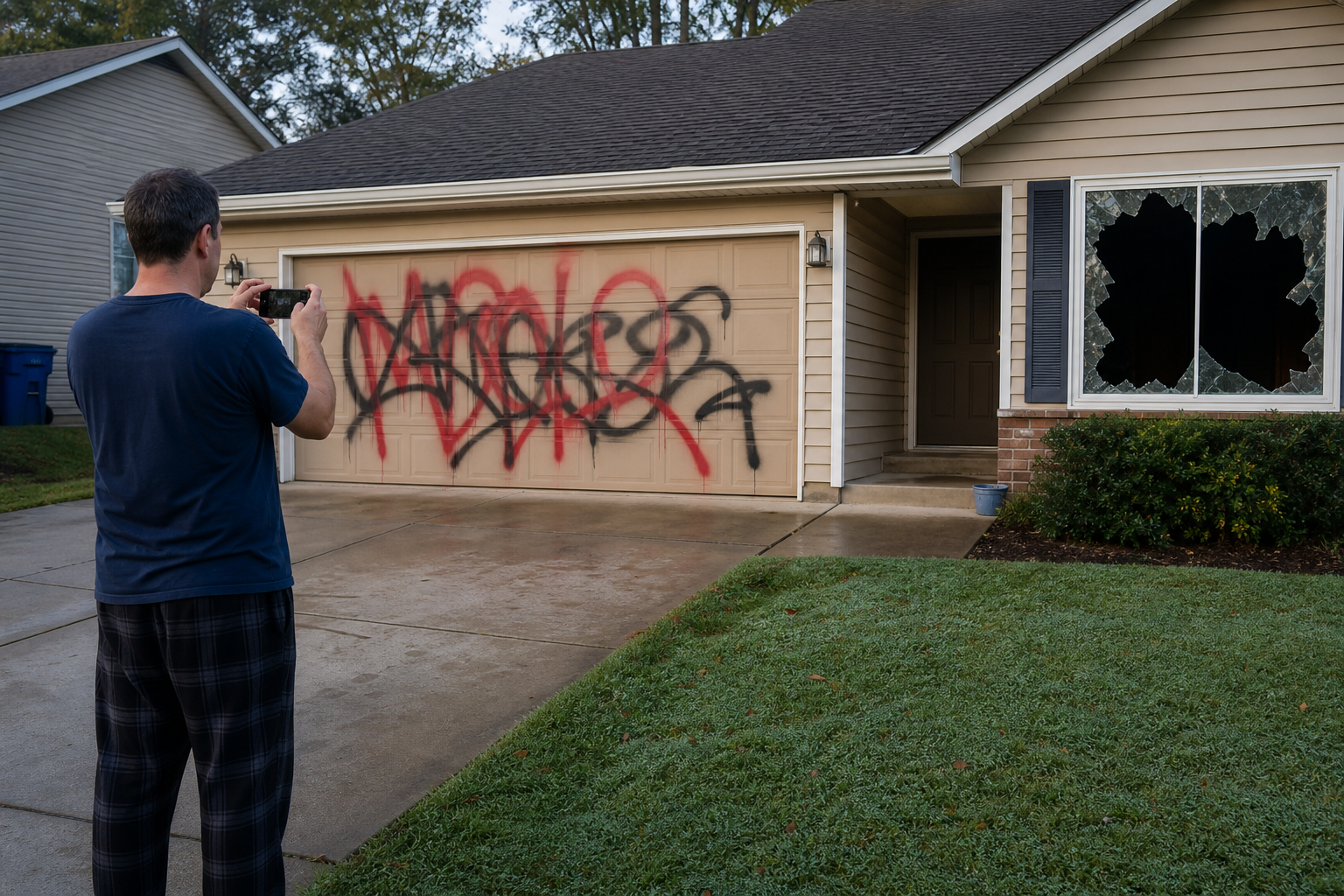
- Graffiti and spray paint on siding, garage doors, walls, or fences
- Broken or smashed windows, doors, and locks
- Egging, toilet-papering, or other intentional defacement
- Slashed screens, damaged siding, or kicked-in doors
- Cut or destroyed trees, shrubs, and landscaping
- Arson, when treated as a malicious act under the policy
The coverage isn't limited to the house itself. Damaged fencing, sheds, mailboxes, and even personal belongings inside the home (like a TV smashed during a break-in) generally fall under vandalism claims, up to your policy's dwelling and personal property limits.

Compare Home Insurance Plans in Ohio
Find your best options in less than 2 minutes
What's Typically Excluded From Vandalism Coverage
The single biggest coverage gap involves vacant homes. The standard ISO HO 00 03 form suspends vandalism, glass breakage, and theft coverage once the dwelling has been vacant for more than 60 consecutive days immediately before the loss, and many carriers shorten that trigger to 30 days. "Vacant" generally means empty of both people and substantially all personal property, which is stricter than simply being away on vacation.
Other common exclusions include:
| Excluded Situation | Why It's Not Covered |
|---|---|
| Damage by you or a household member | Treated as intentional acts by an insured |
| Intentional tenant damage | Usually falls under landlord policy or lease |
| Long-term vacancy (30 to 60+ days) | Vacancy clause voids VMM coverage |
| Vehicle vandalism | Requires auto comprehensive coverage |
| Riots or civil commotion (some policies) | May need separate endorsement |
| Neglect or poor maintenance | Not a sudden, malicious act |
| Flood, earthquake, mold, pests | Covered by other policies, not VMM |
If you're planning an extended absence for a renovation, sale, or inherited property, look into vacant home insurance options or ask your insurer about a vacancy permit endorsement before the 30-day mark. Coverage during active work is a different beast, so also see our breakdown of insurance during renovation.

Protect your home with State Farm
Average Rate:
Homeowners who bundle and save with State Farm save an average of $1,000 per year!

You're in Good Hands® with Allstate
Average Rate:
Get comprehensive home coverage with flexible policy options.

Customize your home coverage
Average Rate:
Only pay for the coverage you need with personalized home insurance.

Smart coverage for your home
Average Rate:
Protect what matters most with award-winning home insurance.
The Vandalism Claim Process Step by Step
Filing a vandalism claim isn't complicated, but the order of operations matters. Skipping the police report or making permanent repairs before the adjuster arrives are two of the most common reasons claims get delayed or reduced. This is especially true now that an April 2026 Weiss Ratings review found 15 large U.S. insurers closed at least half of their 2025 homeowner claims with no payment, with Mid-Century Insurance of Texas topping the list at 78.4% and industry-wide no-payment closures hitting roughly 41.3%.
1. Secure the property and stop further damage
Board up broken windows, cover smashed doors, and take reasonable steps to prevent additional loss. Keep every receipt: temporary repair costs are generally reimbursable under your policy. Just avoid permanent repairs until the adjuster has documented the scene.
2. Call the police and get a report number
Vandalism is a crime, so nearly every insurer either requires or strongly expects a police report before they'll process a claim. Get the report number, the responding officer's name, and a copy of the written report as soon as it's available. Even for minor damage like a busted mailbox, filing a report protects you if related damage surfaces later.
3. Document everything before you clean up
Take wide-angle and close-up photos of every damaged surface, plus short videos walking through the scene. Note the date and time, and pull any doorbell camera or security footage.
4. Notify your insurer promptly
Call the claims line, use the mobile app, or file online. Have your policy number, the police report number, and a rough description of the damage ready. Most policies contain a prompt notification clause, and delays give the insurer grounds to reduce your payout.
5. Work with the adjuster and get repair estimates
The adjuster will inspect the property, verify the cause of loss, and estimate repair costs. You may be asked to obtain one or two independent contractor bids. For a deeper walkthrough of what to expect, see our full breakdown of common policy exclusions so you don't get blindsided.
6. Receive payment and complete repairs
Payment is usually issued on an actual cash value (ACV) basis first, with a replacement cost (RCV) supplement paid after repairs are documented, depending on your policy form.
How Vandalism Claims Affect Your Future Premium in 2026
Filing any home insurance claim leaves a footprint on your CLUE (Comprehensive Loss Underwriting Exchange) report for up to seven years, and vandalism is no exception. National premiums keep climbing: Insurify projects the 2026 average home insurance bill at $3,057, up about 4% from 2025's $2,948, while The Zebra pegs the current average closer to $2,966 per year and Insurify's own comparison data puts it at $2,844 for a $300,000 dwelling. On top of that, Bureau of Labor Statistics producer-price data shows premiums have risen roughly 7% since the start of 2025, so any percentage-based surcharge hurts more than it did just a few years ago.
Recent 2026 data varies by source, but the range typically lands between 7% and 28% for a single claim. The Insurance Information Institute pegs the average at 7% to 10%, MoneyGeek's analysis shows homeowners with one claim in the past five years pay 16% more per year, The Zebra's 2026 rate data shows a vandalism claim adds about 19%, and Insure.com puts the broader national range at 18% to 28%. A second claim within a few years can push the total closer to 49%. Actual increases depend on your insurer, ZIP code, prior claim history, and loss size.
That's why the deductible math matters. If your deductible is $1,500 and the vandalism repair estimate is $1,900, the $400 net payout probably isn't worth a multi-year rate hike. But if a professional graffiti abatement job plus window and siding replacement runs $6,000 or more, filing almost always makes financial sense.
Ways to soften the premium impact
- Ask about claim forgiveness if this is your first loss in years
- Raise your deductible at renewal to offset the rate bump
- Bundle home and auto to preserve multi-policy discounts
- Shop competing quotes at renewal; some carriers weight vandalism claims less heavily than others
For context on how other claim types compare, our guide on theft coverage and premium impact shows a similar 10% to 20% pattern lasting three to five years.
Documenting Damage: Tips That Maximize Your Payout
Adjusters rarely dispute what's clearly documented, so thorough evidence is the single best lever you have on the outcome. That's especially true given Weiss Ratings' finding that no-payment closures across all reporting insurers hit 41.3% in 2025, up from 39% in 2023 and just 25.7% in 2004.
Practical documentation checklist:
- Photos of each damaged surface from three angles, with a ruler or common object for scale on graffiti
- Video walkthrough narrating what you see and when it was discovered
- Written inventory of damaged personal property with brand, model, purchase date, and approximate cost
- Receipts or online order history proving ownership and value
- Police report number and responding officer's contact info
- Security or doorbell camera footage backed up to the cloud
- Contractor estimates from at least one licensed local pro
For high-value items like art, jewelry, or musical instruments, note that standard personal property coverage carries strict sub-limits. Reviewing what happens with accidental damage claims will show you where a scheduled personal property endorsement or an HO-5 upgrade is worth considering. If the vandalism also damaged fences or outbuildings, our fence damage coverage guide walks through how Coverage B (other structures) applies.
Frequently Asked Questions
Do I have to file a police report to get a vandalism claim paid?
In practice, yes. Most homeowners insurers either explicitly require a police report for vandalism claims or condition payment on your cooperation with law enforcement. Even for small losses, you should file a report and get a case number. Skipping this step is one of the most common reasons vandalism claims are delayed or denied.
What if my home is vacant when it gets vandalized?
If the property has been vacant beyond your policy's vacancy limit (60 days under the standard HO 00 03 form, or as few as 30 days with some carriers), your insurer will almost certainly deny the vandalism claim. To maintain coverage on an empty home, you need either a vacancy permit endorsement added to your existing policy or a specialty vacant home insurance policy such as a DP-1 or DP-3 dwelling fire form, which averages around $4,200 per year in 2026.
Is vandalism to my car covered under my home insurance?
No. Vandalism to a vehicle, whether it's parked in your driveway or on the street, is handled by the comprehensive portion of your auto insurance policy, not your homeowners policy. Home insurance only covers vandalism to the house, other structures, and personal property that isn't a licensed motor vehicle.
How much will my premium go up after a vandalism claim?
Broader 2026 industry figures put single-claim home insurance rate hikes anywhere from 7% to 28% depending on carrier, state, and loss size, with The Zebra's 2026 data specifically showing about a 19% average bump after a vandalism claim. Against a 2026 national average approaching $3,000 to $3,057 per year, that can easily mean $500 or more in added annual cost. The claim also stays on your CLUE report for up to seven years, which can affect quotes when you shop for a new policy.
Should I file a claim for minor graffiti or a broken window?
Run the numbers first. If the repair cost is only slightly above your deductible, paying out of pocket often costs less than absorbing a multi-year premium hike. For example, a single window replacement at the 2026 average of $850 with a $1,000 deductible generates no payout at all, while a $6,000 graffiti and siding repair is clearly worth filing. Get a quick contractor estimate before you call your insurer.