
Compare Home Insurance Plans in Ohio
Find your best options in less than 2 minutes



What Theft Is Covered Under a Standard Home Insurance Policy
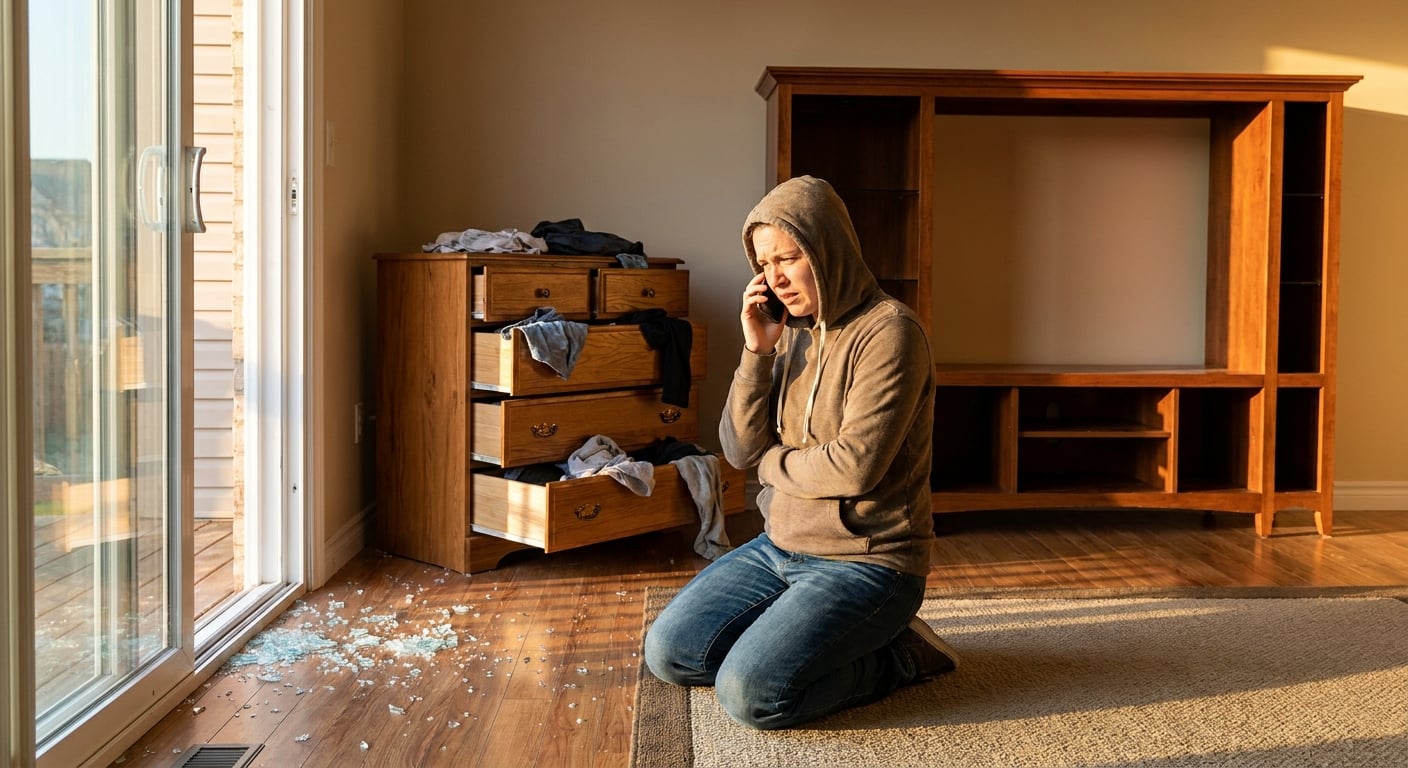
Theft is one of the named perils built into virtually every homeowners insurance policy in the United States. Coverage falls primarily under Coverage C (personal property), which protects your belongings whether they are stolen from inside your home, from a detached garage, or even from a hotel room across the country.
Most standard policies set personal property coverage at roughly 50% to 70% of your dwelling coverage limit. So if your home is insured for $400,000, you likely have $200,000 to $280,000 in personal property coverage available for theft losses, minus your deductible. With the national average home insurance premium projected to reach $3,057 in 2026 (a 4% jump on top of the 12% increase in 2025), it is more important than ever to understand exactly what you are paying for.
Here is what theft coverage typically includes:
- On-premises theft of items inside your home or detached structures after a break-in
- Off-premises theft of items stolen anywhere in the world (luggage at a hotel, gym locker, college dorm)
- Theft of items inside your car (the car itself is covered by auto comprehensive, not homeowners)
- Damage to your home caused by the burglar during entry or exit, covered under your dwelling protection
What is not covered
Standard policies exclude theft of property from a home that is under construction, vacant for an extended period, or being rented out under a different arrangement. Theft committed by an insured person or household member is also excluded, as is damage to your actual vehicle from a break-in (that falls under auto insurance). Reading the personal property coverage section of your policy is the only way to know what your specific carrier excludes.

Compare Home Insurance Plans in Ohio
Find your best options in less than 2 minutes
Special Sublimits for Cash, Jewelry, Firearms & Electronics
This is where most homeowners get burned. Even if you have $200,000 in personal property coverage, your policy caps how much it will pay for certain categories of high-value or high-fraud-risk items. These caps are called sublimits or "special limits of liability," and they apply within your overall personal property limit.
The table below shows typical 2026 sublimits for theft losses on a standard ISO HO-3 policy:
| Item Category | Typical 2026 Theft Sublimit |
|---|---|
| Money, coins, bullion, gold | $200 |
| Securities, stamps, manuscripts | $1,500 |
| Jewelry, watches, furs | $1,500 (some carriers now $2,500) |
| Firearms and accessories | $2,500 |
| Silverware, goldware, pewterware | $2,500 |
| Portable electronics (off-premises EDP) | $1,500 |
| Business property on-premises | $2,500 |
| Business property off-premises | $250 |
If a thief takes your $8,000 engagement ring, your policy may only pay $1,500 toward replacement unless you scheduled the ring separately. A detailed breakdown of these caps is available in our home insurance sublimits guide.
Off-premises theft is also limited
Even though belongings are covered worldwide, off-premises theft is typically capped at 10% of your personal property limit or $1,000, whichever is greater. So with $50,000 in personal property coverage, expect roughly $5,000 of off-premises theft protection. This matters most for travelers, college students, and remote workers carrying expensive gear.

Protect your home with State Farm
Average Rate:
Homeowners who bundle and save with State Farm save an average of $1,000 per year!

You're in Good Hands® with Allstate
Average Rate:
Get comprehensive home coverage with flexible policy options.

Customize your home coverage
Average Rate:
Only pay for the coverage you need with personalized home insurance.

Smart coverage for your home
Average Rate:
Protect what matters most with award-winning home insurance.
Burglary vs. Robbery vs. Theft: Why the Distinction Matters
Adjusters use these terms precisely, and the category your loss falls into can affect how the claim is handled. Nationally, burglary is trending downward: the FBI recorded 779,542 burglaries in 2024 (a rate of 229.2 per 100,000 residents, the lowest since at least 2005), and residential burglaries fell another 17% to 19% in the first half of 2025. Even so, the average loss per burglary is around $2,661, and only about 11% of cases are solved.
Theft (sometimes called larceny) is the broadest category. It simply means taking property without permission, with no required element of force, violence, or unlawful entry. A guest pocketing your watch, a cleaner taking cash, or a package stolen off your porch are all theft but neither burglary nor robbery.
For insurance purposes:
- Burglary claims are usually the easiest to verify because there is physical evidence (broken locks, smashed windows). They are almost always covered.
- Robbery claims require documentation of force or threats, typically from a police report or witness statements. Both on-premises (home invasion) and off-premises (street mugging) robbery are usually covered.
- Simple theft without forced entry can be trickier. Some insurers scrutinize these claims more closely, and "mysterious disappearance" (an item missing with no evidence of theft) is excluded under most standard policies.
How to File a Home Insurance Theft Claim
The claim process is where preparation pays off. Carriers expect a specific sequence of steps and documentation, and a Wall Street Journal analysis of the five largest home insurers found that more than 44% of homeowner claims resolved in 2025 closed with no payment (up from 36% a decade ago). A separate Weiss Ratings study found 15 large insurers each closed at least half of their 2025 claims without payout. Skipping any step creates leverage for the adjuster to deny or reduce your recovery. The full home insurance claims process timeline is worth reviewing before you ever need it.
Step 1: Call the police immediately
A police report is non-negotiable for theft claims. Get the incident number, the responding officer's name, and the department's contact info. Most policies explicitly require you to notify law enforcement as one of your duties after a loss.
Step 2: Document the scene before cleaning up
Take photos and video of broken entry points, ransacked drawers, empty shelves, and any other damage. These visuals corroborate the police report and your itemized list.
Step 3: Notify your insurer
Call the claims line or use the mobile app within the time window listed in your policy. Have your policy number, the police report number, and a preliminary description of stolen items ready. Late reporting alone accounts for roughly 15% of homeowners claim denials.
Step 4: Build a detailed stolen-items list
For each item include:
- Brand, model, color, and serial number
- Purchase date and approximate price
- Estimated current value
- Proof of ownership documents available
A well-maintained home inventory makes this step dramatically easier. Without one, you are reconstructing your possessions from memory under stress, and insufficient documentation is one of the top drivers of denied theft claims.
Step 5: Provide proof of ownership
Adjusters typically accept receipts, credit card statements, photos of you with the item, warranty cards, appraisals (for jewelry and art), and serial number registrations. The stronger your documentation, the closer your payout will be to actual replacement cost.
Step 6: Secure your home and keep repair receipts
Board up broken windows, change locks, and document everything. Your policy requires you to take reasonable steps to prevent further loss, and temporary repair receipts are usually reimbursable.
How Theft Claims Affect Your Future Premiums
Filing a theft claim will almost always raise your homeowners premium at renewal. Consumer analyses in 2026 put the typical theft or vandalism claim increase at roughly 10% to 20%, with the impact lingering for 3 to 5 years. That is on top of ordinary 2026 rate inflation, which Insurify projects at 4% nationally.
| Claim Size | Typical Premium Increase | How Long It Stays on Record |
|---|---|---|
| Under $2,500 | 7% - 12% | 3-5 years |
| $2,500 - $10,000 | 12% - 20% | 5-7 years |
| Over $10,000 | 20% - 40% | 5-7 years |
Insurers treat theft as a recurring risk because thieves often target the same neighborhoods (or the same houses) again. A second claim within a few years can push rates 40% to 80% higher, and multiple claims can trigger non-renewal. If you have already filed other home insurance claims recently, the long-term cost may exceed the payout. Shopping your policy after a claim can offset some of the impact, so review when it makes sense to file before you pick up the phone.
Scheduled Personal Property: Better Protection for Valuables
If you own anything worth more than your policy's sublimits (jewelry, fine art, collectibles, high-end cameras, expensive watches, musical instruments, or multiple firearms), a scheduled personal property endorsement is the standard fix. Coverage is written on an agreed-value, open-perils basis at roughly 1% to 2% of the item's value per year in 2026.
A $5,000 engagement ring scheduled separately might cost $50 to $100 per year extra, but the policy will pay the full $5,000 if it is stolen, lost, or mysteriously disappears (versus the $1,500 sublimit on a standard policy). If most of your valuables are jewelry, the jewelry coverage guide walks through appraisal costs and standalone carriers like Jewelers Mutual and BriteCo.
Tips to Prevent Theft Claim Denials
Denials usually trace back to a handful of fixable mistakes, and with insurers tightening underwriting standards in 2026, precision matters more than ever. Here is how to avoid each one:
- Know your policy before you need it. Review the theft section, sublimits, and exclusions when the policy is calm, not during a crisis. Policy exclusions account for roughly 33% of all denied homeowners claims.
- Keep a current home inventory with photos, receipts, and serial numbers stored in the cloud so you can access it after a break-in. Insufficient documentation is cited in about 12% of denials, especially for theft claims without proof of ownership.
- Schedule high-value items so the sublimit problem is solved before a loss occurs.
- Report promptly. Call the police first, then your insurer, within the time window your policy specifies.
- Be accurate and consistent. Only list items that were actually stolen, and value them at amounts you can support with documentation. Overstating a claim is treated as fraud and voids coverage.
- Maintain reasonable security. Lock doors and windows, use any alarm system you claimed on your application, and keep your policy current with on-time premium payments.
- Update your insurer if circumstances change (renting out the home, starting a home business, adding security upgrades).
If you are still building out your overall coverage strategy, our overview of what personal property coverage includes walks through how Coverage C interacts with the rest of your policy, and our full coverages A through F guide puts theft in context with the other protections in your policy.
Frequently Asked Questions
Does home insurance cover theft from my car?
Yes, but only the personal belongings inside the car (laptop, gym bag, sunglasses), not the car itself or any damage to the vehicle. Damage to the car from a break-in falls under your auto insurance comprehensive coverage. The items inside count as off-premises theft and are subject to the 10% off-premises limit and any applicable sublimits.
What is the home insurance theft deductible?
The standard homeowners deductible applies to theft claims, typically $500, $1,000, or $2,500 depending on what you chose at purchase. Scheduled personal property items usually carry a $0 deductible in 2026, which is one of their major advantages. Always weigh your deductible against your loss before filing.
How do I prove ownership of stolen items I do not have receipts for?
Credit card statements, bank records, photos of you using the item, warranty cards, owners' manuals, original packaging, and even social media posts can all serve as ownership evidence. Appraisals work for jewelry and collectibles. Building a home inventory in advance is the single best way to bulletproof future claims.
Does home insurance cover theft of cash?
Yes, but only up to the cash sublimit, which is typically just $200 on a standard ISO HO-3 policy. Some carriers offer slightly higher limits ($400 to $500) through endorsements, but storing significant cash at home is never a great insurance bet. A bank account or fireproof safe paired with a separate rider is a smarter approach.
Will my premium go up if my theft claim is denied?
Even denied or zero-payout claims can affect future premiums because the claim is still recorded on your CLUE (Comprehensive Loss Underwriting Exchange) report for up to seven years. Insurers see the claim activity even without a payout, and with more than 44% of large-carrier claims closing without payment in 2025, that risk is bigger than ever. This is one more reason to think carefully before reporting a small theft just over your deductible.