
Compare Home Insurance Plans in Ohio
Find your best options in less than 2 minutes



What Is Personal Property Coverage (Coverage C)?
Personal property coverage, officially Coverage C on a standard HO-3 homeowners policy, is the part of your insurance that pays to repair or replace your movable belongings after a covered loss. Think furniture, clothing, electronics, appliances, sporting equipment, and more. While your dwelling coverage protects the physical structure of your home, Coverage C focuses entirely on what's inside it (and even some things outside it).
Coverage C activates when a covered peril (such as fire, theft, vandalism, windstorm, or sudden water damage) causes a loss. Like all insurance coverages, it applies subject to your deductible and any policy exclusions. For a broader look at how all the coverages work together, see our complete guide to Coverages A through F.
What Does Personal Property Coverage Include?
Coverage C is broad by design. Here's a breakdown of what's typically covered:
| Category | Examples |
|---|---|
| Furniture | Sofas, beds, tables, dressers, bookshelves |
| Electronics | TVs, laptops, gaming systems, cameras, tablets |
| Appliances | Countertop microwaves, coffee makers, stand mixers |
| Clothing & Shoes | All personal wardrobe items |
| Sporting Goods | Bicycles, golf clubs, skis, gym equipment |
| Tools | Power tools, hand tools, lawn equipment |
| Kitchenware | Cookware, dishware, cutlery, small gadgets |
| Musical Instruments | Guitars, keyboards, amplifiers |
| Collectibles & Art | Rugs, artwork, décor (subject to sublimits) |
What Coverage C Does NOT Cover
Even with solid personal property coverage, certain gaps exist:
- Flood damage requires a separate flood insurance policy
- Earthquakes typically need a separate endorsement
- Wear and tear or mechanical breakdown
- Sewer backup unless you add a water backup endorsement
- Your home's built-in structure, including walls, floors, and built-in cabinetry which fall under Coverage A

Compare Home Insurance Plans in Ohio
Find your best options in less than 2 minutes
Personal Property Coverage Limits Explained
How Much Coverage Do You Get?
Your Coverage C limit is automatically set as a percentage of your dwelling coverage (Coverage A), typically between 50% and 70% in 2026, and some 2026 policy forms extend that range up to 75%. For example, if your dwelling coverage is $400,000, your personal property coverage will typically fall somewhere between $200,000 and $280,000:
| Dwelling Coverage (Coverage A) | Coverage C at 50% | Coverage C at 70% |
|---|---|---|
| $200,000 | $100,000 | $140,000 |
| $300,000 | $150,000 | $210,000 |
| $400,000 | $200,000 | $280,000 |
You can usually raise or lower this percentage based on the actual value of your belongings. The type of homeowners policy you carry also significantly affects how personal property claims are evaluated, so it's worth reviewing our guide on how much coverage you need.
Special Sublimits for Valuables
Standard policies place category sublimits on certain high-value or high-risk items. These caps apply within your total Coverage C limit, not in addition to it, and they don't automatically increase when you raise your overall Coverage C limit. Here's a breakdown of typical sublimits seen on 2026 ISO HO-3 policies:
| Item Category | Typical Theft Sublimit |
|---|---|
| Jewelry & Watches | $1,500 to $2,500 |
| Firearms | $2,500 |
| Silverware / Goldware | $2,500 |
| Cash & Currency | $200 |
| Securities & Valuable Documents | $1,500 |
| Business Property (on premises) | $2,500 |
| Business Property (off premises) | $500 |
| Watercraft & Trailers | $1,500 |
| Credit Card / EFT Fraud | $500 |
| Electronics (off-premises) | $1,500 |

Protect your home with State Farm
Average Rate:
Homeowners who bundle and save with State Farm save an average of $1,000 per year!

You're in Good Hands® with Allstate
Average Rate:
Get comprehensive home coverage with flexible policy options.

Customize your home coverage
Average Rate:
Only pay for the coverage you need with personalized home insurance.

Smart coverage for your home
Average Rate:
Protect what matters most with award-winning home insurance.
Replacement Cost vs. Actual Cash Value for Contents
This is one of the most important decisions you'll make when setting up your personal property coverage. The valuation method your policy uses determines how much you actually receive when filing a claim. Keep in mind that most standard 2026 HO-3 policies default personal property loss settlement to ACV unless you add a personal property replacement cost endorsement.
Example: Your 5-year-old TV originally cost $2,000, and a comparable new TV also costs about $2,000 today. With a $500 deductible:
- Under ACV, after depreciation the insurer might pay just $500 out of a claim, leaving you to cover the remaining $1,500 yourself.
- Under RCV, the insurer pays $1,500 (the full $2,000 replacement cost minus your deductible), so you end up with a new TV.
After a major loss such as a kitchen fire or big storm, the difference between RCV and ACV is often a five-figure swing in your settlement. RCV claims are typically paid in two steps: the insurer first pays the ACV amount, then reimburses the recoverable depreciation once you submit receipts proving the items were actually replaced.
Scheduled Personal Property & Off-Premises Coverage
Scheduled Personal Property: Coverage for High-Value Items
When standard sublimits aren't enough, a scheduled personal property endorsement (also called a personal articles floater) allows you to insure specific items individually for their full appraised value. This is the smart move for:
- Expensive jewelry and engagement rings
- Fine art, sculptures, and rare collectibles
- High-end camera equipment
- Musical instruments
- Antiques or heirloom pieces
What it costs in 2026: The standard industry rule of thumb is that scheduling jewelry costs roughly 1% to 2% of the item's value per year, so a $10,000 ring runs about $100 to $200 annually. Rates vary based on your ZIP code, with urban areas that have higher theft rates costing more. A $6,000 engagement ring typically adds about $60 to $120 per year, while a $15,000 art collection often runs around $30 to $75 per year, since fine art is priced lower than jewelry (typically 0.2% to 0.5% of value annually).
Key advantages of scheduling items:
Off-Premises Personal Property Coverage
Coverage C doesn't just apply at home. Most standard 2026 HO-3 and HO-5 policies cap off-premises personal property coverage at 10% of your total Coverage C limit, so if you have $50,000 in personal property coverage, only $5,000 may apply to losses that happen outside the home. Some 2026 policy forms use language like "10% of Coverage C or $3,000, whichever is greater," and a few state-filed forms set that minimum floor even higher for property in self-storage or at a secondary residence.
Example: Your policy has $150,000 in personal property coverage. Your laptop gets stolen from your car while traveling.
- Off-premises limit = $150,000 × 10% = $15,000
- Your laptop claim would be subject to that $15,000 cap, your deductible, and any applicable sublimits for electronics (often $1,500 for electronic equipment away from the premises).
Keep in mind that theft from off-premises locations like vehicles and hotel rooms is covered, but the same category sublimits still apply (jewelry, firearms, business property, and so on). If you're a frequent traveler or regularly transport valuable items, consider increasing your off-premises limit or scheduling high-value items separately for full worldwide protection.
How to Document Your Belongings & Maximize Coverage
Creating a Home Inventory
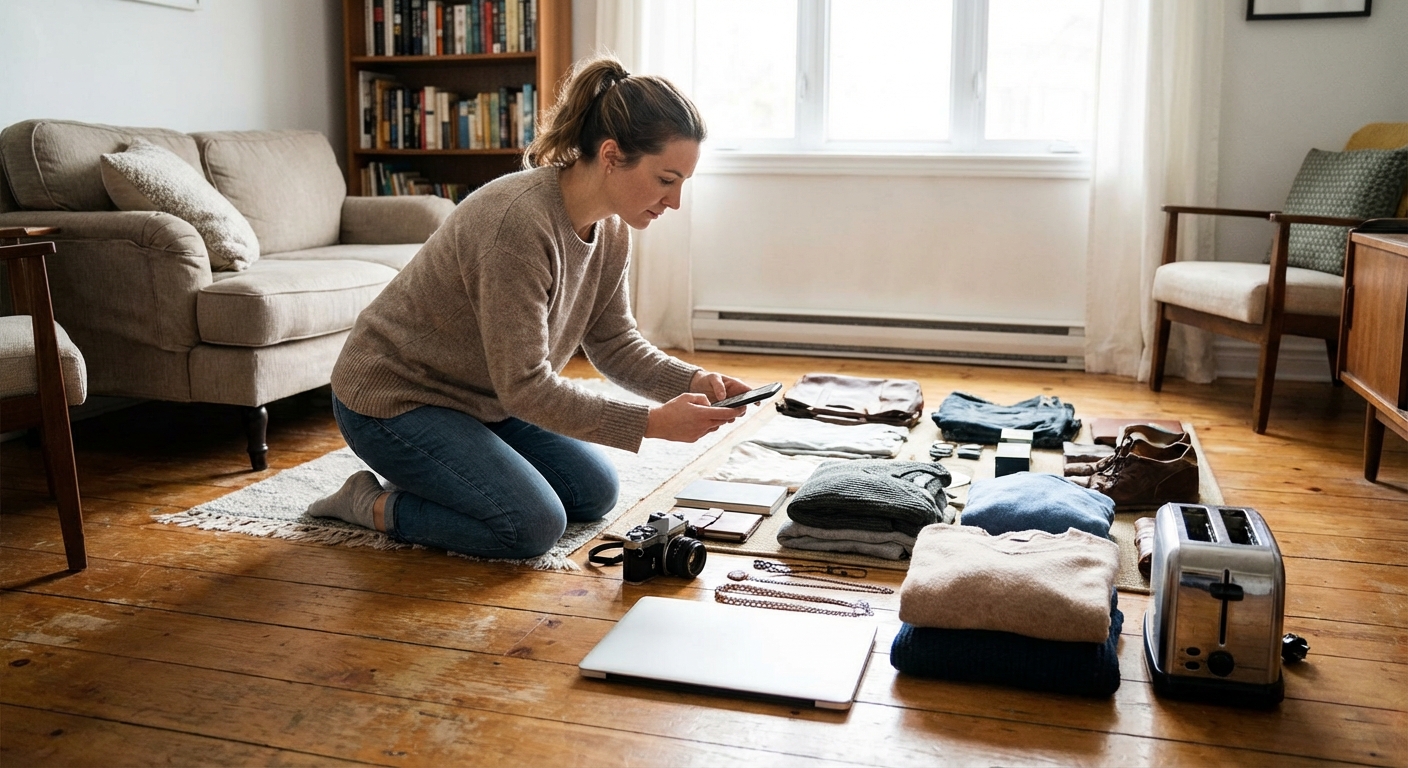
A home inventory is your most powerful tool for getting a fair, fast payout after a loss. Here's how to build one properly:
Step 1: Choose your method The National Association of Insurance Commissioners (NAIC) offers a free Home Inventory app designed to help consumers document possessions and prepare for claims. For more robust 2026 options, Encircle is widely considered the top claims-grade tool (used by adjusters), Sortly offers a polished photo catalog with barcode scanning, and Club of Things provides free, offline-first tracking with insurer-ready PDF and CSV exports.
Step 2: Take video of every room The fastest way to build an inventory isn't an app or spreadsheet at all. It's a simple video walkthrough. Slowly pan around each room, open closets, cabinets, and drawers, and narrate brand, model, approximate price, and purchase date as you go. Most homes can be documented in about 30 minutes.
Step 3: Capture the right details for high-value items
- Item name and category
- Brand, model, and serial number (especially for electronics)
- Purchase date and original price
- Estimated current replacement cost
- Photos of the item and serial number label
Step 4: Prioritize the items insurers care about most Focus first on furniture, electronics, jewelry, artwork, musical instruments, collections, and power tools. An incomplete inventory that captures your big-ticket items is still highly valuable at claim time.
Step 5: Store it safely off-premises Save your inventory and videos to cloud storage and email a copy to yourself. Keep an additional copy on an external drive in a fireproof safe or safety deposit box. An inventory that burns up with the house can't help you.
Step 6: Update it regularly Review and refresh your inventory at least once a year and after any major purchase, sale, or renovation. Keeping receipts, warranties, appraisals, and serial numbers with the inventory speeds up claim handling considerably.
When Should You Increase Your Coverage?
Consider raising your personal property limits or adding endorsements when:
- You've made significant purchases (new furniture, appliances, electronics)
- You've received expensive gifts or inherited valuables
- Your jewelry collection has grown in value
- You've started a home office with business equipment
- You're renting out a room or a portion of your home
If you're a renter rather than an owner, the same Coverage C rules generally apply to your policy. Our renters insurance guide and our detailed HO-4 policy breakdown walk through how limits, sublimits, and endorsements work under a tenant's policy.
Frequently Asked Questions
What is personal property coverage in home insurance?
Personal property coverage (Coverage C) is the part of your homeowners insurance policy that pays to repair or replace your movable belongings, including furniture, electronics, clothing, and appliances, after a covered loss such as fire, theft, or windstorm. It's a standard component of every HO-3 homeowners policy. Coverage applies both at home and, to a limited extent, away from home.
How much personal property coverage do I need in 2026?
Most homeowners need enough coverage to replace everything they own at today's prices. Start by doing a home inventory and totaling the estimated replacement cost of all your belongings. Compare that total to your current Coverage C limit (usually 50% to 70% of your dwelling coverage, sometimes up to 75%). If your belongings exceed that limit, ask your insurer to raise it, since the additional cost is typically very modest.
What is the difference between replacement cost and actual cash value for personal property?
Replacement cost value (RCV) pays the current cost of buying a new, similar item without deducting for age or depreciation. Actual cash value (ACV) pays the depreciated value of the item, which can be significantly less, especially for electronics and furniture that lose value quickly. Because most standard 2026 policies default to ACV on contents, adding a replacement cost endorsement is almost always worth the small additional premium.
What are special limits on personal property coverage?
Special limits (sublimits) are per-category caps built into your standard policy. For example, jewelry theft is often capped at $1,500 to $2,500 and firearms at $2,500, regardless of your total Coverage C limit. If you own valuables that exceed these caps, you'll want to add a scheduled personal property endorsement to insure them for their full appraised value.
Does homeowners insurance cover belongings outside the home?
Yes, most homeowners policies include off-premises personal property coverage, but it's limited. Standard 2026 policies typically cover belongings temporarily away from home, like a laptop stolen from your car or luggage stolen during travel, up to 10% of your total Coverage C limit. Some policy forms add a minimum dollar floor, and high-value items away from home may still need scheduled coverage for full worldwide protection.