
Compare Home Insurance Plans in Ohio
Find your best options in less than 2 minutes



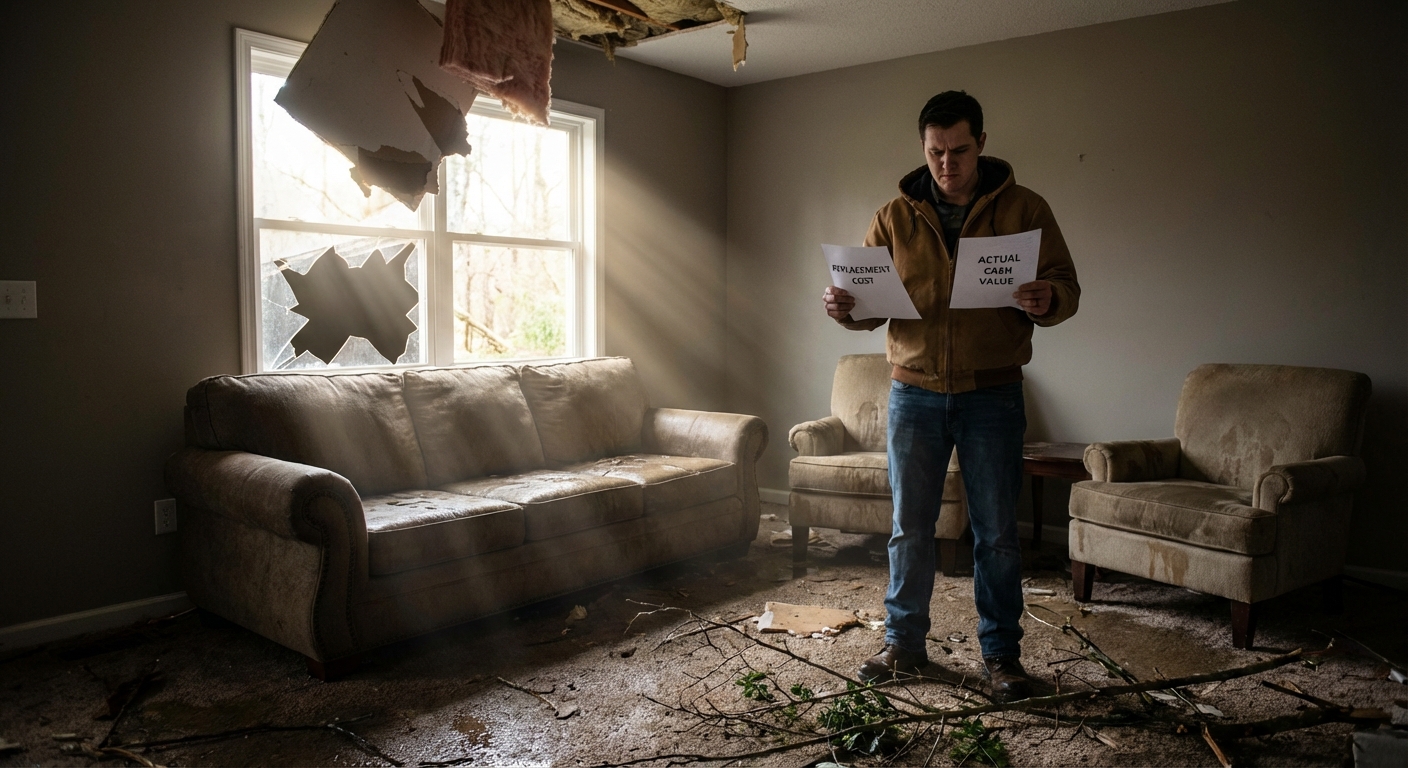
What Is Replacement Cost vs. Actual Cash Value?
When you purchase a homeowners insurance policy, one of the most important decisions you will make is choosing how your property will be valued if you ever need to file a claim. The two standard valuation methods are replacement cost value (RCV) and actual cash value (ACV), and the difference between them can mean thousands of dollars in your pocket (or out of it) when disaster strikes.
Replacement cost coverage pays the full current cost to repair or replace your damaged property with new materials of similar kind and quality, without any deduction for depreciation. If your roof costs $12,000 to replace today, that is what the insurer pays regardless of how old that roof was.
Actual cash value coverage, on the other hand, pays the replacement cost minus depreciation. Depreciation accounts for the age, wear and tear, and remaining useful life of the damaged item. So that same $12,000 roof, if it was 10 years into a 20-year lifespan, might only yield a roughly $6,000 ACV payout, leaving you to cover the rest out of pocket.
Most standard homeowners policies still insure the dwelling structure at RCV by default, but in higher-risk areas or for older homes some insurers now only offer ACV on certain components. Roofs are the most common example, with many carriers depreciating shingle roofs after year 10 and some switching to ACV once a roof reaches 15 to 20 years old (unless the homeowner buys a specific RCV buy-back endorsement). Personal property (your belongings) also often defaults to ACV unless you specifically add a replacement cost endorsement. To see how this fits into your overall policy, read our home insurance coverage guide.

Compare Home Insurance Plans in Ohio
Find your best options in less than 2 minutes
How Depreciation Works and Why It Matters
Understanding depreciation is the key to understanding why ACV policies can leave homeowners in a financial bind. Here is how insurers calculate it in 2026:
The ACV Calculation
Most insurers use a straight-line depreciation method for both roofs and personal property:
- Estimate replacement cost. The adjuster calculates what it would cost to repair or replace the item brand new today.
- Assign useful life. A typical asphalt shingle roof gets a 20 to 25 year useful life, while metal roofs may get 40 to 60 years and appliances usually get 8 to 15 years.
- Calculate annual depreciation. Annual rate = 1 ÷ useful life. A 25-year composition shingle roof depreciates about 4% per year under normal conditions, and many carriers apply 1% to 5% depending on condition and material.
- Subtract and pay. Total depreciation (plus your deductible) is subtracted from the replacement cost.
Formula: ACV = Replacement Cost − Depreciation − Deductible
Real-World Payout Examples for 2026
Construction and repair costs remain elevated in 2026. Recent industry data puts the average asphalt shingle roof replacement at roughly $10,000 to $16,000 for a typical U.S. home, with several 2026 cost reports centering near $10,500 to $12,000 and larger or premium jobs on 2,200+ sq ft roofs commonly landing in the $15,000 to $18,000 range. On top of that, non-recoverable depreciation has become a much bigger factor as ACV roof endorsements and age-based roof schedules spread across the industry, and it now regularly consumes a meaningful chunk of a homeowner's roof settlement.
The table below shows how dramatically the payout difference can be between RCV and ACV for common 2026 claims, assuming a $1,000 deductible:
| Item | Age | Replacement Cost | ACV Payout | RCV Payout | Out-of-Pocket (ACV) |
|---|---|---|---|---|---|
| Asphalt Roof | 5 years old | $12,000 | $8,000 | $11,000 | $3,000 |
| Asphalt Roof | 15 years old | $12,000 | $3,000 | $11,000 | $8,000 |
| Refrigerator | 8 years old | $2,800 | $1,000 | $1,800 | $800 |
| Sofa/Furniture set | 5 years old | $3,800 | $1,700 | $2,800 | $1,100 |
| HVAC System | 10 years old | $14,000 | $5,600 | $13,000 | $7,400 |
Estimates for illustrative purposes. Actual payouts vary by insurer, item condition, and policy terms.
As you can see, the older the item, the wider the gap between what an ACV policy pays and what it actually costs to replace. A 15-year-old roof under an ACV policy could receive a payout that barely covers a quarter of the true 2026 replacement cost. For a deeper dive into how depreciation schedules work, see our ACV home insurance breakdown or our detailed ACV vs RCV coverage guide.
Recoverable vs. Non-Recoverable Depreciation
One important distinction: under an RCV policy, the insurer typically pays the ACV amount first, then releases the withheld "recoverable depreciation" after you complete repairs and submit receipts. Under an ACV policy, depreciation is permanent and never repaid. Most policies give you 180 days to a year to complete repairs and recover the depreciation, so missing that window can cost you thousands. Learn more about the mechanics in our home insurance settlements guide or our home insurance payout options breakdown.

Protect your home with State Farm
Average Rate:
Homeowners who bundle and save with State Farm save an average of $1,000 per year!

You're in Good Hands® with Allstate
Average Rate:
Get comprehensive home coverage with flexible policy options.

Customize your home coverage
Average Rate:
Only pay for the coverage you need with personalized home insurance.

Smart coverage for your home
Average Rate:
Protect what matters most with award-winning home insurance.
Replacement Cost Coverage Options: Standard, Extended, and Guaranteed
Not all replacement cost policies are created equal. There are three tiers of replacement cost coverage, and each offers a different level of protection against rebuilding cost overruns. That matters more than ever now that the NAHB's national construction benchmark sits at roughly $162 per square foot for a typical single-family home (based on a 2,647 sq ft home costing $428,215, excluding land and contractor overhead), climbing to about $195 per square foot once general contractor overhead and profit are included. High-end and coastal markets routinely run $300 to $450+ per square foot in 2026.
Standard Replacement Cost
Standard RCV pays to repair or rebuild your home using materials of similar kind and quality up to your policy's coverage limit. If rebuilding costs exceed that limit, you are responsible for the difference.
Extended Replacement Cost
Extended replacement cost adds a financial cushion above your dwelling coverage limit, typically 25% to 50% more than your stated policy limit, with some carriers now going as high as 125% to 200% of dwelling. For example, if your home is insured for $400,000, an extended RCV policy with a 25% buffer would cover up to $500,000. This is particularly valuable when construction costs spike unexpectedly after widespread natural disasters. Most mainstream insurers including State Farm, Allstate, Erie, Chubb, Hippo, and Kin offer extended replacement cost as either a standard feature or an endorsement.
Guaranteed Replacement Cost
Guaranteed replacement cost is the gold standard of home insurance coverage. It covers the full cost to rebuild your home regardless of how far it exceeds your policy limit, with no ceiling. If your home is insured for $400,000 but rebuilding costs balloon to $650,000 due to post-disaster material shortages, the policy covers the full $650,000.
However, true GRC has become harder to find in 2026 and is now concentrated in a smaller group of carriers. Companies still explicitly writing it include Erie, Acuity, Chubb (Masterpiece), PURE, Cincinnati Insurance, Berkley One, AIG Private Client, Farmers, The Hanover, Nationwide (Private Client), NJM, Openly, and Andover Companies. Many other insurers have phased it out or now offer only high-cap extended replacement cost (125% to 200% of dwelling) in its place.
If you want to make sure your dwelling limit is set correctly in the first place, read our guide on dwelling coverage and how much you need, our deep dive on the guaranteed replacement cost endorsement, or learn more about rebuild cost vs. home value.
Which Coverage Is Right for You?
Choosing between RCV and ACV ultimately comes down to your financial situation, the age of your home, and how much risk you are comfortable carrying. With residential construction input prices still running well above pre-pandemic levels and the gap between depreciated payouts and actual repair costs continuing to widen, the choice matters more now than ever. Our construction cost inflation guide tracks the latest 2026 numbers.
Choose Replacement Cost Coverage If You:
- Own a newer home with recently updated systems, appliances, and finishes
- Have valuable personal belongings (electronics, furniture, jewelry) you could not easily replace out of pocket
- Live in an area prone to severe weather, wildfires, or other high-risk perils
- Cannot afford a large out-of-pocket expense to cover the gap between a depreciated payout and actual repair costs
- Want the peace of mind that a total loss will not leave you financially devastated
Choose Actual Cash Value Coverage If You:
- Own an older home where many components are already significantly depreciated
- Are on a tight budget and need to minimize monthly premium costs
- Have substantial savings set aside that could cover the gap between your ACV payout and actual repair costs
- Are insuring a secondary or rental property where top-tier coverage may not be cost-effective
Premium Cost Comparison
While exact premiums vary by insurer, location, home value, and risk factors, ACV policies are consistently less expensive. Industry data shows RCV premiums typically run about 5% to 15% higher than ACV for comparable coverage, with an average increase of roughly 8%. Forbes Advisor's analysis found the average annual premium jumped from $1,535 to $1,661 when adding replacement cost coverage, though some carriers add as little as 2%.
| Coverage Type | Premium Impact | Best For |
|---|---|---|
| Actual Cash Value (ACV) | Lowest premiums | Budget-focused; older homes |
| Standard Replacement Cost | 5-15% increase | Most homeowners |
| Extended Replacement Cost | Moderate increase | Newer homes; high-risk areas |
| Guaranteed Replacement Cost | Highest premiums (+5-10%) | Maximum protection seekers |
The bottom line? Most insurance experts recommend replacement cost coverage for the average homeowner. ACV policies save money upfront, but the gap between a depreciated payout and actual repair costs can be financially crippling after a major loss, especially for roofs, HVAC systems, and structural damage where 2026 costs remain elevated. If you are concerned you may already be underinsured, check our guide on signs of underinsured home insurance, or learn more about the roof replacement coverage rules that changed in 2026.
Frequently Asked Questions
Is replacement cost coverage worth the extra premium in 2026?
For most homeowners, yes. The premium difference is typically 5% to 15% more than ACV, or roughly 8% on average, which is modest compared to the potential out-of-pocket gap you could face at claim time. A 15-year-old roof could yield a payout of just $3,000 to $5,000 on an ACV policy while still costing $12,000 or more to replace in 2026. That gap far outweighs years of premium savings.
How is replacement cost calculated for a home?
Insurers use specialized cost estimator tools that combine square footage, construction materials, local labor rates, and regional building codes. In 2026, the NAHB benchmark puts national construction at about $162 per square foot excluding land and contractor overhead, and closer to $195 per square foot with typical overhead and profit included. Coastal or luxury markets often run $300 to $450+ per square foot. Importantly, this figure is different from your home's market value because it reflects what it would cost to rebuild, not what you could sell for.
Can I switch from actual cash value to replacement cost coverage?
Yes, in most cases you can upgrade your coverage at renewal or even mid-policy. For the home structure, replacement cost is standard on most policies, but personal property and roof coverage may need to be upgraded separately, especially after the March 2026 FHFA rule change that lets lenders accept ACV roof coverage. Contact your insurance agent to review your current policy and request a quote for the upgrade.
What does "extended replacement cost" mean on a home insurance policy?
Extended replacement cost means your insurer will pay beyond your stated policy limit, typically 125% to 150% (and up to 200% with some carriers) of your dwelling coverage amount, if rebuilding costs exceed what your policy covers. It serves as an important buffer against unexpected cost spikes in construction materials and labor, which have remained elevated well above pre-pandemic levels heading into the second half of 2026.
Does actual cash value coverage ever make sense?
ACV coverage can make sense for homeowners with tight budgets who have significant savings to cover any gaps, or for those insuring older properties where most components are already heavily depreciated. It may also be a reasonable choice for investment or rental properties. However, for primary residences, especially in areas prone to severe weather, the risk of being underinsured with ACV is significant, and non-recoverable depreciation now shows up on a growing share of roof claims industry-wide.