
Compare Home Insurance Plans in Ohio
Find your best options in less than 2 minutes



HO3 vs. HO5: How Policy Type Determines Accidental Damage Coverage
Not all home insurance policies treat accidental damage the same way. Your coverage depends heavily on which policy type you hold, and most homeowners are surprised to learn how little a standard policy actually protects them from everyday mishaps.
The Standard HO3 Policy and Its Limits
The HO3 is America's most popular homeowners policy, holding roughly 63.5% of the market. It provides open perils coverage for your home's structure, meaning the dwelling is covered against any cause of loss not explicitly excluded. However, when it comes to your personal property, an HO3 flips to named perils only. That means your belongings are only covered if the cause of damage appears on a specific list (typically 16 named events like fire, theft, windstorm, and vandalism).
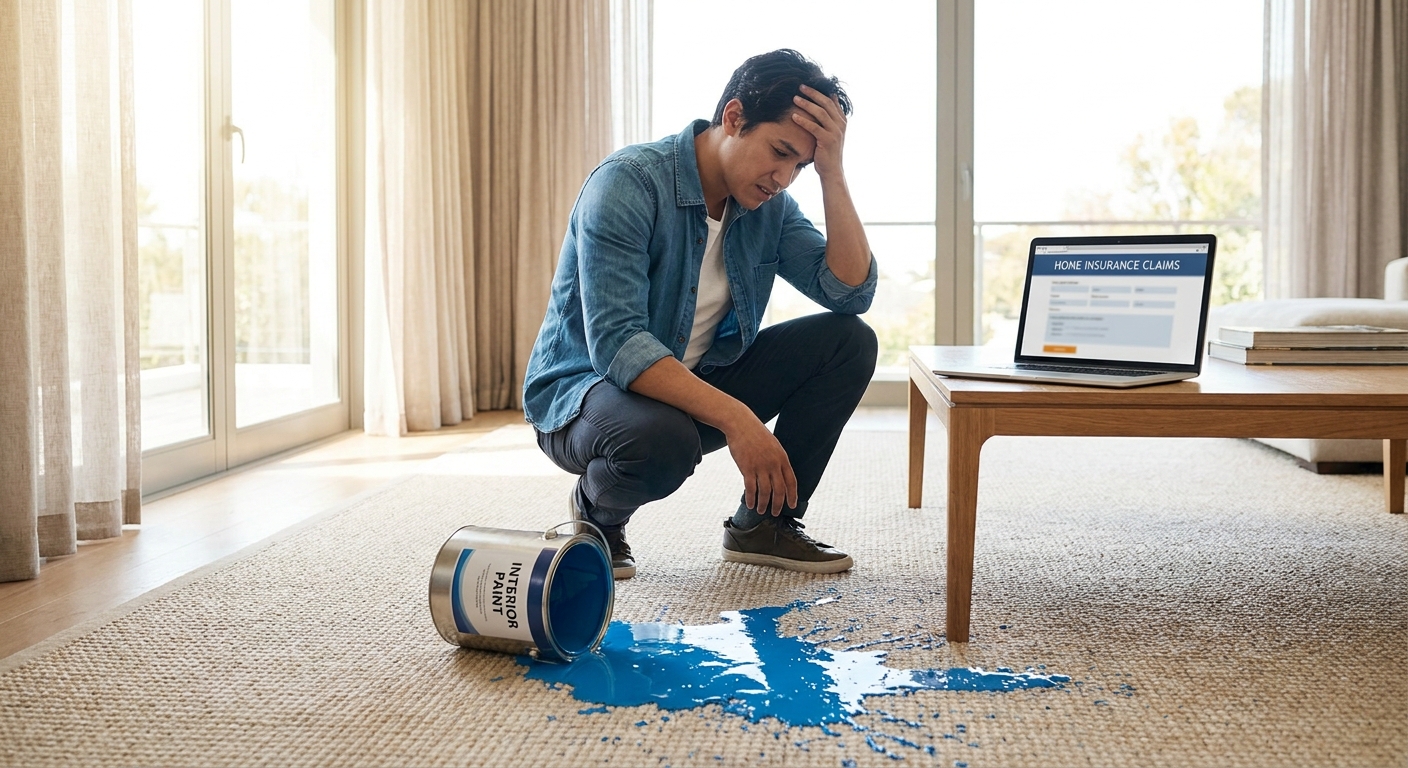
This is a critical gap. Spilling paint on your carpet, dropping a TV, or cracking your bathroom tile by accident? None of these are named perils, so an HO3 policy won't cover them unless you've added an endorsement. Learn more about named vs. open perils coverage to understand how this distinction affects your financial exposure.
The HO5 Advantage for Accidental Damage
An HO5 policy extends open perils protection to both the dwelling and personal property, meaning it covers all causes of loss except those specifically excluded. This broader approach makes it far more responsive to accidental damage claims. With an HO5, a sudden drop that cracks a countertop or a mishap that breaks an appliance has a much stronger chance of being covered.
A comprehensive policy like the HO5 also typically pays replacement cost value on your belongings instead of the depreciated actual cash value that standard HO3 personal property claims receive, which means you get more money toward repair or replacement. Reviewing your Coverage A through F structure is one of the fastest ways to spot whether you're getting RCV or ACV on contents.

Compare Home Insurance Plans in Ohio
Find your best options in less than 2 minutes
What Accidental Damage Is (and Isn't) Covered
Understanding exactly what qualifies as "accidental damage" in the eyes of your insurer is the key to knowing when to file and when you're on your own. In 2026, insurers are more aggressive than ever about denying claims that don't clearly fit their definitions.
Covered Accidental Damage Examples
With an HO5 policy or an accidental damage endorsement added to an HO3, you're typically covered for sudden, unintentional mishaps such as:
| Scenario | Coverage Likely? | Notes |
|---|---|---|
| Spilling paint on carpet | ✅ Yes | With open perils or endorsement |
| Dropping a heavy object through a window | ✅ Yes | Broken windows may be covered |
| Unintentionally cracking floor tiles | ✅ Yes | Sudden accidental breakage |
| Knocking over a TV causing it to shatter | ✅ Yes | Under open perils personal property |
| Child accidentally breaks a window with a ball | ✅ Yes | With endorsement or HO5 |
| Burst pipe flooding a room | ✅ Yes | Covered under most burst pipe scenarios |
| Power surge frying an appliance | ✅ Yes | If from a covered peril |
| Accidentally damaging a neighbor's property | ✅ Yes | Under personal liability coverage |
Excluded Accidental Damage Scenarios
Even the broadest homeowners policy has hard limits. The following scenarios are almost universally excluded, regardless of your policy type:
- Intentional acts. If you or a household member deliberately caused the damage, it's not covered, period.
- Negligence. Damage from failing to maintain your home (a roof that has been leaking for months, for example) is considered an owner responsibility, not an insurable event. See maintenance requirements that keep claims valid.
- Wear and tear. Gradual deterioration, aging appliances, or a slowly rotting deck are excluded because they're predictable, not accidental.
- Mechanical breakdown. An appliance that breaks down on its own falls outside standard home insurance. Consider an equipment breakdown endorsement as an add-on.
- Gradual damage. A slow leak that builds mold over months is not sudden or accidental.
- Pest damage. Termites, rodents, and insect infestations are treated as maintenance issues.
- Flood and earthquake. These require separate policies or endorsements entirely.

Protect your home with State Farm
Average Rate:
Homeowners who bundle and save with State Farm save an average of $1,000 per year!

You're in Good Hands® with Allstate
Average Rate:
Get comprehensive home coverage with flexible policy options.

Customize your home coverage
Average Rate:
Only pay for the coverage you need with personalized home insurance.

Smart coverage for your home
Average Rate:
Protect what matters most with award-winning home insurance.
Sudden & Accidental vs. Gradual Damage: A Critical Distinction
Insurers don't just ask what happened, they ask how quickly it happened. This is one of the most important and misunderstood concepts in home insurance claims, and it's where a significant share of 2026 denials get their footing (through excluded perils and gradual damage classifications).
What Makes Damage "Sudden and Accidental"
Sudden and accidental damage happens abruptly, in minutes or hours, without warning and without any prior signs of a developing problem. Examples include:
- A frozen pipe that bursts overnight
- A guest accidentally dropping a heavy sculpture on hardwood floors
- A power surge that fries an expensive appliance
- A washing machine hose that suddenly ruptures
For water damage specifically, the line between sudden and gradual is where most claims are won or lost. A pipe that bursts is sudden. A slow drip that damages drywall over six months is gradual and typically denied. Many policies now explicitly exclude "continuous or repeated seepage" lasting 14 days or more, and insurers use this reasoning to classify water damage as long-term whenever the evidence allows. The same principle applies to plumbing-related claims throughout your home.
What Counts as Gradual Damage (and Why It's Excluded)
| Damage Type | Timeline | Covered? |
|---|---|---|
| Pipe burst flooding a room | Minutes | ✅ Yes |
| Slow drip causing mold behind walls | Months | ❌ No |
| Sudden storm breaks a window | Immediate | ✅ Yes |
| Aging roof slowly deteriorates | Years | ❌ No |
| Accidental spill ruins carpet | Immediate | ✅ With endorsement |
| Long-term wood rot from poor drainage | Years | ❌ No |
| Termite or pest damage | Months to years | ❌ No |
Insurers examine evidence like staining, rot patterns, moisture readings, and repair history to determine whether damage was truly sudden. A sudden discovery of a problem doesn't override evidence that it developed slowly, and adjusters increasingly rely on plumber and contractor reports, drone imagery, and AI-powered claim reviews to build their case. This distinction also applies to structural damage claims, so always document new damage immediately.
When to Upgrade Coverage, How to File, and What It Costs
Is Accidental Damage Coverage Worth the Extra Cost?
In 2026, the national average homeowners premium sits between roughly $2,400 and $2,900 per year for $300,000 in dwelling coverage. Insurance.com puts the average at $2,872, Insurify at $2,844, and Compare.com at $2,584, with Insurify projecting a national average of $3,057 by year end. An HO5 policy typically costs 5% to 20% more per year than a comparable HO3, and for homeowners with high-value personal property, children, pets, or simply a busy household, that modest price difference can be well worth it.
Alternatively, you can add an accidental damage endorsement or scheduled personal property floater to your existing HO3 policy to gain broader protection without switching policies entirely. Cost varies significantly by insurer, home value, contents value, and your chosen deductible, so the only reliable way to price it is to request a quote from your current carrier and shop the market for cheaper home insurance rates.
Accidental damage coverage makes the most sense when:
- You own expensive electronics, art, or furniture
- You have children or pets in the home
- Your home has high-end finishes (hardwood floors, stone countertops)
- You want fewer out-of-pocket surprises on claims
Also consider your Coverage A through F limits and personal property sub-limits. Even with open perils protection, sub-limits on specific categories like electronics or jewelry can leave you underprotected without scheduled endorsements.
How to File an Accidental Damage Claim
If you've experienced accidental damage and believe it's covered, here's how to move through the claims process efficiently:
- Document everything immediately. Photos, videos, and a written description of what happened and when.
- Review your policy. Confirm the damage qualifies under your coverage type before filing.
- Compare the damage cost to your deductible. If repair costs are close to your deductible (typically $1,000 to $5,000 in 2026, with many insurers raising deductibles significantly), it may not be worth filing, as claims can raise your premium.
- File promptly. Contact your insurer via phone, app, or online portal with your policy number and all documentation ready. Late reporting is one of the most common denial reasons.
- Cooperate with the adjuster. An inspector will assess the damage. Provide all supporting materials, including any contractor reports that confirm the damage was recent.
- Receive your payout. Payment arrives minus your deductible. Keep all repair receipts.
Frequently Asked Questions
Does standard homeowners insurance cover accidental damage?
Not automatically. A standard HO3 policy covers your home's structure under open perils but limits personal property coverage to named perils only, and everyday accidents like spills or drops are not on that list. To get true accidental damage protection for your belongings, you typically need to upgrade to an HO5 policy or add an accidental damage endorsement to your existing HO3. Always review your declarations page to know exactly what's included.
What's the difference between accidental damage and negligence in a home insurance claim?
Accidental damage is a sudden, unintentional mishap, something that happens without warning and couldn't have been prevented through reasonable maintenance. Negligence refers to damage that resulted from a failure to maintain your home or take reasonable care. For example, a pipe that unexpectedly bursts is accidental, while a pipe that deteriorated over years due to lack of upkeep is negligence, and insurers will deny claims in the latter scenario.
Will home insurance cover me if I drop something and break it?
It depends on your policy type. Under a standard HO3, dropping an object that breaks (whether it's a TV, a vase, or a tile) is not a named peril and will likely not be covered. Under an HO5 or with an accidental breakage endorsement, this type of sudden unintentional damage has a much better chance of being approved. Always confirm your coverage type before assuming a claim will go through.
How do I know if my damage qualifies as "sudden and accidental"?
Insurers look for evidence that the damage occurred quickly and without prior warning signs. If there's no history of staining, rot, prior complaints, or visible deterioration, the damage is more likely to be classified as sudden. Document the incident immediately with photos and a written timeline. If the damage shows signs of slow development (like mold growth or water staining that predates the incident), the insurer may classify it as gradual damage and deny the claim.
Is an HO5 policy worth the extra cost for accidental damage coverage?
For most homeowners, yes, especially if you have significant personal property or high-end finishes in your home. The HO5 typically costs 5% to 20% more per year on average, and in exchange you get open perils protection on both the structure and your belongings, plus replacement cost value payouts. Given that the top five carriers now close over 44% of claims without payment, the broader coverage of an HO5 provides meaningful protection. Compare quotes for both policy types to see whether the premium difference makes sense for your household.