
Compare Home Insurance Plans in Ohio
Find your best options in less than 2 minutes


The 8 Types of Home Insurance Policies at a Glance
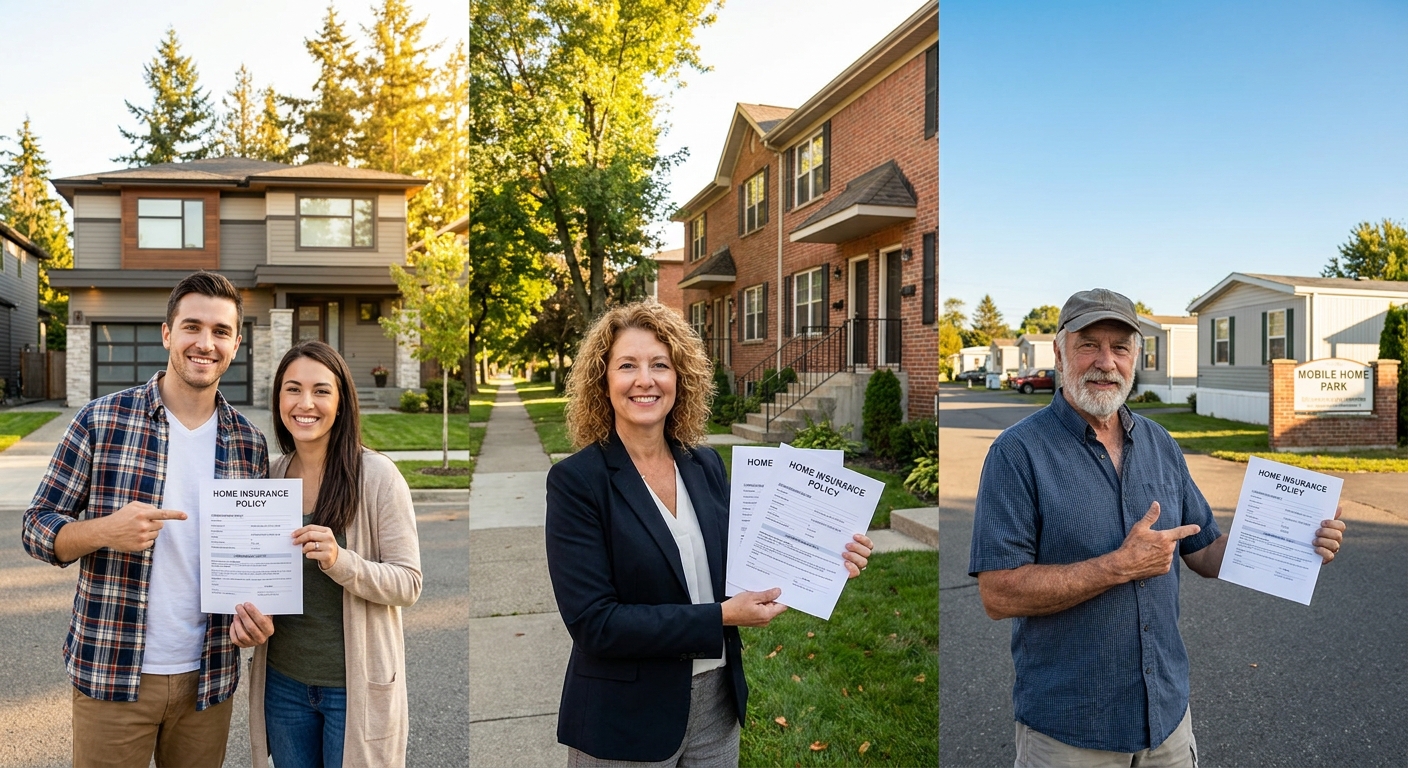
Home insurance policies in the U.S. are standardized into eight forms, HO-1 through HO-8, each designed for a specific type of property or coverage need. Before diving into the details, here's a quick-reference comparison of all eight:
| Policy | Common Name | Designed For | Coverage Type | Payout Method |
|---|---|---|---|---|
| HO-1 | Basic Form | Standard homes (rarely issued) | Named perils (~10) | Actual Cash Value |
| HO-2 | Broad Form | Standard homes on a budget | Named perils (~16) | Actual Cash Value |
| HO-3 | Special Form | Single-family homes | Open perils (dwelling) / Named perils (property) | Replacement Cost (dwelling) |
| HO-4 | Renters Form | Renters / apartment dwellers | Named perils (property only) | Replacement Cost |
| HO-5 | Comprehensive Form | High-value single-family homes | Open perils (both dwelling & property) | Replacement Cost |
| HO-6 | Condo/Unit-Owners Form | Condo & co-op owners | Named or open perils (interior only) | Replacement Cost |
| HO-7 | Mobile Home Form | Mobile / manufactured homes | Open perils (dwelling) / Named perils (property) | Replacement Cost |
| HO-8 | Modified/Older Home Form | Older or historic homes | Named perils (~10) | Actual Cash Value |
Two of the most important distinctions across all HO forms are named perils vs. open perils and replacement cost vs. actual cash value (ACV). Named-peril policies only cover losses from events explicitly listed in the policy. Open-peril (also called "all-risk") policies cover any loss unless it is specifically excluded, putting the burden of proof on the insurer to deny a claim. For a deeper dive, see our full comparison of named perils vs all risk coverage, or check our guide to accidental damage and home insurance.

Compare Home Insurance Plans in Ohio
Find your best options in less than 2 minutes
HO-1 Through HO-5: Policies for Standard Homes
HO-1, Basic Form (Rarely Issued)
The HO-1 is the most stripped-down homeowners policy available, covering only about 10 named perils such as fire, lightning, windstorm, hail, explosion, theft, vandalism, smoke, riot, and volcanic eruption. It typically covers only the dwelling structure, with no personal property and, in most versions, no liability coverage.
The HO-1 is largely a relic. Most major insurers have discontinued it, and under the March 18, 2026 FHFA rule, mortgage lenders following Fannie Mae and Freddie Mac guidelines still require replacement cost dwelling coverage on the main structure, only permitting ACV settlements on roofs. If you're being offered an HO-1, it's worth exploring alternatives first. Read our full breakdown in our HO-1 basic form coverage guide.
HO-2, Broad Form
The HO-2 expands on HO-1 by adding around 16 named perils, including falling objects, freezing pipes, accidental water discharge, electrical damage, and glass breakage. Both the dwelling and personal property are covered, along with basic liability and additional living expenses.
It pays out at actual cash value (ACV), meaning depreciation is deducted from your claim payout. It's typically 10 to 20% cheaper than an HO-3 but offers narrower protection. HO-2 remains a niche product, accounting for only a small share of owner-occupied policies today. For a detailed look at whether broad form coverage makes sense for you, see our HO-2 broad form coverage guide.
HO-3, Special Form (The Most Popular Policy)
The HO-3 is the most common homeowners insurance policy in the U.S., holding roughly 63.5% of market revenue in 2026 and covering the vast majority of owner-occupied policies. Here's what makes it stand out:
- Dwelling coverage: Open perils, covered against all risks except those explicitly excluded (like floods or earthquakes)
- Personal property: Named perils, only covered for the ~16 listed causes of loss
- Liability, medical payments, and additional living expenses: Included
- Dwelling payout: Replacement cost value
In 2026, HO-3 pricing depends heavily on the coverage amount and source. National benchmarks range widely: MoneyGeek puts the 2026 average HO-3 policy at $3,503 per year for $250,000 in dwelling coverage, NerdWallet's analysis puts the average at $2,490 per year, or about $208 a month, for $400,000 of dwelling coverage, and Insurify puts the national average at $2,844 per year for a policy with $300,000 in dwelling coverage. Insurify also projects the national average will reach roughly $3,057 by year end after climbing 12% in 2025. The one gap in an HO-3 is that personal property still falls under named perils. If a mysterious or unusual cause damages your belongings, you may not be covered. For most homeowners, though, the HO-3 strikes the right balance of cost and protection.
HO-4, Renters Insurance
The HO-4 is built exclusively for tenants. It covers your personal property and liability but includes zero dwelling coverage (that's your landlord's responsibility). It operates on a named-perils basis and also covers additional living expenses if a covered event makes your rental uninhabitable. Rates are remarkably affordable: the national average cost of HO-4 renters insurance is $22 per month, or around $264 per year, for a policy with $30,000 in personal property coverage, according to Insurify data, while NerdWallet's rate analysis puts the average even lower at $151 per year, or about $13 per month. Learn more in our HO-4 renters insurance guide.
HO-5, Comprehensive Form
The HO-5 is the most robust standard homeowners policy available. The key difference from HO-3? It extends open-perils coverage to your personal property as well, and pays out at replacement cost value for both your home and your belongings, with no depreciation deductions.
HO-5 is ideal for homeowners with high-value belongings, those in areas with diverse risks, or anyone who wants the most comprehensive protection with fewer claim disputes. In 2026, HO-5 policies cost 5% to 15% more than an equivalent HO-3 according to MoneyGeek, while some Texas-based analyses show the gap can widen to 15% to 30% in coastal or high-risk markets. Explore the full comparison in our HO-3 vs. HO-5 coverage guide or review the six standard home insurance coverages A through F.

Protect your home with State Farm
Average Rate:
Homeowners who bundle and save with State Farm save an average of $1,000 per year!

You're in Good Hands® with Allstate
Average Rate:
Get comprehensive home coverage with flexible policy options.

Customize your home coverage
Average Rate:
Only pay for the coverage you need with personalized home insurance.
Smart coverage for your home
Average Rate:
Protect what matters most with award-winning home insurance.
HO-6, HO-7, and HO-8: Specialized Policy Forms
HO-6, Condo / Unit-Owners Insurance
If you own a condo or co-op, an HO-6 is your go-to policy. Because the condo association's master policy covers the building's exterior and common areas, the HO-6 focuses on "walls-in" coverage, protecting your interior improvements, personal property, and personal liability.
Key coverages under HO-6:
- Interior structures (flooring, cabinets, fixtures you own)
- Personal property (named perils)
- Personal liability
- Loss assessment (if the HOA levies a special charge after a shared loss)
- Additional living expenses
HO-6 policies are significantly more affordable than HO-3 policies, though 2026 national averages vary widely by source: NerdWallet's rate analysis puts the national average at $510 per year, while Insurance.com puts the nationwide HO-6 average at $815 per year, with Wyoming as the cheapest at $288 and Florida the most expensive at $1,408. Wallet Grower's analysis shows a national range of $455 to $656 per year, with Florida and Louisiana highest and Vermont, Wisconsin, and Idaho lowest. For a detailed walkthrough, see our HO-6 condo insurance guide.
HO-7, Mobile and Manufactured Home Insurance
The HO-7 is the HO-3 equivalent for mobile, manufactured, and modular homes. It provides open-perils coverage for the structure and named-perils coverage for personal property when the home is stationary. It does not cover motor homes or homes being transported.
Specialty insurers like Foremost (a Farmers subsidiary and the largest mobile/manufactured home writer in the U.S.), American Modern, and Farmers lead the market, along with Assurant, American Family, and Erie. Annual premiums commonly range from about $700 to $1,500, though homes in hurricane- or tornado-prone states can run significantly higher due to increased wind and hail risk. Mobile home insurance in Florida typically costs between $1,200 and $3,000 per year, with wind coverage as the primary cost driver, averaging approximately $1,392 per year with wind coverage versus just $372 per year without. Underwriting continued to tighten in 2026, with fewer national carriers writing HO-7 policies and many declining older units or raising percentage-based wind and hail deductibles. Learn more in our HO-7 mobile home insurance guide and our mobile home insurance comparison for 2026.
HO-8, Modified Coverage for Older Homes
The HO-8 is specifically designed for older or historic homes (typically those built more than 40 years ago) where the cost to rebuild to original standards far exceeds the home's market value. Standard insurers often won't write full replacement cost policies for these properties, making HO-8 the practical alternative.
Key characteristics of HO-8:
- Named perils only (~10 perils, similar to HO-1)
- Pays claims at actual cash value, with depreciation applied
- Focuses on functional repair using modern materials, not full historic restoration
- Covers dwelling, personal property, liability, and additional living expenses
One of the biggest 2026 shifts affecting older homes is the March 2026 FHFA rule. Fannie Mae and Freddie Mac retired the 2024 requirement that lenders document replacement cost value to confirm property insurance coverage sufficiency for one- to four-unit properties, and now allow actual cash value coverage for roofs on single-family homes and condo buildings. Insurers are also relying more heavily on hyper-local ZIP-code modeling, satellite imagery, and AI to identify high-risk properties, which disproportionately impacts older homes with aging roofs.
For a deeper look, our HO-8 older home insurance guide covers everything from coverage triggers to Functional Replacement Cost coverage as an alternative.
How to Choose the Right Home Insurance Policy
Match Your Policy to Your Property Type
The simplest starting point is your property type:
| Your Situation | Recommended Policy |
|---|---|
| Owner of a standard single-family home | HO-3 (or HO-5 for added protection) |
| High-value home or expensive belongings | HO-5 |
| Condo or co-op owner | HO-6 |
| Renter / apartment dweller | HO-4 |
| Mobile or manufactured homeowner | HO-7 |
| Owner of an older or historic home | HO-8 (or HO-3 with endorsements, if available) |
| Townhouse owner | HO-3 or HO-6 (depends on ownership structure) |
Townhouse owners face a unique situation. Whether you need an HO-3 or HO-6 depends on how your property is titled and what the HOA master policy covers. See our townhouse insurance HO-3 vs. HO-6 guide for the full breakdown.
Key Questions to Ask Before Buying
Before committing to any policy, ask these five questions:
- Is this open perils or named perils? Open perils offers broader protection and fewer claim disputes.
- Does my property qualify for replacement cost, or just actual cash value? ACV can leave you thousands short after a major loss.
- What are the personal property limits, and are high-value items covered? Jewelry, electronics, and art often need separate endorsements.
- Does the policy match my property type exactly? A standard HO-3 won't properly cover a condo or mobile home.
- What common exclusions apply, and do I need separate flood or earthquake coverage? All HO forms exclude floods and earthquakes by default.
Consider Your Coverage Amounts Too
Choosing the right policy type is only half the equation. Make sure your coverage limits are sized correctly for today's rebuild costs, which typically run $162 to $195 per square foot. Our guide on the six standard home insurance coverages A through F walks you through the details.
Frequently Asked Questions
What is the most common type of home insurance policy?
The HO-3 (Special Form) is by far the most common homeowners insurance policy in the United States, accounting for roughly 63.5% of market revenue. It provides open-perils coverage for the dwelling and named-perils coverage for personal property, along with liability, medical payments, and additional living expenses. Most mortgage lenders following the March 2026 FHFA rule require at least an HO-3-level policy for financed homes, with only the roof allowed to be settled at actual cash value.
What is the difference between named perils and open perils coverage?
Named-perils coverage only pays for losses caused by specific events listed in your policy, such as fire, theft, or windstorm. If the cause isn't on the list, the claim is denied. Open-perils (or "all-risk") coverage works the opposite way: it covers any loss unless the cause is specifically excluded, which puts the burden of proof on the insurer rather than the homeowner. HO-3 uses open perils for the dwelling and named perils for personal property, while HO-5 applies open perils to both.
Do I need a different policy if I own a condo?
Yes, condo owners need an HO-6 policy, not a standard HO-3. Because the condo association's master policy typically covers the building's exterior and common areas, an HO-6 focuses on your unit's interior, personal belongings, personal liability, and loss assessments from the HOA. NerdWallet's rate analysis puts the average condo insurance cost at $510 per year, though coastal states like Florida run over $1,000 per year on average. The exact coverage you need depends on whether your HOA has a "bare walls-in," "single-entity," or "all-in" master policy.
Is HO-5 worth the extra cost over HO-3?
For most homeowners, yes, especially if you own high-value electronics, jewelry, furniture, or other personal property. The HO-5 extends open-perils coverage to personal belongings and pays replacement cost value (not depreciated ACV) for those items. MoneyGeek reports HO-5 policies cost 5% to 15% more than equivalent HO-3 coverage, which can easily be offset by a single avoided claim dispute. However, HO-5 eligibility is more restricted in climate-risk areas, so approval matters as much as cost.
What type of insurance covers a mobile home?
Mobile and manufactured homes are covered by an HO-7 policy, which is the mobile home equivalent of an HO-3. It provides open-perils coverage for the dwelling (when stationary) and named-perils coverage for personal property. Specialized insurers like Foremost, American Modern, Assurant, American Family, and Erie are the leading providers, with 2026 premiums commonly running $700 to $1,500 annually, though homes in hurricane- or tornado-prone states can cost significantly more. Many carriers now decline coverage for units over 25 years old, so pre-1976 mobile homes may need a specialty carrier or a state FAIR plan.