
Compare Home Insurance Plans in Ohio
Find your best options in less than 2 minutes



Why Older Home Insurance Costs More in 2026
If your home is 30 years old or more, you've likely noticed that insurance quotes are higher, sometimes significantly, compared to what your neighbors pay for newer construction. That's not a coincidence. Insurers view older homes as higher-risk properties, largely because of the systems and materials that were standard decades ago but are now considered outdated, hazardous, or simply expensive to repair.
According to 2026 data from Insurify, a 30-year-old home averages $2,584 per year for a policy with $300,000 in dwelling coverage, while a two-year-old home averages just $1,596 per year. NerdWallet's 2026 analysis puts the national average at $2,490 per year (about $208 per month) for $400,000 in coverage, and MarketWatch reports that a home built in 1950 averages $2,692 per year, roughly 73% more than a comparable new-build. The Zebra's 2026 State of Insurance report notes that insurance prices rise sharply for homes older than 5 years, with the average U.S. homeowner now paying $2,966 annually. MoneyGeek's 2026 analysis found the annual cost gap between newer and older homes grows from about $851 at the $100,000 dwelling level to $4,048 at the $750,000 level.
Insurify projects that the national average will climb another 4% in 2026 to $3,057 after jumping 12% in 2025, and CNBC reports that insurers are increasingly using drone surveillance and data mining to identify homes with outdated plumbing and wiring, meaning older properties often see fewer carriers willing to compete for their business. A Pew Research survey found that 71% of U.S. homeowners say their insurance costs have gone up in recent years, with 42% saying they've gone up "a lot."
The Key Risk Factors Insurers Evaluate
Insurance underwriters assess several areas of concern for older homes:
| Risk Factor | Why It Raises Premiums | Potential Insurer Response |
|---|---|---|
| Outdated electrical systems | Fire hazard; fails modern codes | Policy denial or required upgrade |
| Aging plumbing | Leaks, corrosion, water damage risk | Higher premiums or coverage exclusions |
| Old roof (15-20+ years) | Storm vulnerability, leak exposure | Rate hikes or ACV-only coverage |
| Outdated building materials | Costly to source and replicate | Higher replacement cost estimates |
| Code compliance gaps | Post-loss upgrades required by law | Limits on standard policy payouts |
| Structural wear | Foundation settling, wall weakening | Reduced claim eligibility |
Beyond age alone, insurers consider the overall condition of the home. A well-maintained 60-year-old home may qualify for better rates than a neglected 35-year-old one. That said, some systems, regardless of maintenance, are simply unacceptable to most standard carriers.
Learn more about home insurance underwriting to understand exactly what insurers look at during the process, or explore why some properties fall into the hard-to-insure category.

Compare Home Insurance Plans in Ohio
Find your best options in less than 2 minutes
Problem Features That Can Kill Your Coverage
Certain features found in older homes are considered red flags by nearly every major insurer. Some will lead to policy denial outright; others will drive up your premiums considerably.
Knob-and-Tube Wiring
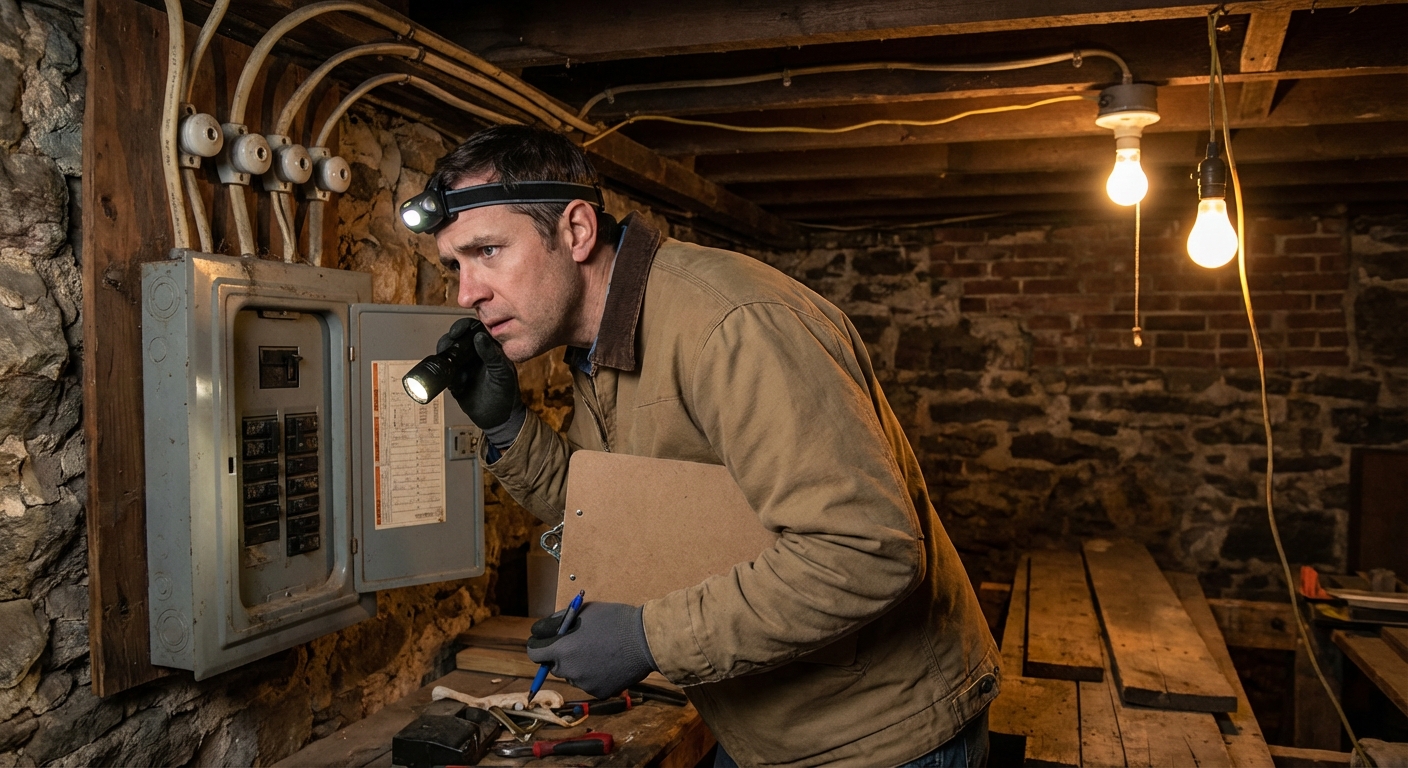
Common in homes built before the 1950s, knob-and-tube (K&T) wiring is ungrounded, has degrading insulation, and can't safely handle modern electrical loads. Carrier responses in 2026 vary: many issue a flat denial, others charge 15% to 30% higher premiums, and some will issue a policy but require you to replace the wiring within 30, 60, or 90 days or face cancellation. In Florida, no standard carrier will write a home with active K&T; a complete copper rewire is essentially required. Full rewiring costs an average of $12,000 to $36,600 in 2026 (roughly $10 to $20 per square foot, with a national midpoint near $24,300), and prices can climb past $40,000 once wall and ceiling repair is included. Explore your options in our guide to knob and tube wiring insurance.
Polybutylene Pipes
Installed in millions of U.S. homes between 1978 and 1995, polybutylene (PB) pipes are prone to failure from chlorine exposure over time, leading to unexpected bursts and major water damage. In 2026, most Florida carriers, including Citizens Property Insurance, will not insure homes with active polybutylene plumbing. In other states, some carriers accept PB with a 15% to 30% surcharge and a recent plumbing inspection, while many now exclude water-damage losses tied to PB failures. Full repiping is often the only path to standard coverage.
Fuse Boxes
Older homes with fuse panels (rather than modern circuit breakers) present an overload and fire risk. Insurers commonly require an upgrade to a standard breaker panel before a policy can be issued. This is a straightforward fix compared to full rewiring, but it still needs to be done by a licensed electrician.
Aging Roofs
Roofs more than 15 to 20 years old are one of the most scrutinized elements of old roof home insurance. Many insurers switch from replacement cost coverage to depreciated actual cash value (ACV) for aging roofs, or decline coverage altogether. The March 18, 2026 FHFA rule (Fannie Mae LL-2026-03 and Freddie Mac Bulletin 2026-C) now formally allows ACV roof coverage on federally backed mortgages, which has pushed more carriers to use it. See our updated guide on roof age and home insurance eligibility for state-by-state rules.

Protect your home with State Farm
Average Rate:
Homeowners who bundle and save with State Farm save an average of $1,000 per year!

You're in Good Hands® with Allstate
Average Rate:
Get comprehensive home coverage with flexible policy options.

Customize your home coverage
Average Rate:
Only pay for the coverage you need with personalized home insurance.

Smart coverage for your home
Average Rate:
Protect what matters most with award-winning home insurance.
Replacement Cost vs. Actual Cash Value for Older Homes
The difference between Replacement Cost Value (RCV) and Actual Cash Value (ACV) coverage matters to every homeowner, but it's especially critical for owners of older homes.
How Each Coverage Type Works
Replacement Cost Value (RCV): Pays the full current cost to repair or rebuild your home using today's materials and labor, with no deduction for depreciation. If your 20-year-old roof needs replacing after storm damage, RCV pays the full bill (minus your deductible).
Actual Cash Value (ACV): Pays replacement cost minus depreciation based on age and condition. A 20-year-old roof on a $10,000 claim could yield a payout of nearly $0 after depreciation and your deductible are applied.
| Coverage Type | Depreciation Deducted? | Better For | Premium Cost |
|---|---|---|---|
| Replacement Cost (RCV) | No | Older homes needing full rebuilds | Higher |
| Actual Cash Value (ACV) | Yes | Tight budgets; newer components | Lower |
For older homes, RCV coverage is almost always the smarter choice, but verify your policy actually includes it. Some insurers automatically assign ACV coverage to older roofs or outdated systems even within an RCV policy. This has become more common since the March 2026 FHFA rule, which allows ACV roof coverage on federally backed loans while requiring the rest of the home to remain on RCV. Read the fine print carefully, and pay close attention to how home insurance coverages A through F apply to your dwelling limit.
Another critical endorsement to consider is Ordinance or Law coverage, which pays the cost of bringing your home up to current building codes after a covered loss. Without it, a partial claim on an older home could result in enormous out-of-pocket costs for code compliance. Understanding what home insurance doesn't cover is especially important for older homes where standard exclusions can wipe out claim value.
Inspections, Insurers & Renovation Strategies
What Inspections to Expect
Before issuing a policy on a home 30 years or older, most insurers will require one or more of the following, as covered in our home insurance inspection guide:
- 4-Point Inspection: Covers roof, electrical, plumbing, and HVAC. Typical cost is $75 to $175 and takes 30 to 60 minutes. Florida's updated 2026 Citizens form now requires additional photos of the water heater TPR valve, roof slopes, and electrical panels.
- Wind Mitigation Inspection: Required in hurricane-prone areas, this evaluates features like roof shape, shutter systems, and bracing that reduce wind damage risk.
- Full Home Inspection: A broader assessment of the exterior, interior, attached structures, and safety features, typically $300 to $600.
Some carriers now conduct virtual or aerial reviews rather than in-person visits. Learn more about home insurance without a traditional inspection and what to expect if your insurer uses drones or satellite imagery.
Best Companies for Older Homes in 2026
Not all insurers will walk away from an older home. Based on 2026 rankings from Insurify, MarketWatch, and Policygenius, these companies have a track record of covering older and historic properties:
| Company | Why They Stand Out | Best For |
|---|---|---|
| Westfield | WesPak Estate policy; lowest 2026 average premium at ~$1,193/yr | High-value older homes |
| Unitrin | ~$1,343/yr average per Insurify's 2026 older-home data | Budget-conscious owners |
| Grange | ~$1,363/yr average per Insurify's 2026 older-home data | Standard older homes |
| AIG | Competitive quotes on 1950-era builds; tailored endorsements | Architecturally unique homes |
| American Family | Home renovation coverage protects foundation and materials during projects | Renovated older homes |
| Chubb | Masterpiece policy with guaranteed replacement cost and historic-material coverage | Historic and landmark homes |
| Foremost | Willing to write homes other insurers won't (per CNBC Select 2026) | Hard-to-insure older homes |
Allstate, Progressive, State Farm, Liberty Mutual, and Travelers are also frequently recommended for older properties. If you're struggling to find coverage through standard carriers, explore high-risk home insurance options including E&S insurers and state FAIR Plans. If standard coverage isn't available at all, an HO-8 insurance policy averaging $2,035 per year (vs. $1,278 for a comparable HO-3) is a common fallback. Understanding the full range of HO-1 through HO-8 policies can help you pick the right form.
Renovation Strategies That Lower Your Premium
Strategic upgrades not only make your home safer, they can meaningfully reduce what you pay for insurance. 2026 cost and savings data:
| Renovation | Typical Premium Impact | Estimated 2026 Cost |
|---|---|---|
| New roof (impact-resistant) | 5% to 35% off | $6,000 to $25,000 |
| Electrical panel upgrade (100A to 200A) | Up to 15%; improves insurability | $1,300 to $4,500 |
| Full rewiring (K&T replacement) | Enables standard coverage | $12,000 to $36,600 |
| Plumbing repipe (PB or galvanized) | Removes denial risk | $8,000 to $25,000 |
| Smart smoke/CO detectors | 5% to 10% | $50 to $300 |
| Monitored security system | 5% to 20% | $200 to $600/yr |
| Storm shutters / impact windows | Up to 25% in high-risk zones | $3,000 to $12,000 |
Always notify your insurer after completing major upgrades and provide documentation (permits, contractor invoices, completion certificates). Asking the right home insurance questions before you buy or renew also helps you avoid overpaying, and reviewing what home insurance doesn't cover can highlight endorsements worth adding.
Frequently Asked Questions
Is it hard to get home insurance on a 50-year-old house in 2026?
It can be more challenging, but it's absolutely possible, especially if the home is well-maintained and major systems have been updated. The biggest hurdles are outdated electrical (particularly knob-and-tube wiring), old plumbing, and an aging roof. Many standard insurers now require a 4-point inspection before offering a quote, with a 4-point almost universally required at 40 years and commonly at 30. If standard carriers decline, HO-8 policies or E&S (Excess & Surplus) insurers are alternatives worth exploring.
What is an HO-8 policy and do I need one for my older home?
An HO-8 policy is a specialized homeowners insurance form designed for older homes (typically 40+ years) where the cost to rebuild exceeds the home's current market value. Instead of paying replacement cost, HO-8 policies typically cover the functional replacement cost using materials of similar function rather than identical quality. The average HO-8 policy costs about $2,035 per year for $300,000 to $399,999 in dwelling coverage, compared to $1,278 for a comparable HO-3, but it offers more limited, named-peril coverage. It's a common solution for homes that can't qualify for standard HO-3 policies.
Will insurance cover a 100-year-old house?
Yes, some insurers will cover century-old homes, but you'll need to work with companies that specialize in older or historic properties, such as Chubb, AIG, Liberty Mutual, or Foremost. Expect higher premiums, a thorough inspection, and potentially required upgrades to the electrical, plumbing, or roof systems. Historic homes may also qualify for specialty programs (like Chubb's Masterpiece) that include guaranteed replacement cost and coverage for period-appropriate materials and craftsmanship.
How does insurance handle a claim on an older home with depreciated components?
If your policy uses Actual Cash Value (ACV) for aging components, your claim payout will be reduced by depreciation, potentially by a large amount. For example, a 20-year-old roof involved in a $10,000 claim may yield very little after depreciation and your deductible. Since the March 2026 FHFA rule now formally allows ACV roof coverage on Fannie Mae and Freddie Mac loans, more insurers are applying it. Review your policy carefully and consider upgrading to RCV coverage, particularly for your roof, HVAC, and other aging systems.
What's the best way to lower insurance costs on an older home?
The highest-impact improvements are replacing an aging roof (which can save 5% to 35%), upgrading your electrical panel or rewiring entirely, and repiping outdated plumbing. Adding a monitored security system, smart smoke detectors, and storm protection features can each add further savings. Beyond renovations, shopping multiple insurers, bundling your auto and home policies, and raising your deductible are all effective strategies. Asking the right home insurance questions before you buy also helps you avoid overpaying.