
Compare Home Insurance Plans in Ohio
Find your best options in less than 2 minutes



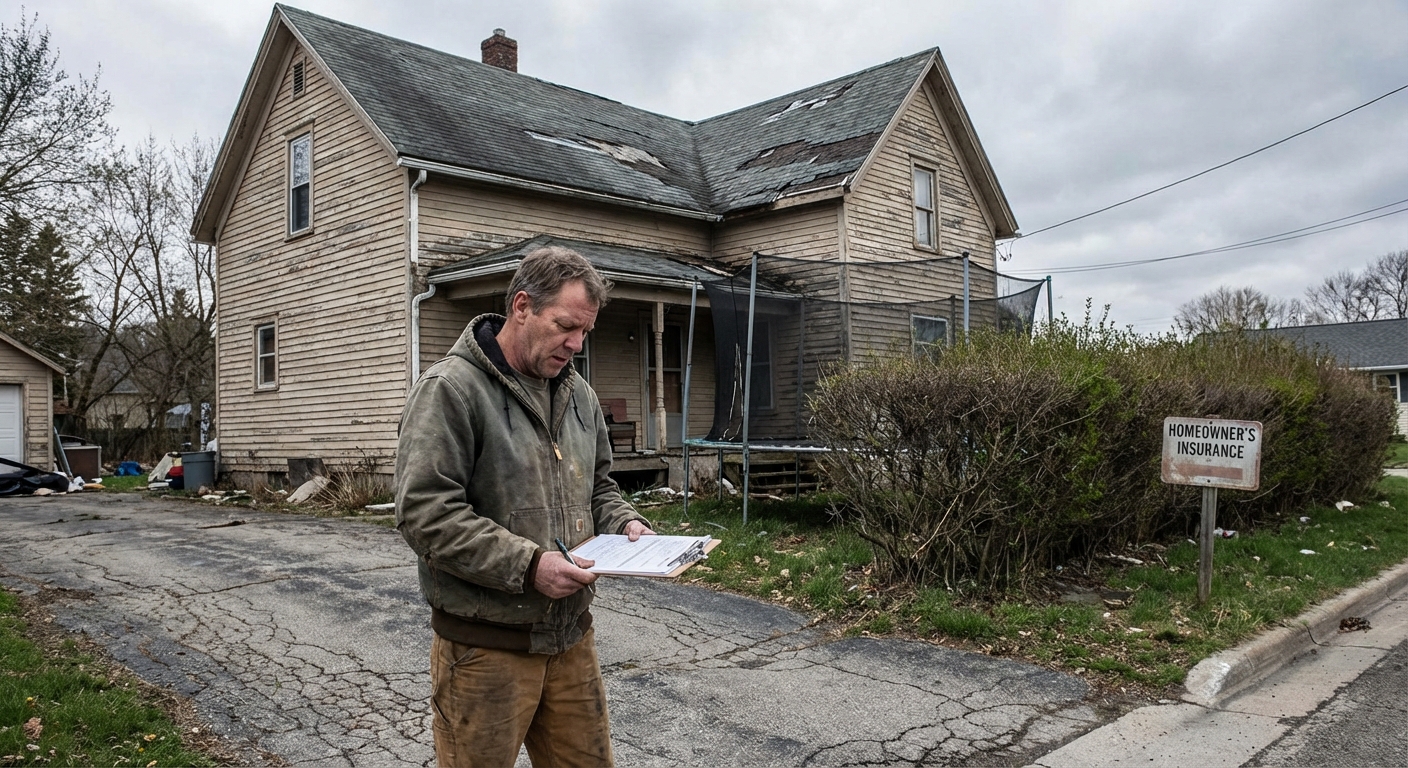
The Most Common Reasons Homes Are Hard to Insure
Not every home qualifies for a standard homeowners policy. Insurers evaluate dozens of risk factors before agreeing to cover a property, and certain red flags can trigger steep premium hikes, restrictive policy conditions, or flat-out denial. With Insurify projecting the U.S. average annual home insurance premium will rise 4% to about $3,057 by the end of 2026 after jumping 12% in 2025, and premiums up roughly 46.8% since 2020, the cost of being flagged as high risk can be substantial. Understanding why your home might be difficult to insure is the first step toward fixing the problem or finding the right alternative coverage.
Roof Age and Condition
A roof that's 20 years or older is one of the most common reasons insurers decline to write a standard policy. About 70% of major insurance carriers now enforce a 20-year roof threshold, up from roughly 50% in 2020. Once your roof hits 20 years old, carriers commonly switch coverage from Replacement Cost Value (RCV) to Actual Cash Value (ACV), require replacement within 30 to 90 days, or non-renew entirely. A March 2026 FHFA rule (Lender Letter LL-2026-03) now formally allows Fannie Mae and Freddie Mac loans to accept ACV-only roof coverage, making the issue even more common for older homes.
Why it's high-risk: Aged roofing materials lose their ability to shed water and resist wind uplift, making water intrusion and storm damage far more likely.
What you can do: Replacing your roof with modern materials, especially impact-resistant shingles, can dramatically improve your insurability and even unlock discounts with many carriers. In Florida, existing statute F.S. § 627.7011 remains the operative roof-age rule after HB 815 and its identical Senate companion SB 808 both died in committee on March 13, 2026. Under current Florida law, insurers cannot refuse to issue or renew a homeowner's policy solely because a roof is less than 15 years old, and for roofs 15 years or older, an inspection showing at least 5 years of useful life remaining defeats an age-only refusal. Learn more about how roof age affects coverage before your next renewal, or review our old roof insurance guide for carrier-by-carrier thresholds.
Outdated Electrical Systems
Homes built before the 1970s may still contain knob-and-tube (K&T) wiring or aluminum wiring, two systems that most modern insurers consider serious fire hazards. Knob-and-tube wiring lacks grounding, deteriorates with age, and cannot handle today's electrical loads. Aluminum wiring (common in homes built between 1965 and 1973) oxidizes at connection points, creating resistance and heat that can ignite fires.
Why it's high-risk: Most standard national carriers now decline to issue or renew coverage on homes with active knob-and-tube wiring. In markets like California and Florida, K&T is effectively uninsurable in the admitted market as of 2026, and in Florida only a handful of major carriers will even accept single-strand aluminum wiring, and only after approved COPALUM or AlumiConn connector remediation. Those insurers that will still bind coverage often require a licensed electrician's inspection, partial rewiring, or AFCI breaker upgrades as a condition, and specialty carriers commonly charge 50% to 100% more than a comparable updated home. Four-point inspections (roof, electrical, plumbing, HVAC) are widely used for older homes and are typically required once a home is 20+ years old.
What you can do: A full rewire to modern copper wiring is the gold standard fix. It restores full insurability, reduces your premiums, and significantly increases your home's resale value. Partial mitigations like arc-fault circuit interrupter (AFCI) breakers can help in the short term. For a deeper dive, our guide on home insurance with knob and tube wiring covers your specific options, and our older home insurance guide walks through what to expect for homes with legacy systems.
Old and Problematic Plumbing
Two plumbing types raise major red flags for insurers: galvanized steel pipes (common in homes built before the 1960s) and polybutylene pipes (installed from the 1970s through the mid-1990s). Galvanized pipes corrode internally over time, restricting water flow and eventually bursting. Polybutylene reacts to chemicals commonly found in municipal water supplies, becoming brittle and prone to sudden failure.
Why it's high-risk: Both pipe types significantly increase the likelihood of water damage claims, which are among the most expensive types of home insurance losses. Water damage now represents 22.6% of all homeowner claims industry-wide, and many insurers will decline coverage outright on a home with active polybutylene plumbing.
What you can do: Replacing galvanized or polybutylene pipes with copper or modern PEX piping eliminates the risk and can restore your eligibility for standard coverage. Some insurers will also require a plumbing inspection before binding a policy on an older home. Understanding what home insurance doesn't cover, including gradual leaks from deteriorating pipes, makes this upgrade even more important.

Compare Home Insurance Plans in Ohio
Find your best options in less than 2 minutes
Location and Environmental Risk Factors
Where your home sits matters just as much as what's inside it. Insurers use location data extensively when determining whether to offer coverage and at what price.
Distance From Fire Stations
Homes located far from fire stations face measurably higher fire loss risks. Insurers use the ISO Public Protection Classification (PPC) system (a 1-to-10 scale) to evaluate a community's fire protection capabilities. Living just 5 miles from a fire station can raise the average cost of homeowners insurance by about 8%, and homes 25+ miles away face a 9% premium increase nationwide (up to 43% in Alaska and roughly 20% in California). If a home sits more than 5 miles from the nearest department, the area often defaults to PPC Class 10, which most standard insurers will not accept.
Why it's high-risk: Longer fire department response times mean fires cause more damage before crews arrive, resulting in larger, more costly claims.
What you can do: You can't move a fire station, but you can invest in on-site fire suppression systems, fire-rated construction materials, and monitored alarm systems that can partially offset your location disadvantage. In rural areas where coverage is especially scarce, E&S surplus lines carriers and state FAIR Plans are often the most realistic options.
High-Crime Areas
Homes in neighborhoods with elevated crime rates face higher premiums due to the increased risk of theft, vandalism, and property damage claims. Insurers factor in ZIP-code-level crime statistics when pricing policies, and in 2026 they are increasingly moving away from state-wide risk assessments toward hyper-local ZIP code modeling, using satellite imagery and AI to identify specific neighborhoods (sometimes just a few blocks) that they deem uninsurable. Roughly 85% of the top 25 U.S. property insurers now use drones or aerial imagery in underwriting. Learn more about home insurance underwriting to see how carriers use that data.
What you can do: Installing a monitored security system, deadbolt locks, motion-sensor lighting, and security cameras can help reduce your premium. Some insurers offer explicit discounts for alarm systems connected to a central monitoring service.
Previous Claims History
Your home's claims history follows it everywhere. Insurers pull a CLUE (Comprehensive Loss Underwriting Exchange) report when you apply for coverage, which shows the claims filed for any house or car for the past seven years, listing claims on your home even if you weren't the owner at the time. Most insurers become hesitant to provide coverage once there are more than two claims in the last three years, and many will decline new applications or issue non-renewals at that point. If you're worried about your record, our guide on home insurance denials explains how carriers weigh claim frequency.
Why it's high-risk: Frequent claims, even small ones, signal to insurers that the property has recurring problems or that the owner is a high-frequency filer.
What you can do: If possible, consider paying smaller losses out of pocket to keep your claims record clean. You're entitled to one free CLUE report every 12 months from LexisNexis Risk Solutions, either online at consumer.risk.lexisnexis.com or by calling 1-866-312-8076. If you've been non-renewed due to claims history, shopping the E&S market or a state FAIR Plan may be your best near-term path.

Protect your home with State Farm
Average Rate:
Homeowners who bundle and save with State Farm save an average of $1,000 per year!

You're in Good Hands® with Allstate
Average Rate:
Get comprehensive home coverage with flexible policy options.

Customize your home coverage
Average Rate:
Only pay for the coverage you need with personalized home insurance.

Smart coverage for your home
Average Rate:
Protect what matters most with award-winning home insurance.
Structural Features and Property Use That Raise Red Flags
Some homes are hard to insure not because of their age or location, but because of how they're built or used.
Unique Construction Types
Log homes and earth-sheltered (earth) homes require specialized policies that most standard carriers don't offer. Log homes are prized for their beauty but carry unique risks: moisture infiltration, settling, log rot, and higher susceptibility to fire given the large volume of exposed wood. Earth homes, including underground and rammed-earth structures, present challenges around moisture intrusion, seismic risk, and the high cost of repair due to unconventional materials.
What you can do: Specialty insurers who focus on non-traditional construction are the best route. Our dedicated log home insurance guide covers carriers and endorsements that work for unique wood builds, and our overview of home insurance policy types explains which forms fit non-standard construction.
Trampolines and Unfenced Pools
These are the classic "attractive nuisance" risks. Trampolines caused more than 111,000 injuries in 2023, with children younger than 15 accounting for nearly 90% of those incidents according to the U.S. Consumer Product Safety Commission, and unfenced swimming pools create significant liability exposure, particularly involving children. Some insurers will flat-out cancel your policy if they discover a trampoline during an inspection. Others will require specific safety measures (safety nets, padding, locked pool fencing) as a condition of continued coverage.
What you can do: If you keep a trampoline, install enclosure nets and padding, keep it locked when not in use, and notify your insurer. For pools, a compliant fence with a self-latching gate is typically required. In either case, consider increasing your liability limits or adding an umbrella policy.
Homes With Commercial Use
Standard homeowners policies are designed to cover personal residential use only. If you run a business from your home, whether it's a day care, a salon, a rental unit, or even a busy home office with regular client visits, your standard policy may not cover business-related liability or property losses. Insurers view commercial activity as a fundamentally different risk category.
What you can do: Notify your insurer of any commercial use. Depending on the activity, you may need a home business endorsement, a commercial lines policy, or a separate general liability policy. Failing to disclose commercial use is a common reason claims get denied, and running an unlisted ADU or in-law suite as a rental creates similar exposure.
Your Options When Standard Coverage Isn't Available
If your home has been declined by standard admitted insurers, you still have meaningful options in 2026.
Surplus Lines (E&S) Insurance
The Excess and Surplus (E&S) lines market exists specifically for properties that standard carriers won't cover. U.S. domestic excess and surplus direct premiums surpassed the $100 billion mark for the first time in 2025, reaching $105.31 billion nationwide, up 7.8% from the prior year according to S&P Global Market Intelligence. Homeowners was one of the fastest-growing E&S segments, jumping 29.5% year over year to $4.14 billion in 2025, and Amwins reports the segment continues to grow strongly into 2026 as carriers pivot from pure admitted underwriting to a hybrid approach. Broader NAIC data that includes all surplus lines transactions puts the 2024 total at about $131 billion. In catastrophe-exposed states, the E&S share is much higher, with insurers increasingly using it as the release valve for admitted market retrenchment.
The trade-off: E&S policies are typically more expensive than standard coverage, and they aren't backed by your state's insurance guaranty fund if the insurer becomes insolvent. Always verify the financial strength of any E&S carrier before purchasing. Learn more about when E&S insurance makes sense for your situation.
State FAIR Plans
Every state offers a FAIR (Fair Access to Insurance Requirements) Plan (or a residual market equivalent) as a last resort for homeowners who can't get private coverage. FAIR Plan enrollment has exploded in high-risk states. As of June 2026, the California FAIR Plan's total policies in force reached 696,562, reflecting an 8% increase since September 2025, with total exposure now approaching $768 billion. Rates are also rising sharply: California's insurer of last resort is increasing rates by an average of 29.1% for its more than 675,000 customers starting October 15, 2026, the highest rate bump in recent history. Growth is finally slowing, though. In the second quarter of 2026, the residual market added just 12,305 policies, the lowest quarterly increase since 2022, as depopulation efforts started to take hold.
FAIR Plans typically provide basic dwelling and fire coverage only. They should be treated as a temporary solution while you make the improvements needed to qualify for private market coverage. Also consider a modified older-home form like an HO8 insurance policy if your home won't qualify for HO3 coverage.
Is It Worth Making Improvements to Gain Standard Coverage?
In most cases, yes, especially for issues like roofing, electrical, and plumbing. The upfront cost of updates is often offset by:
- Lower annual premiums over time
- Access to replacement cost (rather than ACV) coverage
- Increased home resale value
- Protection against major losses that go uninsured
The one exception is location-based risk. If your home is in a wildfire zone, flood plain, or very rural area, structural improvements alone won't fully resolve your insurability challenges. According to a U.S. Treasury Federal Insurance Office analysis, consumers in the highest-risk ZIP codes faced average non-renewal rates of 1.61% over 2018 to 2022, about 80% higher than the average in the lowest-risk zones, with the gap widening over time as availability continues to decrease. If you're already labeled high risk, our full guide on high risk home insurance options covers every fallback route, and a wildfire insurance overview explains what mitigation can (and can't) fix. For homes needing a fresh inspection to prove insurability, see our guide on home insurance without an in-person inspection.
Frequently Asked Questions
Can a home be completely uninsurable?
Technically, very few homes are truly uninsurable, but some are only insurable at a very high cost through specialty or surplus lines carriers. A completely dilapidated structure or a home in extreme disrepair may genuinely have no viable insurance options until it's brought up to a minimum livable standard. For most hard-to-insure situations, some form of coverage exists, it just may not be cheap or comprehensive.
Will upgrading my electrical system lower my home insurance premium?
Yes, in most cases significantly. Replacing knob-and-tube or aluminum wiring with modern copper wiring removes one of the most serious fire risk flags from your property profile. This can restore eligibility for standard admitted carriers and eliminate the surcharges associated with high-risk electrical systems, which often run 50% to 100% above updated homes. The savings over five to ten years can often offset the cost of the upgrade itself.
How do I find out what's on my home's CLUE report?
You can request a free copy of your home's CLUE report directly from LexisNexis Risk Solutions, which maintains the database, at consumer.risk.lexisnexis.com or by calling 1-866-312-8076. Federal law entitles you to one free report every 12 months, and additional copies are typically available for a small fee. Reviewing your report before shopping for insurance (especially when buying a home) helps you understand exactly what claims history insurers will see.
What's the difference between a FAIR Plan and surplus lines insurance?
A FAIR Plan is a state-administered last-resort insurance program that provides basic dwelling coverage to homeowners who can't get private market insurance. Surplus lines (E&S) insurance is provided by private non-admitted insurers who specialize in high-risk or unconventional properties. E&S policies typically offer broader coverage than FAIR Plans but cost more and aren't backed by state guaranty funds. Both are legitimate fallback options, but private E&S coverage is generally preferred when available.
Does having a trampoline automatically disqualify me from homeowners insurance?
Not automatically, but it can. Some carriers will cancel or non-renew your policy if they discover a trampoline during an inspection. Others will allow it with conditions such as requiring a safety enclosure net, proper padding, and adequate liability limits. If you own a trampoline, the best approach is to disclose it upfront and ask your insurer about their specific requirements. Adding an umbrella policy is a smart move to protect yourself from liability claims.