
Compare Home Insurance Plans in Ohio
Find your best options in less than 2 minutes



Why Insurers Avoid Knob and Tube Wiring
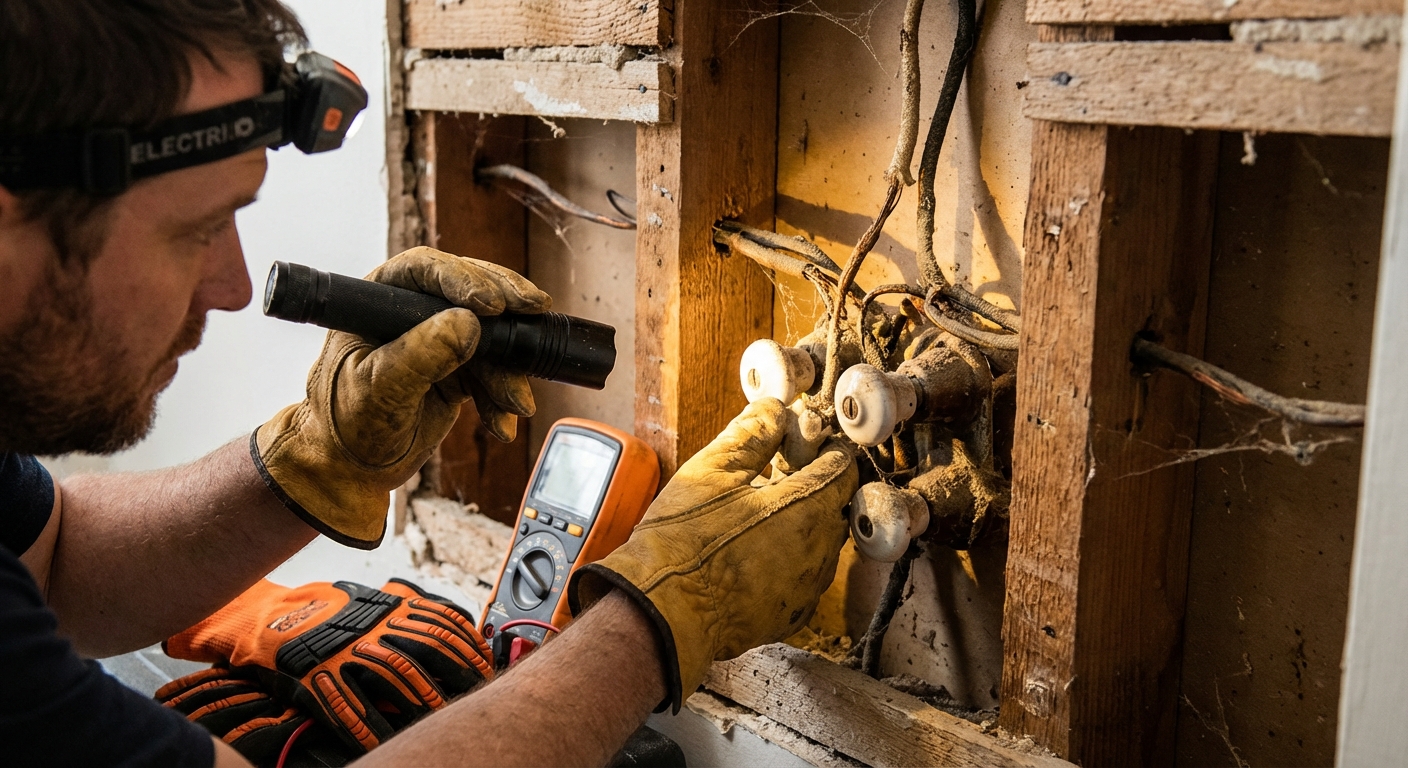
Knob and tube (K&T) wiring was the standard electrical system installed in American homes built before 1950. It uses ceramic knobs, tubes, and copper wire insulated with cloth or rubber, materials that simply weren't designed to power a modern household. Today, it's one of the biggest red flags any home insurance underwriter can find during a property inspection.
The core reason insurers steer clear is fire risk. K&T wiring was engineered for low electrical loads, like basic lighting and a handful of appliances. It has no ground wire, meaning stray electrical currents have nowhere safe to go. After 70+ years, the cloth and rubber insulation becomes brittle and cracked, exposing live wires to nearby wood framing. Add in decades of potential amateur splicing, overloaded circuits from modern appliances, and attic insulation trapping heat around the wires, and you have a system that poses a measurably elevated risk of electrical fire.
Here's a breakdown of the key hazards K&T wiring presents:
| Risk Factor | Why It's Dangerous |
|---|---|
| No Ground Wire | Stray currents can't be redirected safely, increasing shock and fire risk |
| Degraded Insulation | Brittle cloth/rubber exposes live wires to ignition sources |
| Overloading | Not built for modern appliance loads, causing overheating |
| Improper Modifications | Unlicensed splicing creates hidden fire hazards in walls |
| Heat Trapping | Attic insulation covering K&T is a code violation and fire hazard |
| Physical Damage | Rodents, moisture, and age accelerate wire deterioration |
From an underwriter's perspective, this is not a theoretical risk. Knob and tube wiring is considered a fire hazard, and most home insurers are reluctant to cover a property that still has it. Many insurers won't offer coverage until it's been upgraded to current safety standards, and those that do often charge higher premiums. That's why many carriers will either decline to write a policy altogether or impose strict conditions on homes that still have active K&T wiring. If you own a pre-1950s property, our guide to older home insurance covers the broader challenges you may face, and our overview of hard-to-insure homes explains other property features that trigger denials.

Compare Home Insurance Plans in Ohio
Find your best options in less than 2 minutes
Insurance Coverage: What to Expect With K&T Wiring in 2026
Getting covered isn't impossible, but your options have narrowed further heading into 2026. Most insurers won't cover a home with active K&T wiring unless you agree to upgrade it. In many states, carriers that do write these homes require replacement within 30 to 60 days of the policy start date. Miss that deadline, and your insurer can cancel your policy and notify your lender, which may put your loan at risk.
Companies That May Offer Coverage
The pool of willing insurers is small and shrinking. Historically, carriers such as State Farm, Allstate, Farm Bureau, Foremost, Auto-Owners, Encompass, Liberty Mutual, Safeco, and USAA have written K&T homes in some markets, but availability is now highly regional and case-by-case in 2026. Foremost Specialty in particular has covered homes with limited K&T (typically in basements or attics) when an electrician's report confirms the system is safe. In many states, coverage is now only available through specialty and excess and surplus (E&S) carriers or a state FAIR Plan. Our full breakdown of the excess and surplus home insurance market explains how these non-admitted carriers price and structure K&T policies.
Regional restrictions matter a lot. In Florida, knob and tube wiring is treated as virtually uninsurable, no standard Florida carrier will write a home with active K&T, and a complete copper rewire is required before binding coverage. As of 2026, even Citizens Property Insurance will not write new policies for Florida homes with active knob and tube systems. California's Bay Area has seen a similar wave of cancellations and non-renewals tied to outdated wiring, and major California carriers including State Farm, Allstate, USAA, Travelers, Liberty Mutual, and AAA now require replacement of active K&T before policy renewal.
Homes that fall outside the standard market are often candidates for high risk home insurance, which includes E&S underwriters who specialize in higher-risk properties.
What Insurers Typically Require
If a carrier agrees to insure your home, expect some or all of the following conditions:
- Electrical Inspection: An inspection by a licensed electrician is typically required before an underwriting decision is made. Florida also requires a 4-point inspection on homes 40 years or older, and home insurance underwriting has become significantly more data-driven in 2026, with drone and satellite imagery adding a second layer of scrutiny.
- Rewiring Timeline: Many carriers that do offer coverage require the homeowner to complete a full rewire within 30 to 60 days of the policy start date. Failure to comply can result in cancellation, and potentially trigger action from your mortgage lender.
- Higher Premiums: Homes with knob and tube wiring, galvanized plumbing, or a roof past 20 years typically pay 15% to 30% more in annual premium, and many carriers decline coverage outright until you upgrade. On a national average premium of roughly $2,395 per year, that surcharge works out to about $359 to $719 extra annually. Specialty markets can push premiums 50% to 100% above standard rates.
- Modified Replacement Cost Policy: Rather than a standard replacement cost policy, you may only qualify for an HO-8 modified policy, which pays claims at actual cash value and uses standard materials rather than those matching your home's original character.
State-by-State Differences
Insurance rules for K&T wiring vary by state and by carrier. There's no single national standard. In Ohio and Massachusetts, the state FAIR Plan is often the only market willing to write homes predominantly wired with K&T. In Washington, homeowners have found options through the Washington FAIR Plan or specialty writers like Safeco and Pemco. In California and Florida, expect a full rewire to be the practical prerequisite for any admitted coverage. New Jersey carriers commonly require replacement within 30 to 60 days as a condition of binding a new policy.
The key takeaway: your state's insurance commissioner's office and a licensed local broker are your best resources for understanding what's available in your specific market. Underwriting appetite for K&T is shifting quickly, and quotes from even 12 months ago may no longer be valid.

Protect your home with State Farm
Average Rate:
Homeowners who bundle and save with State Farm save an average of $1,000 per year!

You're in Good Hands® with Allstate
Average Rate:
Get comprehensive home coverage with flexible policy options.

Customize your home coverage
Average Rate:
Only pay for the coverage you need with personalized home insurance.

Smart coverage for your home
Average Rate:
Protect what matters most with award-winning home insurance.
Replacement Cost vs. Higher Premiums: Running the 2026 Numbers
The most effective long-term solution for securing affordable home insurance is replacing the K&T wiring entirely. But it's not a cheap fix, so is it worth it compared to just paying higher premiums?
Cost to Replace Knob and Tube Wiring in 2026
Rewiring a home is a major project. The total cost depends on square footage, home layout, accessibility, local labor rates, and whether drywall repairs and panel upgrades are needed. Replacing a home's knob and tube wiring costs an average of $12,000 to $36,600 in 2026, usually ranging from $10 to $20 per square foot, with most projects averaging around $24,300. Some 2026 cost guides put the figure between $8 and $17 per square foot for straightforward jobs.
| Home Size | Estimated 2026 Rewiring Cost |
|---|---|
| 800 sq ft | $8,000 – $16,000 |
| 1,000 sq ft | $10,000 – $20,000 |
| 1,300 sq ft | $13,000 – $26,000 |
| 1,600 sq ft | $16,000 – $32,000 |
| 2,000 sq ft | $20,000 – $40,000 |
| 2,500 sq ft | $25,000 – $50,000 |
Additional costs can include drywall repair, repainting, and electrical panel upgrades (typically $600 to $4,000). With construction input prices still climbing (see our guide to construction cost inflation for context), get multiple bids from licensed electricians and pull the appropriate permits, since unpermitted work can create its own insurance complications. Also keep in mind that carriers classify replacement as a maintenance and upgrade expense rather than a covered loss, so the cost falls to the homeowner.
Replacement vs. Higher Premiums: A Comparison
The math often favors replacement. If you're paying $1,000 to $2,000 extra per year in premiums for K&T coverage versus a standard policy, a $20,000 rewiring project can pay for itself in 10 to 20 years, while also increasing your home's resale value. For most homeowners planning to stay in the home long-term, replacement is the financially smarter move, especially as national premiums are projected to reach about $3,057 in 2026. Learn how to lower your home insurance premium once your electrical system is modernized, or explore home insurance discounts that can offset upgrade costs.
Alternatives If You're Denied Coverage
If a standard carrier denies your application, you still have options. Being proactive here is critical, because going without homeowners insurance on a mortgaged property can trigger your lender to force-place insurance, which is typically far more expensive and offers less protection.
Option 1: Your State's FAIR Plan
Every participating state has a FAIR (Fair Access to Insurance Requirements) Plan, a state-backed insurer of last resort for properties that can't get standard coverage. Roughly 33 to 34 U.S. states and Washington, D.C. offer some form of FAIR Plan home insurance. Most plans require proof that you applied for and were denied homeowners insurance by at least two or three standard admitted insurance companies.
For a deeper dive on eligibility and coverage limits, see our full FAIR Plan insurance guide. California residents should also review the California FAIR Plan rules, since a 29.1% average rate increase takes effect for policies renewing on or after October 15, 2026, affecting more than 675,000 policyholders. The California FAIR Plan is now writing roughly 696,562 policies with $768 billion in exposure as of June 2026, and its residential dwelling limit sits at $3 million per location.
Florida is a special case: it does not have a FAIR Plan. Its equivalent backstop is Citizens Property Insurance, which in 2026 also declines new policies on homes with active K&T wiring. Citizens' own 4-point inspection form explicitly asks whether a property has active knob and tube wiring, and homes with it are generally expected to be fully rewired with modern copper before Citizens will bind coverage. FAIR Plans generally offer basic coverage at higher premiums and with fewer policy options, but they are a legitimate safety net. Not every state's FAIR Plan will accept active K&T without upgrades, so check with your state's plan directly.
Option 2: Excess & Surplus Lines Insurers
E&S carriers specialize in high-risk properties that standard carriers won't touch. They can and do write policies for K&T homes, but expect to pay a significant premium, often 50% to 100% more than a standard policy. These policies may also come with exclusions, higher deductibles, or limited coverage types. Many homeowners on a FAIR Plan pair coverage with a Difference in Conditions (DIC) wrap-around policy for liability and theft protection, which typically adds 25% to 60% to the base FAIR Plan premium.
Option 3: Partial Electrical Upgrades
If full rewiring isn't immediately feasible, partial upgrades can sometimes improve your insurability, though most 2026 underwriters still treat active K&T itself as the disqualifying problem:
- GFCI Outlets: Ground fault circuit interrupters protect against electrical shock in wet areas (kitchens, bathrooms) and are relatively affordable to install.
- AFCI Breakers: AFCI devices protect against arcing faults and are the more relevant of the two device types for aging K&T circuits. Some insurers will accept AFCI protection as a partial mitigation measure.
- Dual-Function AFCI/GFCI Breakers: Combined AFCI/GFCI breakers, or an AFCI breaker paired with GFCI receptacles at each socket, provide the strongest protection short of a full rewire.
- Panel Upgrade: Upgrading to a modern electrical panel can independently improve safety and may satisfy some carrier requirements, even if the wiring itself isn't replaced.
Keep in mind that AFCI and GFCI upgrades help with safety, but in 2026 they rarely replace a full rewire in the eyes of a major underwriter. Reports from California, Portland, and other tight markets consistently show carriers refusing to bind or renew policies on homes with active K&T, regardless of the breakers protecting the circuit. Also, on K&T circuits, shared neutrals across multiple circuits can cause AFCIs to trip randomly, so installation often requires an electrician familiar with legacy wiring.
Frequently Asked Questions
Can you get homeowners insurance with knob and tube wiring in 2026?
Yes, but it's difficult and getting harder. Most major national insurers will decline coverage for homes with active K&T wiring, especially in Florida and California. Your best options are specialty insurers, excess and surplus (E&S) carriers, or your state's FAIR Plan. Expect limited policy types, higher premiums, and potentially a required rewiring timeline of 30 to 60 days before coverage can be maintained.
How much more expensive is insurance for a home with K&T wiring?
When coverage is available, homeowners typically pay 15% to 30% more per year through admitted carriers, and 50% to 100% more through specialty and E&S markets. On a national average premium of about $2,395, that's roughly $359 to $719 extra annually at the low end. A clean electrician inspection and partial upgrades like AFCI protection can sometimes reduce the premium impact.
Do I have to disclose knob and tube wiring to my insurer?
Yes, absolutely. Failing to disclose it can result in your policy being voided, meaning any claim you file could be denied. Always be transparent about your home's electrical system when applying for or renewing homeowners insurance.
What is the cheapest way to deal with knob and tube wiring for insurance purposes?
Short-term, installing GFCI and AFCI protection and getting a certified electrician inspection may help you secure some form of coverage. Long-term, full rewiring is the most cost-effective solution because it unlocks competitive standard insurance rates, increases home value, and eliminates ongoing fire risk. Partial upgrades alone are rarely enough for major carriers in 2026.
Does replacing knob and tube wiring increase home value?
Yes. Modern electrical wiring is a significant selling point for buyers and their home inspectors. A fully rewired home is easier to insure, more appealing to buyers, and commands a higher market value. The upfront cost of replacement is often partially offset by the increase in home equity and lower long-term insurance expenses.