
Compare Home Insurance Plans in Ohio
Find your best options in less than 2 minutes



How Home Insurance Classifies Your Driveway
Most standard HO-3 and HO-5 homeowners policies treat a driveway as part of "other structures" coverage, also called Coverage B. This is the same bucket that pays for detached garages, sheds, fences, and gazebos. A few insurers lump the driveway in with dwelling coverage (Coverage A) if it physically connects to the house, but functionally the rules are the same: your insurer pays only if a sudden, accidental event listed in your policy causes the damage.
Coverage B is almost always set as a percentage of your dwelling limit. On a typical policy, that default is 10%, meaning a home insured for $400,000 has about $40,000 in Coverage B available for every detached structure combined. If you own a large detached garage, a fence, and a decorative concrete driveway, all three claims draw from that same pool. You can learn more about how this works in our full guide to other structures Coverage B, which explains when to raise your limit.

Compare Home Insurance Plans in Ohio
Find your best options in less than 2 minutes
Driveway Damage That Home Insurance Usually Covers
Home insurance pays for driveway damage that stems from a named peril. The list is remarkably consistent across HO-3 policies:
- Fire and smoke (grease fire, house fire, vehicle fire on the drive)
- Lightning strikes that crack or spall the surface
- Windstorm, hail, and tornado damage
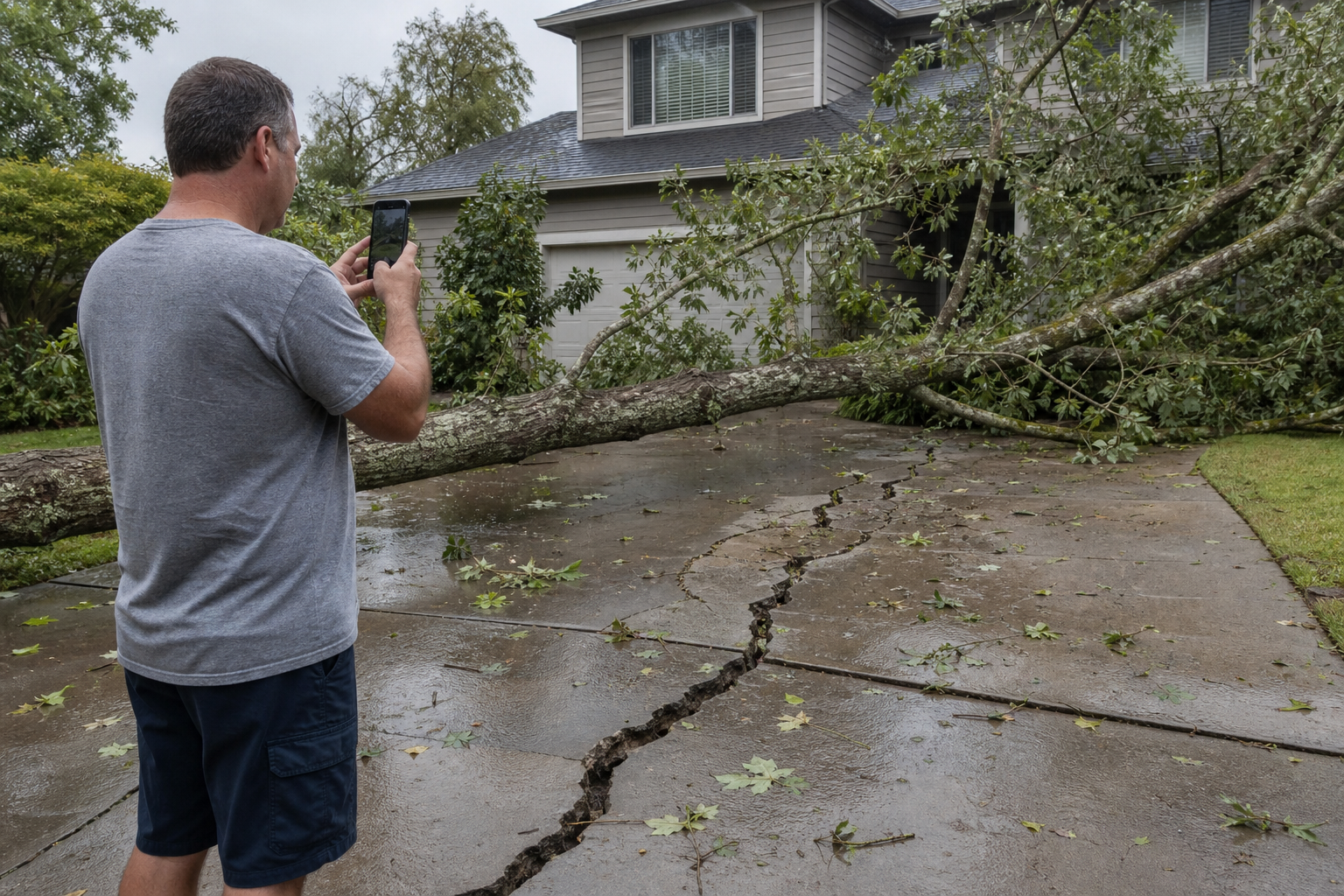
- Falling objects, including trees, large limbs, and airborne debris
- Vehicle impact from a car, truck, or delivery vehicle
- Vandalism and malicious mischief, such as graffiti, spray-paint, or intentional gouging
- Explosion, riot, and civil commotion
The common thread is that the loss must be sudden and identifiable. If a UPS truck backs over your driveway apron and cracks a section, that's a discrete incident with a date, cause, and witness. If your neighbor's oak tree topples onto the driveway during a windstorm, that also qualifies. Similar rules apply to tree-related driveway damage and to damage from wind or falling limbs that also affects your home.
How the Coverage B Sublimit Actually Works
Because Coverage B is a shared pool, a single storm can quickly deplete your limit. Here's an illustration of how the math plays out on a $400,000 dwelling policy with a $2,000 deductible:
| Loss | Repair Cost | Paid by Insurer |
|---|---|---|
| Driveway (tree fell) | $8,000 | $6,000 after deductible |
| Detached garage roof | $22,000 | $22,000 |
| Wood privacy fence | $9,000 | $9,000 |
| Total Coverage B used | $39,000 | $37,000 available limit |
In this example, the homeowner is $2,000 short of a full recovery because all three losses draw from the same 10% pool. The lesson: if your other detached structures already carry high replacement values, the driveway claim may leave you underinsured unless you've increased Coverage B.

Protect your home with State Farm
Average Rate:
Homeowners who bundle and save with State Farm save an average of $1,000 per year!

You're in Good Hands® with Allstate
Average Rate:
Get comprehensive home coverage with flexible policy options.

Customize your home coverage
Average Rate:
Only pay for the coverage you need with personalized home insurance.

Smart coverage for your home
Average Rate:
Protect what matters most with award-winning home insurance.
Damage That Is Almost Never Covered
This is where most driveway claims get denied. Insurers treat gradual deterioration as a maintenance problem, not a loss. Common exclusions include:
If your driveway has slowly cracked over five winters, an adjuster will classify it as wear and tear. The same is true for a slab that has slowly heaved because a maple root grew under it. To be covered, you generally need to point to one identifiable event that caused the failure. Sinkholes are their own category and typically require a separate endorsement, which we cover in our dedicated sinkhole insurance guide.
Repair vs. Replacement Costs in 2026
The financial stakes depend heavily on whether you have concrete or asphalt and whether you're patching or tearing out the whole slab. Here are the national ballpark ranges for 2026:
| Job | Concrete | Asphalt |
|---|---|---|
| Minor crack fill / patch | $100 to $400 | $100 to $300 |
| Standard professional repair | $800 to $3,000 (avg ~$1,800) | $250 to $800 |
| Resurfacing per sq ft | $3 to $8 | $2 to $5 |
| Full replacement (2-car drive) | $4,800 to $10,800 (avg ~$6,400) | $3,100 to $7,400 (avg ~$5,258) |
| Per sq ft (installed) | $8 to $18 | $7 to $15 |
Concrete generally costs more to repair and replace, but it also lasts longer, which matters because most policies pay driveways on an actual cash value (ACV) basis rather than replacement cost. That means the insurer subtracts depreciation based on the driveway's age and expected life span before cutting a check. A 15-year-old asphalt driveway that would cost $6,000 to replace might net you only $2,500 to $3,500 after depreciation and your deductible.
Does the Material Actually Matter to Insurance?
From a coverage standpoint, insurers don't discriminate between asphalt and concrete: both fall under Coverage B, and both face the same list of covered and excluded perils. The material matters mostly for payout size. Because concrete replacement is 20% to 25% more expensive per square foot, concrete claims deplete your Coverage B sublimit faster. Asphalt, on the other hand, depreciates faster on an ACV settlement (typical lifespan is 15 to 20 years versus 30+ for concrete), so an older asphalt drive may net a smaller settlement even if the repair bill is smaller.
When Someone Else's Insurance Pays Instead
If a third party's vehicle damages your driveway, their auto policy's property damage liability coverage is almost always primary. This applies even on private property. If a delivery van backs into your gate post and cracks the apron, you file a claim against the driver's auto insurer, not your own home policy. Home insurance only steps in as a backup if:
- The at-fault driver is uninsured or flees the scene
- Their liability limits are too low to cover the full damage
- You can't identify the driver
This distinction is important because filing against another driver's auto liability coverage keeps the claim off your homeowners record and preserves your deductible. Our guide on property damage liability limits explains why state minimums often fall short of real repair costs.
Note also that your vehicle itself parked on the driveway is never covered by home insurance. If hail pits your car's hood or a tree crushes your SUV, that's a comprehensive auto claim, not a home claim. Our comprehensive coverage guide explains how those payouts work.
How to File a Driveway Claim the Right Way
If you believe the damage qualifies, move quickly:
- Document everything. Take wide and close-up photos, including timestamps, weather reports, and any witnesses.
- Get two written repair estimates from licensed contractors before you call the insurer.
- Compare the total to your deductible. If your deductible is $2,500 and the repair is $3,200, you're only recovering $700 and risking a premium hike.
- Call your agent first, not the claim line, to informally discuss whether it's likely to be approved.
- File promptly. Most policies require notice within 30 to 60 days of the incident.
For related situations that share the same Coverage B rules, see our guides on fence damage claims, structural damage coverage, and common home insurance exclusions.
Frequently Asked Questions
Is a driveway sinkhole covered by home insurance?
Standard HO-3 policies exclude earth movement, which includes sinkholes, mudslides, and settling. Florida is the only state that mandates catastrophic ground cover collapse coverage, and residents in high-risk states like Kentucky, Tennessee, and Pennsylvania can typically add sinkhole coverage as an endorsement. Without that add-on, a driveway sinkhole is almost always denied.
Will my insurance pay to replace the whole driveway if only part is damaged?
Usually no. Most policies pay to repair or replace only the damaged portion, and adjusters will approve a full replacement only when repairing a section would leave a functional or safety defect. If the damaged panels can be cut out and re-poured to match, expect a partial payout even if the color and texture won't match perfectly.
Does insurance cover cracks from tree roots growing under my driveway?
No. Tree-root damage is considered gradual and preventable, so it's treated as a maintenance issue rather than a sudden covered loss. If the root belongs to a neighbor's tree, you may have a civil claim against the neighbor, but your insurer will not pay the repair bill under a standard policy.
What if my own car hits my driveway or garage door?
Damage to the driveway itself from your own vehicle is generally covered under your homeowners policy's vehicle-impact peril, subject to your deductible. Damage to the car, however, must be filed under your auto policy's collision coverage. Filing both simultaneously is common but doubles your out-of-pocket in deductibles.
Can I be denied a driveway claim even if it's clearly a covered peril?
Yes. Insurers can still deny a claim if they determine the pre-existing condition of the driveway contributed to the damage, if you missed the notification window, or if you failed to mitigate further damage. Detailed photos taken before the loss (annual property "walk-through" photos) are the single best way to prove a driveway was in sound condition before the event.