
Compare Home Insurance Plans in Ohio
Find your best options in less than 2 minutes



When Home Insurance Covers Chimney Damage
Standard HO-3 homeowners policies cover chimney damage the same way they cover any other part of your home: the loss has to be sudden, accidental, and caused by a peril named in the policy. The chimney itself isn't singled out, but insurers apply the same "sudden vs. gradual" test they use for roofs, siding, and foundations.
The most commonly covered chimney perils in 2026 are:
- Fire and chimney fires (creosote ignition, house fires spreading to the flue)
- Lightning strikes cracking bricks, the crown, or the flue liner
- Windstorm and hail damage to caps, flashing, and upper masonry
- Weight of ice or snow causing cracks or partial collapse
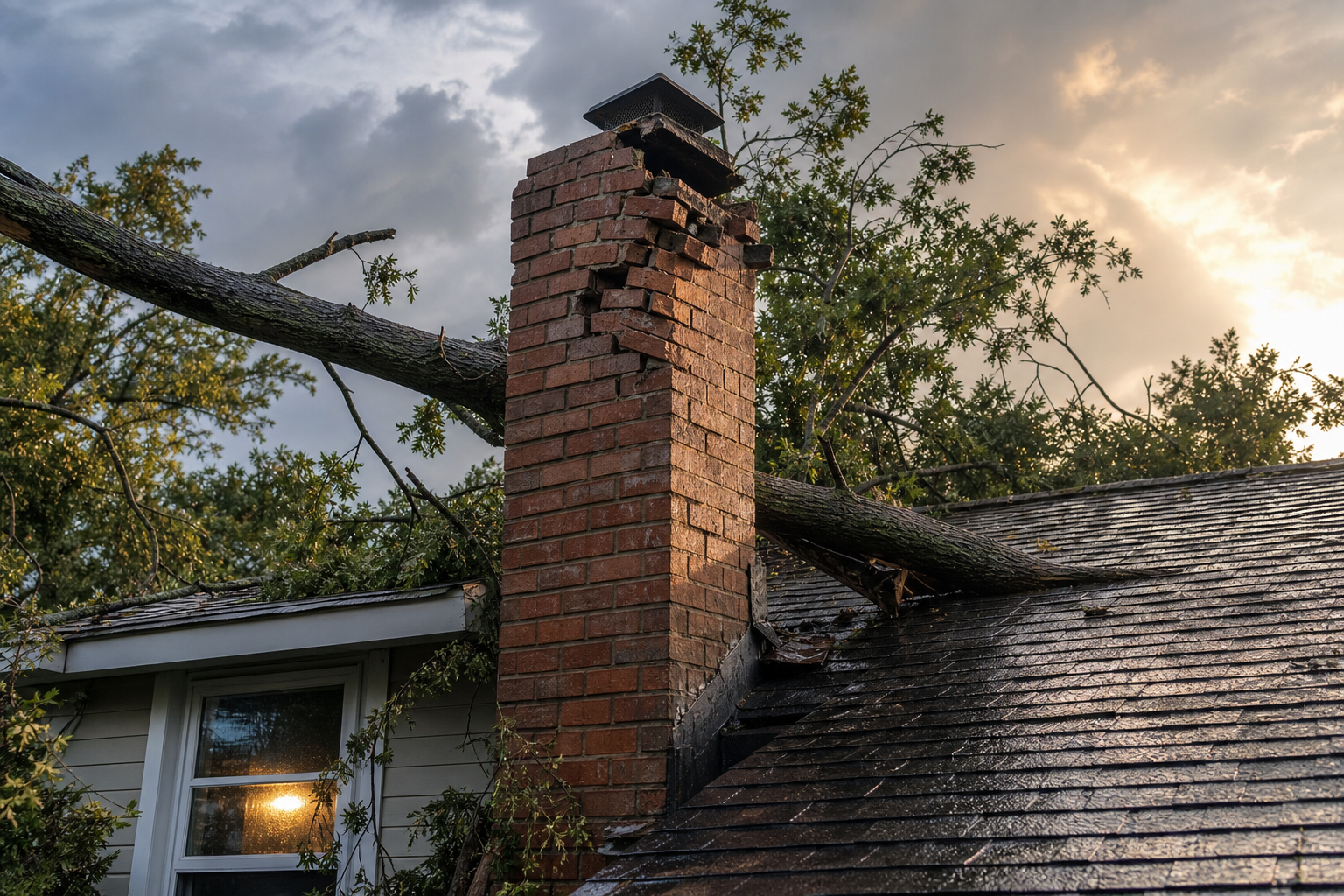
- Falling trees, branches, or debris hitting the chimney
- Vandalism and sudden accidental impact (e.g., a vehicle or construction equipment)
If a tree splits during a storm and knocks the top off your chimney, that's a covered event under nearly every standard policy. The same logic that governs tree damage insurance claims applies here: the tree's origin doesn't matter, only that the fall was sudden and caused by wind or another covered peril.
Chimney fires and lightning strikes
Chimney fires are one of the most common covered losses. When creosote ignites inside the flue, it can crack the liner, damage masonry, and spread into the attic or walls. Because fire is a core named peril, most policies pay to repair or replace the chimney and any collateral structural damage, similar to how home fire damage claims are handled for other structures.
Lightning is equally straightforward. A direct strike can crack the crown, split bricks, damage the flue liner, or cause the entire stack to lean. Standard policies cover this along with any electrical or interior damage that follows, the same way lightning damage insurance coverage works for wiring and electronics elsewhere in the home.

Compare Home Insurance Plans in Ohio
Find your best options in less than 2 minutes
What Insurance Won't Cover on a Chimney
The exclusions are where most homeowners get burned. Insurers deny chimney claims in 2026 by pointing to one of these six categories:
Wear and tear is the most common denial reason. Cracks from freeze-thaw cycles, settling, spalling bricks, and general aging are treated as expected maintenance and never covered. Long-term leaks around flashing or the crown are excluded even if water eventually damages walls or ceilings, because the leak itself was gradual.
Animal damage falls into the same bucket. Birds nesting in the flue, squirrels chewing through the cap, or raccoons dislodging the chase cover are treated as pest problems, not insurable events. This is consistent with how home insurance handles rodent and wildlife damage throughout the rest of the home.
Earthquake damage to chimneys is excluded from every standard homeowners policy. In California, chimney collapse from a quake is only covered if you carry a separate California Earthquake Authority (CEA) or private earthquake policy, and even then there's a $10,000 total sublimit for all chimneys combined. The policy will pay the lesser of that $10,000, the actual repair cost, or the cost to replace a masonry chimney with a non-masonry earthquake-resistant chimney.

Protect your home with State Farm
Average Rate:
Homeowners who bundle and save with State Farm save an average of $1,000 per year!

You're in Good Hands® with Allstate
Average Rate:
Get comprehensive home coverage with flexible policy options.

Customize your home coverage
Average Rate:
Only pay for the coverage you need with personalized home insurance.

Smart coverage for your home
Average Rate:
Protect what matters most with award-winning home insurance.
2026 Chimney Repair Costs
Understanding realistic repair costs helps you decide whether it's worth filing a claim at all, since minor repairs may fall below your deductible. Here's what homeowners are paying in 2026:
| Repair Type | Typical Cost Range | Notes |
|---|---|---|
| Chimney cap replacement | $200-$650 | Stainless steel costs more than galvanized |
| Flashing repair or replacement | $300-$600 | Depends on roof pitch and access |
| Minor crown repair (sealing) | $150-$500 | Crack sealing and resurfacing |
| Full crown rebuild | $1,500-$3,000+ | Removing and recasting the concrete cap |
| Above-roofline masonry rebuild | $2,500-$8,000 | Rebuilding the top few feet |
| Flue liner replacement | $2,000-$7,000 | Critical for safety and draft |
| Full chimney replacement | $8,000-$20,000+ | Firebox through roof, tall/complex stacks |
The national average for common repairs sits around $455, but structural work climbs fast. A full rebuild averages $9,300 across the country, with tall or stone chimneys pushing past $15,000. If your damage sits below a typical $1,000-$2,500 deductible, filing a claim isn't worth the mark on your CLUE report.
Brick vs. Metal Chimneys and Inspection Requirements
Insurers treat brick (masonry) chimneys and metal (prefabricated) chimneys differently in a few important ways:
Metal chimney chases and prefab units are often denied faster because rust, warping, and connection failures look like age-related decay. Adjusters look closely at whether the unit was installed to code, and non-permitted installations can void coverage entirely, similar to how structural damage claims are scrutinized elsewhere in the home.
How often you need an inspection
The National Fire Protection Association (NFPA 211) standard is clear: chimneys should be inspected at least once per year, regardless of how often you use them. There are three inspection levels:
- Level 1 – Annual visual inspection of accessible portions. Required at every yearly sweep.
- Level 2 – Video-scan inspection required after a chimney fire, home sale, fuel change, or seismic event.
- Level 3 – Invasive inspection when a serious hazard is suspected.
Most standard policies don't explicitly require you to prove annual inspections upfront, but insurers absolutely rely on inspection history when reviewing claims. Missing that paper trail makes it much easier for an adjuster to argue neglect, which is one of the top home insurance maintenance requirements to avoid claim denials in 2026.
Why Chimney Claims Get Denied (And How to Fight Back)
The five largest carriers now fail to pay more than 44% of claims, up from 36% a decade ago, and chimney damage sits squarely in the disputed zone. Insurers deny chimney claims for six main reasons:
- Damage classified as wear and tear rather than a sudden event
- Neglect or lack of maintenance (missed inspections, creosote buildup)
- No documented triggering event (no storm report, no fire report)
- Policy exclusions (earthquake, flood, construction defect)
- Insufficient documentation (weak photos, no expert report)
- Late filing past the reporting deadline
The step-by-step appeal process
If your claim is denied, don't accept the first "no." Here's how to fight back:
- Request the written denial letter and identify the exact reason cited.
- Get an independent chimney inspection from a CSIA-certified sweep. The report should describe the damage, the probable cause, and specifically state why it's not wear and tear.
- Gather your evidence: dated photos, weather reports for the loss date, prior maintenance receipts, fire department reports if applicable, and multiple contractor estimates.
- File a formal written appeal within the deadline (usually 30-60 days). Quote the specific policy language covering your peril and address each denial reason one by one.
- Request a reinspection with your chimney expert present, or invoke the appraisal clause if it's a dispute over payment amount rather than coverage.
- Bring in a public adjuster for larger claims. They work for you and typically take 10-15% of the recovered settlement.
- File a complaint with your state insurance department if the insurer is acting in bad faith.
Frequently Asked Questions
Does homeowners insurance cover a chimney leak?
Only if the leak is caused by a sudden covered event, such as a tree falling through the flashing or hail cracking the crown. Long-term leaks from failed sealant, deteriorated flashing, or aging masonry are considered maintenance issues and are almost always denied. Get a professional to document that the leak started with a specific incident.
Is chimney cap replacement covered by insurance?
A chimney cap replacement is only covered if the cap was damaged by a covered peril like wind, hail, a falling branch, or vandalism. Because caps typically cost $200-$650, the repair often falls below your deductible even when it is technically covered. Rust, corrosion, and animal damage to the cap are excluded as wear and tear.
Will insurance pay for a chimney fire caused by creosote?
Chimney fires are usually covered as fire losses, but the insurer will investigate whether excessive creosote buildup and skipped sweepings caused it. If they can tie the fire to long-term neglect, they can deny the claim on maintenance grounds. Annual sweep receipts and inspection records are your best defense.
Does home insurance cover chimney collapse from an earthquake?
Standard homeowners policies exclude all earthquake damage, including chimney collapse. In California, a CEA earthquake policy will cover chimney damage but caps the payout at $10,000 for all chimneys combined, and only pays to replace masonry with non-masonry, quake-resistant construction. You need a separate earthquake policy or endorsement for this coverage.
How much does a chimney repair claim raise home insurance rates?
A single chimney claim under $10,000 typically raises premiums 5-15% at renewal, and the claim stays on your CLUE report for seven years. If the repair cost is close to your deductible (usually $1,000-$2,500), paying out of pocket is often cheaper long-term than filing. Two claims within three years can trigger non-renewal from some carriers in 2026.