
Compare Home Insurance Plans in Ohio
Find your best options in less than 2 minutes



Is Fire Damage Covered by Standard Home Insurance?
Yes. Under a standard HO-3 homeowners policy (the most common form sold in the U.S.), fire is one of the core named perils, listed alongside lightning, wind, and hail. That means most accidental fires inside the home and many wildfires outside it are covered, subject to your policy's limits, deductible, and exclusions.
A standard policy responds to fire damage through four main coverage parts:
- Coverage A (Dwelling): Repairs or rebuilds the physical structure
- Coverage B (Other Structures): Detached garages, sheds, fences
- Coverage C (Personal Property): Belongings inside the home
- Coverage D (Loss of Use / ALE): Hotel, food, and living costs while displaced
Accidental fires, electrical fires, and wildfires
Insurers treat the three differently in practice:
- Accidental fires (kitchen, candle, fireplace) are almost always covered if sudden and unintentional.
- Electrical fires from short circuits, overloaded outlets, or faulty wiring are covered, unless the insurer can show you ignored known hazards like outdated wiring or rodent damage.
- Wildfires are technically a "fire" peril, but in high-risk ZIP codes (parts of California, Colorado, Arizona, and Texas) carriers may exclude them, charge a separate wildfire deductible, or refuse to renew altogether.
For a deeper dive on the wildfire market specifically, see our guide to wildfire insurance coverage and the California FAIR Plan.

Compare Home Insurance Plans in Ohio
Find your best options in less than 2 minutes
What Fire Damage Insurance Actually Pays For
Here is what each coverage part typically pays out after a fire claim:
| Coverage | What It Pays | Typical Limit |
|---|---|---|
| Dwelling (A) | Rebuild structure, walls, roof, built-ins | Insured value (e.g., $300K to $600K) |
| Other Structures (B) | Detached shed, fence, garage | 10% of Coverage A |
| Personal Property (C) | Furniture, electronics, clothing | 50% to 70% of Coverage A |
| Loss of Use (D) | Hotel, restaurants, rental | 20% to 30% of Coverage A |
| Debris Removal | Clearing burned materials | Usually 5% of A |
| Trees & Landscaping | Damaged shrubs and trees | ~$500 per item, 5% of A |
Smoke damage is included with fire
Smoke is bundled into the fire peril, not sold separately. That means cleaning soot off walls, repainting ceilings, deodorizing carpets, and replacing smoke-saturated clothing all fall under the same claim. Smoke damage is covered even if the fire started in a neighbor's home and drifted into yours.
Additional Living Expenses (ALE)
If the fire makes your home uninhabitable, your insurer pays the extra costs of maintaining your normal standard of living, including:
- Hotel or short-term rental
- Restaurant meals above your normal grocery budget
- Laundry and dry cleaning
- Pet boarding
- Extra mileage to work or school
You can usually request an ALE advance within 7 to 14 days of the fire so you are not paying out of pocket while the claim is processed. Learn more about loss of use coverage and California's guaranteed 24 to 36 month ALE for declared-disaster claims.

Protect your home with State Farm
Average Rate:
Homeowners who bundle and save with State Farm save an average of $1,000 per year!

You're in Good Hands® with Allstate
Average Rate:
Get comprehensive home coverage with flexible policy options.

Customize your home coverage
Average Rate:
Only pay for the coverage you need with personalized home insurance.

Smart coverage for your home
Average Rate:
Protect what matters most with award-winning home insurance.
Typical Fire Damage Payouts in 2026
Recent industry data pegs the average fire and lightning homeowners claim payout at roughly $83,519 per incident, with some 2026 datasets running as high as $89,500, making fire the priciest category of homeowners losses. Actual checks vary widely based on severity:
| Fire Severity | Typical Payout Range |
|---|---|
| Minor stovetop or electrical fire | $25,000 to $90,000 |
| Multi-room or attic fire | $100,000 to $350,000 |
| Total loss, standard home | $300,000 to $600,000 |
| Total loss, custom or high-value home | $400,000 to $1,000,000+ |
Your check is reduced by your deductible. Most standard fire deductibles range from $1,000 to $2,500, but wildfire-prone areas increasingly use a separate percentage-based wildfire deductible of 2% to 5% of your dwelling limit, with some higher-value policies now running as steep as 10%. On a $500,000 home, a 5% wildfire deductible means $25,000 out of pocket before coverage kicks in, and a 10% deductible on that same home means $50,000. For context on how rebuild costs interact with policy limits, our structural damage coverage guide explains why you need at least 80% to 100% replacement-cost coverage to avoid coinsurance penalties.
How to File a Fire Damage Insurance Claim Step by Step
The process below is what successful claimants follow. Skipping steps (especially documentation) is the single biggest reason claims get reduced. For a broader overview, see our full home insurance claims process guide.
Step 1: Stay safe and secure the scene
Do not re-enter the home until the fire department clears it. Once safe, board up windows, tarp the roof, and lock down access points. Insurers require you to mitigate further damage, and they will reimburse reasonable mitigation costs.
Step 2: Notify your insurer within 24 to 48 hours
Call your agent or the carrier's claims line as soon as you can. Have your policy number ready and provide the date, location, and a brief description. Ask what documents they will need, whether you can make temporary repairs before the adjuster arrives, and whether you can get an ALE advance for lodging.
Step 3: Request the official fire report
Your local fire department's incident report documents the cause, time, and extent of the blaze. It is a critical piece of evidence, especially for electrical fires where the insurer may push back on cause.
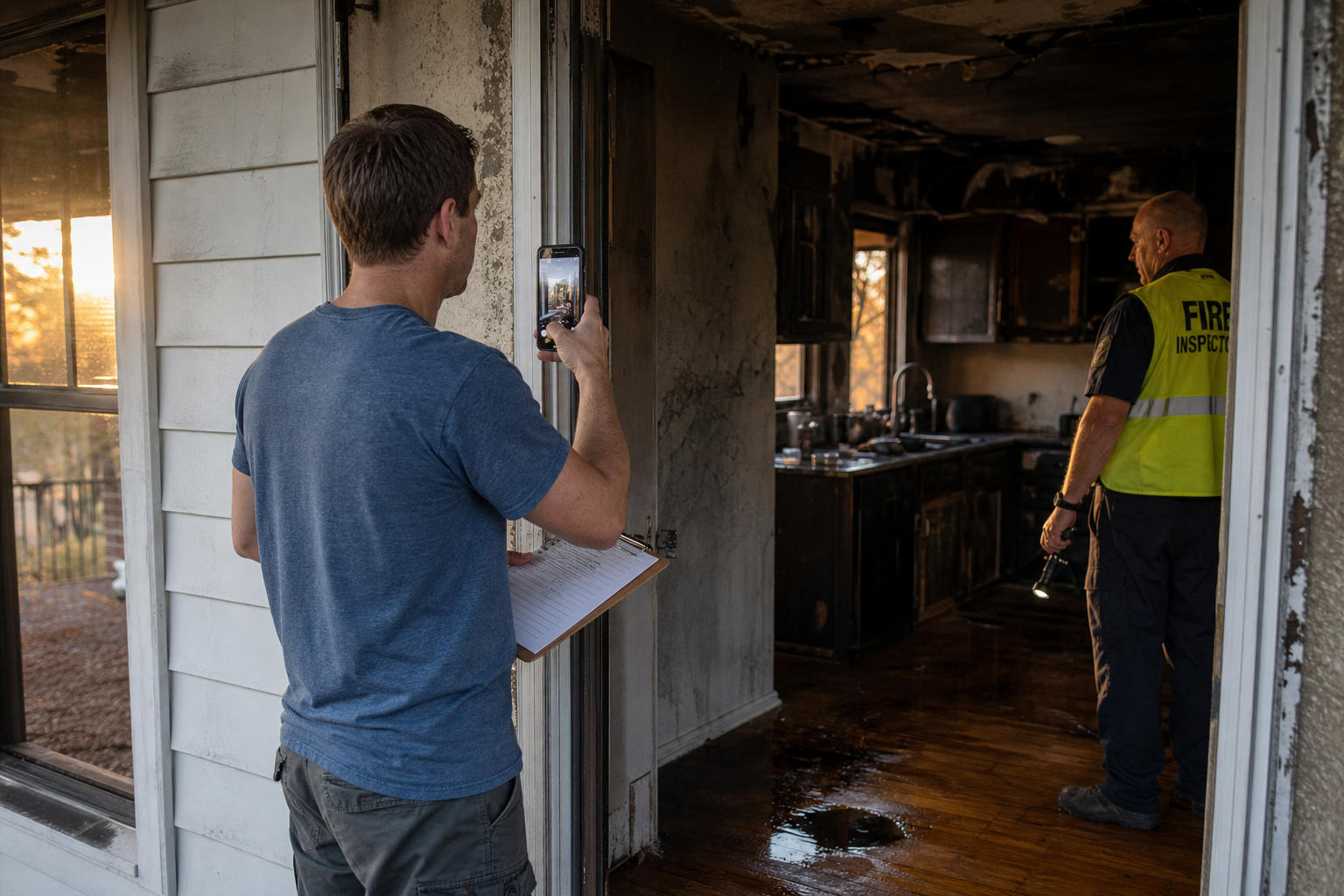
Step 4: Document everything before cleanup
Photograph and video everything "at its worst" before mitigation begins:
- Every exterior side of the house
- Every room from the doorway and from the center
- Close-ups of damaged items, serial numbers, and model labels
- Smoke-stained surfaces, even if not visibly charred
Step 5: Build a room-by-room inventory
For every damaged item, list description, brand/model, age, condition before the fire, purchase price, and replacement value today. Use receipts, credit card statements, and online retailers to back up valuations. In California, SB 495 (effective January 1, 2026) now requires insurers to automatically advance 60% of personal property coverage (capped at $350,000) on total-loss declared-disaster claims without requiring a detailed inventory, and gives policyholders at least 100 days to submit proof of loss with three-month good-cause extensions available.
Step 6: File the claim and proof of loss
Complete the carrier's claim form and submit a sworn proof of loss itemizing structure, contents, and ALE losses. Most policies require this within 30 to 60 days, though California's SB 495 extends that to 100 days minimum for declared-disaster claims.
Step 7: Work with the adjuster
Walk the adjuster through the property and provide all documentation. If their estimate is well below your independent contractor bids, you can negotiate or hire a public adjuster to advocate on your behalf (typically 10% of the settlement). Our guide to home insurance settlements walks through negotiating lowball offers in a market where 44% of claims at the top five carriers now close without payment, up from 36% a decade ago, and 15 large insurers close more than half of homeowner claims with no payment.
When Home Insurance Will NOT Cover Fire Damage
Even though fire is a standard covered peril, there are several scenarios where claims are routinely denied. See our full breakdown of common home insurance exclusions for the wider picture.
Arson and intentional acts
Any fire deliberately set by the policyholder, a household member, or someone acting on their behalf is excluded. Filing such a claim is insurance fraud and can lead to denial, policy cancellation, fines, and criminal charges. If a third party (a stranger or vandal) sets your home on fire without your involvement, that is generally covered as vandalism plus fire, subject to investigation.
Vacant homes
Most policies contain a vacancy clause: if the home is unoccupied for more than 30 to 60 consecutive days, coverage for certain perils (vandalism, glass breakage, water damage, theft) is suspended, and some ISO forms reduce any remaining covered loss payment by 15%. While fire coverage often remains intact under many HO-3 forms, some insurers and dwelling forms treat fire more strictly during vacancy, and insurers may deny claims tied to unreported vacancy. If you own a second home, a rental between tenants, or a property under long renovation, ask about a vacant home insurance policy or a dwelling fire (DP-1 or DP-3) form.
Neglect and poor maintenance
Insurers can deny fire claims tied to ignored hazards. Common examples:
- Uncleaned chimneys causing creosote fires (see our chimney damage guide)
- Known faulty wiring that was never repaired
- Failure to address rodent damage to electrical lines
- Code violations the homeowner knew about
Wildfires in high-risk zones
Some policies exclude wildfire entirely or impose a separate wildfire deductible in fire-prone areas. In California, the FAIR Plan now covers 684,388 policies with $750 billion in total exposure as of March 2026, though Q2 2026 growth has slowed to 1.9% (the third consecutive quarter of deceleration). The plan has an approved 29.1% average rate hike taking effect October 15, 2026. Many homeowners can now only obtain basic fire coverage through the FAIR Plan paired with a Difference in Conditions wrap. Always check the "perils insured against" and "exclusions" sections of your policy.
How to Document Fire Losses for Maximum Payout
Documentation is the single biggest variable in how much you collect, especially in a market where the top five carriers (State Farm, Allstate, Liberty Mutual, USAA, and Farmers) close more than 44% of claims with no payment and 15 large insurers close over half of homeowner claims. Use this checklist:
A few extra tips that pay off:
- Preserve damaged items until the adjuster has seen them, even if they look ruined.
- Keep a claim journal logging every call, email, and conversation, including names and times.
- Get independent estimates if you suspect the insurer's number is low. Two or three licensed contractor bids carry weight.
- Account for hidden smoke damage, which can ruin electronics, HVAC ducts, insulation, and porous materials weeks after the fire.
For losses involving electrical systems specifically, our breakdown of lightning and electrical damage coverage explains how sub-limits and surge protection affect payouts, especially now that the average lightning claim payout has jumped to $26,616.
Frequently Asked Questions
Does home insurance cover fire damage from a candle or cooking accident?
Yes. Accidental fires from candles, cooking, fireplaces, and space heaters are textbook covered losses on a standard HO-3 policy. The insurer will pay to repair the structure, replace damaged belongings, and cover additional living expenses while you are displaced, minus your deductible. The key requirement is that the fire was sudden and unintentional.
What is the deductible on a fire damage home insurance claim?
Most policies have a flat deductible between $1,000 and $2,500 for fire claims, which is subtracted from your payout. However, in wildfire-prone states some carriers apply a separate percentage-based wildfire deductible of 2% to 5% of your dwelling limit, and some higher-value policies now use deductibles as steep as 10%. On a $500,000 home, a 5% wildfire deductible would mean $25,000 out of pocket before coverage kicks in.
Will my insurance cover a fire if my home was vacant?
It depends on your policy wording. Standard policies typically suspend coverage for vandalism, glass breakage, water damage, and theft after 30 to 60 consecutive days of vacancy, and some ISO forms cut any remaining covered loss by 15%. Fire coverage often remains, but insurers may deny claims if you failed to disclose the vacancy. If you own a second home, a rental between tenants, or a property under long renovation, you need a vacant property endorsement or a separate dwelling fire policy to keep fire coverage clearly in force.
How long does a fire damage insurance claim take to pay out?
Simple smoke or partial-loss claims often settle in 30 to 60 days. Moderate fires typically take 3 to 6 months, and total-loss claims routinely run 6 to 18 months or longer because rebuilding requires permits, contractor scheduling, and staged payments. Most insurers issue an ALE advance within 7 to 14 days and an initial dwelling payment within a few weeks of the adjuster's inspection.
Does home insurance cover wildfire damage in California?
Yes, but coverage is increasingly hard to obtain in high-risk areas. Standard homeowners policies in California do cover wildfire, and insurers have paid more than $22.4 billion on 42,121 January 2025 LA wildfire claims (with 94% fully or partially paid and total insured losses estimated at $40 billion). However, many private carriers have stopped writing new policies or are non-renewing in fire-prone ZIP codes, so homeowners increasingly rely on the FAIR Plan paired with a difference-in-conditions policy or a high-risk home insurance surplus-lines solution.