
Compare Home Insurance Plans in Ohio
Find your best options in less than 2 minutes



What Does Wildfire Insurance Actually Cover?
Wildfire damage is covered under standard homeowners insurance as a named peril, meaning your policy specifically lists fire as a covered event. Unlike flood or earthquake damage, you do not need a separate policy for wildfires. However, what your policy pays for and how much it pays depends on your coverage limits and where you live.
Here is a breakdown of the four key coverage areas that apply after wildfire damage:
| Coverage Type | What It Pays For |
|---|---|
| Dwelling Coverage | Rebuilding or repairing your home's structure |
| Other Structures | Detached garages, fences, sheds |
| Personal Property | Furniture, electronics, clothing, appliances |
| Additional Living Expenses (ALE) | Hotel stays, meals, and temporary housing while your home is uninhabitable |
One important caveat: your coverage is only as good as your limits. If you are underinsured, meaning your dwelling coverage does not reflect current construction costs, you could face a serious gap after a total loss. Review your policy limits annually, especially given how much rebuilding costs have risen since the 2025 LA fires. For a deeper look at what standard policies do and do not include, see our guide on fire damage claims and payouts.

Compare Home Insurance Plans in Ohio
Find your best options in less than 2 minutes
Why Insurers Are Dropping Homeowners in Wildfire Zones
The January 2025 Los Angeles wildfires (primarily the Palisades and Eaton fires) were the costliest wildfire event in U.S. history. As of the California Department of Insurance's wildfire claims tracker, 41,800 claims have been filed, 40,377 claims have been partially paid, and $23.7 billion in claims has been paid to date. Moody's estimates that insured losses from the LA fires remain in the $25 to $30 billion range, largely driven by the Palisades and Eaton events, and these numbers have pushed insurers to aggressively pull back from high-risk markets.
The reasons insurers are leaving the wildland-urban interface (WUI) go beyond just one bad fire season:
- Rising reinsurance costs are pushing carriers to raise rates or exit. Learn more about how reinsurance affects your rates
- Advanced risk modeling like the new public wildfire catastrophe model (SB 429, effective January 2026) is revealing exposure that older models missed
- Profitability struggles, with claims in fire-prone ZIP codes routinely outpacing collected premiums
- Climate-driven frequency, as wildfires burn hotter, faster, and in places previously considered safe
Between 2020 and 2026, California homeowners insurance premiums surged sharply, with homes in the highest-risk wildfire zones (FRS 4 and FRS 5) seeing the fastest rate hikes in the state. To address the crisis, California maintains a mandatory one-year moratorium on cancellations and non-renewals for ZIP codes affected by any declared wildfire emergency, which was expanded on January 1, 2026 through the Business Insurance Protection Act (SB 547) to also cover commercial buildings, HOAs, condos, affordable housing, and nonprofits. Learn more about the ongoing California home insurance crisis and what to do when your insurer leaves your state.
The bigger picture: climate change is reshaping home insurance costs across the entire country, and wildfire zones are at the epicenter of that shift.

Protect your home with State Farm
Average Rate:
Homeowners who bundle and save with State Farm save an average of $1,000 per year!

You're in Good Hands® with Allstate
Average Rate:
Get comprehensive home coverage with flexible policy options.

Customize your home coverage
Average Rate:
Only pay for the coverage you need with personalized home insurance.

Smart coverage for your home
Average Rate:
Protect what matters most with award-winning home insurance.
How to Protect Your Home and Your Coverage
The single best thing you can do as a homeowner in a fire-prone area is reduce your home's risk profile through mitigation. The California Department of Insurance now requires insurers to offer discounts ranging from 4% to 40% for wildfire mitigation actions, with the highest discounts going to the highest-risk homes. You can also stack these with broader home insurance mitigation credits available across most carriers.
Mitigation Measures That Can Help You Get or Keep Coverage
Defensible Space and Zone Zero
California law requires homeowners to maintain two zones of defensible space around their property, plus the newer Zone Zero (the first 5 feet), now formalized under the Safer from Wildfires framework:
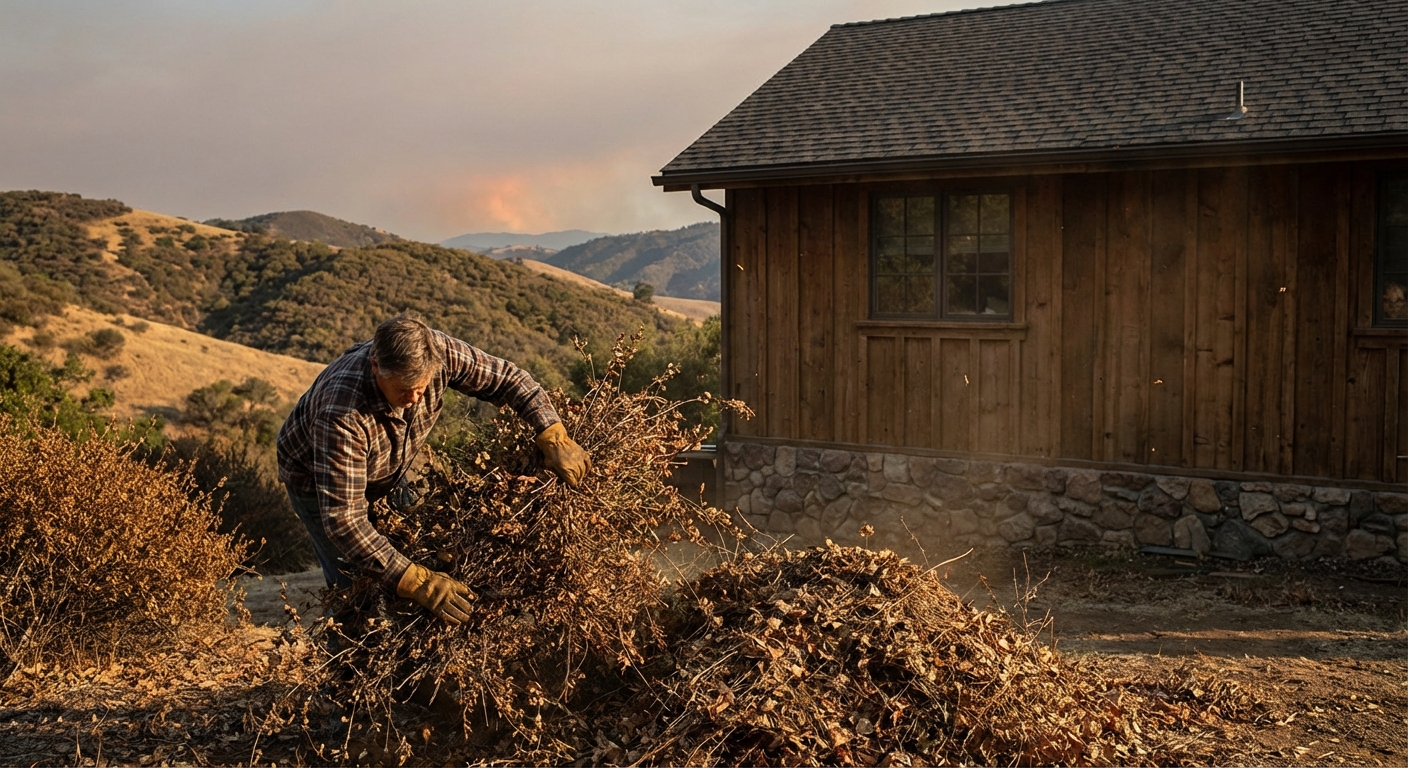
- Zone Zero (0 to 5 feet): Clear all vegetation, mulch, and combustible materials. This is now the highest-priority mitigation area
- Zone 1 (5 to 30 feet): Remove dead vegetation, dry leaves, and combustible materials from under decks
- Zone 2 (30 to 100 feet): Thin trees, remove dead brush, and create spacing between plants to slow fire spread
Participating in Firewise USA communities can qualify you for additional community-level discounts with insurers like State Farm, USAA, Mercury, and Chubb. Residential structures in Very High Fire Hazard Severity Zones are expected to comply with Zone Zero standards under regulations still being finalized in 2026.
Fire-Resistant Construction Materials
- Roof: A Class A roof (asphalt fiberglass composition, concrete or clay tile, stone, or metal) is one of the most impactful upgrades. Embers landing on a combustible roof are a top cause of home ignition
- Vents: Install ember-resistant vents with approved 1/8 or 1/16-inch noncombustible metal mesh to prevent embers from entering attic or crawl spaces
- Walls: Use non-combustible materials for at least the bottom 6 inches of exterior walls
- Windows: Upgrade to multi-paned tempered glass or install fire-rated shutters
Discount Amounts You Can Actually Expect
Discounts vary widely by carrier. Here is what the market looks like in 2026:
| Insurer | Wildfire Mitigation Discount |
|---|---|
| California FAIR Plan (updated Nov 15, 2025) | Up to 12 individual discounts, roughly 14.6% to 16.4% off the wildfire portion for dwellings |
| State Farm (CA) | Up to 4.2% combined discount for completing 10 mitigation actions; up to 21% off wildfire portion with two-tier certification |
| Mercury (CA) | Up to ~60% off the wildfire peril portion at highest tier (Fire-Resistive Construction) |
| Overall CA range | Up to ~50% off the wildfire portion with IBHS Wildfire Prepared Home Plus certification at some carriers |
How Insurers Assess Your Risk
Insurers no longer rely solely on ZIP codes. Today, carriers use satellite imagery, aerial surveillance, drone data, and predictive risk models to evaluate individual properties. Under California Regulation 2644.9, insurers using a wildfire risk model must provide policyholders with their wildfire risk score in writing at application, at renewal, after non-renewal, and within 30 days of completing new mitigation work. To understand how this factors into rate-setting, see our guide on home insurance underwriting.
The California FAIR Plan: Last Resort Coverage Explained
If you have been non-renewed by private insurers and cannot find standard coverage, the California FAIR Plan is your backstop. It is a state-mandated, not-for-profit insurance pool backed by all licensed California insurers. You apply through a licensed broker after being declined by private carriers. If your home has other insurability challenges beyond wildfire risk, our guide on high-risk home insurance covers your full menu of options.
The FAIR Plan has grown dramatically under the availability crisis. As of June 2026, the FAIR Plan's total exposure is $768 billion, reflecting an 11% increase since September 2025 and a 250% increase since September 2022, with 696,562 policies in force. That said, policy growth slowed to 1.9% in the second quarter of 2026, the third consecutive quarter of slowing growth and the lowest quarterly increase since 2022, an early sign the private market may be starting to stabilize. The January 2025 LA fires generated roughly 5,400 FAIR Plan claims and $3.5 billion in payouts, prompting a $1 billion assessment on member insurers.
The FAIR Plan only covers fire and basic perils. You will not have liability coverage, and you will not be covered for theft, water damage, or other standard homeowner perils. Most insurance professionals recommend pairing it with a Difference in Conditions (DIC) policy from a private insurer to fill those gaps. For a complete breakdown of costs, application steps, and coverage details, read our detailed guide on the California FAIR Plan or our broader overview of FAIR Plan insurance nationwide.
Frequently Asked Questions
Does standard homeowners insurance cover wildfire damage?
Yes. Wildfire is a named peril covered under most standard homeowners insurance policies. Your policy will typically pay to rebuild your home's structure, replace personal property, cover other structures on your property, and pay for temporary living expenses while your home is being repaired or rebuilt. However, your payout is limited to your coverage amounts, so being underinsured is a real risk given today's elevated construction costs.
Why did my home insurance get cancelled because of wildfire risk?
Insurers in high-risk areas are non-renewing policies due to mounting wildfire losses, rising reinsurance costs, and updated risk models showing far greater exposure than previously estimated. The 2025 LA fires alone drove $23.7 billion in paid claims by early 2026, accelerating insurer withdrawals from California's wildland-urban interface zones. If you have been dropped, California law requires a one-year moratorium on non-renewals in declared disaster areas, and you have options including the FAIR Plan and surplus lines carriers.
What mitigation steps can help me keep my home insurance in a fire zone?
Insurers and the California FAIR Plan offer discounts for specific upgrades: a Class A roof, ember-resistant vents, defensible space maintenance (Zone Zero within 5 feet plus clearing out to 100 feet), non-combustible siding, enclosed eaves, and multi-paned windows. The FAIR Plan's updated program (effective November 15, 2025) offers up to 12 individual discounts totaling roughly 14.6% to 16.4% off the wildfire portion for dwelling policies. Earning an IBHS Wildfire Prepared Home Plus designation can unlock some of the largest discounts, up to roughly 50% off the wildfire portion at certain carriers.
What is the California FAIR Plan and who qualifies?
The California FAIR Plan is the state's insurer of last resort, a fire insurance pool available to homeowners who have been declined by private insurers. It provides basic fire and smoke coverage for structures but does not include liability, theft, or water damage protection. Dwelling limits go up to $3 million after 2026 reforms, and you apply through a licensed insurance broker. Most policyholders also need a DIC (Difference in Conditions) policy to get more complete homeowner-level protection.
How much does wildfire insurance cost in California in 2026?
Costs vary widely based on your location, risk score, home value, and mitigation measures. California homeowners insurance premiums have surged in the last five years, with the highest wildfire-risk zones (FRS 4 and FRS 5) seeing the fastest increases. FAIR Plan rates are rising 29.1% on average statewide starting October 15, 2026, and homeowners in the most fire-prone neighborhoods could see their wildfire premium portion roughly double. Completing wildfire mitigation upgrades and applying for AB 888 grants is one of the most effective ways to reduce your out-of-pocket cost.