
Compare Home Insurance Plans in Ohio
Find your best options in less than 2 minutes



The Climate-Insurance Connection: By the Numbers
The relationship between climate change and your homeowners insurance premium is no longer a future concern. It's playing out on your renewal notice right now. Depending on the data source, the average U.S. home insurance premium in 2026 ranges from roughly $2,395 to $3,057 per year, with LendingTree reporting the national average at $2,395 and Insurify projecting the average annual premium will increase 4% to about $3,057 this year, after jumping 12% in 2025. Since 2021, premiums have climbed roughly 46%, roughly three times as much as inflation.
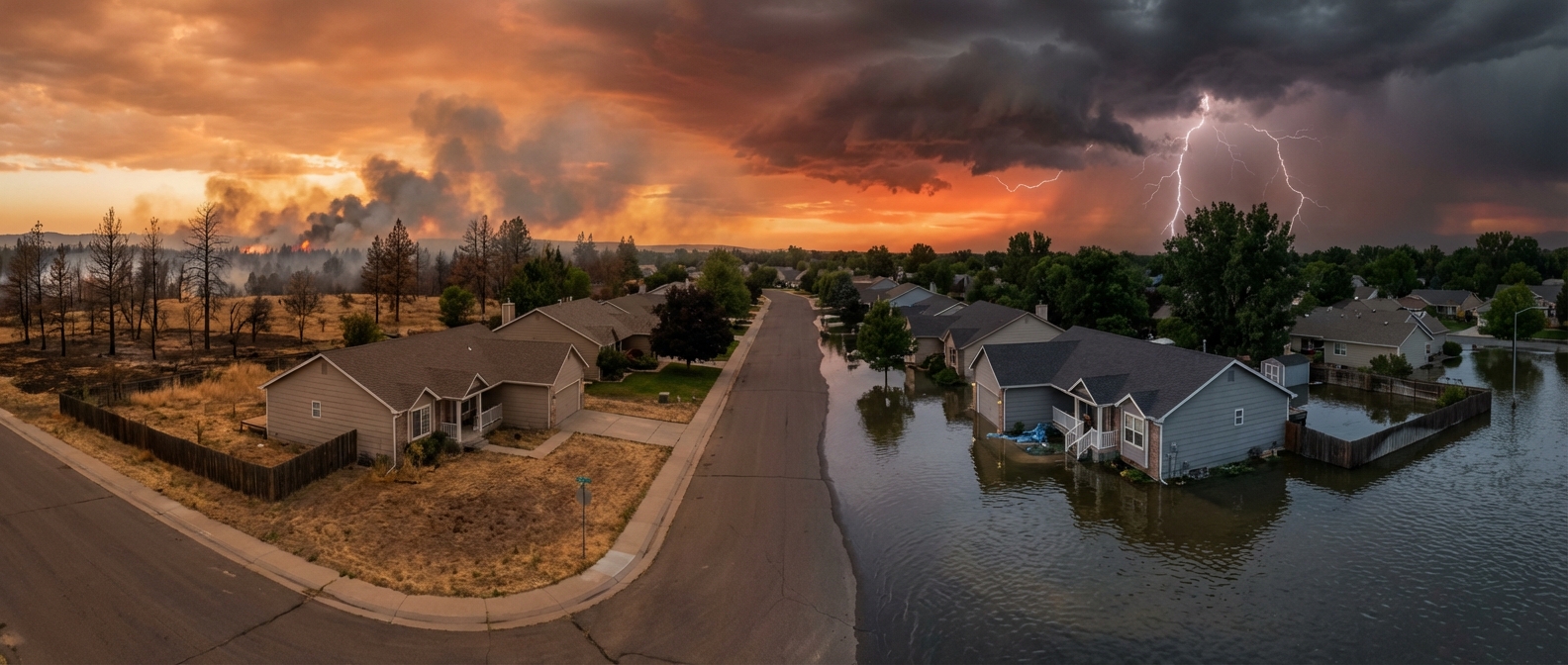
The driver behind these increases is unmistakable: natural disasters are getting more frequent, more severe, and more expensive to cover. Insured natural catastrophe losses in 2025 totaled about $107 billion globally, the sixth consecutive year exceeding $100 billion, driven by the dominance of secondary perils including wildfires and severe convective storms. And 2026 has continued the trend: U.S. natural catastrophes generated about $36 billion in insured losses during the first half of 2026, accounting for roughly 75% of global insured losses, according to Aon's Global Catastrophe Recap.
| Metric | 2021 | 2024 | 2026 |
|---|---|---|---|
| Avg. annual U.S. premium | ~$2,094 | ~$3,303 | $2,395 to $3,057 |
| Cumulative increase since 2021 | Baseline | +24% | ~+46% |
| U.S. H1 insured cat losses | ~$40B | ~$50B | ~$36B (H1 2026) |
Understanding why home insurance rates are increasing is the first step toward protecting yourself financially. A separate look at why premiums keep rising in 2026 breaks down every driver.

Compare Home Insurance Plans in Ohio
Find your best options in less than 2 minutes
Regional Hotspots: Where Climate Risks Are Hitting Hardest
Climate risk is not evenly distributed. Depending on where you live, the peril most likely to affect your premium, or your ability to get coverage at all, varies significantly.
California: The Wildfire Crisis
California's home insurance market remains in full-scale crisis through 2026. The January 2025 Palisades and Eaton wildfires caused historic damage, and the state's FAIR Plan, the insurer of last resort, has ballooned in size. As of June 2026, the FAIR Plan's total written premium is $2.04 billion, reflecting a 6% increase since September 2025 and a 212% increase since September 2022.
The California Department of Insurance approved a 29.1% average statewide rate increase for the FAIR Plan, effective on new and renewal policies starting October 15, 2026. The Plan had originally requested 35.8%. The impact varies dramatically by ZIP code: among the FAIR Plan's roughly 668,000 policyholders, the statewide average hides a wide spread, with roughly a quarter of customers seeing decreases while high wildfire-zone policyholders could see their wildfire premium component double.
Meanwhile, State Farm's 17% emergency interim rate increase for California homeowners was locked in by a March 2026 three-party settlement with the California Department of Insurance and Consumer Watchdog. The settlement also requires State Farm to halt mass non-renewals in 2026 and face further rate review by 2027. For a deeper dive, see the California home insurance crisis 2026 update and the wildfire insurance guide for fire-prone areas.
Gulf Coast: Hurricane Country (With Real Relief)
Florida has long been the most expensive home insurance state in the nation, but 2026 brings a major shift. After years of legislative reforms, Citizens Property Insurance is actually cutting rates. Citizens Property Insurance Corporation is reducing rates for its homeowners multiperil policyholders by an average of 8.8% in 2026, with wind-only policies dropping an average of 5.5%. The changes took effect July 1 for new policies and apply to existing policies as they renew.
South Florida sees the biggest cuts, with roughly 14.1% in Broward and 13.9% in Miami-Dade, according to figures approved by the Florida Office of Insurance Regulation. Citizens said the 2026 rate reductions are the first broad personal-lines decrease since 2015 and reflect reforms that have helped stabilize the Florida property insurance market.
Despite this relief, hurricane risk remains acute. NOAA's August 2026 update forecasts a below-normal Atlantic season with 7 to 13 named storms, 2 to 6 hurricanes, and 0 to 2 major hurricanes, and raised the probability of a below-average season to 75%. Colorado State University's team projects 9 named storms, 4 hurricanes, and 1 major hurricane, and puts the odds of a major hurricane landfall along the entire continental U.S. coastline at 24% versus a long-term average of 43%. But a below-average season does not guarantee low losses. Losses depend first and foremost on the number and location of landfalls.
For a deeper look at the Florida market, see the guide to Florida home insurance costs and best companies and the hurricane insurance coverage explainer. If you're elsewhere along the coast, the coastal home insurance guide covers wind deductibles in detail.
Midwest and Great Plains: Hail Is the Hidden Cost Driver
In Tornado Alley and across the broader Midwest, it isn't tornadoes making insurance unaffordable. It's hail. Roof damage from hail accounts for the majority of severe convective storm claims, and premiums reflect it.
| State | 2026 Avg. Annual Premium |
|---|---|
| Oklahoma | $5,298 |
| Nebraska | $4,956 |
| Colorado | $4,310 |
| Kansas | Top 5 most expensive |
Oklahoma has the highest average rate at $5,298, roughly 121% above the national average, followed by Nebraska ($4,956) and Colorado ($4,310). Insurify projects Nebraska premiums will jump another 13% in 2026. Colorado homeowners in particular should review the Colorado home insurance guide for hail-specific strategies, and the severe convective storms guide covers this peril in depth.
Coastal Flooding: The Risk Beyond Flood Zones
Here's a critical fact most homeowners don't know: approximately 40% of all flood damage in the U.S. occurs outside designated high-risk flood zones. And standard homeowners insurance covers exactly zero flood damage.
As sea levels rise and storms intensify, flooding is reaching neighborhoods that FEMA maps have never flagged. Flood damage requires a separate flood insurance policy through the NFIP or a private flood insurer.
The NFIP national average sits around $926 to $976 per year in 2026, while private flood insurance benchmarks range from about $985 (Neptune Flood) to $1,140 (S&P Global) per year nationally. Private policies can be 30% to 50% cheaper for well-rated low-to-moderate risk homes and often offer higher coverage limits than the NFIP's $250,000 building cap.

Protect your home with State Farm
Average Rate:
Homeowners who bundle and save with State Farm save an average of $1,000 per year!

You're in Good Hands® with Allstate
Average Rate:
Get comprehensive home coverage with flexible policy options.

Customize your home coverage
Average Rate:
Only pay for the coverage you need with personalized home insurance.

Smart coverage for your home
Average Rate:
Protect what matters most with award-winning home insurance.
Severe Convective Storms: The New #1 Peril
Ask most homeowners which natural disaster is the costliest for insurers, and they'll say hurricanes. The answer is now officially different. Aon's annual Climate and Catastrophe Insight report confirmed that severe convective storms have surpassed tropical cyclones to become the costliest insured peril of the 21st century.
A severe convective storm is a powerful thunderstorm characterized by at least one of the following: wind gusts of 58+ mph, hail of 1 inch or more in diameter, or a tornado.
What makes SCS the new top peril isn't any single catastrophic event. It's volume and geography. Triple-I data shows that severe convective storms, including hail, damaging winds and tornadoes, caused roughly $52 billion in U.S. insured losses in 2025, marking the third straight year such losses exceeded $50 billion.
And 2026 is running below the extremes of the past three years but still well above historical norms. Aon put U.S. SCS insured losses at approximately $27 billion in H1 2026, significantly below the $40 billion-plus recorded in H1 of each year from 2023-2025, but Munich Re confirms this remains close to a decade average. Moody's notes first-half 2026 SCS losses are running at roughly half the recent 2023-2025 pace, though still among the larger historical first-half totals. For a deep dive, see the guide to severe convective storms and home insurance.
How Insurers Are Responding and What You Can Do
How the Industry Is Adapting
Insurers are deploying a multi-pronged response to climate-driven losses:
- Withdrawing from high-risk markets: Major carriers have exited or drastically reduced their footprint in California, Florida, and Gulf Coast states. This drives homeowners toward state FAIR Plans and increases the risk of non-renewal. See the high-risk home insurance guide and the FAIR Plan guide.
- Advanced catastrophe modeling: AI-driven tools now score individual property climate vulnerability, allowing insurers to price risk more precisely and identify properties they no longer want to cover.
- Higher deductibles: Separate wind, hail, and hurricane deductibles are standard in many high-risk states. Review the rising home insurance deductibles guide before assuming your coverage is adequate.
- Requiring mitigation for coverage: Insurers increasingly want to see wildfire defensible space, storm-resistant roofing, or flood elevation before issuing or renewing policies.
- Rising reinsurance costs flow downstream: Understanding how reinsurance affects home insurance rates helps explain premium behavior even for homeowners who never file a claim.
What Homeowners Can Do Right Now
The good news: homeowners aren't powerless. Taking the right steps can protect your property, your coverage access, and your wallet.
1. Fortify your home against your region's top perils
- Wildfire zones: Create defensible space, use Class A fire-rated roofing, install ember-resistant vents
- Hurricane/wind zones: Install storm shutters, reinforce garage doors, use impact-resistant windows; the IBHS FORTIFIED Roof standard can significantly reduce damage
- Hail-prone areas: Upgrade to Class 4 impact-resistant roofing materials (many insurers offer 10% to 30% discounts)
- Flood-prone areas: Elevate HVAC and electrical systems, add flood vents, consider barriers
2. Buy flood insurance even outside a flood zone If you live near a river, coastal inlet, or low-lying area, don't assume FEMA's flood zone designation protects you. A separate flood policy averaging around $926 to $985 per year can prevent a six-figure loss.
3. Audit your coverage limits Construction costs have risen significantly since 2020 in many markets. If your policy's dwelling coverage was set years ago, you may be underinsured. Review your rebuild cost vs. home value to make sure your limits reflect today's reality.
4. Ask about mitigation discounts Many insurers offer premium reductions for certified upgrades. Mitigation credits for impact-resistant roofs, fire-resistant materials, and storm shutters can meaningfully offset the climate-driven rate increases hitting your renewal notice.
5. Factor climate risk into location decisions Increasingly, insurance availability and cost are becoming critical inputs in home-buying decisions. A growing number of homeowners are now part of a climate-driven relocation trend as premiums make some markets unaffordable, and insurance costs are also starting to affect home values and resale.
Frequently Asked Questions
How does climate change directly affect my home insurance premium?
Climate change increases the frequency and severity of natural disasters, including wildfires, hurricanes, floods, hailstorms, and severe thunderstorms. When disasters become more common, insurers pay out more claims, which raises their costs. Those costs are passed on to policyholders through higher premiums, larger deductibles, and tighter coverage terms. U.S. Treasury data shows homeowners in the highest climate-risk ZIP codes paid 82% more than those in the lowest-risk ZIP codes from 2018 to 2022.
Which U.S. regions are seeing the worst climate-driven insurance increases?
California (wildfires), Florida and the Gulf Coast (hurricanes), and the Midwest and Plains states (severe convective storms and hail) are the hardest-hit regions. Oklahoma, Nebraska, and Colorado now top the state cost rankings at $4,300 to $5,300 per year. California FAIR Plan policyholders face a 29.1% average rate increase taking effect October 15, 2026, while Florida is bucking the trend with an 8.8% average Citizens multiperil rate cut that took effect July 1, 2026.
Does standard homeowners insurance cover flood damage from storms?
No. Standard homeowners insurance policies do not cover flooding regardless of the cause. This includes flooding from hurricanes, heavy rainfall, storm surge, or rising rivers. To be protected, you need a separate flood insurance policy, either through the federal NFIP (averaging about $926 to $976 per year) or a private insurer. Given that roughly 40% of flood damage occurs outside designated high-risk flood zones, this gap affects far more homeowners than many realize.
What are severe convective storms, and why are they driving up insurance costs so much?
Severe convective storms are powerful thunderstorms that produce at least one of the following: wind gusts of 58+ mph, hail of 1 inch or larger, or tornadoes. They have officially surpassed tropical cyclones as the costliest insured peril of the 21st century according to Aon. U.S. SCS insured losses hit about $27 billion in H1 2026 per Aon, and 2025 saw roughly $52 billion in U.S. SCS insured losses, the third straight year above the $50 billion threshold.
Can home upgrades actually lower my insurance premium in a climate-risk area?
Yes, though results vary by insurer and state. Impact-resistant (Class 4) roofing can qualify for 10% to 30% wind/hail discounts with many carriers. Wildfire mitigation measures like defensible space and fire-resistant materials can reduce premiums and improve your ability to get covered at all in places like California. Hurricane-resistant upgrades such as storm shutters and reinforced roof connections can qualify for significant discounts in Florida and along the Gulf Coast. Always ask your insurer specifically which upgrades they recognize and how much they'll reduce your premium before investing.