
Compare Home Insurance Plans in Ohio
Find your best options in less than 2 minutes



What Is the Average Home Insurance Cost in 2026?
The national average home insurance cost in 2026 lands somewhere between $2,400 and $3,100 per year, depending on coverage limits and which dataset you reference. NerdWallet pegs the average at $2,490 per year for $400,000 worth of dwelling coverage, while Insurify reports homeowners pay an average of $2,868 per year for a policy with $300,000 in dwelling coverage. The Zebra's mid-2026 data shows the average homeowner is now paying $2,966 a year for home insurance, with the average cost nearing $3,000 a year in 2026. LendingTree's 2026 State of Home Insurance report puts the figure at $2,395 per year, with Oklahoma topping the list at $5,298 (121.2% above the national average).
What's clear is that premiums keep climbing. The average annual premium is projected to increase 4% to about $3,057 in 2026, after jumping 12% in 2025, according to Insurify. While the rate of growth is slowing from the double-digit hikes of 2023 and 2024, prices remain at record highs. For more on what's driving each year's increase, see our breakdown of home insurance rate increases in 2026.
The table below shows how the average annual home insurance cost scales with your dwelling coverage amount:
| Dwelling Coverage | Avg. Annual Cost | Avg. Monthly Cost |
|---|---|---|
| $200,000 | ~$1,650 | ~$138 |
| $300,000 | ~$2,868 | ~$239 |
| $400,000 | ~$2,490 | ~$208 |
| $500,000 | ~$4,416 | ~$368 |
Rates are national averages from NerdWallet, Insurify, and The Zebra. Your actual premium depends on location, home age, and insurer.

Compare Home Insurance Plans in Ohio
Find your best options in less than 2 minutes
Home Insurance Rates by State: Highest & Lowest Costs
Where you live is one of the biggest drivers of your home insurance cost. States exposed to hurricanes, tornadoes, wildfires, and flooding consistently carry higher premiums. Florida has now overtaken Oklahoma as the priciest market in most 2026 rankings. Insurance.com data shows Florida at $7,136 per year, while other analyses put the Florida average as high as $9,449. For state-by-state detail, see our full guide to the cheapest and most expensive states for home insurance.
Most Expensive States (2026)
| State | Avg. Annual Cost | Avg. Monthly Cost |
|---|---|---|
| Florida | $7,136 | $595 |
| Oklahoma | $5,298 | $442 |
| Nebraska | $4,956 | $413 |
| Colorado | $4,310 | $359 |
| Louisiana | $4,150 | $346 |
| Kansas | $4,050 | $338 |
| Mississippi | $3,900 | $325 |
| Texas | $3,850 | $321 |
Most Affordable States (2026)
| State | Avg. Annual Cost | Avg. Monthly Cost |
|---|---|---|
| Hawaii | $801 | $67 |
| Vermont | $984 | $82 |
| Delaware | $1,365 | $114 |
| New Hampshire | $1,410 | $118 |
| Alaska | $1,385 | $115 |
| New Jersey | $1,480 | $123 |
| Utah | $1,610 | $134 |
| Oregon | $1,720 | $143 |
Homeowners in high-risk states can pay premiums more than 8 to 10 times higher than those in the most stable markets. If you live in a state like Florida, Oklahoma, or Louisiana, shopping multiple carriers and taking mitigation steps is especially critical. Learn more about bundling home and auto to potentially offset the cost. Homeowners struggling with sky-high renewals can also explore options in our guide to cheap home insurance coverage.

Protect your home with State Farm
Average Rate:
Homeowners who bundle and save with State Farm save an average of $1,000 per year!

You're in Good Hands® with Allstate
Average Rate:
Get comprehensive home coverage with flexible policy options.

Customize your home coverage
Average Rate:
Only pay for the coverage you need with personalized home insurance.

Smart coverage for your home
Average Rate:
Protect what matters most with award-winning home insurance.
What Factors Affect Home Insurance Cost?
Insurers evaluate dozens of variables when pricing your policy. Understanding these factors helps you anticipate your rate and identify ways to bring it down. To dig deeper into individual drivers, see our full explainer on why home insurance rates go up.
Key Rating Factors
1. Location
Your ZIP code is the single most influential factor. Insurers use increasingly granular property-level risk scoring, including AI-driven satellite imagery, to price wind, fire, and flood exposure. Even within a state, rates can vary by hundreds of dollars based on local weather history and crime statistics.
2. Home Value & Rebuild Cost
The higher your home's rebuild cost, the more dwelling coverage you need, and the more you pay. Rebuild cost inflation has been one of the biggest drivers of premium growth, as construction material and labor costs remain elevated above pre-2020 baselines. Insurers automatically adjust dwelling limits upward to keep coverage adequate, and premiums rise with those limits.
3. Home Age & Condition
Older homes carry more risk. Aging roofs are especially penalized, and many carriers now flag roofs older than 10 to 15 years as an underwriting concern. In Florida, a new 2026 law now prohibits insurers from refusing to renew a policy solely because of roof age without considering actual condition, but the trend of tighter roof underwriting is nationwide.
4. Construction Type
Homes built with fire-resistant materials or that meet newer building codes typically cost less to insure. Frame homes generally cost more to insure than masonry structures.
5. Claims History
Your personal claims history and the property's history affect your premium. Multiple claims within a short period can result in a rate increase or even a non-renewal.
6. Credit Score
In most states, insurers use a credit-based insurance score to price your policy. A poor credit score can significantly raise your premium, while excellent credit can lower it. States like California and Massachusetts restrict or prohibit credit-based pricing.
7. Deductible
Choosing a higher deductible (for example, $2,500 instead of $1,000) lowers your monthly premium by shifting more financial risk to you in the event of a claim. Average deductibles have continued to climb as carriers push higher out-of-pocket levels to keep monthly premiums more manageable.
Why Is Home Insurance So Expensive in 2026?
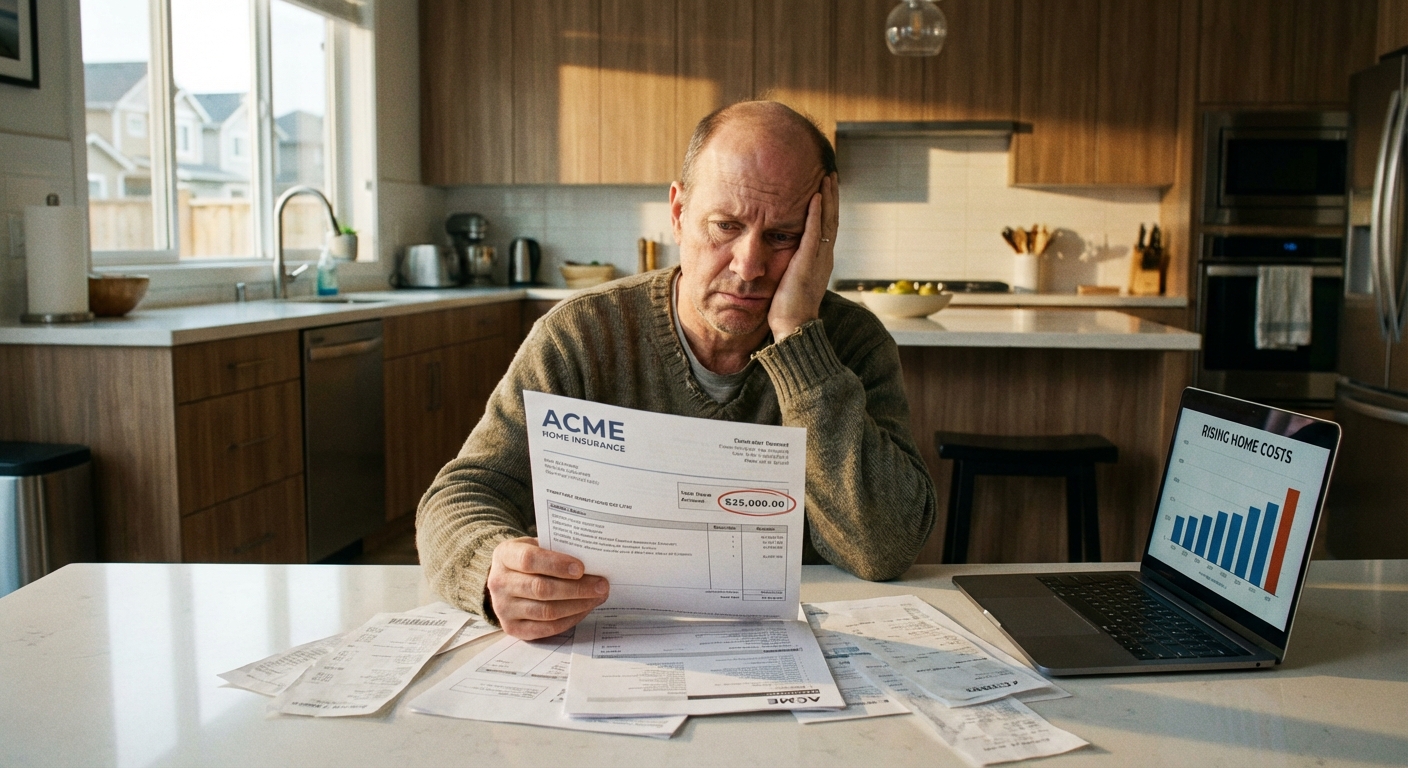
If your renewal notice shocked you, you're not alone. US home insurance premiums are set to rise for a fifth straight year in 2026 as insurers grapple with losses from extreme weather and high rebuilding costs. The pressure comes from a combination of forces that show no signs of quickly reversing.
The Main Drivers of Rising Premiums
| Driver | Impact |
|---|---|
| Natural disasters (wildfires, hurricanes, tornadoes, hail) | More frequent, more costly claims |
| Inflation in construction, labor & tariffs | Rebuild costs still elevated above pre-2020 baseline |
| Rising reinsurance costs | Insurers pass cost increases to consumers |
| Insurer pullback in high-risk markets | Fewer carriers competing, higher prices |
| Litigation in some states | Inflated claim payouts raise overall premiums |
Insurify projects average U.S. home insurance premiums will rise about 4% in 2026 to roughly $3,057 per year, while Cotality's market outlook projects a steeper 8% increase. Catastrophe-exposed states will see much sharper hikes. Insurify data scientists forecast California climbing an average of 15.8% (to $2,843), Nebraska up 13.2% (to $4,560), and New Mexico up 10.8% (to $2,524) by the end of 2026. To dig deeper into the underlying causes, see our analysis of why home insurance premiums keep rising.
The good news? Premium growth has slowed from its peak. The 12% year-over-year jump in 2025 is expected to moderate to roughly 4% to 8% in 2026. But premiums remain at historically high levels, making cost-reduction strategies more important than ever. For homeowners facing affordability issues, read our guide on the home insurance affordability crisis for additional options. Flood insurance is also typically excluded from standard policies, so review our guide on flood insurance coverage when budgeting total protection costs.
How to Calculate How Much Home Insurance Coverage You Need
The most important rule: insure your home for what it costs to rebuild, not what you paid for it. Market value includes land, which can't burn down or flood. Replacement cost only covers the structure.
Step-by-Step Coverage Calculation
Step 1: Estimate Dwelling Coverage (Coverage A) Multiply your home's square footage by the local construction cost per square foot. In most U.S. markets, that's $150 to $250 per square foot. A 2,000 sq ft home might cost $300,000 to $500,000 to rebuild.
Step 2: Other Structures (Coverage B) Typically 10% of your dwelling coverage. For a $300,000 policy, that's $30,000 for fences, garages, sheds, and other detached structures.
Step 3: Personal Property (Coverage C) Conduct a home inventory. Most policies provide 50% to 70% of Coverage A by default. If you have high-value items (jewelry, art, electronics), schedule them separately.
Step 4: Liability (Coverage E) Standard policies offer $100,000 to $300,000. Experts recommend at least $300,000 to $500,000 to protect against lawsuits.
Step 5: Loss of Use (Coverage D) Typically 20% to 30% of Coverage A. This pays for temporary housing if your home is uninhabitable after a covered loss.
HO-3 and HO-5 home insurance policies are the same except for coverage of personal property. HO-3 policies cover named perils and pay actual cash value for your items, while HO-5 policies cover open perils and pay replacement cost value for your possessions. In practice, HO-5 typically runs 5% to 20% more than an equivalent HO-3 for the same home and limits, and can run 15% to 30% more in high-risk states like Texas. The premium is worth it if you own high-value belongings or want simpler claims processes.
How to Lower Your Home Insurance Cost
With premiums continuing to rise, taking action is the best way to protect your budget. For an exhaustive breakdown, see our guide to 17 proven ways to lower your home insurance premium. Here are the most effective strategies:
1. Bundle Home and Auto Insurance
Combining your home policy with your auto from the same carrier can deliver major savings. Bundling home and car insurance can save you 10% to 25% with many major insurance companies, and buying a home and auto insurance bundle (two policies from the same insurance company) can save you up to 25%, depending on the insurer. State Farm advertises savings of up to $1,429 annually for bundled policies, while Liberty Mutual reports new bundled customers save over $950 per year on average. Insurance.com's 2026 data pegs typical savings at about 15%, or roughly $869 per year. See our full breakdown on bundling home and auto to find the best bundle deals.
2. Raise Your Deductible
Raising your deductible can substantially cut your premium. Moving from $500 to $1,000 typically cuts premiums by about 10% to 25%, and a jump to $5,000 can save roughly 35% to 45%. Just make sure you have enough in savings to cover the higher out-of-pocket cost if you file a claim.
3. Make Your Home Safer
Insurers reward risk reduction. Installing monitored security systems, smoke detectors, fire sprinklers, and smart water shut-off devices can earn meaningful discounts. Replacing an aging roof with impact-resistant materials is one of the biggest single improvements you can make. Explore the full list in our guide to 15+ home insurance discounts.
4. Improve Your Credit Score
In most states, insurers use a credit-based score as a pricing factor. Paying down debt, avoiding late payments, and reducing credit utilization can lower your insurance score (and your premium) over time.
5. Ask About Every Available Discount
| Discount Type | Potential Savings |
|---|---|
| Multi-policy (bundle) | 10-25% |
| New home / new roof | 5-20% |
| Security system / smart home devices | 5-20% |
| Claims-free history | 5-10% |
| Annual payment (vs. monthly) | 2-5% |
| Paperless / auto-pay | 1-3% |
| 55+ / retiree | up to 10% |
6. Shop Around Every Year
Never assume your current insurer is still competitive. Get at least 3 quotes at each renewal from different carriers. Independent agents can compare multiple companies for you at once. Learn more about how to compare home insurance policies effectively, and use our home insurance shopping tips to negotiate a better rate.
Frequently Asked Questions
What is the average cost of homeowners insurance per month?
The national average home insurance cost ranges from roughly $200 to $250 per month in 2026, depending on coverage and source. NerdWallet pegs the average around $208/month for $400,000 in dwelling coverage, while Insurify's 2026 data points to about $239/month for $300,000 in coverage. Your actual monthly premium depends on your home's size, age, location, and the coverage limits you choose.
How do I calculate how much home insurance I need?
Start by estimating your home's rebuild cost, not its market value. Multiply your square footage by the local cost per square foot to build (typically $150 to $250 depending on your area and finishes). Add 10% for other structures, and ensure your personal property coverage reflects the value of your belongings through a home inventory. At minimum, carry $300,000 in liability coverage to protect yourself from lawsuits.
Why is my home insurance so expensive?
Home insurance premiums have surged due to more frequent and severe natural disasters, rising construction and labor costs (including tariff-driven material inflation), sharply higher reinsurance costs, and insurer pullback in high-risk markets. If you're in a high-risk state like Florida, Oklahoma, or Louisiana, these factors compound significantly. Premiums are expected to rise another 4% to 8% in 2026 on top of the 12% increase from 2025.
What's the difference between HO-3 and HO-5 insurance?
The HO-3 is the most common homeowners policy and covers personal property for named perils only, typically paying claims at actual cash value (which factors in depreciation). The HO-5 is a comprehensive policy that covers both the dwelling and personal property on an open-perils basis and pays replacement cost value for belongings, with no depreciation deduction. HO-5 policies typically cost 5% to 20% more than HO-3, and up to 30% more in high-risk states, but provide significantly broader protection.
How can I lower my home insurance premium without reducing coverage?
The most effective moves are bundling home and auto insurance (saving 10% to 25% or about $869 per year on average), raising your deductible, installing safety devices like monitored alarms and smart water shut-offs, and maintaining a claims-free history. You should also shop around each year at renewal, since loyalty discounts rarely outperform the savings from switching to a more competitively priced insurer. Improving your credit score can also lead to meaningful savings over time.