
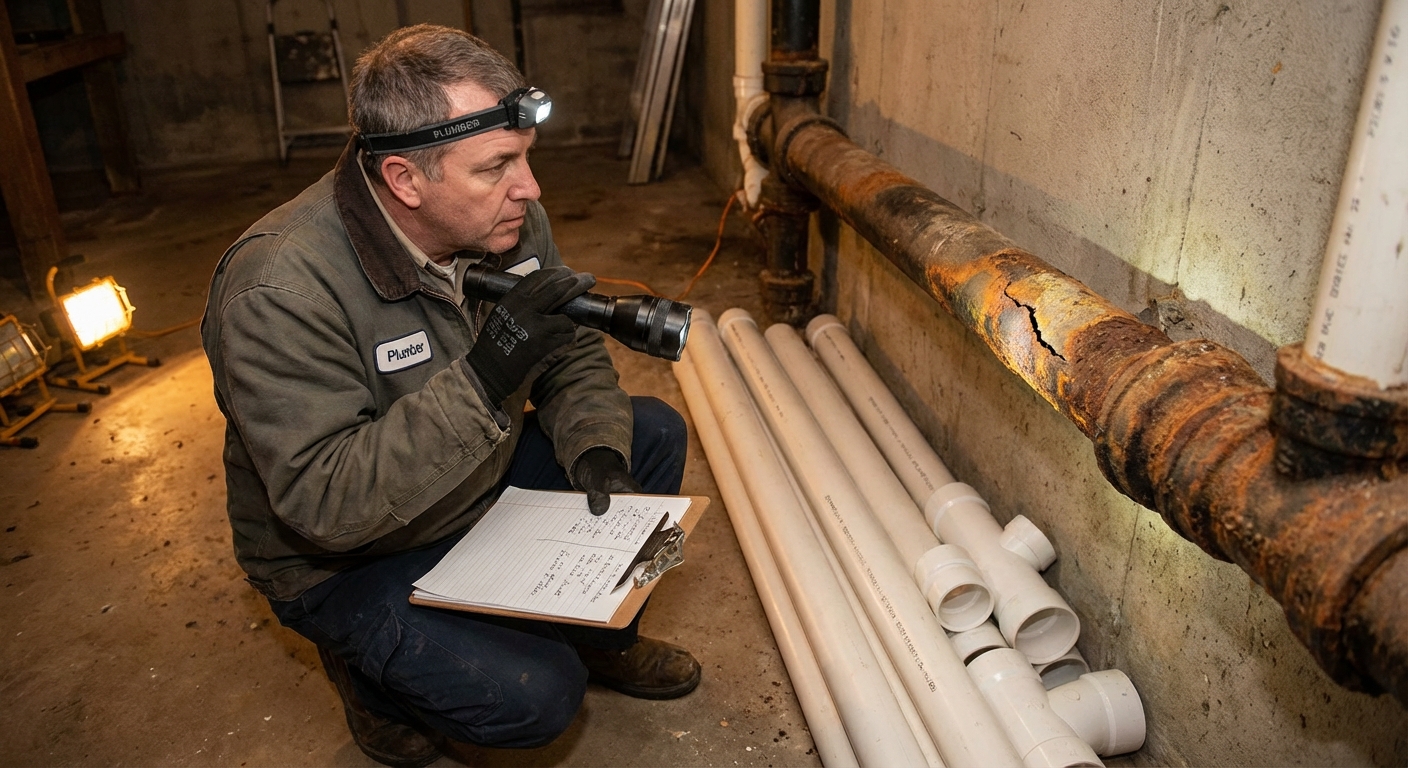
How Long Do Cast Iron Pipes Last?
Cast iron pipes were once the gold standard in residential and commercial plumbing. They were built tough, heavy, and designed to last. But "last" has an expiration date. Under ideal conditions with neutral-pH soil and minimal external stress, cast iron pipes can survive 50 to 100 years. In reality, most homeowners should expect a lifespan closer to 50 to 75 years, with factors like soil acidity, tree root activity, hard water, high humidity, and freeze-thaw cycles all chipping away at that number.
If your home was built before 1975, there's a strong chance your original cast iron plumbing is either at or well past its expected lifespan. Homes in regions like Florida or the Gulf Coast see accelerated deterioration due to humidity and high groundwater, while homes in states like Minnesota face freeze-thaw stress that cracks aging pipes from the outside in. Regional context matters, but the bottom line is simple: age alone is reason enough to schedule an inspection.
Quick Lifespan Reference by Region
| Region | Estimated Lifespan | Primary Threat |
|---|---|---|
| Midwest (e.g., Minnesota) | 50-100 years | Freeze-thaw cycles, soil acidity |
| Southeast (e.g., Florida) | 40-60 years | High humidity, groundwater |
| Southwest (e.g., Texas) | 30-50 years | Clay soil shifts, hard water, roots |
| General Average | 50-75 years | Corrosion, age, usage |
If you're buying an older home, a review of common plumbing red flags is one of the smartest steps you can take before signing anything.

Find Trusted & Licensed Plumbers in Ohio
Get matched with companies for your specific needs
Warning Signs Your Cast Iron Pipes Need Replacing
Cast iron deteriorates from the inside out, which makes it especially tricky. Pipes can look structurally sound on the outside while being severely compromised internally. Here's what to watch for:
Visible Signs
- Rust and surface corrosion on exposed pipe sections in basements, crawl spaces, or utility areas
- Flaking or pitting along the pipe surface, indicating deep corrosion
- Cracks or fractures visible on accessible pipe sections
- Staining on walls, ceilings, or floors directly below or adjacent to pipes
Performance-Based Warning Signs
- Slow drains across multiple fixtures, not just one sink but several at once
- Frequent sewer backups despite no obvious blockage
- Gurgling sounds from drains or toilets, indicating venting problems
- Foul sewage odors coming from drains, walls, or yard areas
- Sewage-like smell in the yard or wet patches near sewer lines
- Unexplained mold or mildew growth near plumbing areas
Root Intrusion
Tree roots actively seek moisture and can infiltrate cast iron pipes through hairline cracks or deteriorated joints. Once inside, roots grow into full blockages and physically split the pipe from within. This is one of the most common cast iron failure points in homes with mature landscaping.
These warning signs are also common in homes with old house plumbing problems that may involve multiple pipe materials failing simultaneously.
How Cast Iron Pipes Are Inspected
Sewer Camera Inspection (Video Pipe Inspection)
The most reliable method for assessing cast iron is a sewer camera inspection, where a professional plumber threads a flexible camera through your drain or sewer line to capture real-time video of the pipe interior. This reveals:
- The precise location and severity of cracks or breaks
- Root intrusion and blockage points
- Internal rust buildup and tuberculation (rough mineral deposits)
- Pipe belly (sags that pool water and cause backups)
- How much cast iron remains versus already-repaired sections
In 2026, a straightforward residential camera inspection typically costs $150 to $500, with cast iron pipe diagnostics running $250 to $400 because older, rougher pipe often requires more advanced camera equipment. Homes without an accessible cleanout may pay $175 to $750 due to added access work. It's the single best tool for confirming whether you need a spot repair, partial replacement, or full system overhaul. For a deeper look at the process, our plumbing camera inspection guide walks through what to expect step by step.
Visual Inspection of Exposed Pipe
In basements, crawl spaces, and utility areas, a plumber will visually inspect all accessible pipe sections for rust, flaking, cracks, or wet spots. However, this method is limited because cast iron fails from the inside first, so external appearance can be deceiving.
Professionals typically recommend video-scanning any plumbing system older than 30 years, and especially before any whole house repiping decision is made.
Cast Iron Pipe Replacement Cost in 2026
Replacement costs vary widely depending on the scope of work, method used, and your home's specific configuration. Here's a practical breakdown based on current 2026 pricing:
Cost by Method
| Method | Cost Per Linear Foot | Typical Total Cost | Disruption Level |
|---|---|---|---|
| Traditional Excavation | $100-$300/ft | $10,000-$30,000+ | High |
| Trenchless Pipe Lining (CIPP) | $100-$225/ft | $5,000-$15,000 | Low |
| Pipe Bursting (Trenchless) | $120-$250/ft | $5,000-$15,000+ | Moderate |
| Spot/Partial Repair | Varies | $3,000-$8,000 | Low-Moderate |
| Full Repipe (PVC/ABS) | $25-$60/ft installed | $3,500-$15,000+ | High |
Traditional Excavation
Traditional excavation involves digging up the ground (or cutting through concrete slabs) to physically access and remove old cast iron pipes. While it's the most thorough option, it comes with significant additional costs: $3,500 to $7,500 for excavation labor and $7,500 to $10,000 for landscaping or driveway restoration afterward. For under-slab work, costs can reach $10,000 to $30,000+ depending on slab thickness and pipe depth. Real-world homeowner reports in 2026 show partial replacements typically landing between $8,000 and $18,000, while full whole-house replacements often exceed $25,000.
Trenchless Replacement
Trenchless methods are increasingly the preferred option for cast iron replacement, especially when pipes run under slabs, finished flooring, or landscaped areas. When restoration costs are factored in, trenchless typically costs 20% to 40% less than dig-and-replace. Two primary methods are used:
For a deeper dive into costs and the trenchless process, check out our guide on trenchless sewer repair and our full sewer line replacement cost guide.
Partial vs. Full Replacement: Which Do You Need?
Partial replacement works best when damage is isolated to a specific section such as a localized collapse, a pipe belly in one area, or severe root intrusion in a short run. It costs significantly less upfront (often 30-50% less than full replacement) and causes less disruption. The trade-off: the rest of your aging cast iron remains in place and may cause problems again soon.
Full replacement is the right move when:
- Multiple sections show systemic corrosion
- You've already had repeated spot repairs
- The system is 50+ years old
- A camera inspection reveals widespread deterioration
A hybrid approach is common and cost-effective. Line the stable sections with CIPP and physically replace the collapsed or severely failed sections.
Handling Pipes in Walls and Under Slabs
- Under concrete slabs: Trenchless pipe lining is almost always the preferred method. Physical excavation through concrete is expensive and disruptive, often costing $10,000 to $30,000+ for slab work alone. This overlaps closely with slab leak repair considerations.
- Pipes in walls: Targeted access points are cut to reach the damaged sections. In severe cases, walls may need to be opened for a full repipe. This is typically necessary in multi-story homes where cast iron stacks run through interior walls.
Best Materials to Replace Cast Iron Pipes
When it's time to replace, modern pipe materials offer 50+ years of corrosion-free performance compared to the deteriorating cast iron they replace. For a broader look, see our guide on corrosion-resistant plumbing pipes.
PVC vs. ABS vs. HDPE: Your Three Best Options
| Feature | PVC | ABS | HDPE |
|---|---|---|---|
| Color | White/Gray | Black | Black |
| Material Cost | Lowest | ~15% higher than PVC | ~25%+ higher than PVC |
| Installation | Two-step (primer + cement) | One-step (cement only) | Heat fusion (specialized) |
| Cold Weather | Brittle below freezing | Handles down to -40°F | Excellent (-40°F to 140°F) |
| Lifespan | 70+ years | 40-50+ years | 100+ years |
| Best For | Most residential drains | Cold climates, indoor DWV | Long buried laterals, pipe bursting |
PVC is the most widely recommended choice for cast iron to PVC pipe replacement in most American homes. It's code-compliant in more jurisdictions, quieter, and less expensive. ABS is preferred in cold northern climates or impact-prone environments. HDPE shines for long exterior sewer laterals and is the go-to material for trenchless pipe bursting because it can be pulled through the ground in a single continuous run with no joints.
Insurance Coverage for Cast Iron Pipe Replacement
Here's the hard truth: standard homeowners insurance typically does not cover cast iron pipe replacement caused by age, corrosion, or normal wear and tear. Insurers categorize routine deterioration as a maintenance issue, not a covered peril.
What may be covered:
- Sudden, accidental pipe bursts (if caused by a covered event, not gradual decay)
- Water damage to floors, walls, and belongings after a sudden pipe failure
- Tear-out and repair labor to access damaged pipes and restore the surrounding structure
What is almost always excluded:
- Full repipe projects due to aging or corrosion
- Gradual leak damage from slow deterioration
- Root intrusion repair costs
Even though policies won't "pay for pipes," a covered water damage event can often result in the insurer paying for most of the surrounding tear-out and restoration, which is where the majority of the total project cost lives.
Add-On Coverage That Can Help
| Endorsement | What It Covers |
|---|---|
| Service Line Coverage | Underground pipe damage from roots, soil shifts, or collapse |
| Equipment Breakdown Coverage | Mechanical plumbing system failures beyond normal wear |
| Sewer Backup Endorsement | Cleanup and repairs after drain backups |
2026 Underwriting Changes to Know
As of 2026, insurers (particularly in high-risk states like Florida and Louisiana) are increasingly flagging cast iron pipes during underwriting. Some carriers now require plumbing inspections before issuing or renewing policies, and a handful exclude or limit coverage entirely for homes with original cast iron drain lines. On the flip side, some insurers now offer premium discounts for homes that proactively replace original cast iron with modern materials. Contact your insurer before replacing pipes to understand what documentation they need and whether any portion of the project may qualify for coverage.
Learn more about how sewer line repair costs factor into insurance claims and out-of-pocket expenses.
Frequently Asked Questions
How much does it cost to replace cast iron pipes in a whole house in 2026?
A whole-house cast iron pipe replacement typically costs $10,000 to $30,000+ in 2026, depending on the method used, pipe length, and whether work is needed under a concrete slab. Trenchless methods generally run $5,000 to $15,000 for most homes, while traditional excavation can easily exceed $25,000 to $30,000 when restoration costs are included. Getting at least two or three quotes from licensed plumbers, along with a camera inspection first, is the best way to get an accurate number for your specific home.
Can I repair a cracked cast iron pipe instead of replacing it?
Yes, in some cases. Isolated cracks in otherwise stable pipe sections can be addressed with trenchless pipe lining (CIPP), which seals the interior without excavation. However, if the pipe is collapsed, severely offset, or shows widespread corrosion across multiple sections, repair is usually a short-term fix that leads to repeated problems. A sewer camera inspection will tell you whether repair or replacement makes more sense for your situation.
What's the difference between trenchless and traditional cast iron pipe replacement?
Traditional replacement involves physically digging up or cutting through the ground (or a concrete slab) to remove and swap out the old pipe. Trenchless methods, including pipe lining and pipe bursting, access the pipe from entry and exit points with minimal digging, preserving your landscaping, driveway, and flooring. Trenchless typically costs 20% to 40% less overall when restoration costs are factored in, but is not suitable for severely collapsed or badly misaligned pipes.
Is PVC better than cast iron for drains and sewer lines?
For modern residential applications, yes. PVC offers a smooth interior that resists clogs and buildup, will not rust or corrode, and has a lifespan of 70+ years with minimal maintenance. Cast iron does offer better sound dampening (quieter water flow), which is why some homeowners in multi-story homes still choose no-hub cast iron for vertical stacks, but for most drain and sewer applications, PVC is the better long-term value.
How do I know if my home has cast iron pipes?
The easiest way is to look at exposed plumbing in your basement, crawl space, or under sinks. Cast iron pipes are dark gray or black, very heavy, and have a dull metallic appearance, often showing surface rust or orange streaking in older homes. They are typically found in homes built before 1975. If you're unsure, a licensed plumber can perform a quick visual inspection or run a camera through your sewer line to identify the pipe material and condition throughout the system.