
What Does Sewer Line Replacement Actually Cost?
The national average for sewer line replacement in 2026 sits between $6,000 and $8,000, with a typical range of $3,000 to $10,000 for most residential jobs. Per-foot costs run $50 to $250 per linear foot depending on method, materials, and conditions. Complex jobs (long runs, deep lines, or pipes under driveways) can push the total well past $25,000.
The wide range comes down to method, materials, pipe length, depth, and what gets destroyed in the process (landscaping, driveways, concrete). Understanding how each piece contributes to your total is the best way to avoid sticker shock and negotiate smarter quotes.
Cost Breakdown: What You're Actually Paying For
Sewer line replacement isn't a single line item. It's a combination of several costs that add up quickly. Here's what goes into that estimate in 2026:
| Cost Component | Typical Range | Notes |
|---|---|---|
| Labor | $45–$200/hr | Often 90%+ of total cost in some metros |
| Pipe Materials (PVC) | $0.50–$5/linear ft | Most common; affordable and durable |
| Pipe Materials (Cast Iron) | $2–$10/linear ft | Premium; required in some municipalities |
| Excavation/Trenching | $4–$12/linear ft | Traditional method only |
| Permits | $30–$1,800+ | Varies widely by municipality |
| Camera Inspection | $125–$500 | Often required before and after work |
| Cleanout Installation | $500–$2,000 | If existing cleanout is missing or damaged |
| Backflow Preventer | $150–$1,200 | Required in some jurisdictions |
| Landscaping Restoration | $500–$5,000+ | Yard, sod, shrubs affected by digging |
| Driveway/Concrete Repair | $1,500–$8,000+ | Concrete cutting runs $3–$8 per sq ft |
What About Permits?
Permits are non-negotiable for most sewer replacement projects. Depending on your city or county, you may need a plumbing permit, a sewer tap/connection permit, and a right-of-way permit if the work reaches the street. Expect to pay anywhere from $30 for a basic plumbing permit in many markets, up to $600 to $1,800 in high-cost cities, with some excavation permits exceeding $2,000 when right-of-way work is involved. Your contractor typically handles this, but always confirm it's included in the quote.

Find Trusted & Licensed Plumbers in Ohio
Get matched with companies for your specific needs
Traditional Excavation vs. Trenchless Replacement
The method your contractor uses will have the biggest impact on your total cost, and on how much of your yard survives the process.
Traditional (Open-Cut) Excavation
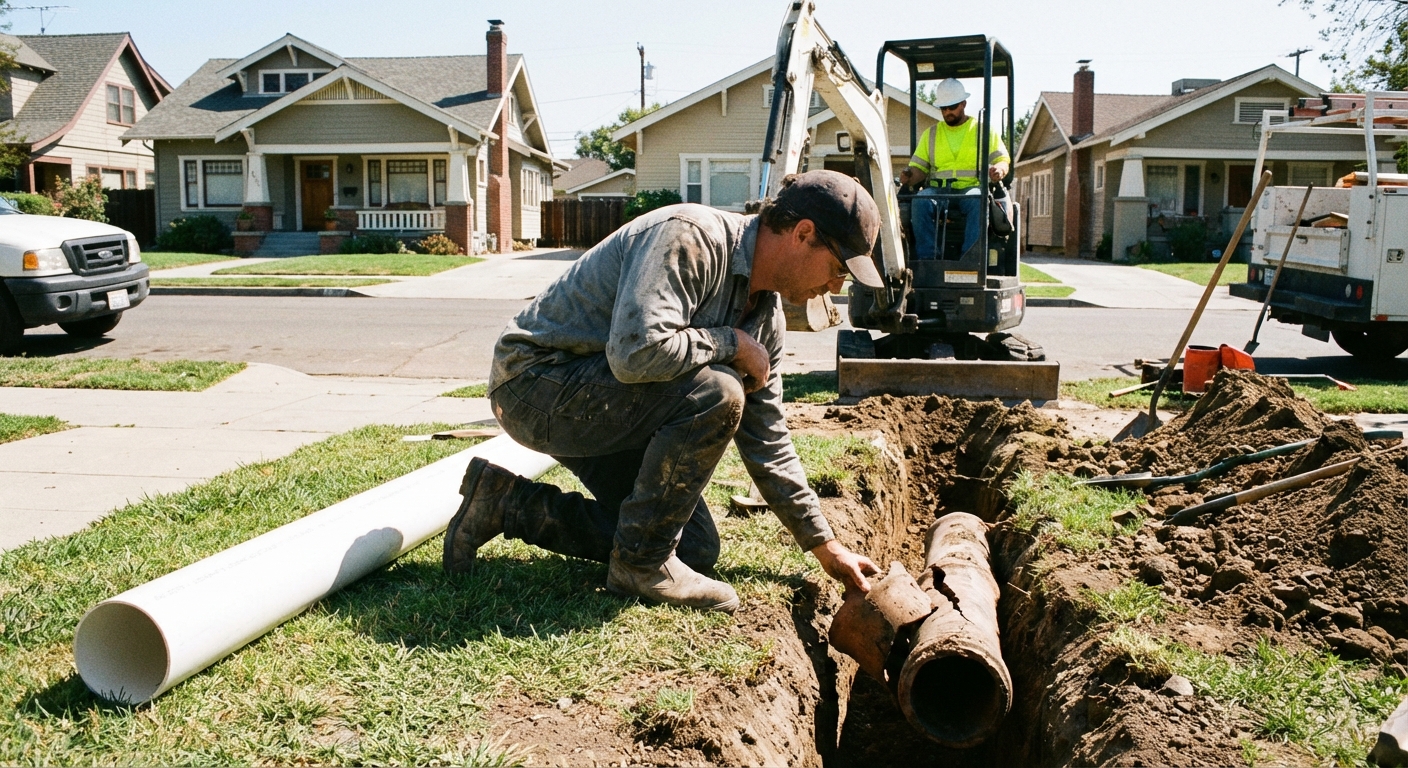
This is the old-school method: dig a trench, remove the old pipe, install the new one, backfill. It costs $50 to $250 per linear foot, with trenching alone adding $4 to $12 per foot on top of materials and labor. The real danger is the restoration costs that follow. If your sewer line runs under a concrete driveway, patio, or mature landscaping, expect that to double or even triple your bill.
Best for: Fully collapsed pipes, severely damaged lines, or situations where the pipe needs complete structural replacement.
Trenchless Pipe Lining (CIPP)
Cured-in-place pipe lining inserts a resin-saturated liner into the existing pipe and cures it in place, creating a new pipe within the old one. No major digging required. In 2026, CIPP lining typically runs $80 to $250 per linear foot, with most residential jobs totaling $4,000 to $12,000. It slightly reduces the pipe's interior diameter but is otherwise highly effective for cracked or leaking pipes that are still structurally intact.
Best for: Minor-to-moderate cracking, leaks, or corrosion in pipes that haven't collapsed.
Trenchless Pipe Bursting
Pipe bursting pulls a new HDPE or PVC pipe through the old one while simultaneously fracturing the old pipe outward. This is a full replacement, not just a liner, and 2026 costs run $100 to $250 per linear foot, with most residential jobs landing between $4,000 and $15,000. Small access pits are still required at each end, but the trench is eliminated entirely. Learn more about the full trenchless sewer repair process and costs.
Best for: Severely deteriorated pipes that need full replacement without extensive excavation.
Factors That Drive Your Final Cost Up (or Down)
Two identical homes can get very different quotes based on a handful of key variables. Here's what actually moves the needle:
Pipe Length & Depth
Length is the primary driver of cost (longer pipe means more materials, labor, and excavation). But depth matters just as much. Sewer lines buried deeper than 5 feet require shoring (trench wall bracing to prevent collapse) and specialized machinery, which significantly increases labor costs. Deep jobs in clay, rock, or high-groundwater soils can push trenchless work to $400 or even $500 per foot in some cases.
Accessibility & Landscaping
Properties with driveways, patios, retaining walls, or mature trees over the sewer line path face substantially higher bills. Traditional excavation through a driveway alone can add $1,500 to $8,000+ in concrete or asphalt repair costs, with concrete restoration running roughly $3 to $8 per square foot. Trenchless methods exist largely because of this problem. They allow pipe replacement without surface destruction.
Pipe Material
Your local municipality may dictate what pipe material must be installed. PVC is the most common and budget-friendly option, but some areas require cast iron, which costs significantly more per foot and is heavier and more labor-intensive to install. If you're replacing old clay pipes (common in homes built before 1980), your contractor will also need to account for the fragility of the surrounding soil during removal. Our cast iron pipe replacement guide covers the specifics if you suspect cast iron is your culprit.
Regional Labor Rates
Where you live has a real impact on what you pay. Labor often represents the majority of project cost, and expensive metros commonly run 16% to 33% higher per foot than national averages. A job that costs $4,000 in a rural Midwest market might cost $8,000+ in Los Angeles, Seattle, or New York. Always search for sewer line replacement quotes locally and compare at least three bids.
Cost Ranges by Replacement Method
| Method | Per Linear Foot | Typical Total (50 ft line) |
|---|---|---|
| Traditional Excavation | $50–$250 | $4,000–$15,000+ |
| Trenchless Pipe Lining (CIPP) | $80–$250 | $4,000–$12,000 |
| Trenchless Pipe Bursting | $100–$250 | $5,000–$15,000 |
For a deeper dive on sewer line repair vs. replacement costs, including pricing by damage type and scenario, see our full repair cost guide.
Does Insurance Cover Sewer Line Replacement?
This is where many homeowners get a painful surprise. The short answer is: it depends on the cause of the damage.
What Standard Homeowners Insurance May Cover
Standard HO-3 type policies will typically cover sewer line damage caused by sudden and accidental perils, such as fire, explosion, vehicle impact, lightning, or falling objects. Coverage usually falls under the "other structures" portion of your policy (Coverage B), often capped at about 10% of your dwelling limit. So a $300,000 dwelling limit might provide up to $30,000 for all other structures combined, including the sewer line.
What Standard Policies Exclude
Here's the problem: most sewer line failures are caused by things that standard policies explicitly exclude.
| Excluded Cause | Why It's Excluded |
|---|---|
| Tree root intrusion | Considered gradual/ongoing |
| Normal wear and corrosion | Maintenance issue, not sudden damage |
| Pipe age and deterioration | Homeowner's responsibility |
| Poor installation or workmanship | Pre-existing condition |
| Flooding or storm surge | Requires separate flood insurance |
| Clogs and blockages | Maintenance issue |
The Solution: Service Line Endorsement
A service line endorsement (also called underground service line coverage) is an add-on to your homeowners policy that specifically covers underground utility lines including sewer, water, gas, electric, cable, and phone. It typically provides $10,000 to $20,000 in coverage per occurrence and is remarkably affordable. Most insurers charge just $20 to $50 per year, with some offering newer-home rates as low as ~$9/year. This endorsement covers common causes like root intrusion, corrosion, freezing, and wear and tear that standard policies ignore.
Note that a service line endorsement covers the underground pipe itself, while a separate sewer backup endorsement covers cleanup and interior damage if sewage backs up into your home. Many experts recommend carrying both. If you're evaluating your full coverage picture, our guide on home insurance coverage options can help you understand what else may be missing from your policy.
Repair or Replace? How to Know Which One You Actually Need
Not every sewer problem requires full replacement. But waiting too long on a repair can turn a $500 fix into a $10,000 emergency. Here's how to tell the difference.
Signs That Repair May Be Enough
- Isolated crack or single offset joint with no structural damage to the rest of the pipe
- Minor, localized root intrusion that can be cleared and sealed without recurring quickly
- Single blockage in an otherwise sound pipe that clears with hydro jetting
- Newer PVC pipes with only one or two defects visible on camera
Signs You Likely Need Full Replacement
- Recurring backups that keep returning after cleaning (signals systemic failure)
- Pipes over 50 years old, especially clay, cast iron, or Orangeburg (tar paper) pipe
- Collapsed or severely deformed pipe that can't be lined or burst
- Multiple problem areas spread across the line length
- Bellied pipe (sagging sections that trap waste) or consistent negative slope issues
- Widespread root intrusion through many joints, not just one area
- Foundation cracks or sinkholes traced back to the sewer line
Start With a Camera Inspection
Before agreeing to any work, insist on a sewer camera inspection. A waterproof camera fed through your cleanout will show the exact condition of your pipe (cracks, root intrusion, belly, collapse) so you're making a decision based on facts, not a guess. Inspections typically cost $125 to $500 and are often credited back toward the job if you hire the same contractor. Newer 2026 inspection systems even use AI defect detection and HD imaging to flag problems more accurately. Ask for a copy of the video so you can get second opinions.
If you're also dealing with issues at your water supply side, review our guide on main water line repair costs to understand your full exposure. And if your home is older than 50 years, consider reading our guide on old house plumbing problems to spot related warning signs.
Frequently Asked Questions
How much does a full sewer line replacement cost on average?
Most homeowners pay between $3,000 and $10,000 for a full sewer line replacement in 2026, with a national average sitting between $6,000 and $8,000. Per-foot costs range from $50 to $250 depending on method, material, and local labor rates. Complex jobs involving deep pipes, long runs, or hardscape removal can exceed $25,000. Always get multiple quotes and confirm what restoration work is included.
Is trenchless sewer replacement worth the extra cost?
In most cases, yes, especially if your sewer line runs under a driveway, landscaping, or other hardscape. While trenchless methods can cost slightly more per linear foot ($80 to $250 for CIPP, $100 to $250 for bursting), you avoid paying $1,500 to $8,000+ in concrete or landscaping restoration. The total all-in cost is often lower or comparable to traditional excavation, and the job is completed in 1 to 2 days rather than a week.
Will my homeowners insurance pay for sewer line replacement?
Standard homeowners insurance will only cover sewer line damage from sudden, accidental events like fire or vehicle impact, not the gradual deterioration, root intrusion, or wear and tear that causes most sewer failures. Adding a service line endorsement to your policy for as little as $20 to $50 per year can give you $10,000 to $20,000 in coverage for common underground pipe failures. Check with your insurance agent about adding this rider before a problem occurs.
How long does sewer line replacement take?
Traditional open-cut excavation typically takes 3 to 5 days, depending on pipe length and site conditions. Trenchless methods (pipe lining or pipe bursting) are generally completed in 1 to 2 days. Permitting can add 1 to 5 business days before work begins, and restoration work (sod, concrete, landscaping) may take additional time after the pipe work is done.
What types of sewer pipe are most expensive to replace?
Clay pipes and cast iron pipes are the most expensive to replace, not because of the replacement pipe itself, but because of their age and the soil conditions typically found around them. Clay pipe (common pre-1980) tends to be fragile and may crumble during excavation, requiring extra care and time. Cast iron requires compatible fittings and sometimes municipal-mandated materials for replacement. PVC is the most cost-effective modern replacement material and is accepted in most jurisdictions.