
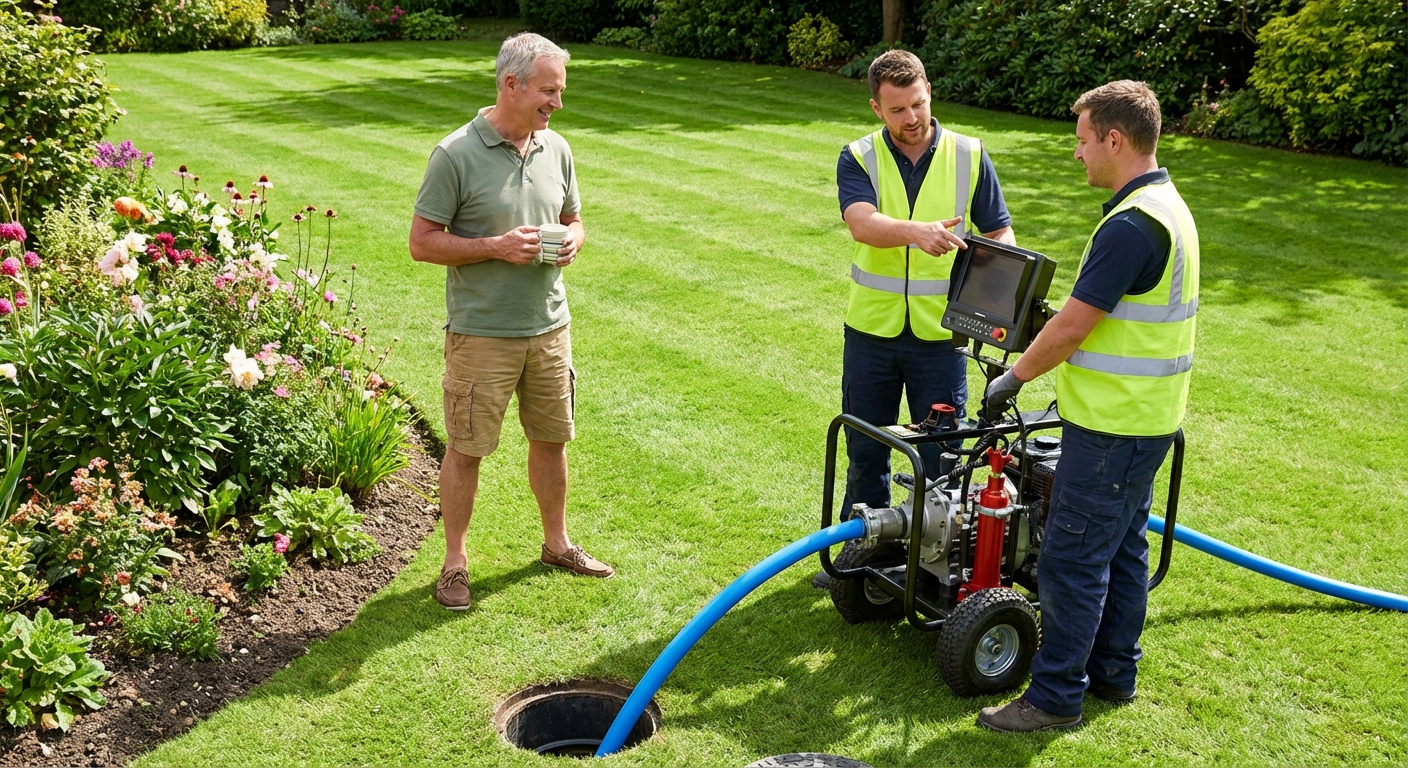
How Trenchless Sewer Repair Works
Trenchless sewer repair is a minimally invasive method of fixing or replacing damaged underground sewer lines without tearing up your yard, driveway, or landscaping. Using small access points rather than a full trench, licensed plumbers can insert specialized equipment to rehabilitate your pipes from the inside out. There are two primary methods used today: pipe lining (CIPP) and pipe bursting. Most jurisdictions now formally recognize trenchless methods in their plumbing and sewer codes, though local permits, 811 utility marking, and video documentation are typically still required before work can begin.
Before any trenchless work begins, a technician performs a plumbing camera inspection to visually assess the inside of your pipes and determine which method, if any, is a viable option.
Pipe Lining: Cured-In-Place Pipe (CIPP)
Pipe lining, also known as Cured-In-Place Pipe (CIPP), creates a brand new pipe inside your existing damaged pipe using a resin-saturated liner. It is considered the industry standard trenchless method and works best on pipes with cracks, corrosion, or root intrusion that haven't fully collapsed.
Here's how the CIPP process works, step by step:
- Inspection & Cleaning. A camera scopes the pipe to assess damage, followed by high-pressure water jetting to remove debris, roots, and buildup. Learn more about hydro jetting service and how it preps a pipe for relining.
- Liner Preparation. A flexible felt or fiberglass liner is saturated with epoxy resin and loaded into an inversion tube.
- Insertion. The liner is fed into the host pipe through a small access point using air pressure, water inversion, or cable winching.
- Inflation & Curing. The liner expands to conform to the pipe's interior walls and is hardened using steam, hot water, or UV light.
- Finishing. Excess liner is trimmed, the flow is tested, and the repair is complete, typically within the same day.
The result is a seamless, jointless pipe within a pipe that resists corrosion, root re-intrusion, and leaks.
Pipe Bursting: Full Pipe Replacement
Pipe bursting is ideal for pipes that are too far gone for lining: severely damaged, brittle, or completely deteriorated lines made of clay, cast iron, or Orangeburg. Rather than rehabilitating the old pipe, this method destroys it and simultaneously pulls a brand new pipe into position.
How pipe bursting works:
- Access Pits. Two small pits (roughly 2 to 4 feet wide) are dug at each end of the damaged pipe run.
- Bursting Head Insertion. A cone-shaped bursting head, attached to a new pipe (typically HDPE), is fed into the old pipe.
- Pulling Through. A hydraulic or pneumatic machine pulls the bursting head forward, fracturing the old pipe outward into the surrounding soil while the new pipe follows directly behind.
- Connection & Backfill. The new pipe is connected to existing lines, tested, and the small pits are backfilled.

Find Trusted & Licensed Plumbers in Ohio
Get matched with companies for your specific needs
Trenchless Sewer Repair Cost vs. Traditional Excavation
One of the biggest concerns homeowners have is cost. Here's the honest breakdown based on 2026 contractor and industry data:
| Method | Per Linear Foot | Typical Project Cost |
|---|---|---|
| Trenchless Pipe Lining (CIPP) | $80–$250/ft (avg ~$135–$150) | $1,900–$6,500 |
| Trenchless Pipe Bursting | $150–$190/ft (up to $300 on tough jobs) | $4,000–$15,000 |
| Traditional Excavation (base) | $50–$250/ft (trench dig $5–$12/ft) | $2,000–$10,000 |
| Traditional Excavation (with full restoration) | +$3,000–$8,000 | $6,000–$25,000+ |
The key insight: Traditional excavation looks cheaper upfront, but once you factor in restoring your driveway ($1,000–$3,000), landscaping ($2,000–$5,000), and concrete work, the total cost often exceeds trenchless repair. Industry data from 2026 suggests trenchless methods come in roughly 30% to 50% lower on total project cost when full restoration is factored in. Trenchless is most cost-effective for deeper pipes and longer runs, while traditional methods may hold a slight edge on shallow, short repairs with no above-ground obstacles. In high-cost markets like Seattle, full traditional replacements can climb to $10,000–$32,000.
For a full breakdown of sewer repair pricing across all methods, see our sewer line repair cost guide or compare it to our sewer line replacement cost breakdown for 2026.
Benefits, Limitations & Ideal Candidates
Key Benefits of Trenchless Repair
How Long Does Trenchless Repair Last?
Durability is one of trenchless repair's strongest selling points. When properly installed, CIPP pipe lining is rated to last 50 to 60 years, and field studies show liners in excellent condition after 25+ years of service. Pipe bursting with HDPE pipe is treated by most utilities as a 50+ year asset thanks to HDPE's non-corroding, fused-joint construction. The seamless, jointless design of both methods means no weak connection points where root intrusion or leaks typically develop. Just keep in mind that the engineering design life (50+ years) is not the same as the contractor's written warranty, which is often 10 to 20 years for residential work and sometimes shorter for municipal projects.
Who Is a Good Candidate?
Trenchless repair is ideal for homeowners who:
- Have cracked, corroded, or root-damaged pipes that are still structurally intact
- Want to protect finished landscaping, garden beds, patios, or driveways
- Need a fast turnaround, like tenants or businesses that can't afford days of disruption
- Have deep sewer lines where excavation costs skyrocket
- Are dealing with older pipe materials like clay, cast iron, or Orangeburg
Trenchless is NOT suitable when:
- The pipe has completely collapsed or has no remaining structural integrity
- The pipe has major slope problems, sags, or bellies that can't be corrected without excavation
- A pipe burst has damaged nearby utilities that require physical access
- Local building codes prohibit the method for the pipe size involved
How to Choose: Trenchless vs. Traditional Repair
There's no universal right answer, the best method depends on your specific situation. Use this decision framework to guide your choice:
| Factor | Lean Trenchless | Lean Traditional |
|---|---|---|
| Pipe depth | Deep pipes (6+ feet) | Shallow pipes (2 to 3 feet) |
| Pipe damage | Cracks, corrosion, roots | Full collapse, severe misalignment |
| Property concerns | Finished yard, driveway, patio | Open land, no surface structures |
| Timeline | Need repair in 1 to 2 days | Can manage multi-day disruption |
| Budget (total) | Want lower all-in cost | Lowest upfront cost is priority |
| Pipe material | Clay, cast iron, Orangeburg | Already partially exposed or accessible |
If your sewer problem is connected to your main water line, it's also worth reviewing our guide on main water line repair to understand overlap in responsibilities and costs. Homeowners in older properties should also review common old house plumbing problems before committing to a specific repair path.
When in doubt, always start with a professional pipe camera inspection followed by quotes from at least two or three licensed contractors who specialize in trenchless technology. The provider you already use for burst pipe repair or routine drain service may offer camera inspection as part of a diagnostic visit, which can reduce your overall out-of-pocket cost.
If costs are a concern and you need help managing a large unexpected repair bill, exploring debt consolidation options may also be worth considering for expensive home repair projects.
Frequently Asked Questions
Q: Is trenchless sewer repair worth it in 2026? In most cases, yes, especially when you account for the total cost including property restoration. Trenchless repair preserves your landscaping, driveway, and hardscaping and is usually completed in 1 to 2 days instead of 5 to 10. With a 50+ year design life and project totals often 30% to 50% lower than full excavation with restoration, the investment generally pays off long term.
Q: How do I know if my pipes qualify for trenchless repair? The only reliable way to determine eligibility is a professional CCTV camera inspection, which typically costs $150 to $350 in 2026. A contractor will insert a waterproof camera into your sewer line to assess the condition, location, and severity of damage. Pipes that are fully collapsed, severely misaligned, or have major slope issues may not qualify for trenchless methods.
Q: How long does trenchless sewer repair take? Most trenchless sewer repairs are completed within 1 to 2 days. Pipe lining can sometimes be done in just a few hours for shorter runs, while pipe bursting may take a full day depending on the length and access conditions. This is a dramatic improvement over traditional excavation, which can take anywhere from 5 to 10 days.
Q: Can trenchless sewer repair fix tree root damage? Yes, root intrusion is one of the most common reasons homeowners choose CIPP pipe lining. The epoxy resin liner seals all cracks and gaps where roots had been entering, and the smooth, jointless surface of the finished liner is highly resistant to future root re-intrusion. However, if roots have caused the pipe to fully collapse, pipe bursting or excavation may be needed instead.
Q: Does homeowners insurance cover trenchless sewer repair? Standard homeowners insurance policies in 2026 typically do not cover sewer line repairs caused by age, wear, corrosion, or root intrusion. They may cover repairs if the damage came from a sudden, accidental event like a fallen tree, vehicle impact, or vandalism. To cover deterioration-based failures, look for a service line endorsement (often with $10,000 to $20,000 limits) or a sewer line warranty offered by your local water utility. Sewer backup coverage is a separate endorsement that pays for interior water damage only, not the outdoor pipe repair itself.