
What Is Backflow & Why Is It Dangerous?
Backflow is the unwanted reversal of water flow in a plumbing system, and it's more common than most property owners realize. Under normal conditions, water moves in one direction: from the municipal supply into your building. But when pressure drops suddenly (such as during a water main break, hydrant use, or a surge in demand), that flow can reverse, pulling non-potable water back into the clean supply.
This reversal happens through two mechanisms:
- Backsiphonage – A vacuum effect that sucks contaminated water into the supply line, often triggered by water main breaks, firefighting demand, pump failures, or power outages
- Backpressure – Higher downstream pressure (from pumps, heating systems, boilers, or elevated tanks) that pushes contaminated water backward
The health risks are serious. Backflow can introduce bacteria (E. coli, Salmonella), viruses, parasites (Giardia, Cryptosporidium), pesticides, fertilizers, glycol, industrial chemicals, and sewage into your drinking water. For commercial properties, the consequences also include financial liability, regulatory fines, and potential shutdowns.

Find Trusted & Licensed Plumbers in Ohio
Get matched with companies for your specific needs
Types of Backflow Prevention Devices
Not all backflow preventers are equal. The right device depends on the hazard level of your water system and your local code requirements. Here are the most widely used types in 2026:
Reduced Pressure Zone (RPZ) Assembly
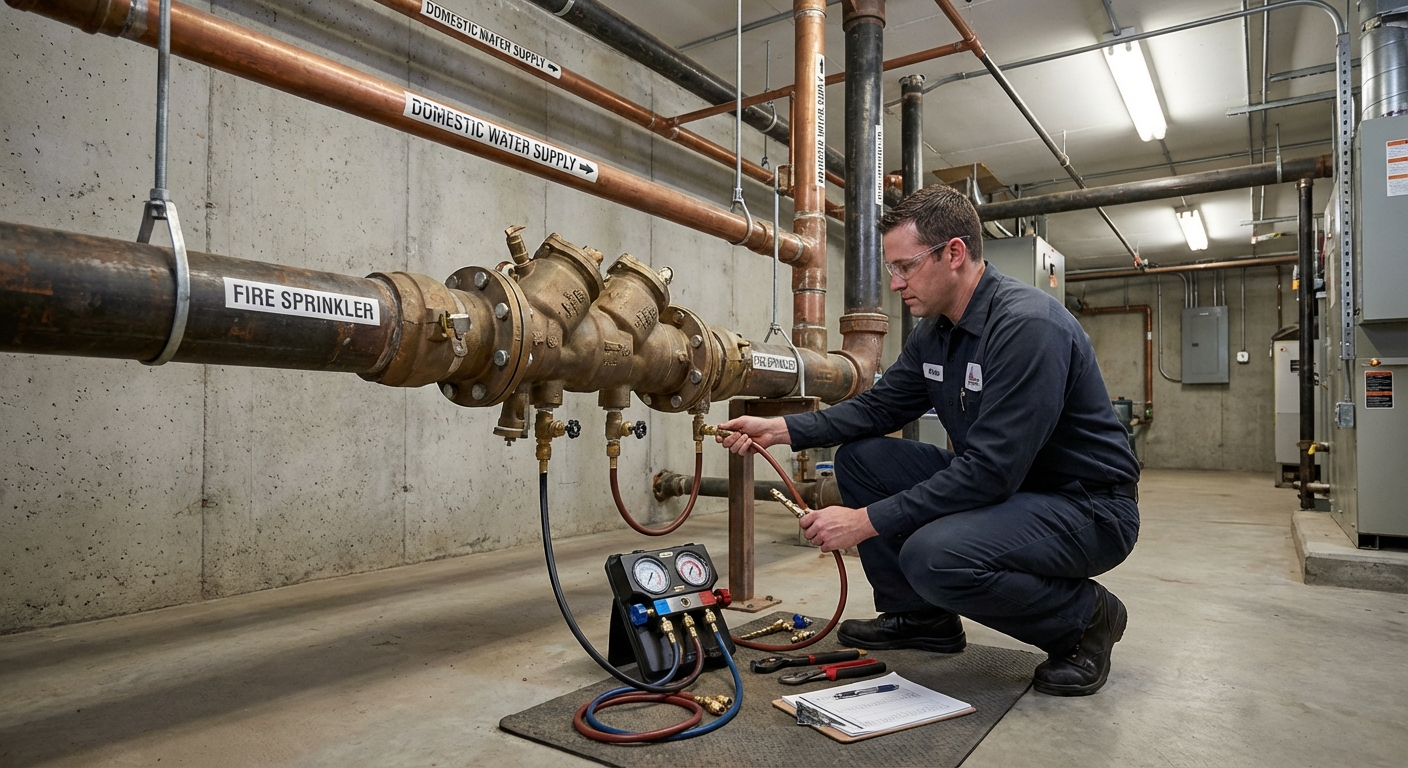
The RPZ is the highest level of protection available and is required in high-hazard settings such as hospitals, chemical facilities, labs, and commercial irrigation systems with fertilizer or pesticide injection. It contains two independently operating check valves with a hydraulically operated relief valve positioned between them. If either check valve fails, the relief valve automatically opens and discharges water to the exterior, ensuring contaminated water never reaches the supply.
RPZ assemblies must be installed above ground with at least 12 inches of clearance below the device for drainage and testing access.
Double Check Valve Assembly (DCVA)
This device uses two one-way check valves assembled in series. If one valve fails, the second still prevents reverse flow, offering a redundant layer of protection. DCVAs are best suited for low-to-medium hazard applications such as residential irrigation, commercial fire sprinkler systems without antifreeze, and in-ground sprinklers where backpressure is not a significant concern.
Pressure Vacuum Breaker (PVB) and Spill-Resistant PVB (SVB)
PVBs and SVBs have become the most common and cost-effective testable devices for residential and light commercial irrigation. They protect against backsiphonage only and must be installed at least 12 inches above the highest downstream outlet. Many utilities now prefer PVB or RP devices at the irrigation system entry point over older AVB designs.
Atmospheric Vacuum Breaker (AVB)
The AVB is a simple, non-testable device that uses a spring and float mechanism to block backsiphonage. AVBs are ideal for low-hazard, low-pressure applications like garden hose connections, mop sinks, and small irrigation zones, but they cannot be installed in locations where downstream piping is permanently pressurized.
Who Needs a Backflow Prevention Device?
Many property owners don't realize they're legally required to have a backflow preventer until they receive a notice from their water utility. Here's a breakdown of who typically needs one:
| Property Type | Device Typically Required | Notes |
|---|---|---|
| Commercial buildings | RPZ or DCVA | Required for meters 1.5" or larger |
| Irrigation/sprinkler systems | PVB, SVB, RPZ, or DCVA | RPZ required if fertilizer/pesticide injection |
| Swimming pools (auto-fill) | DCVA or RPZ | Required where auto-fill valves connect to supply |
| Fire sprinkler systems | DCVA, DCDA, RPZ, or RPDA | RPZ/RPDA required if antifreeze is present |
| Residential (with irrigation) | AVB, PVB, or DCVA | Varies by municipality |
| Homes with private wells | RPZ | Required at the point of connection to public supply |
| Multi-story buildings | RPZ | Backpressure risk triggers higher protection |
Wondering if your setup requires one? Learn more in our guide to commercial plumbing services, which covers code compliance and backflow testing requirements for businesses in detail.
Also note: if you've recently installed a water heater expansion tank, your system is now a closed system which creates additional backpressure risk and typically triggers a backflow preventer requirement. Read more about water heater thermal expansion to understand why this matters.
Installation Requirements & Costs
Installation Requirements
Backflow preventer installation requirements vary by jurisdiction but typically include:
- Location: Must be installed at the point where the public water supply connects to private lines, above ground and easily accessible
- Orientation: Must be installed with flow direction arrows correctly oriented; backward or upside-down installation causes failure
- Clearance: RPZ assemblies require a minimum of 12 inches below the device for drainage
- Freeze protection: Devices must be protected from freezing through insulated enclosures or heated housings
- Approved assemblies: Most jurisdictions require devices listed on the USC Foundation for Cross-Connection Control approval list
- Permits: Most municipalities require a permit and inspection for new installations
Cost Breakdown (2026)
| Installation Type | Estimated Cost Range |
|---|---|
| Basic residential (AVB or dual check) | $135 – $700 |
| Residential irrigation (PVB) | $300 – $1,200 |
| Typical residential install (national average) | ~$350 |
| Commercial / RPZ assembly | $1,000 – $5,000+ |
| Permits and inspections | $50 – $200 |
| Annual testing (certified tester) | $30 – $300 (typical $70–$90) |
| Repair (minor parts/seals) | $50 – $150 |
| Full device replacement | $300 – $1,200 |
Repair costs can rise quickly when the problem is a hidden water leak related to backflow device failure. If you notice low water pressure alongside a leaking backflow preventer, the two issues may be connected.
Warning Signs Your Backflow Preventer Is Failing
- Visible leaks or drips from the device body or relief port
- Discolored, brown, or foul-smelling water from taps
- Sudden drops in water pressure throughout the property
- Unusual hissing, gurgling, or clicking sounds near the device
- Frequent clogs or debris in downstream fixtures
If you're experiencing water pressure problems throughout your home or business, a malfunctioning backflow preventer may be the culprit.
Annual Testing Requirements & Choosing a Certified Tester
Annual Testing Mandates
In the United States, backflow prevention devices must be tested at least once per year by a certified backflow tester in most jurisdictions, though some high-hazard systems (such as New Jersey physical connection permit devices) require quarterly testing. Testing is required for:
- All commercial and industrial properties
- Dedicated irrigation and sprinkler systems
- Properties with fire suppression connections
- Residential properties with pools, irrigation, or well connections
- Any device that has been newly installed, repaired, or relocated
Failure to comply can result in fines or water service disconnection. Keep test records on file for at least three years, as many utilities require documentation during inspections.
2025–2026 Regulatory Updates
California's Cross-Connection Control Policy Handbook (CCCPH) took effect July 1, 2024, with a revised version adopted by the State Water Resources Control Board on June 17, 2025 that extended several compliance deadlines. Additional updates affecting certifier accreditation and protection at existing auxiliary water supplies are under review following a public comment period that closed February 19, 2026.
Most states also continue to recognize only specific certifying organizations such as ABPA, AWWA/NEWWA, ASSE, and USC FCCCHR. New York City, for example, requires devices to be tested by a New York State-certified tester upon installation and every 12 months thereafter, with test forms signed by a Licensed Master Plumber.
How to Choose a Certified Backflow Tester
When searching for "backflow testing near me," don't just go with the cheapest option. Here's what to look for:
| What to Check | Why It Matters |
|---|---|
| ASSE 5110, ABPA, AWWA, or USC certification | Ensures nationally recognized training and competency |
| State or local license | Many states (e.g., Texas TCEQ BPAT) require separate state licensing |
| Calibrated test gauges | Uncalibrated gauges produce inaccurate results |
| Registration with your water utility | Some utilities only accept tests from their approved tester list |
| Experience with your device type | RPZ testing differs from double check, PVB, or AVB testing |
| Proof of continuing education | Certifications typically require renewal every 2 to 3 years |
Questions to ask before hiring:
- "Can you show me your current ASSE, ABPA, AWWA, or USC certification?"
- "Are you registered with my local water utility's approved tester list?"
- "When were your test gauges last calibrated?"
- "How many years have you been testing backflow assemblies?"
- "Will you submit the test report directly to my utility?"
For properties that also rely on water filtration systems, using a tester familiar with cross-connection control on complex plumbing systems is especially important.
Frequently Asked Questions (FAQ)
Do I need a backflow preventer if I'm a homeowner?
Not all homeowners are required to install a backflow preventer, but many are. If your home has an irrigation system, an automatic pool fill valve, a private well connected to public water, or a fire suppression system, your municipality likely requires one. Check with your local water utility to confirm, since requirements vary widely by city and state.
How often does a backflow preventer need to be tested?
In most U.S. jurisdictions, backflow prevention devices must be tested once per year by a state-certified tester. Some high-hazard or commercial systems, such as those under New Jersey physical connection permits, require quarterly testing. Testing is also required after installation, after any repair, and after the device is relocated or disturbed.
What happens if my backflow preventer fails a test?
If your device fails its annual test, it must be repaired or replaced (typically within 30 days) and then retested to confirm it's working correctly. Continued non-compliance can result in your water utility disconnecting service until the issue is resolved, plus financial penalties depending on your jurisdiction.
What's the difference between an RPZ and a double check valve?
An RPZ (Reduced Pressure Zone) assembly offers the highest level of protection and includes an automatic relief valve that discharges water if internal components fail. A double check valve assembly provides redundant check valves but no relief valve, making it appropriate for lower-hazard applications. Your local code or water utility will determine which one is required for your specific situation.
Can a backflow preventer cause low water pressure?
Yes, a failing, clogged, or improperly installed backflow preventer can restrict water flow and cause noticeable drops in pressure throughout your property. If you're experiencing low water pressure and you have a backflow preventer installed, have a certified tester inspect the device as part of your diagnosis.