
Compare Home Insurance Plans in Ohio
Find your best options in less than 2 minutes



What Triggers a Home Insurance Inspection?
Not every home purchase or policy renewal automatically requires someone to walk through your property. Whether an inspection is needed depends on several key factors that signal elevated risk to the insurer. Understanding these triggers helps you anticipate what's coming and prepare accordingly.
Common Inspection Triggers
The following factors most commonly lead insurers to request an inspection of your property:
| Trigger | Why It Matters |
|---|---|
| Home Age | Older homes are more likely to have outdated wiring, plumbing, or roofing that increases claim risk |
| High Property Value | High-value homes require more rigorous assessments to verify accurate replacement cost |
| Location/Geography | Homes in disaster-prone or weather-impacted areas face more frequent risk reviews |
| Claims History | Multiple prior claims signal elevated ongoing risk to underwriters |
| Switching Insurers | A new insurer wants a fresh baseline of your home's current condition |
| Major Renovations | Significant updates change the home's risk profile and replacement cost |
| Routine Renewals | Many carriers inspect every 3 to 5 years to reassess condition and coverage accuracy |
In 2026, home insurance inspections have become significantly more common as carriers tighten underwriting standards nationwide in response to higher rebuilding costs and rising claim severity. If your home is older or has a dated roof, expect a higher likelihood of review. Insurers are also increasingly using underwriting criteria beyond just the physical home. Your credit score and local claims trends can factor in too.

Compare Home Insurance Plans in Ohio
Find your best options in less than 2 minutes
Can You Get Home Insurance Without an Inspection?
The short answer: sometimes, but it's harder in 2026 than it was a few years ago. It depends heavily on your home's age, condition, location, and the insurer you're working with. Many carriers will bind a policy first and conduct an inspection afterward, often within 30 to 60 days of the policy start date. Nevada's Division of Insurance (July 2026) flagged a rise in carriers canceling newly issued homeowner policies within the first 70 days based on those post-binding inspections, so what you provide up front matters.
Insurers Sometimes Cited as Skipping Initial Inspections
While no national insurer offers a guaranteed inspection-free policy, homeowners have reported these carriers occasionally binding coverage without an upfront in-person visit (usually for newer or lower-risk homes):
- Lemonade commonly underwrites using digital data and application details rather than a physical walkthrough
- Amica, Farmers, Travelers, and Mercury have all been reported as sometimes binding without an initial inspection
- Safeco often uses curbside or photo-only checks
- Hippo frequently relies on exterior or remote methods
- Allstate sometimes waives inspection depending on state and property
Scenarios Where Inspections Are Less Likely
- Newer construction: Homes built within the last 20 to 25 years are generally considered lower risk and may not require an in-person inspection at policy inception.
- Lower-value properties: Homes with modest replacement costs present less underwriting exposure and may fly under the inspection radar.
- Straightforward renewals: If you've been with the same carrier for years with no major claims or changes, a full inspection may be skipped.
- Recent prior inspection: If your home was inspected in the past decade and you have documentation, some insurers will accept that in lieu of a new visit.
- Remote inspection substitutes: Many insurers now use aerial imagery, drone footage, or self-guided photo submissions in place of a traditional walkthrough.
Getting a home insurance quote from multiple carriers gives you a better chance of finding one whose underwriting process requires less hands-on review for your specific property. In 2026, most insurers offer at least four inspection formats (exterior-only, full interior and exterior, virtual or photo-based, and drive-by using third-party data), and the format they choose depends heavily on your property profile.

Protect your home with State Farm
Average Rate:
Homeowners who bundle and save with State Farm save an average of $1,000 per year!

You're in Good Hands® with Allstate
Average Rate:
Get comprehensive home coverage with flexible policy options.

Customize your home coverage
Average Rate:
Only pay for the coverage you need with personalized home insurance.

Smart coverage for your home
Average Rate:
Protect what matters most with award-winning home insurance.
Virtual, Satellite & Drone Inspections: The New Standard
The home insurance industry has rapidly embraced remote inspection technology. Virtual and photo-based inspections are now mainstream, coexisting with traditional in-person and drive-by inspections rather than fully replacing them. According to the NAIC, roughly 70% of home insurers surveyed report using, planning to use, or exploring AI and machine learning in their operations. This shift benefits both insurers (lower cost, faster turnaround) and homeowners (no scheduling hassles or strangers walking through your home).
How Each Remote Method Works
Self-Guided App Inspections
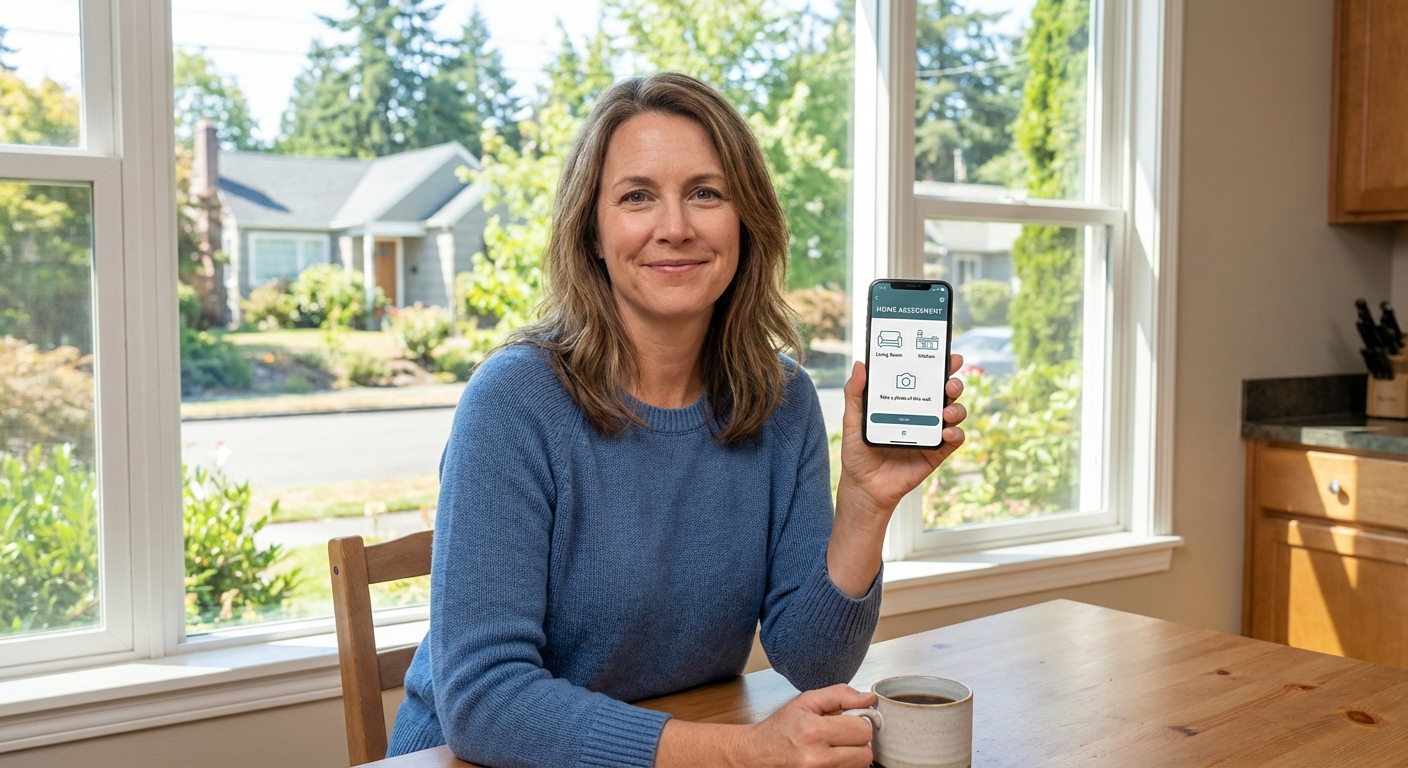
Insurers now offer AI-powered apps where policyholders receive a guided link via email or text, then capture photos and short videos of specific areas of their home, including roof access points, electrical panels, HVAC systems, plumbing, and safety features. The AI analyzes these submissions against hundreds of risk criteria and generates a report.
- Nationwide launched its December 2025 partnership with Chrp, whose AI reviews each submission against more than 400 known failure points to flag corrosion, faulty wiring, and similar concerns. The guided photo survey is offered to existing customers selected for renewal inspections in states where Nationwide writes homeowners policies. As of March 2026, First Mutual Insurance Company (FMIC) also extended its Chrp partnership to include AI self-inspections for home and farm renewals starting June 1, 2026.
- AAA uses virtual inspections at renewal, where policyholders submit exterior and interior photos or join a video call so the insurer can check for fire hazards, roof condition, and other issues.
- Mercury Insurance offers self-guided inspections in select states using the Flyreel Property Assistant app, where homeowners submit photos and short videos without a live agent.
- Orion180 uses the PryzmIQ/Chrp app for DIY assessments that homeowners can typically complete in 30 to 45 minutes.
Satellite and Aerial Imagery
Insurers routinely use aerial and satellite data to assess exterior conditions, particularly roofs, without needing someone on your property. Vendors like ZestyAI (which now covers roughly 97% of U.S. residential properties), CAPE Analytics, and Nearmap provide property-level risk scoring that insurers plug into underwriting systems, generating scores used to set individual premiums. The role of AI in home insurance underwriting has expanded significantly, with algorithms flagging risks across hundreds of thousands of properties simultaneously. LexisNexis Risk Solutions also launched a new AI-driven property risk model in May 2026 aimed specifically at helping insurers improve underwriting accuracy as claim costs rise.
Drone Inspections
Certified drone pilots use high-resolution cameras to gather data on roofs and hard-to-access exterior features, typically completing inspections in under 20 minutes with real-time data flowing directly into claims and underwriting platforms via API integrations. AI-powered drone assessments complete roof evaluations up to 60% faster than manual inspections, and drones are often used in hybrid setups combining aerial footage with remote inspector review.
Pros and Cons of Skipping a Traditional Inspection
What Happens If an Inspection Reveals Problems?
Whether the inspection is virtual or in-person, insurers act on what they find. Inspection results directly influence your coverage terms, premium, and even your eligibility to remain with that carrier. The good news: the 2026 Insurance.com survey found only 1.5% of inspected homeowners had their policies canceled and 4% were asked to make modifications, down sharply from the prior year's higher rates. Over 65% of homeowners reported no impact at all from an inspection, and 21% didn't even know one had taken place.
Possible Insurer Responses
1. Require Repairs Within a Set Timeframe This is the most common response to a minor or moderate issue. Your insurer may give you 30 to 60 days (sometimes 90) to resolve a problem such as replacing missing shingles, trimming tree limbs over the roof, or installing GFCI outlets, before coverage conditions change.
2. Add Coverage Exclusions If your roof is flagged but you can't immediately replace it, the insurer may exclude roof-related damage from your policy until repairs are made. Similar exclusions can apply to plumbing (polybutylene supply lines remain a common automatic exclusion in 2026), electrical, or structural systems. Learn more about what home insurance typically doesn't cover so you're not caught off guard.
3. Increase Your Premium A property found to carry more risk than originally assumed may trigger a premium adjustment. This is especially common after inspections that reveal deferred maintenance or aging systems.
4. Cancel or Non-Renew Your Policy In severe cases involving major structural damage, hazardous electrical systems, or significant roof failure, your insurer may issue a notice of non-renewal or cancel the policy altogether. Non-renewal is far more common than mid-term cancellation because cancellation typically requires material misrepresentation. Since most mortgage lenders require active homeowners insurance, you'll need to find replacement coverage quickly. If you've been denied, review your options in our guide on what to do when home insurance is denied or the fallback options for home insurance non-renewal.
Common Issues That Cause Inspection Failures
| Issue | Risk Level | Typical Insurer Response |
|---|---|---|
| Aging or damaged roof (top failure reason) | High | Require replacement or exclude roof damage |
| Outdated electrical (aluminum, knob-and-tube, Federal Pacific or Zinsco panels) | High | Require upgrade or cancel policy |
| Polybutylene, galvanized, or cast iron plumbing | High | Automatic exclusion or replacement required |
| Foundation cracks or shifting | High | Require inspection by structural engineer |
| Mold or water damage evidence | High | Require professional remediation |
| Tree limbs over roof | Moderate | Require trimming within 30 days |
| Missing GFCI outlets or smoke detectors | Moderate | Require installation |
| Unpermitted additions | Moderate to High | Require permits or exclude that structure |
| Rotting decks, stairs, or unsafe handrails | Moderate | Require repairs to prevent liability claims |
Roof condition is the single biggest underwriting issue in 2026, with insurers focused on shingle roofs older than 15 to 20 years, missing shingles, soft spots, and evidence of prior leaks. If your home has characteristics that frequently trigger these issues, it may be considered a hard-to-insure property, but options still exist including high-risk home insurance, surplus lines, and state FAIR Plans.
Can You Refuse a Home Insurance Inspection?
Technically, yes. Homeowners cannot be legally forced to allow access to their property. However, refusing an inspection almost always backfires.
Consequences of refusing include:
- Policy cancellation or non-renewal: Insurers view refusal as non-compliance with policy terms or a red flag about hidden issues
- Higher premiums: Without verifiable data, carriers may charge more to offset unknown risk
- Coverage limitations: Certain systems may be excluded until an inspection is completed
- Claim complications: Without a prior condition report, your insurer may dispute or reduce future claim payouts
You can technically deny access to specific interior areas of your home, but doing so may result in an incomplete assessment that negatively affects your coverage. If you have concerns about what an inspection will uncover, the better strategy is to address maintenance issues proactively before the inspection takes place.
Frequently Asked Questions
Can I get homeowners insurance without any inspection at all?
Yes, in some cases, especially for newer homes, lower-value properties, or when switching to a carrier that uses remote underwriting tools. Many insurers bind your policy first and conduct a post-binding inspection within 30 to 60 days. However, no major national insurer offers a guaranteed inspection-free policy for all homes. Your best bet is to shop and compare multiple quotes to find the most flexible underwriting approach for your property.
What is a virtual home insurance inspection and how does it work?
A virtual inspection typically involves clicking a guided link from your insurer, then following prompts to photograph and video specific areas of your home including roof access points, electrical panels, HVAC, plumbing, and safety features. AI analyzes the submission for risk factors and generates a report, usually within 24 to 48 hours. Nationwide's Chrp partnership launched this option in December 2025, and insurers like AAA also offer video call options where a remote inspector guides you through the process in real time.
Do insurance companies use satellite imagery to inspect homes?
Yes. Satellite and aerial imagery are now standard tools in home insurance underwriting, with vendors like ZestyAI (covering ~97% of U.S. residential properties), CAPE Analytics, and Nearmap providing property-level risk scores. The AI-driven inspection technology used by major carriers can detect roof wear, storm damage, tree proximity, and other risk factors automatically. New state rules in Louisiana, Kentucky, Colorado, Alabama, Massachusetts, Michigan, Pennsylvania, and Tennessee now limit how insurers can use this imagery for non-renewal decisions.
What happens to my insurance if my home fails an inspection?
Your insurer will typically respond in one of three ways: requiring repairs within a set timeframe (usually 30 to 60 days), adding coverage exclusions for the problem areas, or in serious cases, canceling or non-renewing your policy. The 2026 Insurance.com survey shows only about 1.5% of inspected homeowners were canceled and 4% were asked to make modifications, but if it happens you'll need new coverage quickly. Exploring options like hard-to-insure home coverage or your state's FAIR Plan can help bridge the gap.
How often do insurance companies inspect homes?
Most insurers perform an initial inspection within 30 to 90 days of a new policy and may conduct follow-up inspections every 3 to 5 years for standard policies. Older homes or properties in high-risk areas may see inspections every year or two, while low-risk properties may go 5 to 10 years between reviews. In 2026, the trend has shifted toward more frequent renewal inspections and continuous portfolio-scale aerial monitoring as carriers tighten underwriting in response to rising claim costs, particularly in weather-impacted states.