
Compare Home Insurance Plans in Ohio
Find your best options in less than 2 minutes



The Coverage Gap Standard Policies Don't Tell You About
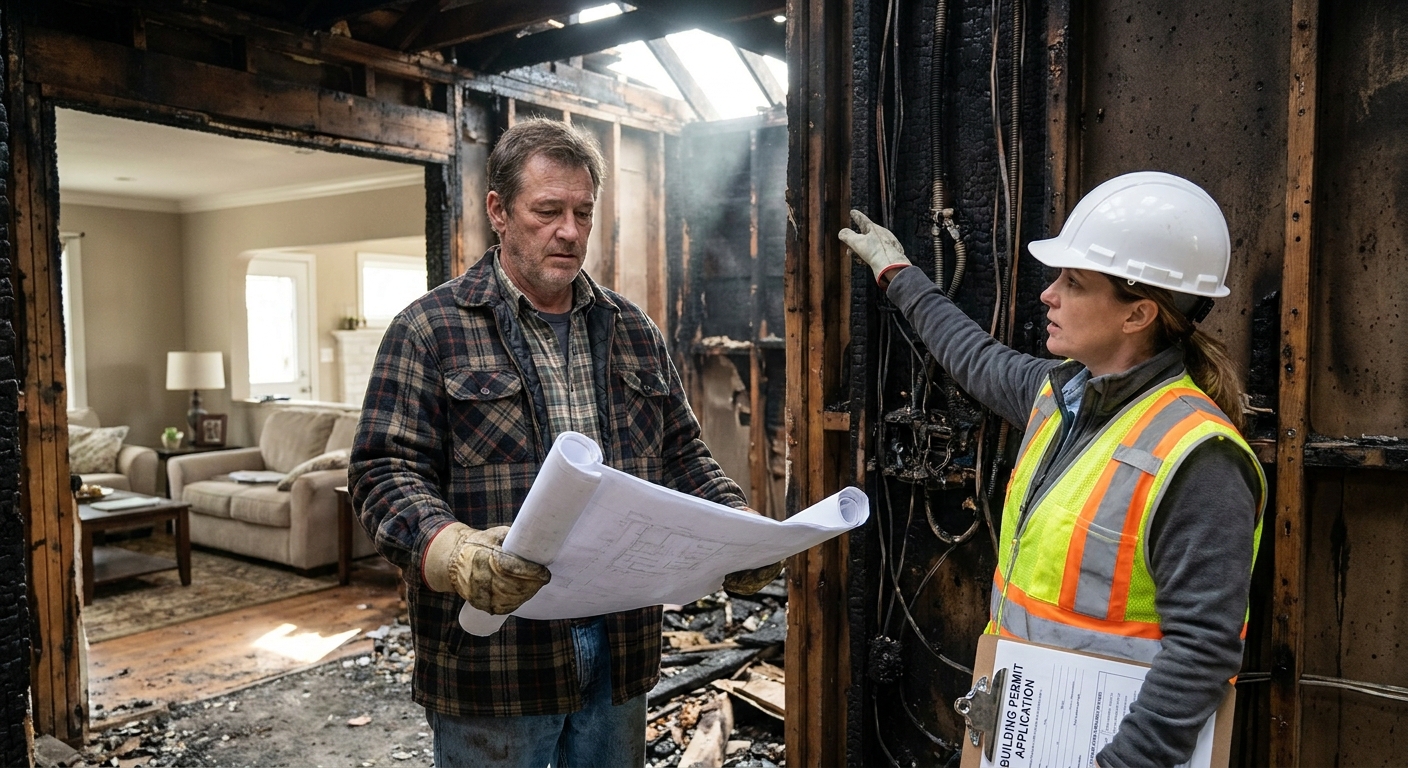
Your home insurance policy is designed to restore your home to the condition it was in before a covered loss, not to upgrade it. That's a critical distinction most homeowners never consider until they're filing a claim. When a fire, windstorm, or another covered peril damages your home, local building departments step in with a mandate: the rebuilt structure must meet today's building codes, not the codes from when your home was originally constructed.
The problem? Standard homeowners insurance specifically excludes the cost of those code-required upgrades. The 2024 IECC now being enforced pushes building envelope performance and mechanical efficiency requirements further than any previous edition, requiring higher insulation values, tighter air-sealing, and improved envelope performance, and includes tighter air-sealing standards and higher efficiency requirements for HVAC and mechanical equipment. The financial shock during a full rebuild can easily reach $20,000 to $100,000 or more, and in coastal markets, post-hurricane code upgrades in Coastal Florida (Miami-Dade, Broward, Palm Beach) regularly include $12,000 to $25,000 in upgrades.
This coverage gap has a name: the ordinance or law exposure. The solution is ordinance or law coverage (sometimes called a law and ordinance endorsement), an add-on that most insurers offer but few homeowners purchase at adequate limits.
Why Standard Policies Exclude Code Upgrade Costs
Home insurance was built around a straightforward principle: indemnification, or putting you back where you were before the loss. Paying for upgrades beyond the home's original condition is considered a "betterment," which falls outside the indemnification model.
Building codes evolve constantly. The 2024 IRC and 2024 IECC (already in force in Georgia as of January 1, 2026, and adopted by South Dakota effective July 1, 2026) introduced sweeping changes covering:
- Electrical systems EV-ready wiring for a dedicated circuit from the panel to the garage, adding about $300 to $600 per home, plus electric-ready 240V circuits for ranges, dryers, and water heaters adding roughly $400 to $600 per home
- Expanded GFCI protection GFCI protection has been expanded to all 125V through 250V receptacles in kitchens, bathrooms, laundry rooms, garages, and outdoors, including 240V dedicated circuits for ranges, dryers, and other major appliances, adding about $30 to $50 per circuit
- Whole-house surge protection New homes must now include a Type 2 whole-house surge protective device at the electrical panel, adding about $100 to $200 per home
- Structural requirements Updated wind speed maps aligned with ASCE 7-22, plus raised-heel (energy heel) truss designs many 2026 jurisdictions now enforce to accommodate higher attic R-values without compressing insulation
- Energy efficiency In Climate Zone 4, wall insulation increased from R-20 to R-21 (or from R-13 + R-5 continuous to R-13 + R-7.5 continuous), and ceiling insulation increased from R-49 to R-60 in multiple climate zones
Your home is currently grandfathered, allowed to remain in its existing condition as long as you don't trigger code enforcement. A major insurance loss can shatter that grandfathered status. Once you pull a building permit to repair significant damage, inspectors apply today's rules.
If the repair cost crosses a jurisdictional tipping point, you may be required to bring the entire property up to current code. Under FEMA's substantial improvement/substantial damage rule, if the cost of repair or improvement equals or exceeds 50 percent of the market value of the structure before the loss, the building must be brought into full compliance with current floodplain and building standards for new construction. In Florida, this is codified explicitly: Florida's 50% Rule under Florida Building Code Section 1612.2 requires that if repair or renovation costs exceed 50% of a structure's market value (excluding land), the entire home must be brought up to current flood and building code standards, including elevation.
This is where ordinance or law coverage becomes essential. Without it, you're personally responsible for every dollar of that code-compliance cost above your standard claim payout.

Compare Home Insurance Plans in Ohio
Find your best options in less than 2 minutes
The Three Parts of Ordinance or Law Coverage
Ordinance or law coverage is typically broken into three distinct components. Understanding each one is critical because insurers often bundle them under a single limit.
Coverage A: Loss to the Undamaged Portion
This is the most misunderstood component. Imagine a fire destroys 60% of your home. The remaining 40% is structurally intact and completely undamaged. But your local building code has a rule: if a structure sustains damage exceeding 50% of its value, the entire building must be demolished and rebuilt to current code.
Your standard dwelling policy pays for the 60% that burned. Coverage A of ordinance or law coverage pays for the value of the undamaged 40% that must be demolished, even though no covered peril touched it. Without this, you absorb that loss entirely out of pocket.
Coverage B: Demolition Cost
Even after accounting for the value of the undamaged portion, someone has to physically tear it down and haul it away. Coverage B pays the actual cost of demolishing and removing debris from the portions of the structure that must be razed by law. This is separate from the debris removal included in your standard policy, which only covers the physically damaged material.
Coverage C: Increased Cost of Construction (Code Upgrades)
This is the component most people associate with the term "code upgrade coverage." Coverage C pays the additional cost of rebuilding the damaged portion to current code standards when that exceeds what it would have cost to simply rebuild it like it was before.
This includes costs like rewiring to current electrical code, adding fire sprinklers, installing hurricane clips on roof trusses, upgrading insulation to meet 2024 IECC standards, or replacing galvanized pipes with code-compliant materials.
Understanding how dwelling coverage interacts with ordinance or law limits is just as important, since underinsuring one affects the other.

Protect your home with State Farm
Average Rate:
Homeowners who bundle and save with State Farm save an average of $1,000 per year!

You're in Good Hands® with Allstate
Average Rate:
Get comprehensive home coverage with flexible policy options.

Customize your home coverage
Average Rate:
Only pay for the coverage you need with personalized home insurance.

Smart coverage for your home
Average Rate:
Protect what matters most with award-winning home insurance.
Real-World Code Upgrades That Can Break Your Budget in 2026
When a covered loss triggers a building permit, here are the upgrades that most frequently blindside homeowners with current 2026 pricing:
| Code Upgrade Required | Trigger Scenario | Estimated 2026 Cost |
|---|---|---|
| Electrical panel upgrade (100A to 200A) | Fire damage to kitchen or wiring | $2,000 to $4,500 |
| Full service upgrade (panel + meter + mast) | Older service entrance | $3,500 to $6,500 |
| Whole-home rewiring (AFCI/GFCI, average home) | Older home, major fire loss | $7,000 to $12,000 |
| Fire sprinkler system (new construction) | Jurisdiction requires on rebuild | $3,000 to $8,000 |
| Fire sprinkler retrofit (existing home) | Substantial damage rebuild | $5,000 to $15,000+ |
| Hurricane straps / sealed roof deck | Storm damage roof replacement (FL) | $850 to $5,000+ |
| Foundation anchoring / seismic retrofit | Structural damage in earthquake zone | $5,000 to $30,000 |
| Full plumbing repipe (PEX/copper) | Water damage triggering permit | $4,000 to $15,000 |
| Energy code upgrades (insulation, air sealing) | Significant wall or roof damage | $1,500 to $4,000 |
| EV-ready wiring per 2024 IECC | Panel or garage rebuild | $300 to $600 |
| Electric-ready 240V circuits (range/dryer/WH) | Kitchen or utility room rebuild | $400 to $600 |
The Zebra estimates ordinance or law coverage costs about $66 extra per year for $40,000 worth of coverage, though rates can vary depending on where you live. For a home with a $300,000 dwelling limit, real-world code compliance could realistically add $30,000 to $90,000 in costs your standard policy won't touch.
Homes that are hard to insure due to outdated electrical or plumbing systems face double jeopardy: they're already flagged by insurers, and a claim will almost certainly trigger expensive mandatory upgrades. Similarly, owners of older homes should treat ordinance or law coverage as non-negotiable.
How Much Does Ordinance or Law Coverage Cost, and Who Needs It Most?
Cost of Coverage in 2026
The good news: this protection is remarkably affordable relative to the risk it covers.
- Adding $40,000 of ordinance or law coverage averages about $66 per year nationally
- Boosting coverage to 25% of your dwelling limit typically adds only $50 to $100 per year on a standard single-family home
- Coverage is expressed as a percentage of your dwelling (Coverage A) limit, most commonly 10%, 25%, 50%, or 100%
| Coverage Level | Example ($300K Dwelling) | Approx. Annual Add-on Cost |
|---|---|---|
| 10% (often default) | $30,000 | Often built in |
| 25% (recommended for most) | $75,000 | ~$50 to $100/year |
| 50% (older or high-risk homes) | $150,000 | ~$100 to $200/year |
| 100% (historic or strict-code) | $300,000 | ~$200 to $400/year |
State Requirements Worth Knowing
State-level regulation has finally caught up with the risk. According to a 2026 50-state regulatory survey, only three states impose mandates:
- California: Starting July 1, 2026, all residential replacement cost policies must include building code upgrade coverage equal to at least 10% of the dwelling limit. This coverage is additional and does not deplete the dwelling limit.
- Florida: Insurers must offer 25% or 50% ordinance-or-law coverage, and 25% is deemed included absent written rejection.
- Colorado: Requires an offer of ordinance-or-law coverage at stated minimums (at least 20% of the dwelling limit).
California's Building Standards Code (Title 24) is updated on a triennial cycle, with the most recent edition taking effect January 1, 2026, which means California homeowners face both stricter codes and a new mandated coverage floor in the same year.
Who Needs It Most
When evaluating whether your limits are high enough, also consider how rising construction costs amplify the dollar impact of code compliance. A $50,000 code upgrade estimate from 2020 may cost significantly more today thanks to 2024 IECC updates and tariff-driven materials increases.
For the best overall protection, pair ordinance or law coverage with guaranteed replacement cost coverage and make sure your dwelling coverage reflects your true rebuild cost, not your home's market value. If you're doing a project mid-policy, understand that home insurance during renovation has its own gaps that intersect with building code compliance issues.
Frequently Asked Questions
What is the 50% rule and how does it affect my grandfathered home?
The 50% rule is a building code threshold used in many jurisdictions that states if the cost of repairing or rebuilding your home equals or exceeds 50% of the structure's value (excluding land), the entire building must be brought up to current code. This effectively eliminates your home's grandfathered status for that rebuild event. Even if only part of your home was physically damaged, you could be required to upgrade the whole structure to meet today's standards. This is the exact scenario ordinance or law coverage is designed to address.
Does standard replacement cost coverage pay for code upgrades?
No. Standard replacement cost coverage, even a strong policy, is designed to restore your home to its pre-loss condition using today's materials and labor prices. It does not cover the additional expense of meeting current building codes like the 2024 IRC or IECC. The upgrade costs triggered by building permits are a separate exposure that requires an ordinance or law endorsement. Learn more about how dwelling coverage works and its limits.
Are there situations where code upgrades are covered without a separate endorsement?
A number of standard homeowners policies include a modest amount of ordinance or law coverage automatically, often 10% of your dwelling limit. Some states go further: as of July 1, 2026, California mandates a 10% minimum built into every residential replacement cost policy, and Florida deems 25% included unless you reject it in writing. However, that default amount is frequently insufficient for significant losses, particularly for older homes or in strict-code jurisdictions. Check your declarations page for an ordinance or law line item and confirm whether the limit is combined A/B/C or split individually.
What's the difference between "ordinance or law" and "building code upgrade" coverage?
These terms are used interchangeably by the insurance industry and refer to the same coverage. Some insurers label it "ordinance or law," others call it "building code upgrade coverage," and some use "law and ordinance endorsement." Regardless of the label, the concept is identical: paying the extra costs of bringing your home into compliance with current building laws after a covered loss. See our full ordinance or law coverage guide for a deeper breakdown.
How do I know if my current ordinance or law coverage limit is enough?
A good starting point in 2026 is 25% of your dwelling coverage for homes older than 20 years, or 10% to 15% for newer homes in stable-code areas. Pre-1990 homes and properties in high-hazard zones (coastal Florida, wildfire-prone California, tornado corridors) should consider 50% or more, since code-driven costs alone can hit 25% to 50% of the property's value. Ask your agent for a contractor's rough assessment of what code-required upgrades would cost if your home needed a significant repair today, and pair this review with a check on your overall structural damage coverage.