
Compare Home Insurance Plans in Ohio
Find your best options in less than 2 minutes



The 2026 Construction Cost Surge: What Every Homeowner Needs to Know
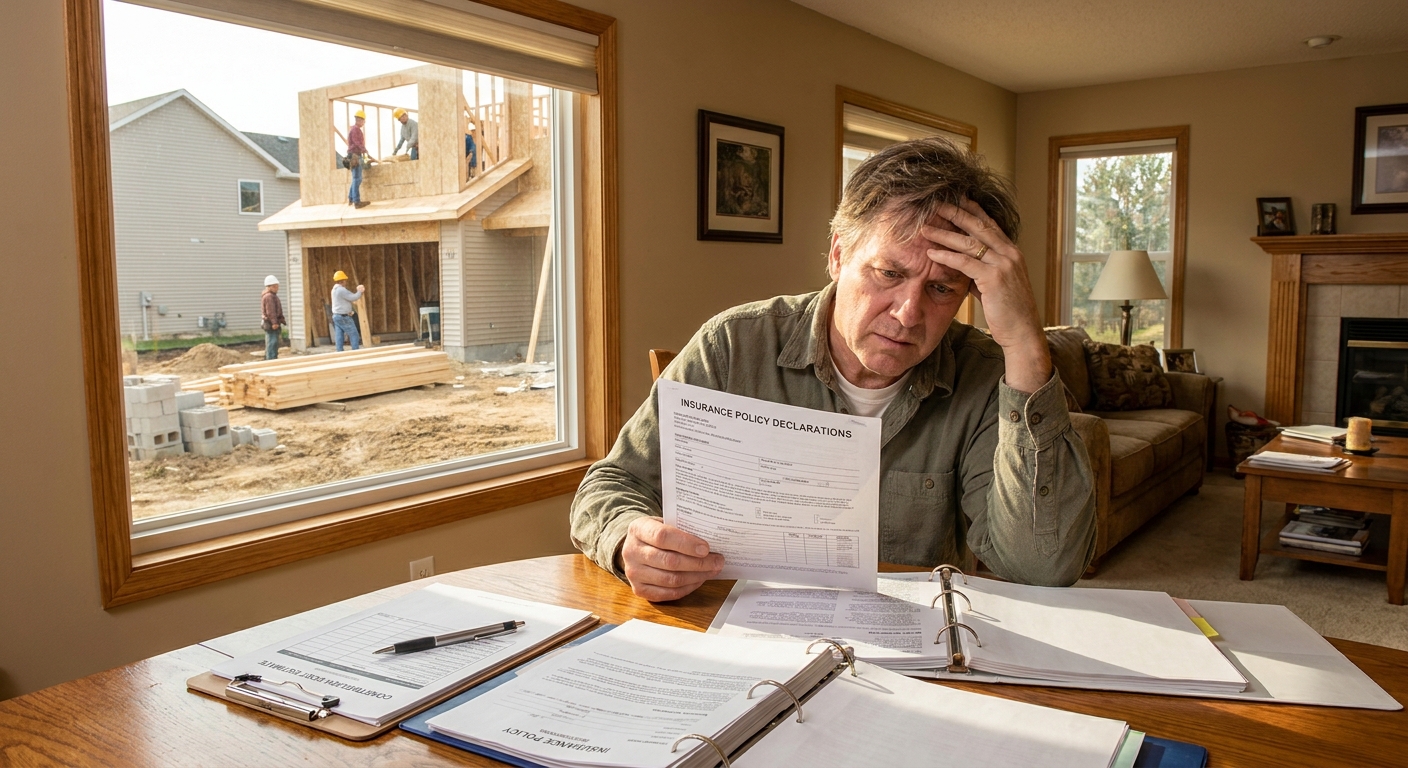
Construction costs aren't just a problem for builders. They're quietly eroding the value of your home insurance policy right now. According to the National Association of Home Builders, residential building material prices excluding energy rose 0.4% in July 2026 and were up 5% from a year ago, the fastest year-over-year pace since December 2022. That followed 4.6% year-over-year growth in June and 4.4% in May, meaning the trend is accelerating, not cooling. The producer price index for inputs to new residential construction (including energy) climbed 2.1% in May alone, up 8.3% year over year, the largest annual jump since the post-pandemic surge. Construction input prices are now up roughly 46% since February 2020, nearly double the 24% cumulative rise in overall consumer prices. If your homeowners policy hasn't been updated to reflect these realities, you could face a devastating coverage gap when you need your insurance most.
How Rising Building Material Costs Are Reshaping Home Insurance
The cost to rebuild a home is no longer what it was even two or three years ago. Here's where key inputs stand in mid-2026:
| Material / Input | 2026 Status | Change |
|---|---|---|
| Residential building materials (ex. energy) | Rising | +5.0% YoY (July 2026), fastest since Dec 2022 |
| Softwood lumber (PPI) | Sharp monthly jump | Largest monthly increase in over a year (July 2026) |
| Residential construction inputs (incl. energy) | Sharply higher | +8.3% YoY (May 2026) |
| Copper | Elevated | Roughly +35% YoY, near $6/lb |
| Steel / aluminum / copper articles | Tariffed | 50% Section 232 tariff on full customs value |
| Steel / aluminum / copper derivatives | Tariffed | 25% Section 232 tariff on full customs value |
| Select downstream metal derivatives | Temporarily reduced | 15% rate through Dec 31, 2027 |
| Tariff impact on average new home | Added cost | ~$9,200 to $10,900 per new single-family home |
Under the June 2026 presidential proclamation, the U.S. maintained a 50% ad valorem duty on articles made of steel, aluminum, and copper, applied to the full customs value (not just the metal content), a 25% duty on derivative products predominately composed of those metals, and a temporarily reduced 15% rate on a subset of derivative products including certain residential HVAC equipment through December 31, 2027. Softwood lumber prices posted their sharpest monthly jump in over a year in July 2026, while metal-heavy scopes (framing connectors, rebar, HVAC, wiring, plumbing) continue to feel steady upward pressure.
What does this mean for homeowners? It means the cost to rebuild your home is meaningfully higher today than what your insurance company calculated when you last updated your policy. If you experienced a total loss tomorrow, your payout might not cover a full rebuild. This is the underinsurance trap, and by most estimates, tens of millions of U.S. homeowners are already in it.
Learn more about how tariffs on building materials are compounding this problem and pushing premiums even higher in 2026.

Compare Home Insurance Plans in Ohio
Find your best options in less than 2 minutes
Market Value vs. Replacement Cost: A Critical Distinction
One of the most common and costly misunderstandings in homeowners insurance is confusing market value with replacement cost. These are two entirely different numbers, and basing your coverage on the wrong one can leave you severely underinsured.
- Market value is what a buyer would pay for your home today. It includes the land, location, neighborhood desirability, and real estate trends.
- Replacement cost is what it would actually cost to rebuild your home's physical structure from the ground up using current labor and material prices, excluding the land.
These figures continue to diverge in 2026. A home might sell for $350,000 on the open market but cost $475,000 or more to rebuild, because rebuilding factors in custom finishes, local labor rates, code-compliant materials, and today's elevated construction prices.
A real-world example: If your home has a $300,000 replacement cost policy but the actual rebuild runs $390,000 due to inflated material and labor costs, you're responsible for the $90,000 shortfall out of pocket. In disaster-prone areas, where post-event demand surges can push prices even higher, that gap can be even larger.
Most mortgage lenders require replacement cost coverage, and for good reason. Always confirm your policy is based on replacement cost value (RCV), not market value or actual cash value (ACV). For a deeper look at how these numbers are calculated, see our guide on rebuild cost vs. home value, and compare the payout differences in our replacement cost vs. actual cash value breakdown.

Protect your home with State Farm
Average Rate:
Homeowners who bundle and save with State Farm save an average of $1,000 per year!

You're in Good Hands® with Allstate
Average Rate:
Get comprehensive home coverage with flexible policy options.

Customize your home coverage
Average Rate:
Only pay for the coverage you need with personalized home insurance.

Smart coverage for your home
Average Rate:
Protect what matters most with award-winning home insurance.
Why Dwelling Coverage Limits Need Regular Adjustment
Your dwelling coverage limit is the cornerstone of your homeowners policy. It determines how much the insurer will pay to rebuild your home after a covered loss. In a high-inflation construction environment, a limit set even two years ago may no longer be adequate.
The 80% Rule and the Coinsurance Penalty
Most standard homeowners policies include a coinsurance clause: you must insure your home for at least 80% of its current replacement cost to receive full claim payouts. Fall below that threshold, even on partial claims, and your payout gets proportionally reduced.
Example: If your home has a current replacement cost of $400,000 but you're only insured for $250,000 (62.5%), you may only receive about 78% of any claim, even for a $50,000 partial loss like roof damage. That's a meaningful shortfall you'd never see coming. For a full breakdown of the formula, see our coinsurance clause guide.
Inflation Guard Endorsements: Automatic Annual Adjustments
One of the smartest and most underused tools available to homeowners is the inflation guard endorsement. This add-on automatically increases your dwelling coverage limit each year based on a fixed percentage or an inflation index determined by your insurer, keeping your limits in step with local construction costs at each renewal.
How it works in practice:
- A $400,000 dwelling limit with a 4% annual inflation guard becomes $416,000 at renewal
- At 6% annually, a $400,000 limit grows to roughly $535,000 over five years
- Adjustments can happen at renewal or pro-rata throughout the policy term
The key limitation? Inflation guard percentages are set by the insurer and may not always keep pace with actual local construction inflation, especially with residential inputs still running 5% or more year over year and metals subject to a 50% tariff on full customs value. That's why inflation guard should be paired with an annual manual review.
Extended and Guaranteed Replacement Cost Coverage
For broader protection, consider these two powerful endorsement types:
| Coverage Type | How It Works | Best For |
|---|---|---|
| Extended Replacement Cost | Pays 20% to 50% above your dwelling limit if rebuild costs exceed your policy limit | Homeowners in volatile markets |
| Guaranteed Replacement Cost | Covers full rebuild regardless of cost, no cap | Maximum protection; premium homes |
| Inflation Guard | Auto-adjusts limits annually by a set % | Ongoing inflation protection |
Extended replacement cost is especially valuable because it acts as a buffer against unexpected mid-term construction price spikes. If your insurer offers a 25% or 50% extended replacement cost option, it's worth the added premium, particularly given 2026's unpredictable material and labor costs.
For a complete look at what's driving your premium higher, see why home insurance rates keep rising and how to respond strategically. You may also want to understand how much home insurance coverage you actually need before adjusting your limits.
If you're concerned about being underinsured, now is the time to act, before a loss makes the question unavoidable.
How to Calculate Adequate Coverage When Construction Costs Are Rising
Getting your dwelling coverage right in 2026 requires a few deliberate steps. Here's a practical framework for calculating and maintaining adequate limits:
Step 1: Estimate Your Home's Current Replacement Cost
The Insurance Information Institute recommends multiplying your home's square footage by the local cost per square foot for new construction. In 2026, the NAHB Cost of Construction Survey benchmarks the national average at roughly $162 per square foot for direct construction costs, or approximately $195 per square foot with typical general contractor overhead and profit. Standard builds generally run $150 to $300 per sq ft, while custom homes in high-cost markets can exceed $450 per sq ft.
Formula:
Square Footage × Local Cost Per Sq. Ft. = Baseline Replacement Cost
Regional ballparks for 2026, based on the latest builder surveys:
- South / Southeast: ~$109 to $260/sq ft (higher in coastal hurricane zones)
- Midwest: ~$100 to $180/sq ft
- Northeast: ~$155 to $265/sq ft
- West Coast / California: ~$220 to $450+/sq ft
Then add:
- Custom features (vaulted ceilings, granite countertops, hardwood floors)
- Detached structures (garage, fence, shed), typically covered at 10% of dwelling limit
- Code upgrade costs, covered separately under ordinance or law coverage
Step 2: Use Online Replacement Cost Estimators
Major insurers and independent tools offer replacement cost calculators. Allstate, NerdWallet, Progressive, and Matic all offer 2026-updated calculators. Input your address, square footage, year built, and any major renovations for a more precise estimate. Your insurer may also provide their own in-house tool.
Step 3: Set Related Coverages as a Percentage of Dwelling
For context on 2026 pricing, Insurify projects the average annual cost of home insurance will rise another 4% to $3,057 by the end of 2026, following a 12% jump to $2,948 in 2025. The Zebra reports the average homeowner is now paying $2,966 a year for home insurance, while LendingTree pegs the national average at $2,395 and NerdWallet at $2,490 for $400,000 in dwelling coverage. Cumulatively, U.S. home insurance rates rose 46.8% from 2020 to 2025. Standard percentage-based recommendations for related coverages:
| Coverage Type | Recommended Limit |
|---|---|
| Dwelling (Coverage A) | 100% of replacement cost |
| Other Structures (Coverage B) | 10% of dwelling limit |
| Personal Property (Coverage C) | 50% to 70% of dwelling limit |
| Loss of Use (Coverage D) | 20% to 30% of dwelling limit |
| Liability (Coverage E) | $300,000 minimum |
Step 4: Review Annually and After Any Renovation
Your dwelling coverage limit should be revisited at every renewal. If you've completed a renovation, added a bathroom, finished a basement, or upgraded a kitchen, your replacement cost has increased and your policy must reflect that. Failing to update after renovations is one of the most common causes of coverage gaps.
Also consider reviewing coverage during any home renovation, since standard policies weren't designed for homes under construction. And if you own an older home, factor in the added risk of code-triggered rebuilds when a claim occurs.
Frequently Asked Questions
How much has construction inflation increased home rebuild costs in 2026?
Residential building material prices excluding energy rose 0.4% in July 2026 and were up 5% from a year ago, the fastest year-over-year pace since December 2022, and softwood lumber posted its biggest monthly jump in over a year. The producer price index for inputs to new residential construction rose 8.3% year over year in May 2026, the largest annual jump since the pandemic era. Steel, aluminum, and copper articles still carry a 50% Section 232 tariff on their full customs value, with derivatives at 25%, adding roughly $9,200 to $10,900 to the cost of a typical new single-family home. Homes insured five or more years ago are almost certainly underinsured today.
What is the difference between market value and replacement cost in home insurance?
Market value is the price your home would sell for on the open market. It includes your land and reflects neighborhood demand. Replacement cost is the amount required to physically rebuild your home's structure from scratch using current labor and material prices, with no land component. In 2026, these figures often diverge sharply, meaning a home that sells for $350,000 may cost $475,000 or more to fully rebuild, creating a dangerous gap for homeowners with market-value-based policies.
What is an inflation guard endorsement and do I really need it?
An inflation guard endorsement is an add-on to your homeowners policy that automatically increases your dwelling coverage limit each year, typically by 4%, 6%, or 8%, based on a percentage or inflation index set by your insurer. Given that residential building material costs are running 5% year over year and metals are still subject to a 50% Section 232 tariff on full customs value, an inflation guard won't close every gap on its own, but it significantly reduces the risk of falling dangerously short. It's generally inexpensive and widely recommended for any homeowner who wants to avoid underinsurance.
How do I know if my home is underinsured right now?
The most reliable check is to compare your current dwelling coverage limit against an up-to-date replacement cost estimate for your home. LendingTree data shows an estimated 12.2 million owner-occupied homes in the U.S. lack insurance, roughly 1 in 7 households, and Harvard Business School research found the average mortgaged homeowner insures just 70% of true rebuild cost. If your limit was last set more than two years ago, hasn't been updated after renovations, or is based on your home's purchase price rather than rebuild cost, there's a high probability you're underinsured.
What's the best protection against coverage gaps from rising construction costs?
The strongest approach is layering multiple protections: carry replacement cost value (not ACV or market value) coverage, add an inflation guard endorsement for automatic annual adjustments, and consider extended replacement cost coverage (typically 20% to 50% above your dwelling limit) for a buffer against unexpected price surges. Review your policy every year at renewal, and immediately after any renovation that increases your home's rebuild value. For older homes, also look into ordinance or law coverage, which pays the added cost of rebuilding to current building codes, a frequently overlooked but important gap-filler.